the hook-up culture and its effects on men and women
cohabitation and its effect on marriage stability
balancing marriage, family and career
single motherhood by choice and IVF
donor-conceived children
modern sex: a sterile, recreation activity
the real purposes of sex: procreation and spousal unity
the hormone oxytocin: when it is secreted and what it does
the hormone vassopressin: when it is secreted and what it does
the sexual revolution and the commoditization of sex
the consumer view of sex vs the organic view of sex
fatherlessness and multi-partner fertility
how the “sex-without-relationship” view harms children
52 minutes of lecture, 33 minutes of Q&A from the Harvard students. The Q&A is worth listening to – the first question is from a gay student, and Dr. Morse pulls a William Lane Craig to defeat her objection. It was awesome! I never get tired of listening to her talk, and especially on the topics of marriage and family. She is a debater, as well (see below).
And just so everyone knows, the Wintery Knight is pro-chastity and pro-marriage. I believe in chastity and I am chaste. I recommend chastity to men who are contemplating a stable, effective marriage. The research shows that you will have a better marriage by being chaste before marriage.
The number of single women and lesbian couples receiving fertility treatment has soared since the Government took the controversial decision to remove the legal requirement for any child conceived to have a father or father figure.
In 2007, before the change in the law, only 350 single women had IVF. But by 2010, the last year for available figures, that had leapt 448 per cent to 1,571. The number of lesbian couples given IVF more than doubled in the same period, from 178 to 417. But the number of heterosexual couples treated rose by only 18 per cent.
[…]The Human Fertilisation and Embryology Act in 2008 removed the requirement for clinics to take into account a child’s need for a father or male role model before agreeing to treatment. Instead, gay couples or individuals have to prove only that they can provide ‘supportive parenting’.
The legislation also allowed birth certificates to record two mothers or two fathers for the first time.
One beneficiary is single mother Elizabeth Pearce, who had treatment to have her son Leo, now two. She paid £900 for sperm from an anonymous donor.
Unable to afford IVF after being made redundant from her job as a personal assistant, she cited the European Convention on Human Rights to compel her local NHS trust in Ealing, West London, to pay for her treatment.
Ms Pearce, 40, who now lives in Kent, said: ‘In an ideal world, Leo would have had a dad but that’s not the way things worked out. Single women have as much right to a child as couples.’
Natalie Woods and Betty Knowles, from Brighton, were the first lesbian couple to have a child that listed them both as parents on the birth certificate.
Ms Woods, 40, who had IVF and gave birth to daughter Lily-May in 2010, said: ‘The legal changes have given a clear message that it is OK to parent without a father. What’s important is that there are either one or two big hearts filled with love for your children.’
Keep in mind that IVF is completely taxpayer-funded in the UK. Families where the man works and the wife stays home with the children are forced to subsidize IVF treatments for single women through the UK’s very progressive income tax code.
Just in case anyone needs a refresher, here are some statistics showing the harm that fatherlessness causes little boys and girls. It’s also important to realize that IVF typically results in some number embryos being thrown away because they are not wanted. So not only are there harmful effects on children caused by the fatherlessness, but there may also be the killing of innocent unborn children when discarding unwanted embryos. And if that were not enough, keep in mind that marriage prevents abuse of women and children as well as child poverty, according to the evidence we have.
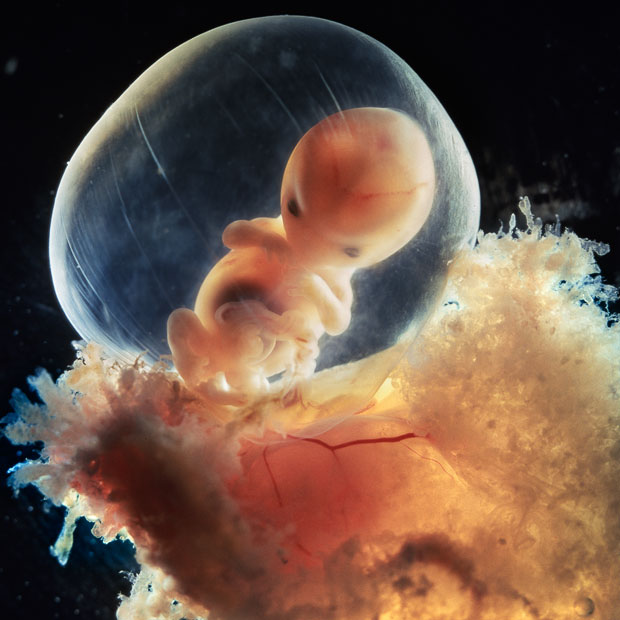
Unborn baby scheming about making abortion unthinkable
Scott Klusendorf is a tough, practical pro-life debater. When you listen to him talk about moral issues, it’s like listening to Tim Tebow talk about running the two-minute offense. Even if you are not into bio-ethics, you will have a good time listening to him work through the topics. Anyone who likes to understand issues strategically and operationally will enjoy this interview. It’s extremely practical because Scott is the top pro-life debater in the world. He has had to defend all of his views on the field.
Details:
Today’s interview is witth Scott Klusendorf, president of Life Training Institute. LTI is the first place to look for excellent resources to get better equipped to defend the pro-life position. Scott talks about defining abortion and its terms, the issue of the debate, the legal history of abortion, defending the pro-life view using science and philosophy, the four pillars of the pro-life argument, answering a litany of objections to the pro-life position, the right and wrong use of emotional appeals, taking on the right tone in the debate, how to get better equipped, and more.
If you like this interview, please be sure and buy the best basic book on pro-life apologetics – Scott Klusendorf’s “The Case for Life“. I do have to mention that Scott is an evangelical Christian. Evangelicals are very much into understanding and debating pro-life and pro-marriage positions – we want to understand and we want to explain why we believe what we believe.
Learn more by reading
You can learn more by reading basic pro-life apologetics… from Francis Beckwith. You might recognize Frank Beckwith as the author of “Defending Life: A Moral and Legal Case Against Abortion Choice“. He wrote that book for Cambridge University Press, a top academic press. But before Cambridge University Press, Beckwith wrote easy-to-understand essays for the Christian Research Journal.
Here are four essays that answer common arguments in favor of legalized abortion.
Anyone who keeps up with the many pro-choice demonstrations in the United States cannot help but see on pro-choice placards and buttons a drawing of the infamous coat hanger. This symbol of the pro-choice movement represents the many women who were harmed or killed because they either performed illegal abortions on themselves (i.e., the surgery was performed with a “coat hanger”) or went to unscrupulous physicians (or “back-alley butchers”). Hence, as the argument goes, if abortion is made illegal, then women will once again be harmed. Needless to say, this argument serves a powerful rhetorical purpose. Although the thought of finding a deceased young woman with a bloody coat hanger dangling between her legs is — to say the least — unpleasant, powerful and emotionally charged rhetoric does not a good argument make.
The chief reason this argument fails is because it commits the fallacy of begging the question. In fact, as we shall see, this fallacy seems to lurk behind a good percentage of the popular arguments for the pro-choice position. One begs the question when one assumes what one is trying to prove. Another way of putting it is to say that the arguer is reasoning in a circle. For example, if one concludes that the Boston Celtics are the best team because no team is as good, one is not giving any reasons for this belief other than the conclusion one is trying to prove, since to claim that a team is the best team is exactly the same as saying that no team is as good.
The question-begging nature of the coat-hanger argument is not difficult to discern: only by assuming that the unborn are not fully human does the argument work. If the unborn are not fully human, then the pro-choice advocate has a legitimate concern, just as one would have in overturning a law forbidding appendicitis operations if countless people were needlessly dying of both appendicitis and illegal operations. But if the unborn are fully human, this pro-choice argument is tantamount to saying that because people die or are harmed while killing other people, the state should make it safe for them to do so.
A woman who becomes pregnant due to an act of either rape or incest is the victim of a horribly violent and morally reprehensible crime. Although pregnancy as a result of either rape or incest is extremely rare, [1] there is no getting around the fact that pregnancy does occur in some instances.
[…]Despite its forceful appeal to our sympathies, there are several problems with this argument. First, it is not relevant to the case for abortion on demand, the position defended by the popular pro-choice movement. This position states that a woman has a right to have an abortion for any reason she prefers during the entire nine months of pregnancy, whether it be for gender-selection, convenience, or rape. [3] To argue for abortion on demand from the hard cases of rape and incest is like trying to argue for the elimination of traffic laws from the fact that one might have to violate some of them in rare circumstances, such as when one’s spouse or child needs to be rushed to the hospital. Proving an exception does not establish a general rule.
[…]Fourth, this argument begs the question by assuming that the unborn is not fully human. For if the unborn is fully human, then we must weigh the relieving of the woman’s mental suffering against the right-to-life of an innocent human being. And homicide of another is never justified to relieve one of emotional distress. Although such a judgment is indeed anguishing, we must not forget that the same innocent unborn entity that the career-oriented woman will abort in order to avoid interference with a job promotion is biologically and morally indistinguishable from the unborn entity that results from an act of rape or incest. And since abortion for career advancement cannot be justified if the unborn entity is fully human, abortion cannot be justified in the cases of rape and incest. In both cases abortion results in the death of an innocent human life. As Dr. Bernard Nathanson has written, “The unwanted pregnancy flows biologically from the sexual act, but not morally from it.” [5]Hence, this argument, like the ones we have already covered in this series, is successful only if the unborn are not fully human.
Some ethicists argue that the unborn becomes fully human sometime after brain development has begun, when it becomes sentient: capable of experiencing sensations such as pain. The reason for choosing sentience as the criterion is that a being that cannot experience anything (i.e., a presentient unborn entity) cannot be harmed. Of course, if this position is correct, then the unborn becomes fully human probably during the second trimester and at least by the third trimester. Therefore, one does not violate anyone’s rights when one aborts a nonsentient unborn entity. [13]
There are several problems with this argument. First, it confuses harm with hurt and the experience of harm with the reality of harm. [14] One can be harmed without experiencing the hurt that sometimes follows from that harm, and which we often mistake for the harm itself. For example, a temporarily comatose person who is suffocated to death “experiences no harm,” but he is nevertheless harmed. Hence, one does not have to experience harm, which is sometimes manifested in hurt, in order to be truly harmed.
Second, if sentience is the criterion of full humanness, then the reversibly comatose, the momentarily unconscious, and the sleeping would all have to be declared nonpersons. Like the presentient unborn, these individuals are all at the moment nonsentient though they have the natural inherent capacity to be sentient. Yet to countenance their executions would be morally reprehensible. Therefore, one cannot countenance the execution of some unborn entities simply because they are not currently sentient.
Someone may reply that while these objections make important points, there is a problem of false analogy in the second objection: the reversibly comatose, the momentarily unconscious, and the sleeping once functioned as sentient beings, though they are now in a temporary state of nonsentience. The presentient unborn, on the other hand, were never sentient. Hence, one is fully human if one was sentient “in the past” and will probably become sentient again in the future, but this cannot be said of the presentient unborn.
There are at least three problems with this response. First, to claim that a person can be sentient, become nonsentient, and then return to sentience is to assume there is some underlying personal unity to this individual that enables us to say that the person who has returned to sentience is the same person who was sentient prior to becoming nonsentient. But this would mean that sentience is not a necessary condition for personhood. (Neither is it a sufficient condition, for that matter, since nonhuman animals are sentient.) Consequently, it does not make sense to say that a person comes into existence when sentience arises, but it does make sense to say that a fully human entity is a person who has the natural inherent capacity to give rise to sentience. A presentient unborn human entity does have this capacity. Therefore, an ordinary unborn human entity is a person, and hence, fully human.
Second, Ray points out that this attempt to exclude many of the unborn from the class of the fully human is “ad hoc and counterintuitive.” He asks us to “consider the treatment of comatose patients. We would not discriminate against one merely for rarely or never having been sentient in the past while another otherwise comparable patient had been sentient….In such cases, potential counts for everything.” [15]
Third, why should sentience “in the past” be the decisive factor in deciding whether an entity is fully human when the presentient human being “is one with a natural, inherent capacity for performing personal acts?” [16] Since we have already seen that one does not have to experience harm in order to be harmed, it seems more consistent with our moral sensibilities to assert that what makes it wrong to kill the reversibly comatose, the sleeping, the momentarily unconscious, and the presentient unborn is that they all possess the natural inherent capacity to perform personal acts. And what makes it morally right to kill plants and to pull the plug on the respirator-dependent brain dead, who were sentient “in the past,” is that their deaths cannot deprive them of their natural inherent capacity to function as persons, since they do not possess such a capacity.
These four essays are a very good introduction to common responses to pro-abortion arguments. I recommend that people get familiar with this, as once you look into it, you will see that the abortion issue can be debated with as much confidence as William Lane Craig defends Christian theism. You will have the same access to scientific evidence and rational arguments on this topic, and so you will have the upper hand. And that’s fun.


 WINTERY KNIGHT