The Mysterious Drew lectures on Christianity and the culture war in Defenders

Drew’s blog is here. He taught Dr. William Lane Craig’s Defenders class for two weeks in a row while Dr. Craig was in Australia. He chose to focus on secularism.

Note: Drew has some problems with the microphone for the first 2.5 minutes of part 1. Be patient.

Part 1 deals with how Europe and America became secular in different ways. (You can read his essay for part 1 here)

Part 1 topics:

  • Secularism: the attempt to take values based on religion (e.g. – Judeo-Christian values) out of the public square
  • Television programs that are targeted to more thoughtful viewers favor secular or liberal worldviews
  • Consider the sexual revolution – a new set of beliefs about sex are being pushed into the culture
  • Sex revolution includes: same-sex marriage, pornography, hookup culture, no-fault divorce
  • The effect of the sexual revolution has been to introduce widespread fatherlessness, which is very bad for children
  • The sexual revolution is being pushed in the popular culture, but also in the school sexual education programs
  • You can see where secularism has led to by looking at Europe, which has largely rejected its Christian roots
  • For example, Germany and Sweden are very aggressive about stamping out homeschooling
  • They do this because they are trying to push a government-approved set of beliefs and meanings onto children
  • How bad could it get? You can look at how Orthodox Judaism was persecuted in Russia after the communist revolution
  • How did Europe become so secular?
  • Wars in Europe between Protestants and Catholics caused people to think that theistic religion was bad
  • Secularists first attacked theism philosophically by trying to replace it with deism – the view that miracles do not occur
  • Secularists then pushed a radical empirism which attempted to reduce religious claims to meaningless irrationality
  • The Christian church responded by retreating from philosophical and theological claims and focusing on moral claims
  • That’s how Europe became secular, but how did America become secular?
  • America became secular because Christianity was transformed from a knowledge tradition to an emotional tradition
  • Pastors started to move away from presenting Christianity as true and instead presented it as emotionally fulfilling
  • Pastors emphasized personal experiences instead of philosophical theology and apologetics
  • European ideas arrived: deism, Darwinism, Bible criticism, etc.
  • Christianity responded to this by abandoning the centers of learning it had founded (universities) into pious isolation
  • As the universities became more secular, they turned out the next generation of influencers, including the media
  • This retreat from intellectual engagement was augmented by a fixation on end-times speculation (e.g. Left Behind)
  • (Drew talks to Jeremy, a philosophy student at Georgia State University, about whether Christianity is respected in his classes)
  • How politicians and the media used the Scopes Monkey Trial to marginalize Christianity as anti-science
  • The perception of Christians in the public square changed – they were viewed as ignorant, irrational and anti-science
  • Instead of causing Christians to work harder at science, they became even more fundamentalist, and less influential
  • Christians today are a tiny minority of influential groups, e.g. – scientists, media, etc.
  • In contrast, secular Jews, who tend to grow up in a culture that values learning, have a much greater influence
  • Even if Christians try to retreat to the country where they can homeschool, there is no hiding from the Internet
  • Which organizations are working against secularism today?
  • Example of what Christians can do: Plantinga’s refutation of the problem of evil
  • Example of what Christians can do: widespread use of ultrasound to move people to the pro-life view
  • Example of what Christians can do: Liberty University’s effort to produce Christians who can work in media
  • A story about William Lane Craig and a secular physicist who had lost her faith

People must have liked what they heard and saw in the first week, because he got a big turnout in the second week.

Part 2 deals with practical tips for engaging in the culture. (You can read his essay for part 2 here)

Topics in Part 2:

  • The real root cause of opposition to Christianity is from the sexual revolution
  • For example, moral relativism is so popular in the university, but it is almost entirely driven by sexual liberation
  • Evangelism and culture-shaping are not the same thing – each requires a different set of skills
  • Where do people get their information? Public school, news media, late night comedy shows, etc.
  • Two things for every Christian need to do: 1) Get informed, and 2) Get involved
  • First: you do not need to be smarter than average. Dr. Craig is a leading scholar because he studies 9 hours a day
  • Implying that people with influence are “smart” just provides us with an excuse not to try if we are not “smart”
  • Ordinary Christians need to be willing to give up fun more than they need to be naturally “smart”
  • Asks Cody: what about that Christian apologist who hung out mostly with internet atheists and then became one
  • Famous quantum chemist: you’re right, I am not much smarter than most people, I just work a lot harder at it
  • Drew: to get informed, you should follow good Christian blogs like Apologetics 315 and Wintery Knight
  • Drew knows Wintery Knight personally and WK is someone who knows apologetics but he also knows other things
  • WK connects the Christian worldview to lots different things, e.g. = marriage – he can find you the right people and books
  • (Drew holds up “What is Marriage?” book) This is the best book to argue the same-sex marriage issue
  • (Drew hold up “The Case for Life” book) This is the best book to argue the pro-life position
  • Slacktivism: don’t just send people links that you find on the Internet – read the articles and books and then talk about them
  • (Drew holds up the Lee Strobel “Case for” books) These are the best introductory books on basic Christian apologetics
  • Audio books are a great way for people to take in the information, and you can get them for free from the library
  • The Internet is not the best place for arguing about the things you learn – face to face conversations are much better
  • Biola’s apologetics certificate program is an excellent resource, and it’s all audio lectures so you just listen to them
  • You can get free apologetics audio from Apologetics 315 and Phil Fernandes
  • We also need to learn how to how to change the culture and how the other side changes the culture
  • To really make a difference, then a graduate degree might be for you – especially the M.A. in apologetics from Biola
  • The university is also very important – Christianity needs to be represented in the university
  • Influential people like Supreme Court justices come out of the university, which is why we need to be there
  • The Discovery Institute is doing the most to provide a credible rival to naturalistic science
  • They have a budget of $4 million dollars and they are punching way above their weight
  • If every evangelical sent them $20, they’d have a budget of $1.2 billion – what could they do with that?
  • (Drew puts a check for $20 for Discovery Institute in an envelope and seals it, to show how it’s done)
  • The Truth Project, which is put out by Focus on the Family – it’s another excellent training resource
  • When it comes to politics, focus on discussing policy issues, not on pushing particular candidates
  • If every evangelical Christian just pulled their own weight, it would make a big difference
  • It all starts by making the decision to take some leisure time to do things that really work

You can also find the list of recommended resources for both weeks here. This was the handout that he mentioned.

I could not agree with him more on his selections on the marriage debate and the abortion debate. I have bought at least a half-dozen of each of those for people. And I highly recommend getting the Strobel books on audio, especially the Case for a Creator. Love that book. Listen to it a bunch a times and you will start to talk like Lee Strobel.

I listened to all the Biola University lectures before they even had the certificate program, along with the Stand to Reason Masters Series in Christian Thought and about 60 Veritas Forum leture sets. Those things probably did the most for me in terms of turning me from engineer to apologetics-enabled engineer. It’s funny because what I do these days is listen to Apologetics 315 interviews and Phil Fernandes lectures. I was listening to the Fernandes lectures on Roman Catholicism that he mentioned on a recent long drive to visit my parents (Dina recommended them to me).

He mentions the Biola M.A. in apologetics, but I want to do the Biola M.A. in Science and Religion. That’s my “mid-life crisis” plan. A new roadster and the Biola M.A. in Science and Religion.

The point he made about giving money to the Discovery Institute is important. This week I am sending $300 to bring a scholar to a major university (total for this effort is $900) and another $300 for pro-life training and debates. Money matters. If you are going to college, study something that pays well and be generous. It’s one way to make a difference.

I think he’s right when he talks about everyone pulling their own weight. I spend about 2-3 hours a day reading and blogging. I donate a portion of my earnings to Christian scholars who study and/or speak at the university. I support Christian students who are doing degrees in philosophy, science and engineering. In church, I don’t do anything, because they don’t even know about me there, but I have a network of friends who are more sociable who do things in church, like organize lectures, debates and apologetics book studies.

I got started on this by putting in the time on some of the things he mentioned in part 2 of his talk. The basic things to do are reading introductory books on apologetics, especially the ones on philosophy of religion, historical Jesus and physical sciences. If you can’t read, then at least get hold of lectures from Biola University and listen to those, along with Lee Strobel audio books, Brian Auten interviews, Phil Fernandes lectures and William Lane Craig debates. Just put them in the car and listen, and soon you’ll be sounding just like them.
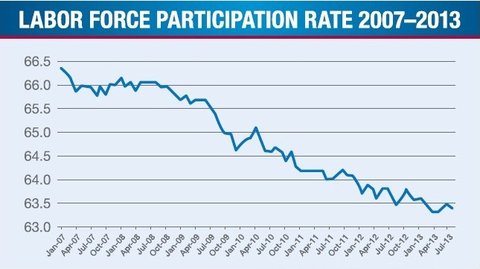
What happened to the economy after Democrats won the House and Senate in 2007?

Labor Force Participation Rate from 2007 (Pelosi/Reid) to 2013

Three data points explain what happens when government gets bigger, and job creators get smaller.

First from Investors Business Daily, Obama’s failure to reduce health insurance premiums with his big government takeover of health care.

Excerpt:

The average employer-provided family health insurance premiums have climbed $2,976 since 2009, according to an annual Kaiser Family Foundation survey released this week. They’re up $3,671 compared with the year before President Obama took office. That’s despite Obama’s repeated promises that the health care reform law he championed would cut premiums by $2,500 in his first term.

And while annual premium increases have moderated over the past two years, that’s due to trends in the insurance market largely unrelated to ObamaCare, and trends the law could actually reverse.

The Kaiser survey found that the average family premium this year is $16,351, up 4% over last year, and up 22% since 2009. After adjusting for inflation, premiums climbed an average 3.2% a year in Obama’s first term, higher than the 2.7% average during President Bush’s last four years in office.

During his first campaign for president, Obama repeatedly claimed that his health reform plan would, as he said at a Virginia rally in 2008 “lower premiums by up to $2,500 for a typical family per year.”

Now, let’s take a look the second failure, as reported by the Weekly Standard.

Excerpt:

President Obama likes to talk about income inequality, but what matters far more is the actual income of the typical American.  And how has the typical American household income fared on Obama’s watch?  Well, the economic “recovery” has now spanned an Olympiad, and during that time the typical American household income has not only dropped—it has dropped more than twice as much as it did during the recession.

New estimates derived from the Census Bureau’s Current Population Survey by Sentier Research indicate that the real (inflation-adjusted) median annual household income in America has fallen by 4.4 percent during the “recovery,” after having fallen by 1.8 during the recession.  During the recession, the median American household income fell by $1,002 (from $55,480 to $54,478). During the recovery—that is, from the officially defined end of the recession (in June 2009) to the most recent month for which figures are available (June 2013)—the median American household income has fallen by $2,380 (from $54,478 to $52,098).  So the typical American household is making almost $2,400 less per year (in constant 2013 dollars) than it was four years ago, when the Obama “recovery” began.

Importantly, these income tallies include government payouts such as unemployment compensation and cash welfare. So Obama’s method of funneling ever-more money and power to Washington, and then selectively divvying some of it back out, clearly isn’t working for the typical American family.

And finally, the third example, from the Daily Caller.

Excerpt:

 In 35 states, welfare benefits pay more than a minimum wage job, according to a new study by the libertarian Cato Institute, and in 13 states welfare pays more than $15 per hour.

“One of the single best ways to climb out of poverty is taking a job, but as long as welfare provides a better standard of living than an entry-level job, recipients will continue to choose it over work,” said Michael Tanner, senior policy analyst and co-author of the study.

The study is an updated version of one Tanner put out in 1995 that estimated the full value of welfare benefits packages across the states. The 1995 study found that such tax-free welfare benefits greatly exceeded the poverty level and “their dollar value was greater than the amount of take-home income a worker would receive from an entry-level job.”

Despite efforts to curb welfare spending, many welfare programs and benefits have continued to outpace the income that many workers can receive for working an entry-level job, which disincentivizes work, according to the study.

“The current welfare system provides such a high level of benefits that it acts as a disincentive for work,” reads the study. “Welfare currently pays more than a minimum-wage job in 35 states, even after accounting for the Earned Income Tax Credit, and in 13 states it pays more than $15 per hour.”

According to the study, the federal government funds 126 separate programs designed to support low-income earners. Seventy-two of these programs provide cash or in-kind benefits to recipients. This is on top of additional welfare programs operated by state and local governments.

Welfare recipients in Hawaii get the most benefits, according to Tanner, at $29.13 per hour — or $60,590 pre-tax income annually. However, the state’s minimum wage is only $7.25 per hour, according to the Labor Department. Hawaiians on welfare also earn 167 percent of the median salary in the state, which is only $36,275.

What if a fireman showed up in front of your house on your birthday and claimed that he wanted to put out the candles on your birthday cake because they were a fire hazard? What if he read out a long, passionate, prepared speech about how much he wanted to put out fires? What if he then dumped a bucket of gasoline on your cake? What if your house caught fire and he claimed that you should let him keep throwing gas on the fire to put it out? What if you found out that this person was a lawyer and a community organizer, and knew nothing at all about putting fires out? Obama was not prepared to run the economy, and, as expected, he spent a ton of money without getting the results he said he was going to get. He gave speeches about jobs and poverty and everything he’s done has been to increase unemployment and increase poverty – and now we are $17 trillion dollars in debt. Speeches about achieving objective X during a campaign don’t necessarily translate into achieving objective X. You actually have to know what you are doing in order to achieve objectives, preferably because you’ve done it before in real life.

UK business owner on trial for tackling burglars on his own property

From the UK Daily Mail. (H/T Dina)

Excerpt:

A businessman who confronted a burglar raiding his premises appeared in court yesterday accused of attacking him.

Andrew Woodhouse, 43, was chasing thieves off his property when he claims one of them ‘came at’ him with a wooden stick.

Father-of-five Woodhouse allegedly used the stick to injure the man’s legs before holding him down while his wife called the police.

But when officers arrived they arrested Woodhouse and held him in a cell for 18 hours.

He appeared at Newport Crown Court yesterday charged with grievous bodily harm with intent which has a maximum sentence of life imprisonment.

Andrew Taylor, defending, said: ‘Mr Woodhouse apprehended two of the burglars at his tyre depot.

‘It happened after two or three men decided they were going to remove a large quantity of diesel from his premises.

‘Mr Woodhouse has been interviewed by police and has provided a full explanation about what happened.

‘There is a CCTV recording of the incident and we are waiting to see the footage.’

[…]Woodhouse was in bed with his wife Lisa at their detached home in the village of Govilon, near Abergavenny, when his burglar alarm went off at about 12.30am.

[…]Woodhouse drove to his business premises where the alleged assault happened.

[…]His wife Lisa said her husband was prepared to go through the legal process to clear his name.

She said: ‘But I fail to see where there was any intent on Andrew’s part.

‘He didn’t intend to get up in the middle of the night to assault anyone. All he did was protect his property.

‘People may think he took the law into his own hands but what was he supposed to do, stand by and watch?’

Woodhouse employs six staff including two of his sons at the family business, which was set up 20 years ago.

The firm has lost £15,000 in recent years to thefts of diesel and tools.

Two fuel thieves who stole £50 worth of diesel from Woodhouse’s premises on the night of the alleged assault have been dealt with in court.

Timothy Cross, 31, and Kevin Green, 52, took two jerry cans of diesel from Woodhouse’s tyre depot in Abergavenny.

Cross and Green both admitted theft and were fined £75 by Cwmbran magistrates.

People sometimes wonder why I think that the UK is the most wussified country in the world. This is not an arbitrary opinion that I hold. The UK is a nanny state, where the people in charge treat men as if they are toddlers in day care. This country has the least respect for men and male nature of any country that I am aware of at this time. I don’t see how you could be a man and be comfortable living in a society that basically criminalizes the righteous use of force against evil. It’s so strange to me when I hear complaints from UK women about how men are not taking responsibility any more, or making commitments, or being ambitious. Well, here’s a little newsflash for you. If you treat men like children and resent them using force to defend their homes and businesses, then you are discouraging manliness. The kinds of men you will get then are wussified, feminized men who attempt nothing and defend nothing.

I was having a conversation with a friend of mine who lives in the UK recently. She was explaining to me how women who are under a certain age are given government housing if they have babies out-wedlock. What kind of message is that sending? It is telling young women that men are optional, and that they don’t have to choose men wisely in order to get one who can do the provider role. So on the one hand, men are punished by the state for protecting, and on the other, they are punished by the state for providing. The state taxes men with jobs to subsidize the losers who get sex without having to commit first. And I know that young women often prefer these men because they don’t want a man who has authority from having a job to tell them what to do. (See here for some examples)

The UK has been trying to undermine and replace men who perform the traditional male roles for decades. The role of protecting has been demonized by punishing men who protect their families and businesses. The role of providing has been marginalized through higher taxes, socialized medicine and welfare benefits. And moral and spiritual leadership have been dismantled with pervasive moral relativism, multicultaralism and secularism. Everything that a strong, virtuous man could do to be recognized has been marginalized and discredited by the socialist, feminist government of the UK. UK women have no right to complain now when men act like children – they caused it by punishing men who were only doing what good men are supposed to do in any good society.

Just 70 years ago we lived in the time of British heroes like Eric “Digger” Dowling, Guy Gibson, Douglas Bader, Patrick Reid and Tommy McPherson. I learned from watching World War 2 movies as a child that British men were courageous and fierce, and able to defend Western civilization from tyranny with force, if necessary. Now all that is going, going, gone thanks to the British socialist welfare state. Men do understand what messages the feminist welfare state is sending by subsidizing single motherhood, taxing men more when their wives stay home, criminalizing self-defense and capitalism, arresting military heroes for owning handguns, discriminating against boys in schools that are dominated by women, and so on. Men understand the message that’s being sent there, and they do adjust.

Related posts