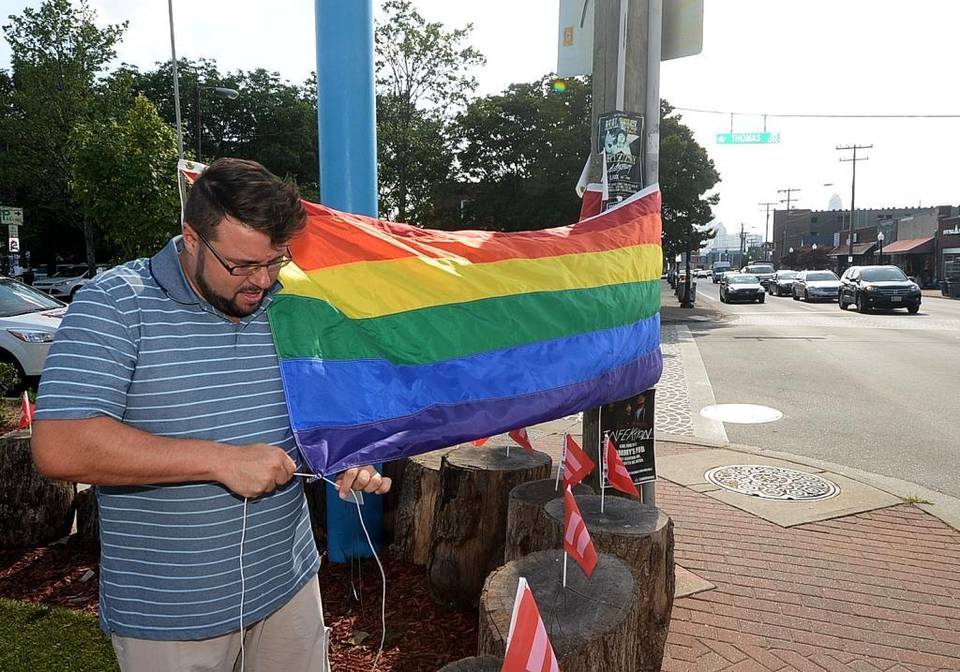
The former president of Charlotte’s LGBT Chamber of Commerce has resigned after he came under fire from a conservative group, which noted that he is on a sex offender list and questioned his role in supporting the city’s expanded nondiscrimination ordinance.
Chad Sevearance-Turner had been the president of the chamber, which supported the newly expanded ordinance that gives legal protection for gay, lesbian, bisexual and transgender individuals.
At a City Council meeting Feb. 8, Mayor Jennifer Roberts cited a survey that showed discrimination was a real problem for the LGBT community. During the meeting, she said the survey was conducted by the LGBT Chamber.
That prompted questions from the N.C. Values Coalition, which opposes the new LGBT protections in the ordinance.
Tami Fitzgerald, who leads the Raleigh-based coalition, first mentioned Sevearance-Turner’s record at a Feb. 8 news conference outside the Government Center, which Sevearance-Turner attended. On Feb. 18, the coalition issued a news release further questioning the chamber’s role in the survey.
Because of his record, “any supposed evidence provided by the group is discredited,” she wrote.
[…]Sevearance-Turner was arrested in 1998, when he was 20, and charged in Cherokee County, S.C., with a “lewd act, committing or attempting a lewd act upon a child under 16.”
A 2000 story in the Spartanburg Herald-Journal said Sevearance-Turner had been a youth minister at a church in Gaffney. A jury there found him guilty of fondling a 15-year-old teenage church member while the boy slept.
Charlotte’s bathroom ordinance was overturned by the state. And North Carolina now requires people with male equipment to use the male washroom, and people with female equipment to use the female washroom.
National Review explains the problems with this sex-offender-designed law.
Here’s one:
The Left likes to pull out the statistic that no transgender individual has ever assaulted someone in a restroom, locker room, etc. That’s great. Good for the transgendered: There are no transgender rapists. But there are plenty of other kinds who would not hesitate to take advantage of this situation.
Under the Charlotte ordinance, transgender people weren’t the only ones allowed to use the restroom of the opposite sex. Anyone could. All he had to do was assert that his true gender wasn’t his biological gender. “Transgender” is a tricky word; it’s not like “transsexual,” which refers to someone who has had an operation or taken large doses of hormones. “Transgender” means simply experimentation with the stereotypes of the opposite biological gender. So a clever (or not so clever) rapist could smear on some lipstick, call himself transgender, and waltz right into a locker room full of half-dressed teenage girls.
People have already taken advantage of these kinds of laws to put other people in compromising situations. In February, after the city of Seattle passed an ordinance similar to Charlotte’s, a man (not transgender) entered a girls’ locker room twice in one day. His goal? To “test” the limits of the new rule. An advocate of the ordinance said that the ordinance itself wasn’t a problem; the man was “just taking advantage of a loophole.”
People like Sevearance-Turner are backed up by some of our largest companies, as the leftist Washington Post noted:
Companies and organizations like American Airlines, Wells Fargo, Apple, Microsoft, Dow Chemical and the NCAA — many of which have a significant presence in North Carolina — have strongly opposed North Carolina’s law.
Now that we know that a convicted sex offender crafted the law, we understand what those big companies think about the safety of children compared to the desires of selfish adults. Given the choice between the sex offender agenda and the pro-child agenda, the big corporations side with the sex offender.
When you do something really, really bad and run up against the moral law, the thing to do is to realize that what you did was wrong. The thing you shouldn’t do is to change the laws of the nation (which are lower than the moral law), so that you can force all the moral people to celebrate the wrong things you did. Sin is scary not just because of the harm it causes to the victims, but because the sinners are tempted to coerce acceptance from others (by exerting force against them) rather than admit their guilt and repent of the sin.
I found an interview with Peter Ward (atheist) and Donald Brownlee (agnostic) discussing astrobiology in Forbes magazine. They were asked about how important plate tectonics are for a planet to be able to support complex life.
Excerpt:
Astrobiologists often cite the sheer numbers of stars and galaxies as evidence that complex life elsewhere must surely have evolved somewhere. But is probability enough?
Without a moon, we don’t have any idea of how commonly a planet could have the long-term stability needed for complex life. Until we “get” that, going to the sheer numbers argument is useless. Without that moon-forming collision, we wouldn’t have plate tectonics. Without plate tectonics, we might have microbes but we’d never get to animals.
What about the rarity of earth’s crustal dichotomy of oceans and continents?
If you can’t make granite, you’re not going to have continents. But granite formation is a consequence of our moon-forming collision. That scrambled the entire density of our crust. Mars doesn’t have granite; all it’s got is this volcanic basalt. To build granite you need a planetary subduction [or plate tectonic] process.
In triggering complex life, how important were plate tectonics’ role in the continual recycling of earth’s atmosphere?
It’s this recycling that allows for a very rich planetary atmosphere with an extended life. Photosynthesis gets you oxygen, but how do you get enough photosynthesis to get oxygen at 10 to 20 percent? You’ve got to have a shoreline next to a rich sea with rocks eroding into it in order to provide the nitrogen and phosphates for [plant] photosynthesis.
This article from Astrobiology explains more about the importance of plate tectonics.
Excerpt:
Plate tectonics is the process of continents on the Earth drifting and colliding, rock grinding and scraping, mountain ranges being formed, and earthquakes tearing land apart. It makes our world dynamic and ever-changing. But should it factor into our search for life elsewhere in the universe?
Tilman Spohn believes so. As director of the German Space Research Centre Institute of Planetary Research, and chairman of ESA’s scientific advisory committee, he studies worlds beyond our Earth. When looking into the relationship between habitability and plate tectonics, some fascinating possibilities emerged.
It is thought that the best places to search for life in the Universe are on planets situated in “habitable zones” around other stars. These are orbital paths where the temperature is suitable for liquid water; not so close to the star that it boils away, and not so far that it freezes. Spohn believes that this view may be outdated. He elaborates, “you could have habitats outside those, for instance in the oceans beneath ice covers on the Galilean satellites, like Europa. But not every icy satellite would be habitable. Take Ganymede, where the ocean is trapped between two layers of ice. You are missing a fresh supply of nutrition and energy.”
So planets and moons that lie beyond habitable zones could host life, so long as the habitat, such as an ocean, is not isolated. It needs access to the key ingredients of life, including hydrogen, oxygen, nitrogen, phosphorous and sulphur. These elements support the basic chemistry of life as we know it, and the material, Spohn argues, must be regularly replenished. Nature’s method of achieving this on the Earth appears to be plate tectonics.
Spohn found that the further he delved into the issue, the more important plate tectonics seemed to be for life. For example, it is believed that life developed by moving from the ocean to the kind of strong and stable rock formations that are the result of tectonic action. Plate tectonics is also involved in the generation of a magnetic field by convection of Earth’s partially molten core. This magnetic field protects life on Earth by deflecting the solar wind. Not only would an unimpeded solar wind erode our planet’s atmosphere, but it also carries highly energetic particles that could damage DNA.
Another factor is the recycling of carbon, which is needed to stabilize the temperature here on Earth. Spohn explains, “plate tectonics is known to recycle carbon that is washed out of the atmosphere and digested by bacteria in the soil into the interior of the planet from where it can be outcast through volcanic activity. Now, if you have a planet without plate tectonics, you may have parts of this cycle, but it is broken because you do not have the recycling link.”
It has also been speculated that the lack of tectonic action on Venus contributed to its runaway greenhouse effect, which resulted in the immense temperatures it has today.
Most planets don’t have a moon as massive as ours is, and the collision that formed the moon is very fine-tuned for life. This is just one of the many factors that needs to be present in order to have a planet that supports complex, carbon-based life.
If you want to learn more about this data, I recommend watching “The Privileged Planet” DVD, and someone posted it on YouTube:
If you haven’t seen it, and have 90 minutes, this is time well-spent.
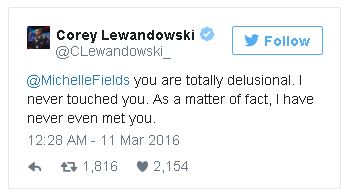
So there is some news about the Trump campaign manager Corey Lewandowski’s assault of journalist Michelle Fields.
Here is what the Trump campaign manager claimed after the assault occured:
The Trump Campaign smearing and mocking women again
Trump himself backed Lewandowski’s story up.
The Daily Wire has a video posted where Trump says the attack never happened:
Upon being apprised of Fields’ accusation, here was Trump’s response:
“Nobody saw it happened. Nobody complained….I think [she] made it up.”
In this interview on the TODAY show, Trump clear says “She made up this story” and “She’s got no evidence”:
Basically, Trump thought he could cover up what happened by repeating the lies over and over and insulting and smearing the people who told the truth. And this refusal to admit fault and apologize went on and on and on.
He retweeted news stories casting doubt on Fields’s story, aided by the fact that the only footage that existed was, at best, sketchy. (He was also aided by exaggerations of Fields’s original claim; at no point was it suggested that she’d been pulled to the ground.)
Police in Jupiter appear to have obtained surveillance footage from inside the ballroom where the event and the incident occurred. There’s no question that Fields was not, in fact, “delusional.”
The video clearly shows Corey grabbing Michelle’s arm and jerking her away from Trump, which resulted in bruises on her arm.
Here is an eyewitness corroboration of Michelle Field’s initial report, reported by Ben Terris in the leftist Washington Post:
As security parted the masses to give him passage out of the chandelier-lit ballroom, Michelle Fields, a young reporter for Trump-friendly Breitbart News, pressed forward to ask the Republican front-runner a question. I watched as a man with short-cropped hair and a suit grabbed her arm and yanked her out of the way. He was Corey Lewandowski, Trump’s 41-year-old campaign manager.
Fields stumbled. Finger-shaped bruises formed on her arm.
“I’m just a little spooked,” she said, a tear streaming down her face. “No one has grabbed me like that before.”
She took my arm and squeezed it hard. “I don’t even want to do it as hard as he did,” she said, “because it would hurt.”
The leftist Washington Post reports on the video, and the charge of battery:
Republican presidential front-runner Donald Trump defended his campaign manager as a “very decent man” Tuesday, hours after the staffer was charged with battery in Florida for allegedly grabbing a reporter and yanking her away from Trump.
Corey Lewandowski, 42, faces one misdemeanor count of battery as a result of the March 8 incident. He voluntarily went to police headquarters in Jupiter, Fla., and signed paperwork ordering him to appear in court May 4.
The police also released a video of the primary-night news conference, taken from the security cameras at Trump’s own golf club. It directly contradicted what Trump and Lewandowski said about the incident in the past.
They had asserted that Lewandowski never touched the reporter, Michelle Fields.
In the video, he does — grabbing her hard enough to pull her backward.
In the past, campaign staffers have been fired for far less. But Trump did not dismiss Lewandowski on Tuesday, and neither apologized. “I don’t discard people. I stay with people,” Trump said.
It was an extreme example of Trump’s approach to campaigning, one apparently based on the idea that the only mistake in politics is to apologize.
After news of the criminal charge came out, Trump didn’t apologize – he went right back to trying to smear Fields as a delusional liar.
As the day went on, Trump offered increasingly strident defenses of Lewandowski. All ran counter to his earlier statements that the contact never occurred. Trump conceded that Lewandowski had touched Fields but implied that it was Fields’s fault for “grabbing” at the candidate — although the photo Trump posted didn’t show a grab but rather the reporter brushing the candidate with the back of her hand.
Then Trump wondered whether he could file charges against the reporter.
And then, at the end of the day, Trump was back to implying that Fields had lied about the incident — if the grab was as bad as she said, he said, why hadn’t she screamed?
“How do you know those bruises weren’t there before? I’m not a lawyer,” Trump told reporters on his plane, referring to finger-shaped bruises that Fields showed to the police. “Wouldn’t you think she would have yelled out a scream or something if she has bruises on her arm?”
In an interview with Sean Hannity on Fox News on Tuesday, Trump said that Lewandowski was merely protecting him against a potential, unidentified threat.
“She grabbed me and she had something in her hand. I don’t know what it was,” he told Hannity. “It looked like it could have been a pen. But you know, from the standpoint of where we are, who knows what it is.”
Ben Shapiro notes in this interview that slandering women is is a pattern for the Trump campaign:
Trump supporters have accused virtually every powerful anti-Trump conservative woman of some nefarious sexual activity with a rival candidate. And of course Trump himself has attacked prominent media females including Dana Perino and most egregiously Megyn Kelly (“blood coming out of her wherever”). Some of those attacks are purely political and within normal boundaries. But many of them are far more personal, obviously. This is a pattern, now, not merely a few isolated events.
Previously, I blogged about how Trump had attacked Heidi Cruz because she is supposedly not as pretty as his supermodel wife (wife number three). This seems to be a pattern that Trump has – to insult women publicly in order to shame them for opposing him.
Trump lies all the time
Earlier this week, Trump tried to argue that ads placed in Utah by a Super PAC that does not support Cruz were actually Cruz’s fault. He went on mainstream media everywhere, and blamed Cruz for the ads. That turned out to be another lie, that was disproved by sources on the right (The Weekly Standard) and the left (The Washington Post) and every source in between. Trump lied again. This is what he does. If he’s not insulting women, bragging about his penis, or giving childish answers to serious policy questions, then he’s probably lying. He’s not fit to pump gas or pack bags at a grocery store. He has one accomplishment in life – being born to a rich father. That’s it. And he used that inheritance to live a life as devoid of Christian convictions and conservative actions as could be.
For a quick 6-minute listing of some of Trump’s previous lies, please see this video featuring Ben Shapiro, who recently resigned from the Trump-supporting Breitbart News (following the Michelle Fields assault):
I would like to think that some Trump supporters would wake up to reality, but my experience with most of them is that they believe what they want to believe, regardless of the evidence. Whenever I present facts to them, they have some excuse why they get to retain their positive view of Trump.
Trump supporters cannot be persuaded with facts. They make decisions about who to hire as President with their feelings. They measure a man by his confidence, instead of by his record of accomplishments that are relevant for the job for which he is being interviewed. It’s like Americans have lost the ability to make a moral assessment of a man – they just want to choose based on feelings. We are truly living in the age of moral relativism and postmodernism.