Category Archives: Commentary

Many professional women spend their 20s getting drunk and having “fun”

Dina sends me this depressing article from the UK Daily Mail. This is a must-read.

Excerpt:

The street smells of urine and lager, police struggle  to break up a fight outside the Walkabout bar and a paramedic bundles a comatose girl on to a wheelchair. But it’s a quiet night for 20-year-old Naomi Jenkins. She has ‘only’ drunk three shots of peach schnapps, cider and three shots of Jagermeister (during a drinking game called I Have Never) and still feels ‘a bit sober’. Her friend Hannah Freeman, 19, was punched in a fight and stumbles about swearing and searching for a bathroom.

‘We only do embarrassing things when we’re really drunk,’ Naomi says. ‘I kiss random men in the street and Hannah has had sex behind a chicken coop.’ She screams with laughter as Hannah lurches unsteadily in the stairwell of Charleston Bar and Grill on Caroline Street (known locally as Chip Alley) and unashamedly urinates in front of us.

Amazingly, none of the 80-strong throng of passers-by seems to notice – or perhaps care. Hannah rearranges her minuscule dress, steps over her own urine, shouts ‘f*** off’ and the pair stumble back to Walkabout. It’s only midnight, after all.

[…]But as I found out on the streets of Cardiff after midnight, many of these women are – by day at least – well qualified pillars of the community. Among them I met teachers, nurses, occupational therapists,
personnel professionals and full-time mothers, all determined to shake off responsibility and have fun in the only way they know how. By getting ‘smashed’.

Every week, the ritual is the same: Groups of between four and six girls congregate to dress up and competitively drink bottles of cheap wine or sickly shots. Competition ramps up over who can wear the tiniest mini-dress, the highest heels or the reddest lipstick. Drinking carries on during the bus ride to Cardiff (many young women travel from the surrounding Valleys) and continues in bars between 9pm and 11pm, or until they feel bold enough to dance.

Condom in purse and telephone number for a pre-booked 3am taxi in handbag, they stagger between nightclubs. The ritual continues long into the morning when, dulled by hangovers, they congregate for McDonald’s or fried breakfasts to giggle about the drunken ‘fun’.

New figures show that alcohol misuse costs the nation £7.3 billion in crime and antisocial behaviour and that one woman in five drinks at levels hazardous to health (more than 14 units each week).

I went looking for the answer to the real question: Why? In a series of raw but illuminating interviews, I discovered that beyond the superficial bravado, their nights of booze-fuelled excess make them anything but happy – but they still have no intention of changing. Naomi Jenkins is a classroom assistant from Carmarthen and is adamant that downing sickly Jagermeister shots (which she nicknames medicine) is ‘a laugh’.

I hear the same knee-jerk answer again and again. Human-resources administrator Becky Sherlock
from Chepstow tells me: ‘Tomorrow morning, I’ll lift my head off the pillow and think, “Oh s***.” But it’s worth it.’

‘A hangover is the sign of a good night,’ says her friend Danielle Malson, a secondary-school teacher.

What quickly becomes apparent is the ease with which these young women distinguish their responsible weekday personas from their ‘fun’ selves. Naomi easily switches from diligent teaching assistant to Saturday night party girl when she squeezes into a skintight minidress. She tells me: ‘I wouldn’t do this if it affected my work.’

Occupational therapist Sally Baldwin, 24, added: ‘If I bumped into any of my patients or their relatives, I’d hide. It doesn’t give off the right image… But as long as it doesn’t interfere with my work, I’ll carry on.’ By splitting their characters into two personas (professional and social), these young women appear confident that their professional reputations remain unblemished. In their own minds, at least.

‘I just like knowing I haven’t lost my mojo,’ admits a 27-year-old full-time mother, dressed in a skimpy football kit and slumped in a shop doorway on St Mary Street. ‘The world seems a better place when you’re wearing beer goggles.’

[…]It is a sad testimony that obliteration of reality is the highlight of the week for many of these young women. For Alicia Howley, 20, and Lucy Griffiths, both shop assistants, the ritual of dressing up in tight minidresses and wearing lashings of make-up begins at 4.30pm, straight after their Saturday shifts at Matalan.

Lucy says: ‘After a few drinks, you feel like you can do anything. It’s amazing. The only time I usually talk to new people is speaking to customers at work. Alcohol makes me loads more confident… Like the time I had a foursome.’ They laugh.

Read the whole thing, as this is going on with women from late high school right through college, until they are age 35, when they suddenly want to have a baby. And that doesn’t mean they want to get married first. They are happy to conclude from their careful search for Mr. Right during drunken “foursomes” that there are no good men. After all, they are already perfectly suitable for marriage as they are, so if Mr. Right doesn’t come along, then it’s not the woman’s fault. And it’s nothing that a little IVF, day care and public school won’t solve – all taxpayer-funded, of course.

This story makes me think about why men like me (chaste, and marriage minded) are in the situation that we are in today. I have been taking some flak from friends of both sexes about my reticence to try to get married. I think that people who are criticizing need to realize what is out there right now to choose from. This is what is normal for most women who go through college today. And even if I could find a girl who managed to stay chaste while getting herself mature and independent, the laws are being made by the majority of women, who are more like the ones in the article.

Even when people mouth the words “I’m a Christian” you have to understand that most people who claim to be Christians go through 15 years of church and learn nothing at all that is useful about Christianity. I understand that once women become aware of what men like me want, that they are able to do it and to see the reasons for doing it. But it’s very difficult to convince women to be serious about things like economics and apologetics these days – many of them aren’t being serious about preparing for marriage in the time that they should be doing that.

Related posts

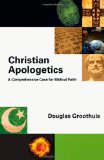
Lee Strobel interviews Douglas Groothuis on his new apologetics book

Christian Apologetics

Mary sent me this article from the BibleGateway site.

Excerpt:

Q. What’s the strongest argument in the arsenal of atheists these days? And why does it fall short?

A. That’s a big question. Different atheists will use different arguments, but they often confront Christians with two things: (1) Darwinism has refuted the idea of Designer and so defeats Christianity (and every other form of theism). They claim that undirected, purely material causes and entities can explain all of biology. (2) The existence of the amount of evil in the world destroys the idea that there is a God who is all-good and all-powerful. No such God would allow this to happen. This is called the problem of evil.

I address (1) in chapters 13 and 14 of Christian Apologetics. To put it into a nutshell: Darwinism is terribly overrated scientifically. Darwinists usually presupposes a materialistic worldview—this is their philosophy, not something derived from science itself—and then interpret everything in biology according to those categories. In other words, “What my net don’t catch, ain’t fish.”

But once we admit intelligent design as a legitimate category of explanation, we find that Darwinism loses its persuasive power as a comprehensive explanation of the biosphere. In fact, Darwinism cannot explain the existence of molecular machines (such as the bacterial flagellum) or the information in DNA code. Nor can it even present a compelling case that all life evolved from a common ancestor.

In addition, my book builds what I hope is a strong cumulative case for Christian theism before addressing the vexing problem of evil in the final chapter. First I consider “dead ends” to explain the fact of evil in the world. Every worldview—and not just Christianity—needs to give an account of the meaning of evil and how to deal with it.

So every worldview has to answer “the problem of evil.” I argue that atheism has no intellectual resources to bring to bear on the problem. It cannot explain the very existence of evil, since it lacks a transcendent and personal standard for good and evil, nor can it give any hope for how to wrestle with evil. This is because all the atheist can say is (to put it politely): “Stuff happens.”

However, Christianity, while challenged by the fact of evil, is not overwhelmed by it. Apart from the problem of evil, we can stand on the foundation of natural theology. There are compelling arguments for, among other things, a First Cause who designed the universe and who is the source of moral law and meaning. Moreover, we find historically reliable documents that speak of Jesus Christ as God incarnate—one who vindicated himself through his matchless life, death, and resurrection. Thus, we do not stand before the problem of evil intellectually naked. Rather, we are girded in strong rational armor.

The Christian answer to the problem of evil is that while God is sovereign, some of God’s creatures (angelic and humans) brought evil into the world through their rebellion. God did not create evil. However, as an all-wise God, God uses evil for greater goods that would not be achievable otherwise. Further, God proves his love and goodness by experiencing the worst possible evil through the crucifixion of Jesus, Christ, God, the Son. Christ’s resurrection three days later stamps history and eternity with the verdict that good (that is, God) wins out over evil in the end.

Q. You offer a compelling case for the resurrection of Jesus. What’s the strongest counter-argument to him rising from the dead? And why does that alternative fail?

A. None of the counter-arguments are as rationally strong as the claim that Jesus left an empty tomb and rose from the dead in space-time actuality. The naturalistic accounts all fail to explain key elements of what we know from history.

However, in recent years, the hallucination theory has generated the most attention, as Gary Habermas has pointed out. This theory affirms that Jesus did not objectively rise from the dead; instead, his followers subjectively hallucinated a resurrection and subsequently built their movement on this delusion. While this counter-argument may be “the best of the bad,” it is still very bad indeed.

First, hallucinations are not group phenomena, but rather individual experiences. But we have well-attested records that many people in their right minds observed the risen Jesus at the same time, as well as other individual appearances (as to Paul).

Second, if many people were deluded about Jesus and began a movement in his name, the Roman government could have put a stop to the young Jesus movement by producing his corpse publicly. They had both the means and the motive to do so. But we have no record of anything like that.

Third, Jesus’ followers did not expect him to rise from the dead. This was not part of their theology and they did not understand Jesus when he made reference to this fact before his resurrection. N.T Wright strongly argues for this. But hallucinations usually involve some form of wish fulfillment: people strongly desire something, and then hallucinate about it. This does not fit the objective historical evidence about Jesus’ followers at all.

I think if you follow apologetics at all, you can see that Doug knows his stuff. But look how precisely he gets the material out – so concisely. I think Doug’s apologetics book and Mike Licona’s resurrection book are the books of the year. But for intermediate to advanced apologists only! Doug and Michael are two of my absolute favorite Christian apologists.

Historian Michael F. Bird assesses the historicity of Matthew 27

Australian historian Michael F. Bird responds to the Geisler/Licona dust-up on the Euangelion blog, a blog that “exists for the purpose of promoting the gospel by commenting on issues relating to the Christian Scriptures and evangelical faith in contexts of the academy and the church”. (H/T Near Emmaus)

Excerpt:

But people need to evaluate the debate for themselves. Here is the text in question, Matt. 27.51-53:

51 At that moment the curtain of the temple was torn in two from top to bottom. The earth shook, the rocks split
52 and the tombs broke open. The bodies of many holy people who had died were raised to life.
53 They came out of the tombs after Jesus’ resurrection and went into the holy city and appeared to many people.
(NIV)

What is the fuss? Well, Lincona calls Matt. 27.52-53 a “strange little text” (p. 548). Many strange phenomena like earthquakes and cosmic portents were said to accompany the death of great leaders in ancient sources. Licona writes: “[I]t seems to me that an understanding of the language in Matthew 27:52-53 as ’special effects’ with eschatological Jewish texts and thought in mind is most plausible. There is further support for this interpretation. If the tombs were opened and the saints being raised upon Jesus’ death was not strange enough, Matthew adds that they did not come out of their tombs until after Jesus’ resurrection. What were they doing between Friday afternoon and early Sunday morning? Were they standing in the now open doorways of their tombs and waiting?” Lincona then regards “this difficult text in Mathew as a poetic device added to communicate that the Son of God had died and that the impending judgment awaited Israel” (pp. 552-53).

In my chapter about the resurrection in How Did Christianity Begin: A Believer and Non-Believer Examine the Evidence, co-authored with James Crossley (London: SPCK, 2008/ Grand Rapids, MI: Baker, 2010), I said in a footnote about Matt. 27.51-53: “My understanding of this text is that it is not historical and it blends the present and the future together so that Matthew provides a cameo of the future resurrection at the point of Jesus’ death to underscore its living-giving power” (p. 69, n. 30). That was my off-the-cuff thought, but I stand by it, since Matt. 27.51-53 is a strange story that is reported nowhere else in Christian or non-Christian literature.

I don’t see any reason why Licona’s or my interpretation of Matt. 27.51-53 does not conform to a view of scripture as infallible, inspired, and authoritative. I think it explains the text and it explains why you don’t hear Josephus or Tacitus talking about the day that many Jewish holy men came back to life.

But I see further problems with Licona’s critics. If I can give another example, is the story of the Rich Man and Lazarus in Luke 16.19-31 a “true” story or a “parable”? Now the word parable does not occur! What if I said that it was a true, literal, and factual story about the afterlife in Hades and everyone who called it a parable about riches and possessions was using ancient genres to dehistoricize the Bible and deny the existence of the intermediate state? Does believing that Luke 16 is a parable violate inerrancy? To employ the logic of Geisler and Mohler, I’d have to say, “yes”. But is it hermeneutically responsible to rule certain literary genres out of bounds based on theological prolegomena, rather than discern them based on the phenomenon of the text and its relationship to extant biblical and non-biblical literature? Moreover, Geisler and Mohler are systematicians, not New Testament scholars, and most of those who came to Licona’s aid in his open letter are New Testament scholars. I think there’s a big lesson to be learned in that!

About Michael F. Bird:

Biography:

Dr. Michael Bird (Ph.D University of Queensland) is Lecturer in Theology and New Testament at Crossway College in Brisbane, Australia. He is the author of several books including Jesus and the Origins of the Gentile Mission (2006), The Saving Righteousness of God (2007), A Bird’s-Eye View of Paul (2008), Colossians and Philemon (2009), Crossing Over Sea and Land: Jewish Missionary Activity in the Second Temple Period (2009), and Are You the One Who is to Come? The Historical Jesus and the Messianic Question (2009). He attends Acacia Ridge Presbyterian Church where he preaches regularly. He is married to Naomi and has four children.

Michael F. Bird is an evangelical historian, and has debated atheist James Crossley on the Unbelievable show (part 1, part 2). I have the book he mentions, which is a debate with Crossley, but haven’t had a chance to dig into it, yet. I really enjoyed the Bird/Crossley debates though. Sometimes, Unbelievable picks a bad defender of the Christian side, but Bird was solid. If I recall correctly, the Matthew 27 passage came up in that debate, and it came up in Crossley’s debate with William Lane Craig as well.

By the way, the other passage that is disputed a lot in the New Testament is the guard at the tomb in Matthew. I wrote a post about it before, featuring a clip from William Lane Craig. William Lane Craig wrote an essay about the guard at the tomb story. My take on that one is that the guard is historical, although I would not want to defend that tradition as a minimal fact in a debate, because it fails all the tests. However, the genre there is clearly historical, not apocalyptic imagery. I do understand the case against the guard story being an apologetics response to the Jewish accusation that the disciples stole the body.

New Testament scholar Richard Bauckham has debated Crossley as well, and you can find the shows here.