All posts by Wintery Knight

https://winteryknight.com/

The true story of Thanksgiving: Squanto’s miraculous path to Plymouth

"The First Thanksgiving at Plymouth" by Jennie Augusta Brownscombe (1914)
“The First Thanksgiving at Plymouth” by Jennie Augusta Brownscombe (1914)

God’s providence in action, as reported by Eric Metaxas in the Wall Street Journal.

Full text:

The story of how the Pilgrims arrived at our shores on the Mayflower—and how a friendly Patuxet native named Squanto showed them how to plant corn, using fish as fertilizer—is well-known. But Squanto’s full story is not, as National Geographic’s new Thanksgiving miniseries, “Saints & Strangers,” shows. That might be because some details of Squanto’s life are in dispute. The important ones are not, however. His story is astonishing, even raising profound questions about God’s role in American history.

Every Thanksgiving we remember that, to escape religious persecution, the Pilgrims sailed to the New World, landing at Plymouth Rock in 1620. But numerous trading ships had visited the area earlier. Around 1608 an English ship dropped anchor off the coast of what is today Plymouth, Mass., ostensibly to trade metal goods for the natives’ beads and pelts. The friendly Patuxets received the crew but soon discovered their dark intentions. A number of the braves were brutally captured, taken to Spain and sold into slavery.

One of them, a young man named Tisquantum, or Squanto, was bought by a group of Catholic friars, who evidently treated him well and freed him, even allowing him to dream of somehow returning to the New World, an almost unimaginable thought at the time. Around 1612, Squanto made his way to London, where he stayed with a man namedJohn Slany and learned his ways and language. In 1618, a ship was found, and in return for serving as an interpreter, Squanto would be given one-way passage back to the New World.

After spending a winter in Newfoundland, the ship made its way down the coast of Maine and Cape Cod, where Squanto at last reached his own shore. After 10 years, Squanto returned to the village where he had been born. But when he arrived, to his unfathomable disappointment, there was no one to greet him. What had happened?

It seems that since he had been away, nearly every member of the Patuxets had perished from disease, perhaps smallpox, brought by European ships. Had Squanto not been kidnapped, he would almost surely have died. But perhaps he didn’t feel lucky to have been spared. Surely, he must have wondered how his extraordinary efforts could amount to this. At first he wandered to another Wampanoag tribe, but they weren’t his people. He was a man without a family or tribe, and eventually lived alone in the woods.

But his story didn’t end there. In the bleak November of 1620, the Mayflower passengers, unable to navigate south to the warmer land of Virginia, decided to settle at Plymouth, the very spot where Squanto had grown up. They had come in search of religious freedom, hoping to found a colony based on Christian principles.

Their journey was very difficult, and their celebrated landing on the frigid shores of Plymouth proved even more so. Forced to sleep in miserably wet and cold conditions, many of them fell gravely ill. Half of them died during that terrible winter. One can imagine how they must have wept and wondered how the God they trusted and followed could lead them to this agonizing pass. They seriously considered returning to Europe.

But one day during that spring of 1621, a Wampanoag walked out of the woods to greet them. Somehow he spoke perfect English. In fact, he had lived in London more recently than they had. And if that weren’t strange enough, he had grown up on the exact land where they had settled.

Because of this, he knew everything about how to survive there; not only how to plant corn and squash, but how to find fish and lobsters and eels and much else. The lone Patuxet survivor had nowhere to go, so the Pilgrims adopted him as one of their own and he lived with them on the land of his childhood.

No one disputes that Squanto’s advent among the Pilgrims changed everything, making it possible for them to stay and thrive. Squanto even helped broker a peace with the local tribes, one that lasted 50 years, a staggering accomplishment considering the troubles settlers would face later.

So the question is: Can all of this have been sheer happenstance, as most versions of the story would have us believe? The Pilgrims hardly thought so. To them, Squanto was a living answer to their tearful prayers, an outrageous miracle of God. Plymouth Colony Governor William Bradford declared in his journal that Squanto “became a special instrument sent of God” who didn’t leave them “till he died.”

Indeed, when Squanto died from a mysterious disease in 1622, Bradford wrote that he wanted “the Governor to pray for him, that he might go to the Englishmen’s God in heaven.” And Squanto bequeathed his possessions to the Pilgrims “as remembrances of his love.”

These are historical facts. May we be forgiven for interpreting them as the answered prayers of a suffering people, and a warm touch at the cold dawn of our history of an Almighty Hand?

America is truly a blessed nation. Why this story is not taught in all the schools of the nation is beyond me.
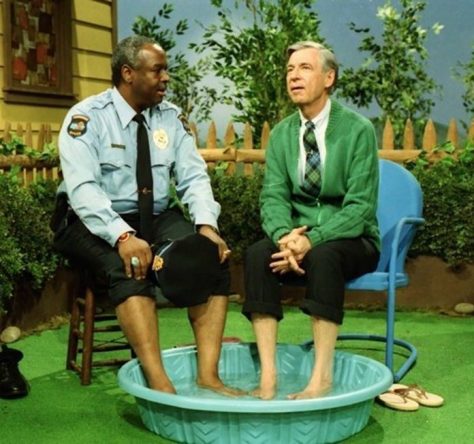

Guest post: Fred Rogers, the patron saint of niceness

Fred Rogers and Francois Clemmons on the Mr. Rogers show

The following is a guest post by a friend who wants to remain anonymous. He is a Christian apologist who works in the software industry.


The marketing machine for the latest Tom Hanks movie portrayal of Mister Rogers is in full swing. And they’re trying hard to sell the movie to the Christian community. A recent Christian Post article claims:

‘Mister Rogers’ Neighborhood’ was Fred Rogers’ mission field, wife Joanne says

“One of the most important things we accept and know is that Fred was first and foremost a minister in the Presbyterian Church,” Joanne Rogers told The Christian Post.

The trouble with this is that if the show was Fred Roger’s mission field, he failed because people know him more for being nice than for preaching Jesus.

It’s telling that one of the most common “surprising facts” shared about Mr Rogers is that he was a Presbyterian minister. If we hadn’t been told this, we wouldn’t know it based on his work and legacy.

A commenter on Facebook writes:

His job was to do a kids show not to proselytize. Did Jesus go around preaching when He was called to be a carpenter? No He did His job.

I’m sure people asked Mr. Rogers what his motivation was and there’s nothing wrong with having private conversations about it and not using the television to preach. People don’t watch kids shows to be preached at. That would be a misuse of his platform! 😒

Is that true? Let’s take the case of Fred Rogers’s longtime friend and frequent show guest, Francois Clemmons. In addition to being a talented broadway actor, Francois Clemmons is proudly gay. And there’s no indication that Fred Rogers pressed Francois Clemmons to repent and turn to Jesus.

“He says he’ll never forget the day Rogers wrapped up the program, as he always did, by hanging up his sweater and saying, “You make every day a special day just by being you, and I like you just the way you are.” This time in particular, Rogers had been looking right at Clemmons, and after they wrapped, he walked over.

Clemmons asked him, “Fred, were you talking to me?”

“Yes, I have been talking to you for years,” Rogers said, as Clemmons recalls. “But you heard me today.”

“It was like telling me I’m OK as a human being,” Clemmons says. “That was one of the most meaningful experiences I’d ever had.””

Which is even more sad when you consider that Fred Rogers took a brave stand against racism. 

He found racism to be an important enough subject to import the foot washing example of Jesus but there’s no indication that he called Francois Clemmons to repent for his sinful lifestyle choice.

“But did Mr. Rogers ever condemn you?

No. He said, “Sometimes people do get married and they settle down, they live a different life. You can’t go to the those [gay] clubs. . .That may not be the answer for you, Franc; you have to consider something else. What, I’m not sure. But that may not be the route for you.””

I don’t expect, nor would I advocate for, Fred Rogers to do nothing but condemn Francois Clemmons. But it’s pretty telling that in all of their years working together, with Fred knowing Francois’s sexual orientation, that Fred never saw fit to tell him where his sinful lifestyle would eventually lead according to Scripture and plead with him to repent.

Fred Rogers is being lionized by popular media. You have to ask yourself why. Especially in a culture that still condemns Chick-fil-A for what its founder’s son said nearly a decade ago. The reason is not because Fred Rogers looked like Jesus. Quite the contrary. It’s because Fred Rogers was soft and effeminate. Fred Rogers is what the world wants Christians to look and act like so they can more easily push around and otherwise mold Christians.

Again, our commenter on Facebook responds:

A children’s show on a public network is no place to be preaching the gospel. Should a flight attendant spend all their time preaching and trying to convert people!? They have a job to do. If the Holy Spirit moves them to say something then fine but you’re going to turn people off if you’re acting like a salesperson and not doing your actual job! I am dead serious. The workplace is to be professional and do your job. If you want to preach be a preacher. Otherwise be careful how and when you bring it up. You have a whole private personal life on your time off to get involved in that kind of stuff!

Do we expect Christians to be sharing their faith all the time they are at work? No. Like every other profession the flight attendant has certain required duties to perform. But we are told to work as if for the glory of God (Colossians 3:23). At the very least that means that there is a mode of working that marks us as Christians. Part of that is the joy and peace that Fred Rogers displayed, yes, but that inevitably leads to others wondering about the source of that joy and peace (1 Peter 3:15). And that’s when an opportunity arises to explain to nonbelievers who Jesus is and why we should _want_ to pay the greatest price (Matthew 13:45-46) of giving up our own lives, characterized by sin (2 Timothy 2:25), to follow him.

If Francois Clemmons never felt judged by Fred Rogers then that is a serious condemnation on the ministry of Fred Rogers. It means, at the very least, that Fred Rogers was not doing his job in calling Francois to repentance so that he could come to a knowledge of the truth. The only truth that has any hope in saving anyone.

Why is it so difficult for a working man to be sole provider and leader of a home?

Welfare spending
Welfare spending

So, I’ve noticed that many men who are interested in marriage have been running into problems with their plans. One challenge is the problem of the financial costs of marriage. In order to undertake a marriage enterprise, men have to believe that they can pay the bills. And this is especially challenging to men who want a stay-at-home wife to raise their children.

*Please note that I am talking about unmarried (never married, divorced) women throughout this post.

Here’s my argument for why I think that feminism has made it harder for men to afford to get married:

  1. Feminism caused no-fault divorce.
  2. No-fault divorce laws led to more frequent divorces.
  3. Divorced women turn to government for financial support.
  4. Taxes increase in order to pay for more government spending.
  5. Men who were interested in marriage were hit with higher taxes, which made marriage enterprise financially unfeasible for them.

Here’s the evidence for each point.

1. Feminism was behind no-fault divorce, according to this feminist, pro-no-fault-divorce writer.

Excerpt:

Households of 2010 don’t look quite like they did in 1969, when no-fault divorce actually was a controversial topic and these counter-arguments held some weight. The working dad/stay-at-home mom model of the middle class has been replaced by two-parent earner households and a growing number of working mom/stay-at-home dad arrangements. In working poor and impoverished families, the one-parent provider model was never the norm. No-fault divorce seemed scary when it had never before existed, but the truth is that its introduction was long overdue. Feminist groups at the time supported no-fault divorce, as it provided women an escape hatch from desperately unhappy marriages in a society where they were already disadvantaged on almost every level, regardless of their marital status. Imagine an abusive marriage in 1968, when the court-savvy abuser could actually force the victim to stay in the relationship forever. Imagine that now, and you know why domestic violence attorneys are in full support of introducing no-fault divorce to New York. And the judges aren’t the only problem.

Note that the author of this piece thinks that it is not women’s fault that they choose men who they then want to divorce. It’s not the woman’s fault that she is unhappy with the man she courted with and then chose and then made vows to. She isn’t responsible for choosing a good man with chastity, sobriety, moral convictions, etc. She thinks that women shouldn’t be held responsible for their choices. Also, feminists think that children do fine without fathers.

2. Easier divorces means more divorces.

Abstract:

This paper analyzes a panel of 18 European countries spanning from 1950 to 2003 to examine the extent to which the legal reforms leading to “easier divorce” that took place during the second half of the 20th century have contributed to the increase in divorce rates across Europe. We use a quasi-experimental set-up and exploit the different timing of the reforms in divorce laws across countries. We account for unobserved country-specific factors by introducing country fixed effects, and we include country-specific trends to control for time-varying factors at the country level that may be correlated with divorce rates and divorce laws, such as changing social norms or slow moving demographic trends. We find that the different reforms that “made divorce easier” were followed by significant increases in divorce rates. The effect of no-fault legislation was strong and permanent, while unilateral reforms only had a temporary effect on divorce rates. Overall, we estimate that the legal reforms account for about 20 percent of the increase in divorce rates in Europe between 1960 and 2002.

It seems obvious, but more evidence never hurts. About 70% of divorces are initiated by women, either because they chose to marry the wrong man, or because they become unhappy with the right man.

3. Marital instability causes women to vote for bigger government for security.

Excerpt:

Giving women the right to vote significantly changed American politics from the very beginning. Despite claims to the contrary, the gender gap is not something that has arisen since the 1970s. Suffrage coincided with immediate increases in state government expenditures and revenue, and these effects continued growing as more women took advantage of the franchise. Similar changes occurred at the federal level as female suffrage led to more liberal voting records for the state’s U.S. House and Senate delegations. In the Senate, suffrage changed voting behavior by an amount equal to almost 20 percent of the difference between Republican and Democratic senators. Suffrage also coincided with changes in the probability that prohibition would be enacted and changes in divorce laws.

[…]More work remains to be done on why women vote so differently, but our initial work provides scant evidence that it is due to self-interest arising from their employment by government. The only evidence that we found indicated that the gender gap in part arises from women’s fear that they are being left to raise children on their own (Lott and Kenny 1997). If this result is true, the continued breakdown of the family and higher divorce rates imply growing political conflicts between the sexes.

Bigger government must be paid for by higher taxes, which makes it harder for one working man’s income to provide for a family. In fact, feminists wanted men to be displaced as sole-providers. They would prefer that women are “equal” to men, and that means making women get out and work like men. It was no concern of theirs that children would be raised by strangers in daycares and government schools.

4. Women are in fact observed to vote for bigger government.

Excerpt:

On Tuesday, the nation made history. It made history in electing the first African American president; it made history in building a bigger margin for the first female Speaker of the House; it made history in delivering the biggest Democratic margin since 1964; it made history in sending a record number of people to the polls and the highest percentage turnout since the 1960 election. Analysts will spend the next few months sifting through the data, trying to figure out what happened and why. Historians will likely spend the next several years and decades studying this election, as well. But one thing is immediately clear. Unmarried women played a pivotal role in making this history and in changing this nation. They delivered a stunning 70 to 29 percent margin to Barack Obama and delivered similarly strong margins in races for Congress and the U.S. Senate. Although unmarried women have voted Democratic consistently since marital status has been was tracked, this election represents the highest margin recorded and a 16-point net gain at the Presidential level from 2004.

In fact, there was a recent (2011) study showing that unmarried women do in fact vote for higher taxes and more government as a substitute for a husband’s provider role.

Abstract:

The last three decades have witnessed the rise of a political gender gap in the United States wherein more women than men favor the Democratic party. We trace this development to the decline in marriage, which we posit has made men richer and women poorer. Data for the United States support this argument. First, there is a strong positive correlation between state divorce prevalence and the political gender gap – higher divorce prevalence reduces support for the Democrats among men but not women. Second, longitudinal data show that following marriage (divorce), women are less (more) likely to support the Democratic party.

What follows from voting Democrat?

If more people vote for Democrats then we will get higher taxes to pay for all the government spending. Higher taxes means that a married man can no longer retain enough of his earnings to support a family. And that means his wife has to work, and that means that his children will learn what the daycare workers and government school teachers decide they should learn.

But what do men want out of marriage? Men don’t want to marry a stressed-out competitor, and be yelled at in their own home. They want a homemaker who is focused on her husband and children. They want their children raised by someone who shares their worldview. Men want to produce moral, influential, independent children. Men want to be respected in their homes as sole provider. Men marry in order to lead on moral and spiritual issues. And men understand that a woman who doesn’t work outside the home usually makes a more feminine, supportive partner in the marriage enterprise.

If society, including the parents of daughters and the pastors of daughters, have decided that women don’t have to care about what men want out of marriage, then they should not be surprised that men don’t want marriage. Men may have no-commitment temporary sexual relationships with a secular left feminist who has been focused on her own feminist projects: travel, student loans, promiscuity, career, etc. But they certainly do not marry those women. When it comes to marriage, men want women who embrace the roles of wife and mother. And unlike shoes and handbags, we get a vote about whether or not the marriage happens.