All posts by Wintery Knight

https://winteryknight.com/

Impeachment hearings causing Independent voters to turn against Democrats

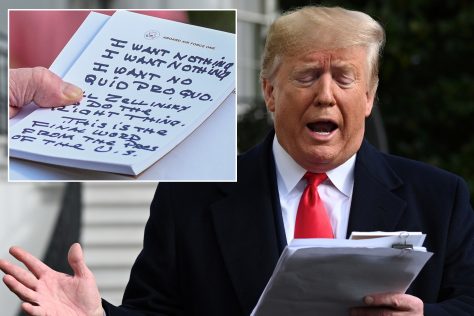
Trump reading out impeachment hearing testimony to reporters

Good news, everyone! Last week, I was posting a lot of videos from the impeachment hearings, featuring Devin Nunes, Elise Stefanik, John Ratcliffe, Jim Jordan and others. Although the mainstream news media reporters were anxious for the Democrat witnesses to provide evidence to impeach Trump, it didn’t work out. And now independents are turning against the Democrats.

Here’s a good summary from The Federalist:

Emerson polling showed that support for impeachment flipped since October from 48 percent support with 44 percent opposing to now 45 percent opposed and 43 percent in support. Among key independents, the switch was even more pronounced. In October, 48 percent supported impeaching President Donald Trump, with 39 percent opposed. Now, 49 percent of independents oppose impeachment, while only 34 percent support it.

A new Marquette University Law School poll found that 40 percent of registered voters in the swing state of Wisconsin think that Trump should be impeached and removed from office, while 53 percent do not think so. Another 6 percent weren’t sure.

A new Gallup poll shows that Trump’s approval has ticked up two points since the impeachment drama began, with 50 percent of Americans opposed to it and 48 percent in support. Henry Olsen notes that Gallup polls all adults, not just registered voters, meaning that a poll of registered voters would have Trump’s job approval even higher and impeachment opposed by closer to a 52-46 margin.

Even more interesting are the numbers for black voters, who traditionally vote Democrat. The Epoch Times reports:

Both polls—Rasmussen, which usually tilts Republican, and Emerson, which is considered even-handed—came out almost exactly the same, putting Trump’s support among blacks at a surprising, almost astonishing, 34 percent. Typically, Republicans poll in single digits among blacks.

“Game Changer” may be one of the great clichés of our our time, but this would actually be one. If even remotely true, Democrats should be having a nervous breakdown. They depend more than ever on African-Americans for success in elections. If Trump were to garner even 18 percent of the black vote, he would easily win in 2020. If he had anything close to the 34 percent, it would be a runaway, a disaster for the Democrats.

So, those are good numbers for Trump. What happened at the hearings? Well, the Democrats were trying to prove that Trump had held up foreign aid to Ukraine, in order to get them to investigate why Joe Biden’s son was collecting hundreds of thousands of dollars when Joe Biden was vice president. But it turned out that no one in the new Ukrainian government thought that their aid was being held up. And that the aid was released after a short delay over concerns that the new Ukraine government was as corrupt as the last one. Once those concerns were investigated, the aid was released. And the aid included lethal defensive anti-tank weapons, something that Obama had never done for Ukraine. And there was never any investigation of Hunter Biden before the aid was released. So, there was no quid pro quo.

I posted a lot of videos showing all the admissions on Facebook, but this 1-minute video was the slam dunk of the hearing:

The mainstream media reported that Ambassador Sondland had said the exact opposite as what you see in the video above, and that’s just because they don’t expect American voters to look at the video of the hearing.

So, what did we learn from all this? We learned that Trump doesn’t like to give American taxpayer dollars to other countries. He thinks that their immediate neighbors ought to help them, not America. And we learned that Trump is concerned that we not throw money away to corrupt regimes. And we learned that far from withholding aid, Trump gave them USEFUL anti-tank Javelin missiles, something that Obama was never willing to do. And he didn’t get any investigation of any Bidens before that aid was sent.

The Federalist article notes that viewership of the hearings decreased as they went on, probably because people realized that there was no evidence there.

Media outlets did all they could to bolster Schiff’s show and ran the impeachment hearings non-stop, as if Schiff’s inquiry had a legitimacy it never quite managed to earn on the merits. But instead of viewership increasing over time, it decreased.

[…]While the argument for impeachment was difficult to understand, Democrats’ own witnesses kept making Trump’s case against “the swamp” for him. There is no question that these bureaucrats, sometimes using third-hand information, were deeply opposed to Trump, his policies, and his behavior. Their problem was that they were not elected president. In fact, they weren’t elected anything. Some of them were political appointees — a testament to the awful job Trump has done at finding personnel who can accomplish his policy goals — and other times they were career bureaucrats.

[…]In part because Schiff and his team seemed confused about what case they were prosecuting, questions to witnesses were almost always leading, but never focused on a particular or consistent goal. Conversely, Republicans kept focused during their questions, always pointing out that the witnesses didn’t actually have first-hand information, or were basing their views on their own conjecture, a shaky basis for impeachment.

In general, Republican members did a surprisingly good job on cross examining witnesses. The Democrats kept rolling out new star witnesses, and some, such as Gordon Sondland and Lt. Col. Alex Vindman had opening statements that were quite strong for Democrats. Their opening statements withered under strong GOP questioning.

I was thinking about what the Republicans should do next, and wondering whether they should vote to advance the impeachment investigation to the Senate. Democrats were able to make the hearings look bad for Trump at the beginning, before Republicans could question the Democrat witnesses.

Initially, Schiff insisted that this whistleblower testify. Schiff repeatedly demanded that testimony. That all changed the precise moment that it was revealed the whistleblower had communicated with Schiff’s staff, something both the whistleblower and Schiff had been dishonest about.

Republicans hammered Schiff about his self-serving about face, even if the media wanted to pretend it wasn’t a big deal. They also reminded him that they weren’t being allowed to call their own witnesses, ask questions, use transcripts of previous depositions, and other things that a fair proceeding would allow. It worked to their benefit.

But imagine if the Republicans were the ones calling witnesses, and they were given more time to ask questions of the leaker, the whistleblower, Adam Schiff, etc. to really find out who is behind all of this. It might be worth it to get all of this settled properly.
Dr. William Lane Craig interviewed on the Ben Shapiro Show Sunday Special

Dr. William Lane Craig on the Ben Shapiro Sunday special

I’m re-posting this old episode of the Ben Shapiro show.  They discuss arguments for God’s existence in the first 25 minutes. The spend the first 26 minutes on arguments for God,and  the next 16 minutes on Christian distinctives. They spend a bunch more time responding to common arguments for atheism, and finally Ben asks Dr. Craig how he became a Christian.

Summary:

William Lane Craig, philosopher, theologian, and best selling author of numerous books including “On Guard: Defending Your Faith With Reason And Precision,” joins Ben to discuss the hard sciences vs. philosophy, the cosmological and ontological arguments, Jesus, slavery, gay marriage, and much more.

Video:

The MP3 file is here.

Topics:

  • Why are we seeing such a decline in religious belief in America?
  • Why are mainline denominations in Christianity and Judaism emptying out?
  • What was the driver behind the move away from religion starting in the 1960s?
  • Why is their a gap in the university and in the broader culture between reason and religious belief?
  • What is the strongest argument for God’s existence?
  • What is the most compelling argument for God’s existence for this culture?
  • Respond to Richard Dawkins’ challenge that God needs a cause.
  • Why does the universe have to have a cause?
  • Does Darwinian evolution provide grounds for our awareness of objective moral values and duties?
  • What is the strongest objection to the cosmological argument?
  • What is the strongest objection to the moral argument?
  • What about the objection that the existence of the universe is just a “brute fact” and doesn’t need an explanation for it’s existence?
  • What about David Hume’s objection to the law of causality?
  • What about objections to the cause of the universe from apparently uncaused events in quantum mechanics?
  • What is the ontological argument, and why is it frequently dismissed?
  • How do we get from an unmoved mover to a moral God?
  • Which arguments show that God is a mind?
  • How do you show that God is present and active in time now?
  • How do you move from God as Creator, Designer and moral lawgiver to a God who has revealed himself to human beings?
  • Who does Jesus claim to be in the gospels, and what is the evidence that his claims were correct?
  • From the Jewish perspective, this narrative has some  problems. First, merely declaring yourself as the Messiah is not seen as a punishable offense.
  • Second, the real problem is that Jesus vision of himself as the Messiah is completely different than how Jews have understood the Messiah. The Messiah in Judaism has always been a political figure who is destined to restore the Kingdom of Israel, bringing more Jews back to Israel, etc.  Claiming to be God, though would be blasphemy and a punishable offense.
  • Why is resurrection proof of divinity? Wasn’t Lazarus also raised from the dead?
  • The gospels were written decades after the events they claim to describe. Should we still see them as reliable enough to infer that the resurrection really happened?
  • Couldn’t legends have been introduced in the gap between the events and the time that the events were recorded?
  • Is it enough for us to have a Creator God, or is there a reason for God to reveal himself to us?
  • Tell us about your experience debating atheist scholars on university campuses.
  • Has any an atheist ever caused you to doubt your arguments?
  • The problem of human evil is easy to respond to, but how do you respond to the problem of natural evil, i.e. – suffering from events in the natural world, such as birth defects or natural disasters.
  • Atheists like to bring up specific disagreements they have with the Bible, e.g. – same-sex marriage, abortion, slavery, genocide. How would you respond to those?
  • Regarding slavery in the Bible, isn’t it the case that people sometimes do things that are not prescribed by God, and the Bible merely records that?
  • How would you respond then to people who push for same-sex marriage by arguing that this is a case where God wanted same-sex marriage, but couldn’t press for it because the people were not capable at that time and in that culture?
  • When discussing specific issues of morality, do you try to argue from a natural law perspective or from the morality in the Bible?
  • How would you respond to someone like Jordan Peterson who approaches religion teachings pragmatically, focusing on behaviors rather than the rational grounding of those behaviors?
  • How do you speak to young people about God without them losing interest?
  • How did you become a Christian?
  • As the influence of Judeo-Christian religion recedes, what do you see filling the void, and how do you see that affecting Western civilization going forward?

Pediatric endocrinologist traces the history of transgender medicine

History of transgender medicine in one slide
History of transgender medicine

I can’t remember who sent me this lecture featuring Dr. Qu3ntin V4n M3t3r, MD, FCP, but I liked it so much I decided to write a post about it. First, we’ll take a look at his credentials, then I’ll post the video of the lecture, and a brief summary with not too many controversial details. Then I will link to a Wall Street Journal article by one of the other physicians mentioned, Dr. P4ul McHu8h.

So, first, the background of Dr. Qu3ntin V4n M3t3r:

Dr. V4n M3t3r graduated from the College of William and Mary in 1969. He attended the Medical College of Virginia where he received his medical degree in 1973. Dr. V4n M3t3r did his pediatric internship in 1973 and 1974, and his pediatric residency from 1974 to 1976, at the Naval Regional Medical Center in Oakland, through the University of California, San Francisco. He completed his pediatric endocrinology fellowship from 1978 to 1980 at Johns Hopkins University School of Medicine.

Dr. V4n M3t3r worked as a staff pediatric endocrinologist at the Naval Hospital in San Diego from 1980 to 1986 and was Chairman and Director of the residency training program at the Naval Hospital Oakland from 1986 to 1991.  In 1991, he retired from a 20-year career in the Navy Medical Corps and moved to the Atlanta area where he joined the Fayette Medical Clinic as a Pediatrician and Pediatric Endocrinologist.  To better serve the ever-expanding population of pediatric patients with endocrine disorders, he developed his own full-time endocrine practice, which today bears his name.  He is a clinical associate professor of Pediatrics at both the Emory University and Morehouse Schools of Medicine.

In addition to the professorships, he has a number of board certifications and professional memberships, listed at the link above.

Here’s the video of the lecture:

And here’s my brief summary, which has no controversial details.

  • speaker biography
  • the history of the transgender medicine movement
  • major figures in the transgender medicine movement
  • the origin of the term gender
  • the origin of the term gender dysphoria
  • early results of the transgender medicine movement
  • other results from transgender clinics from Canada and Netherlands
  • the scholarship of the transgender medicine movement
  • current transgender research
  • effective responses

The lecture has about 560,000 views.

If you don’t have 40 minutes to watch the lecture, then you can read an article that summarizes the lecture.

In the lecture, he mentioned two other physcians, K3nn3th Zuck3r and P4ul McHu8h.

I found a good article by the latter in the Wall Street Journal, which I blogged about previously.

You can grab the PDF of the full text of the WSJ article here.

I also found a useful summary of the science of transgenderism on the web site of one of the medical associations mentioned in the lecture.

Another lecture

Finally, YouTube suggested another lecture featuring some other physicians. I watched that one too, and it talked about some of the repercussions from treating young children with drugs and / or surgeries.

The video is here:

And I found an article about this lecture for those who don’t have an hour to watch it as well. I watched this one as well.