All posts by Wintery Knight

https://winteryknight.com/

Sean Carroll debates William Lane Craig on cosmology and God’s existence

Here’s the video of the debate:

Carroll was as good of a speaker as Craig in terms of style. Very easy to listen to, very quick on his feet, very civil. There was no clear winner on style.

It was difficult to assess the truth value of scientific points being made, especially for the layperson. I explained a few of them in my posts earlier this week, but I think laypeople might struggle with them if they are hearing about these things for the first time.

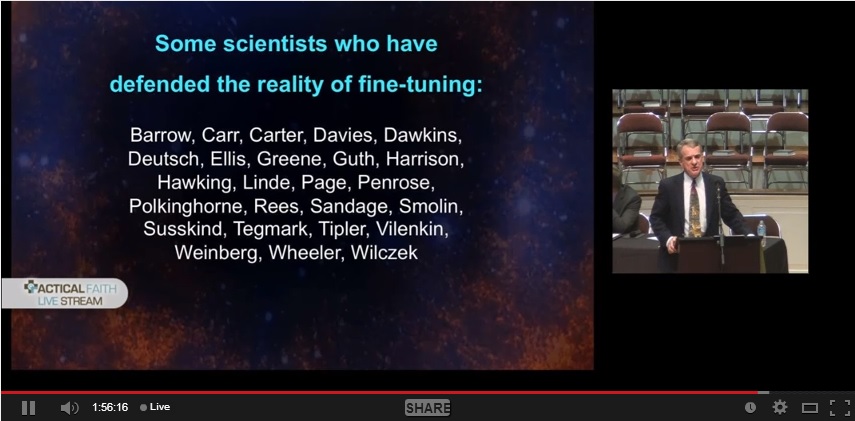
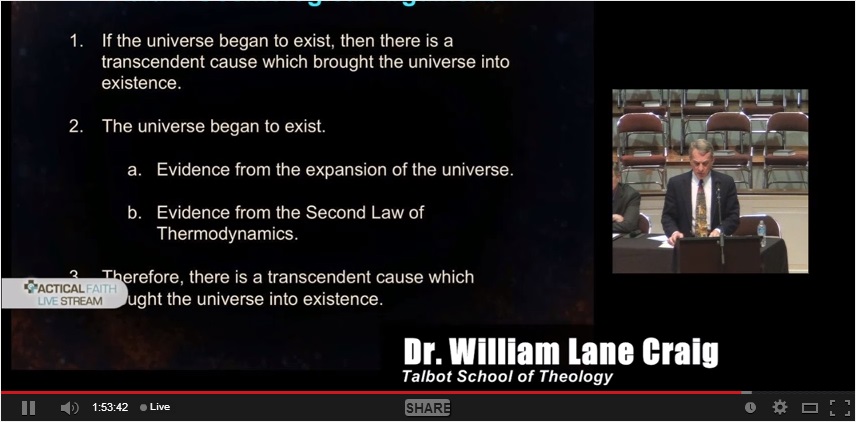
A couple of Craig’s slides: (click for larger images)

Slide 1 of 2:
Dr. Craig slide #1 of 2

Slide 2 of 2:

Dr. Craig slide #2 of 2

Quick summary: (this is not complete, because I couldn’t get everything they were saying noted)

Dr. Craig defended two arguments: 1) the kalam cosmological argument and the fine-tuning argument.

Dr. Craig supported the origin of the universe with 1) the expansion of the universe and 2) the second law of thermodynamics.

Dr. Craig said that the BGV theorem supports a beginning for the universe.

Dr. Craig said that the consensus of scientists did not accept Carroll’s naturalistic cosmology, quoting Stephen Hawking in support.

Dr. Craig said that multiverse models fall victim to the Boltzmann brain problem, where we should observe Boltzmann brains coming into existence and then phasing out again far more probably than embodied minds. But we observe embodied minds, and no Boltzmann brains.

Dr. Carroll said that science cannot study metaphysical questions.

Dr. Carroll said that science is about making models that may or may not be consistent with the experimental data.

Dr. Carroll said that the BGV theorem does not support a beginning for the universe.

Dr. Carroll proposed 17 alternative cosmologies, but did not provide a shred of scientific evidence for any of them, the way that Craig did for the standard model.

Dr. Carroll refuted Dr. Craig’s citation of Stephen Hawking, and Craig yielded the point.

Dr. Carroll speculated that science might progress to the point where the fine-tuning can be explained without an intelligent cause, and he gave an example of where that happened (inflation).

Dr. Craig argued that all 17 of the models suggested by Carroll either conflicted with evidence, had serious problems or did require a beginning.

Dr. Craig argued that Carroll’s own model required a beginning.

Dr. Craig argued that Carroll’s own model fell victim to the Boltzmann brain problem.

Dr. Craig argued that Carroll’s own model violated the second law of thermodynamics.

Dr. Craig re-stated his point that the baby universe spawning in Carroll’s model was speculative and incomplete, and cited Christopher Weaver’s work.

Dr. Carroll denied that things that pop into being out of nothing require a transcendent cause.

Dr. Carroll reiterated that science can only make naturalistic models, and that he did not have to answer questions about ultimate causes.

Dr. Carroll showed a photo of Alan Guth expressing his opinion that the universe is “probably” eternal. No evidence was given for this assertion.

Dr. Carroll said that the fine-tuning was not done in an optimal way, because one fine-tuned value was lower than it needed to be, and it should be exactly what it needed to be if God did it.

Dr. Carroll said that a finely-tuned universe is more probably in naturalism than in theism, because God can do anything he wants and doesn’t need a fine-tuned universe.

Dr. Carroll said he would stop defending his model now, and would instead defend Aguirre-Gratton.

Dr. Craig gave three reasons why the universe popping into being out of nothing requires a transcendent cause.

First, he said that nothing cannot cause anything to happen, because nothing is nothing.

Second, he said that if things pop into being out of nothing, then why don’t we see it happening all the time with other things.

Third, he said that we have no reason to dismiss the causal principle, especially when it is the basis of scientific inquiry and has been so fruitful in the progress of science.

Dr. Craig reiterated that baby universes in Carroll’s model would be dominated by Boltzmann brains, and we don’t observe that.

Dr. Craig said that even on the quantum gravity models that Carroll mentioned, there would still be a beginning.

Dr. Carroll said that Craig mustn’t say “popped into being” but instead that “there was a first moment of time”.

Dr. Carroll said that his model does indeed violate the second law of thermodynamics “YES!”.

At this point Carroll stopped talking about the topic of the debate and started expressing personal opinions about religion. It’s funny how often atheists do this in debates.

Dr. Carroll said that most theists don’t believe in God because of cosmology, but because of community and feelings.

Dr. Carroll said that science had learned a lot in the last 2000 years, so theism was false.

Dr. Carroll said that most philosophers don’t think that God exists, so theism was false.

Dr. Carroll said microscopes and telescopes were absent 2000 years ago, so theism was false.

Dr. Carroll said that religion should be about community and feelings, not about what is true.

Conclusion:

My conclusion was that Carroll lost because he is just satisfied to throw theories out and not to argue that they are true by citing evidence. Carroll never seemed to be interested in finding out what is true, but instead he just wanted to tell a story that didn’t include God, and assert that by Occam’s Razor, his story was a better explanation. I am not impressed with theoretical speculations, although the layperson might be. I kept waiting for him to respond to Craig’s points about how his model was falsified by experimental evidence and observations, e.g. – the Boltzmann brains or the baby universe generation, and he never cited the evidence I wanted him to cite. Craig did have some evidence for his views, but he could have been stronger in making his case. He could have shown the e-mail from Vilenkin that stated that he had understood the BGV theorem, and was using it correctly, for example.

For me the winning side comes down to evidence. The standard model is the standard model because of scientific evidence. Until that evidence is overturned, then speculative models are of no interest to anyone who is evidence-driven. Speculations are not science. A philosophical presupposition of metaphysical naturalism is not science.

If you want to see a good lecture on scientific evidence related to cosmology, then there is the particle physicist Michael Strauss lecture on cosmology and fine-tuning at Stanford University and his more recent lecture at the University of Texas. Note that Strauss is an experimental physicist, not a theoretical physicist like Carroll.

Here’s another review of the debate by Randy Everist of Possible Worlds blog. He explains the back-and-forth over Boltzmann brains and the BGV theorem in more detail.

Christian day care workers in Texas fired for refusing to call a girl a boy

Gay activist vandalizes pro-marriage sign

I have a lot of friends who keep trying to convince me to move to Texas because it’s so conservative, but I have to tell you that stories like this from Houston of all places realky make me think that Oklahoma, Kansas or even Tennessee would be a better bet.

Breitbart News has the story:

Two daycare workers have been fired for refusing to go along with the center’s transgender agenda.Madeline Kirksey, one of the workers who is an author of a Christian book, says her religious liberty rights have been violated. The two were fired after refusing to call a little girl a boy.

The two male parents of a six-year-old little girl told employees at the school to refer to their daughter as a boy, and to call her by a new masculine name. The little girl’s hair had also been cut like a boy’s.

Kirksey told Breitbart Texas in an interview, that the problem was not so much with the transgender issue as it was with telling young children that the little girl was a boy when she was not, and with calling her “John” (not the name given) when that was not her name.

She, and another worker who does not want to be identified, were fired from the Childrens’ Lighthouse Learning Center in Katy, Texas, a city just west of Houston.

The school distributed guidelines to the teachers called “How to Handle Transgender Students.” The printed guidelines were obtained from the internet and can be read at thislink.

The guidelines and the instructions given the teachers included six rules, one of which was “Help defend their dignity.” Another, was to “Educate yourself and your students.” The Christian worker said she did not believe it “was our job,” to thrust the issue on the small children of other parents. She said the school should not force their beliefs on the children, or on her, or upon other parents.

The author of the Christian book, “In Pursuit of the Promise,” said the other children should not be exposed at such an early age to the issue of transgender or “gender identity,” and felt that the two male parents were imposing the issue on their little girl.

“I don’t think we should be talking to other people’s children who are under the age of 18 about being transgender,” Kirksey said in an interview with Fox26 in Houston. Both of the fired workers agreed on this point.

Kirksey said that prior to this happening, she had been commended for the good work that she was doing at the school. After she refused to call the little girl by her new masculine name, and to tell the other children to do so, and to say that the little girl was a little boy, the daycare worker was written-up for alleged infractions that she did not believe were based in reality. She has worked at the school for over a year.

The fired worker notified Child Protective Services that the little girl was being told that she is now a little boy. She believes that it is up to professionals to determine if the little girl is just confused, or if the new gender is being forced upon the little girl.

Kirksey says sometimes the little girl refers to herself as a little boy, and sometimes she tells the other children to not call her a boy or to refer to her by her masculine name.

The Childrens’ Lighthouse in Katy is just one of the school franchise’s that are all over the country. The company is based in Fort Worth and according to its website, there are 37 learning centers in seven states. The school cares for children ages six weeks to twelve years old.

Recall that Houston was the same city that elected a lesbian mayor who subpoena’d the sermons of pastors in order to find out if they were speaking against same-sex marriage in their churches. Apparently, that’s not allowed in Texas any more.

Related posts

Are evangelism and human responsibility for sin rational in Calvinism?

Bible study that hits the spot
Theology that hits the spot

Here is a quote from Dr. Craig that seems to get Calvinists so angry:

“The counterfactuals of creaturely freedom which confront Him are outside His control. He has to play with the hand He has been dealt.”

(Source)

Calvinists have told me that this quotation from Dr. Craig is “heretical” or “borderline heretical”. They are claiming that Dr. Craig thinks that God is lacking in power somehow. But why is God’s power limited, according to this quote?

Well, it’s because God respects FREE WILL. That quote is simply Dr. Craig’s way of saying that God does not override the free will of his creatures.

So let’s make sense of Craig’s statement. Either there is determinism and God causes people to act, or humans have free will and they cause themselves to do things. If you do not cause yourself to act, then you are not responsible for what you do. Just think for a minute. If I push you into someone and you fall into them and then they fall off a cliff, then are you a murderer? No – I would be, because I am the cause. The Bible teaches that God has chosen to limit his power so that that people have genuine responsibility for their actions, and that means they have genuine free will. Humans can only be responsible for their sins if they have the ability to do other than they do, and this is the traditional Christian view.

It’s true that human beings are totally depraved as a result of the fall, and do not want God in their lives, but they are responsible because God wants them to be saved, and it is their free choice that prevents it. Rather than force humans to love him against their will, God lets them resist him, and so they are responsible for their sin.

Dr. Craig cites the famous Calvinist D. A. Carson (who I like) explaining some of the themes of the Bible that affirm robust free will and human responsibility:

The classical Reformed [scholars]… acknowledge that the reconciliation of Scriptural texts affirming human freedom and contingency with Scriptural texts affirming divine sovereignty is inscrutable. D. A. Carson identifies nine streams of texts affirming human freedom: (1) People face a multitude of divine exhortations and commands, (2) people are said to obey, believe, and choose God, (3) people sin and rebel against God, (4) people’s sins are judged by God, (5) people are tested by God, (6) people receive divine rewards, (7) the elect are responsible to respond to God’s initiative, (8) prayers are not mere showpieces scripted by God, and (9) God literally pleads with sinners to repent and be saved (Divine Sovereignty and Human Responsibility: Biblical Perspectives in Tension, pp. 18-22). These passages rule out a deterministic understanding of divine providence, which would preclude human freedom.

On Calvinism, however, all of these 9 features of reality, supported by dozens and dozens of Bible passages, are all false. On Calvinism, God is the sole causal agent. There is no free will. People go to Heaven or Hell as a choice of God. People can only perform good actions if God acts unilaterally to “regenerate” them, making obedience to God possible. Calvinism teaches that God and his agents are constantly exhorting and commanding things that they literally cannot do because they are unregenerate, and the only way to get regenerate is for God to regenerate them, against their will. And they can’t resist that.

So let’s make sense of D.A. Carson’s list of 9 items:

  1. On Calvinism, when God or his agents exhort or command people to perform good actions, it’s meaningless because God has to unilaterally regenerate them first, so that they can perform the good actions.
  2. On Calvinism, when God or his agents tell people to obey, believe and choose God, it’s meaningless because God has to unilaterally regenerate them first, so they can obey, believe and choose God.
  3. On Calvinism, when people sin and rebel against God, it’s like people are soda cans that God shakes up some of them, and then pops the tabs on all of them and the ones he shook up fizz.
  4. On Calvinism, when God judges people for sinning, it’s like God sends the cans who don’t fizz to Hell for eternity, even though he unilaterally chose not to shake them, which is the only way they could fizz.
  5. On Calvinism, when God tests people, it’s meaningless, because there is no way they can pass the tests unless God unilaterally regenerates them first, so they can pass the test.
  6. On Calvinism, when people receive divine rewards, it’s meaningless, because all the credit goes to God for regenerating them. They are just fizzing because he shook the can.
  7. On Calvinism, when people respond to God’s initiative, it’s meaningless, because God’s regeneration is irresistible and irrevocable. They can do nothing other than fizz when he shakes the can.
  8. On Calvinism, when people pray, it’s meaningless, because God unilaterally decides whether to regenerate people or not, and all their fizzing comes solely from his decision to shake or not shake the can.
  9. On Calvinism, when God pleads with sinners to repent and be saved, it’s meaningless, because God has to unilaterally regenerate them before they can repent.

Here’s William Lane Craig to explain it further in an answer to a question of the week from Dr. Craig’s Reasonable Faith web site.

5 problems:

  1. Universal, divine, causal determinism cannot offer a coherent interpretation of Scripture.
  2. Universal causal determinism cannot be rationally affirmed.
  3. Universal, divine, determinism makes God the author of sin and precludes human responsibility.
  4. Universal, divine, determinism nullifies human agency.
  5. Universal, divine determinism makes reality into a farce.

If God’s choice, to regenerate or not, causally determines whether we can respond to him, or not, then that is determinism. And it makes our lives meaningless because we are not responsible for anything we do. Life is a puppet show, and there is only one person pulling the strings. Evangelism makes no sense, because God decides unilaterally and irrevocably who is saved. When I explain this to Calvinists, their response is that God commands us to evangelize, so we must even if it makes no sense on their view.

A Calvinist might respond to this defense of free will and human responsibility with passages from Romans 8 and 9, but those are best understood as speaking about corporate election, rather than unilaterally-determined selection. Membership in the elect group is based on people responding to God’s drawing of them to him. That interpretation fits with the rest of the Bible, which is uniformly affirmative of human free will and human responsibility. Concerns about diminished divine sovereignty are resolved by middle knowledge, in which God chooses to actualize exactly the world that achieves his sovereign will out of all the possible worlds, and he saves exactly the people he chooses to save – but without violating their free will. Yes, it’s cosmic entrapment, but at least the cosmic entrapment does not violate the free will of the creatures, which would render then irresponsible for their own sins.

Disclaimer: I don’t think that this is an issue that should divide Christians, and I do think that Calvinists are most definitely Christians. And that they are very devout and intelligent Christians, too.

If you are looking for a good book on this issue, I recommend Kenneth Heathley’s “Salvation and Sovereignty“, which is a thorough discussion of the problem of divine sovereignty and human freedom.