All posts by Wintery Knight

https://winteryknight.com/

Stephen C. Meyer and Peter Atkins debate intelligent design

This dialog occurred in 2010 on the Unbelievable radio show.

I made a rough transcript, so please see below for that.

The MP3 file is here. (60 minutes)

Details:

The documentary film “Expelled” is presented by US Actor Ben Stein and makes the case that scientists who question Darwinian orthodoxy and support Intelligent Design are being “expelled” from academia.

As the UK edition of the DVD is released we ask “Is freedom of thought at stake or is Intelligent Design out of bounds when it comes to biological science?”

Stephen C Meyer is co founder of the Discovery Institute in the USA and a major proponent of Intelligent Design.

Peter Atkins is Professor of Chemistry at Oxford University and an outspoken atheist.

They both feature in “Expelled” and join Justin to debate the pros and cons of Intelligent Design theory.

Mark Haville who is bringing the film to the UK also joins the discussion.

Note: The transcript below is quite snarky and may include paraphrases of Dr. Atkins for the sake of humor.

My rough transcript of the Meyer-Atkins debate

Stephen Meyer:
– started researching on ID while doing his PhD at Cambridge
– the question is whether the information-bearing properties in DNA require a designer
– what cause is adequate to explain the digital code that in the simplest living cell
– alternative explanations like self-organization and RNA-first have failed
– so the best explanation for functional sequences of parts is an intelligent designer
– Darwinists have responded to this argument with insults and suppression of dissent

Peter Atkins:
– intelligent design is creationism
– there is no science at all in it
– information can emerge without an intelligent designer
– structures emerge spontaneously, no agent is needed to generate the structure
– information in DNA is also a structure

Stephen Meyer:
– structure and information are two different things
– many structures emerge spontaneously
– structure may be like the vortex that occurs when water goes down a drain

Peter Atkins:
– the vortex is information

Stephen Meyer:
– structures are different from functionally-specified digital information
– in DNA, there is a 4-digit alphabet that is used to create code sequences
– the thing to be explained is where do the functional sequences come from

Peter Atkins:
– information can grow without an agent
– the second law of thermodynamics
– the universe is falling into disorder
– but there are local abatements of chaos that create information
– evolution can cause the amount of information to grow

Stephen Meyer:
– that’s just an assertion
– I agree that energy flow through a system can produce spontaneous order
– but spontaneous order is not the same thing as information

Peter Atkins:
– spontaneous order is the same as information

Stephen Meyer:
– it’s not order that needs to be explained it’s specified complexity

Peter Atkins:
– what do you mean by specified complexity?

Stephen Meyer:
– the chemical bonds that connect to each letter do not determine the letter
– the chemical bonding sites will accept any letter as easily as any other
– any one of the 4 bases (letters) can attach at any place along the backbone

Peter Atkins:
– the selection of which letter comes next is determined by evolution

Stephen Meyer:
– that is just an assertion
– there is no physical process that sequences the letters to have a function

Peter Atkins:
– do you believe in evolution? YES OR NO!

Mark Haville:
– for him to answer the question you have to define the word
– do you mean macro or micro? biological or stellar? directed or undirected?

Peter Atkins:
– undirected molecules to man evolution by natural processes

Stephen Meyer:
– but even Dawkins doesn’t believe in evolution then
– you’re including the origin of life from non-living matter in evolution
– Dawkins says that there is no known naturalistic explanation for that

Mark Haville:
– you need to define your terms

[They discuss of the movie Expelled and the case of Richard Sternberg]

Stephen Meyer:
– the problem is people don’t want to talk about the science
– they denounce dissent as unscientific
– they will not debate about whther natural causes can explain the information
– I want to talk about the science

Peter Atkins:
– ID people raise interesting questions for naturalists to work on
– but you want to tell us what the answer is (intelligence) before we begin
– you start from the idea that an intelligence was involved

Justin Brierley:
– but you start with the idea that natural mechanisms can explain everything!

Stephen Meyer:
– for Dr. Atkins, only explanations based on material processes are valid

Peter Atkins:
– that is correct

Stephen Meyer:
– but we think that the activities of mind can explain some effects
– e.g. – the best explanation of the Rosetta stone is a mind

Peter Atkins:
– but we naturalists think of minds as material as well

Stephen Meyer:
– that’s a materialist pre-supposition on your part
– we would have to have a debate about mind and body

Mark Haville:
– I think that the materialist position is socially dangerous
– the problem with naturalism is that it is an ideology
– the ideology pushes absurdities, e.g. – the universe came from nothing uncaused
– and naturalists exert power over others to force them to believe nonsense

Stephen Meyer:
– science progresses as the result of scientists disagreeing
– both sides agree to the facts
– the debate is about the interpretation of those facts
– and one side is being ruled out a priori based on the pre-supposition of materialism

Peter Atkins:
– why do you say that an intelligence is involved in DNA but not general relativity

Stephen Meyer:
– it is always logically possible that intelligence can be invlved in any effect
– the main thing is that explanations based on intelligence should not be ruled out

Peter Atkins:
= well you can’t appeal to any non-material process in expaining anything
– those are the rules

Moderator:
– what does intelligent design have to do with religion?

Stephen Meyer:
– creationism is about understanding the istory of life using the Bible
– intelligent design is about using the same method of inquiry as Darwin
– we know that information arises from intelligent causes
– humans create information all the time by using intelligence to sequence parts

Moderator:
– are intelligent design proponents disreputable?

Stephen Meyer:
– what’s disreputable is shutting down debate by setting arbitrary rules

Peter Atkins:
– we are both interested in the same questions

Moderator:
– why won’t you let Stephen publish his papers then?

Peter Atkins:
– because it breaks the pre-suppositions of naturalism and materialism

Stephen Meyer:
– you’re shutting down inquiry by using an arbitrary definition of science

Mark Haville:
– we need to define the word science
– science should be based on what we can observe empirically
– we can observe micro-evolution empirically
– but Darwinism goes beyond what is observable to postulate macro-evolution

Peter Atkins:
– but paleobiology is replete with evidence

Stephen Meyer:
– paleobiology uses a method of inference that I think is valid
– but intelligent design uses the same mode of reasoning which is also valid

Peter Atkins:
= you’re intellectually lazy
– we’re smart, we’re using our brains

Moderator:
– you’re saying that appeals to intelligent causes ends science?
– is ID the view that some things are too complex to be explained with naturalism?

Peter Atkins:
– yes, and to teach children that materialism is false is child abuse

Stephen Meyer:
– let’s drop the insults and the rhetoric and focus on the arguments
– the ID argument is not based on what we don’t know, it’s based on what we DO know
– first, we can ask what undirected natural processes can and cannot do
– second, we can ask what we know about intelligent causes from our own experience
– what we do know seems to me to require an intelligent agent as a cause

Peter Atkins:
– GOD! Do you mean God!? Do you mean God!?

Stephen Meyer:
– I personally mean God, but all that the arguments proves is a generic intelligent cause
– and I am using the same method of investigation that Darwin used to get there
– what we know from our experience is that a mind is needed to create information

Peter Atkins:
– NONSENSE! ABSOLUTE NONSENSE!

Stephen Meyer:
– in my book, I list 10 predictions made by ID, so it’s not a science-stopper
– furthermore, the enterprise of science began with th goal of understanding God
– consider the earliest scientists, people like James Boyler and Johannes Kepler

Peter Atkins:
– that was 300 years ago, we’ve moved on

Mark Haville:
– what about Max Planck then?

Stephen Meyer:
– how about James Clark Maxwell?

Mark Haville:
– we need to focus on the facts

Peter Atkins:
– what do you mean by the facts?

Mark Haville:
– well the fact is that Darwinism has no mechanism to produce new information

Peter Atkins:
– well copying errors introduces beneficial mutations

Stephen Meyer:
– let’s focus on where we get the first information from the simplest organism
– you can’t account for the first organism by appealing to copying errors
– to add functionality to a program, you need new lines codes from an intelligence
– once you have life, you can generate some new information
– but you can’t generate macro-evolution either

Peter Atkins:
– if we give you your explanation for teh origin of life, will you give this up

Stephen Meyer:
– of course! I’m a former theistic evolutionist
– but right now the evidence is not there for it
– we have to decide these questions based on what we see with our own eyes today

Peter Atkins:
– but I pre-suppose materialism as the starting point of all explanations
– you’re just intellectually lazy to abandon my pre-supposition

Stephen Meyer:
– why is it is less intellectually lazy to insist that materialism is true
– we are making plenty of predictions, and isn’t that what science is about?
– consider Junk DNA – you guys said it had no use
– now we know it has a use

Peter Atkins:
– naturalists were open to the idea that junk DNA might have a use before ID

Moderator:
– Dr. Meyer, what about the wall that locks out intelligence as an explanation?

Stephen Meyer:
– if these are interesting questions, then we should allow freedom of inquiry
– that’s how science advances

Peter Atkins:
– for all their science-talk really they are just saying God did it
– people who don’t agree with me are not using their brains, like I do
– to give up on my pre-supposition of materialism is a denial of humanity

Mark Haville:
– there are important issues that are affected by our view of origins
– everyone who hasn’t seen Expelled movie should definitely see it

UK Guardian claim: religious children are meaner than non-religious children

A conflict of worldviews

Here’s what the the radically secular and leftist UK Guardian had to say about a recent study:

Children from religious families are less kind and more punitive than those from non-religious households, according to a new study.

Academics from seven universities across the world studied Christian, Muslim and non-religious children to test the relationship between religion and morality.

They found that religious belief is a negative influence on children’s altruism.

“Overall, our findings … contradict the commonsense and popular assumption that children from religious households are more altruistic and kind towards others,” said the authors of The Negative Association Between Religiousness and Children’s Altruism Across the World, published this week in Current Biology.

“More generally, they call into question whether religion is vital for moral development, supporting the idea that secularisation of moral discourse will not reduce human kindness – in fact, it will do just the opposite.”

Now, whenever I read studies like this that trumpet how great secularism is, I always look more closely to see how they define the terms. Usually, what’s been done is that the study will define the “good” behavior as “leftist” behavior. For example, “punitive” might mean “judging something morally wrong”, which the secular left regards as bad. So, if your starting point is feelings of compassion, moral relativism, non-judgmentalism, then yes – religious people will look bad.

Anyway, here is a response to the Guardian’s article, and the study they cite, from statistician William Briggs.

He writes:

Here’s how to you can replicate their study at home. First, define altruism. Go on, I’ll wait.

Have a definition in mind? I’m sure it’s correct and matches everybody else’s definition in precise detail, details like no-greater-love, supreme sacrifice, kindness, patience, love, and so on, right? Well, maybe not, but never mind. Instead, think about how you would quantify your definition. Quantification makes your definition scientific. Science means unquestionable truth.

Was your answer about quantification the “Dictator game”? Like this (from the Supplementary description)?:

[C]hildren were shown a set of 30 stickers and told to choose their 10 favorite. They were then told “these stickers are yours to keep.” Children were instructed that the experimenter did not have the time to play this game with all of the children in the school, so not everyone would be able to receive stickers. Children were finally shown a set of envelopes and informed that they could give some of their stickers to another child who would not be able to play this game by putting them in one envelope and they could put the stickers they wanted to keep in the other envelope. Experimenters turned around during the child’s choice and children were instructed to inform the experimenter when they were finished. Altruism was calculated as the number of stickers shared out of 10.

Yes, this scientifically captures every possible nuance of the scientific concept of altruism, doesn’t it? Science science science science. Science. It must be science! Scientists wrote this, peer scientists reviewed it, and scientists nod sagely when reading it.

Now define “religiosity” for kids. I’ll wait again.

Have it? Ha ha! That was a trick question. The authors never assessed the “religiosity” of kids; they did it for the kids’ “caregivers” instead. How? The authors asked parents to name their religion. They also asked parents questions like “How often do you experience the ‘divine’ in your everyday life?” They took pseudo-quantified answers from these and combined them scientifically with a quantification of religious attendance and derived a complete scientific quantification of “religiosity.” This was assigned to each kid in the study.

One of my friends in academia who publishes studies with regression analysis writes:

[I] Don’t buy all of his critiques of regression analysis but he is dead on in that the operationizing of the variables in that research is poor. I would also add that the regression model is underspecified.

So that’s two scholars who deal in statistics who don’t like the study. Sociologist Dr. George Yancey also responds to the study’s methodology in detail over at The Stream.

So here are my thoughts: first of all, children typically are little monsters, and they do not understand religion enough to act consistently with it until much later. So it’s a mistake to look at the religion of the parents and assume that in most cases, the children will have accepted that and be operating from that worldview. Second, if you were judging my religiosity at age 12 by talking to my parents, I would not have been considered religious at all, except I was. Third, giving stuff away to strangers is the secular left’s definition of altruism. Earning things through work and then sharing with people you actually know is what conservatives consider “altruism”. The study didn’t ask about how many stickers the religious kids shared with their friends and family when they got home. Conservatives tend to not want to hand out goodies to strangers through some unknown intermediary like big government. We prefer to give to people we know or through private organizations we know. Government is known to waste money on nonsense.

Hypocrisy on the left

There’s a lot of hypocrisy on the secular left. On the one hand, they want to give away lots of taxpayer money to the poor, on the other hand, they personally give far less in charity to the poor. I.e. – they are very generous with other people’s money – especially when they can brag about it to others to appear generous. But in their personal lives, they are often much less generous about giving away their own money. In fact, Arthur Brooks did a study of non-religious and religious people and charitable giving, and he found that the religious people gave away much more than the non-religious people.

Take a look at this video to understand how secular leftists think about “morality” and giving away money:

So, yes – they may sound generous when they are talking about spending someone else’s money, but they themselves are not generous. And that’s not unexpected, since secular leftists believe that this life is all they have, and there is no objective moral standard, nor any accountability to a Creator / Designer when they die. How will you generate a robust notion of generosity, when your story of origins is “survival of the fittest”? You can’t.

Incoming Kentucky Governor to EPA: we will not comply with your regulations

This is why I think that the real conservatism is always with the governors. When Republicans go to Washington, they often get so squishy that they are no use. If you’re looking for real conservative actions that produce real results, look to the governors. They get things done.

Video:

Here’s the article from The Blaze. (H/T ECM, who was suitably impressed)

Excerpt:

Kentucky Gov.-elect Matt Bevin said in an appearance on The Glenn Beck Radio Program Friday that he will push back against the Environmental Protection Agency’s efforts to regulate the coal industry, telling the EPA to “pound sand.”

Bevin’s comments came after Glenn Beck asked, “Now that you’re in, President Obama has said that he’s going to destroy the coal industry. Kentucky is a coal state. What are you going to be doing specifically to push back on that?”

In August, President Barack Obama unveiled his coal policy in partnership with the EPA, granting the agency authority over what is traditionally a state responsibility.

According to Sam Batkins, director of regulatory policy at American Action Forum, the policy will cost $2.5 trillion and 125,800 jobs, along with shuttering 66 power plants.

Bevin, a Tea Party favorite who became only the second Republican in four decades to win Kentucky’s governorship Tuesday, vowed to stand against the EPA when it comes to protecting his state’s large coal industry.

“Why it is that we in Kentucky — that sit on two extraordinary basins, the Illinois basin and the Central basin, an abundance of this — how are we not participating in something that the world wants more of than they ever have?” Bevin asked. “And so, from my way of thinking, we will tell the EPA and other unelected officials who have no legal authority over us as a state, to pound sand.”

Bevin, a self-described “staunch conservative,” told Beck he believes the 10th Amendment is “one of the most powerful tools” and that power not expressly given to the federal government is the responsibility of the states.

The incoming Kentucky governor said the EPA has “no authority” and that its only recourse would be to “take us to court.” Bevin said that, in the past, the agency has “bribed us with our own money,” but he insisted that will not happen anymore under his leadership.

“The EPA, for example, they don’t have an enforcement arm,” Bevin said. “They use federal dollars. They use our own money. They bribe us with our own money to stick it to ourselves. And we will not do that anymore in the state of Kentucky.”

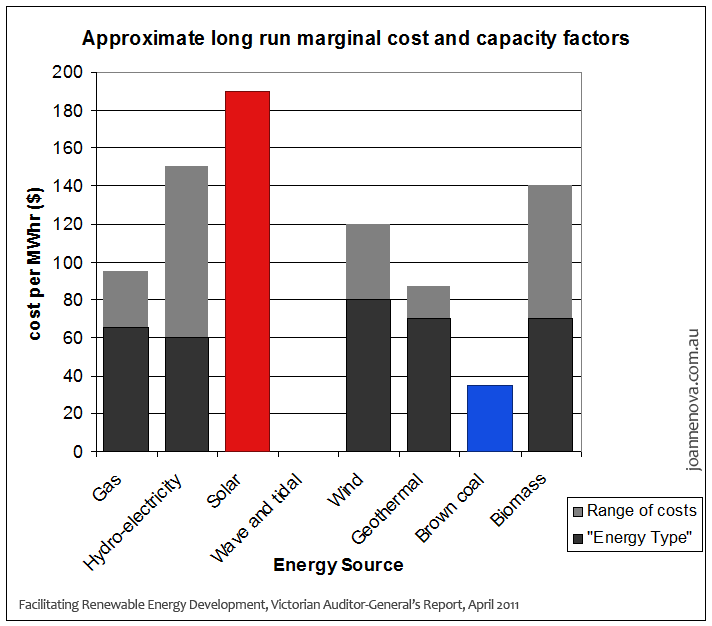
Recall that coal is cheap to produce compared to more politically correct energy sources like wind and solar:

Cost of renewable wind and solar energy

Now, if the people of America really want to do something to draw America off of coal, then we should focus on nuclear power, instead of wasting money on solar and wind. But of course, the Democrats oppose nuclear power, too – despite the facts that scientists are in favor of it.

The left-leaning Pew Research reports:

About half (51%) of Americans favor building more nuclear power plants to generate electricity, while 42% oppose this. Among the general public, a greater percentage of men (60%) than of women (43%) favor building additional nuclear power plants. More college graduates (59%) favor building nuclear power plants than do those with a high school education or less (46%). And larger shares of Republicans (62%) than independents (52%) or Democrats (45%) support expanding the use of nuclear power to generate electricity.

When it comes to nuclear power, the views of scientists are closer to those of Republicans than Democrats nationwide. Seven-in-ten scientists favor building more nuclear power plants to generate electricity, while 27% are opposed. Among scientists, majorities in every specialty favor building more nuclear power plants, but support is particularly widespread among physicists and astronomers (88% favor). As with the public, far more men (76%) than women (55%) support the expansion of nuclear power.

We are bankrupting the country wasting money on green energy production that is not cost effective, and Democrats are opposed to clean energy production that is cost effective: fracking and nuclear. Then they complain about coal and try to regulate it out of existence. Unless and until Democrats come around on fracking and nuclear power, then they should not be regulating coal out of existence. All that will do is raise energy prices for all of us, which is exactly what we see happening in Germany. They are further along the green energy road, and we must learn from their mistake.