
Tag Archives: Work

Apprenticeship programs help boys develop maturity and job skills

If you have boys, or if you know any, then this article in the left-leaning Atlantic is a must-read for you.

Excerpt:

Young men are more likely to drop out of high school and are less likely to aspire to college than their female peers. Young men who are poor, live in a city, and are black or Latino are at even higher risk of unemployment and unplanned teen fatherhood than their peers in other demographics. As men’s earnings have stagnated, marriage has declined. It’s a vicious cycle: Being unmarried weakens men’s commitment to the work force, but a stagnation in earnings is contributing to the decline in marriage.

Robert Lerman—an economist at American University and fellow at the Urban Institute, a nonpartisan economic and social policy research center in Washington, D.C.—has a solution. He believes bringing apprentice-based learning to America’s schools would both raise earnings and give young men the skills they need to be good husbands and fathers. Put boys in a real-world situation outside the classroom, with skilled adults as mentors, Lerman says, and students have a chance to engage in on-the-job training in a wide range of fields from baking to boat-building, farming to architecture, public health to civil engineering. This is learning in context and it’s what young men (and women) crave: It feels immediate and real. It is not isolated or abstract; it is refreshingly relevant, and it is taking place in real time, in real space, and among adults who take young people seriously. Youth apprenticeship has an immediacy that engages students who have trouble paying attention in class; instead, they are being given the time and the means to develop genuine mastery in a given field. At the very same time, they are cultivating skills—such as how to communicate effectively, problem-solve, work in teams, and maintain a positive attitude—that help them be reliable partners to their spouses and present, stable fathers to their children.

“If we teach everything entirely in a classroom context, we’re not going to be as effective—even when it comes to academics,” Lerman tells me. “The reality is that people learn best—whether it’s cognitive or technical skills or even how to get along with others—in context.”

Although skill-based training is in decline, the article convincingly show how boys learn better when their education includes real-world skills and real-world behaviors.

Here’s just one snippet:

Robert Halpern, a professor of education at the Erikson Institute in Chicago, whose research focuses on after-school programs for poor children and their families, argues that the best schooling for adolescent developmental needs goes beyond the classroom. During a 30-month investigation of one afterschool apprenticeship program, After School Matters in Chicago, Halpern found that participating youth, who attend the program a mere three afternoons a week for one school year, became more flexible thinkers and undertook tasks with more care. The youngsters learned to persevere and understand the value of working through problems. They became more self-responsible and more patient. Notably, their public behavior changed; they became “more mature, more appropriately assertive,” Halpern explains in his book The Means to Grow Up: Reinventing Apprenticeship as a Developmental Support in Adolescence. These are all skills that serve young people well when they enter the workforce, and when they start families of their own.

These apprenticeships, according to Halpern, gave youth “a sense of different ways of being an adult, what it means to be passionate about a discipline, and what it takes to become good at thinking.” Not only were students learning actively rather than passively for the first time in their lives, the experience enabled many of them to begin to overcome years of thinking of themselves as subpar learners. In so doing, their experiences opened up a future that would otherwise have remained closed, and influenced them at a critical time in their lives. These “very specific learning and work experiences leave a deep imprint on still malleable selves.”

You need to read the whole thing if this is relevant to you. It’s no use complaining about “man up” and other nonsense. The real causes of male decline are systemic. Find the policies that work and implement them. Throw out the failed ideology of feminism from the classroom and do what works for our young men.
J. Warner Wallace: influence the culture by encouraging young Christians

From the Cold Case Christianity blog.

Excerpt:

I came to faith at the age of 35. I didn’t have a deep relationship with any Christians at the time, and I had no strong Christian influences in my life. Without a mentor or role model, I felt like I had to work through the evidence and claims of Christianity on my own. Many years later however, as I was preparing to write my own book and start a modest journey as a public Case Maker, members of the apologetics community surrounded me with support and encouragement. While I wasn’t much younger than any of them (and was, in fact, older than some), they recognized I was the “new kid” on the block and surprised me with their generosity, wisdom and assistance. I was humbled by the response, and began to look at my own sphere of influence, searching for young men and women I could encourage in a similar way.

Those of us who hope to influence the culture for Christ typically think of our own efforts to communicate and reach the world. What can I write today? What can I say? How can I effectively use the internet to promote and defend the Christian worldview? Like others, I’m guilty of viewing my influence through the narrow lens of my own efforts. As a guy who started this season in my 50’s however, I’ve come to realize the limits of my own impact and the role I can play as an encourager. My questions are starting to change: Who can I inspire as a young Christian Case Maker? What small piece of wisdom can I provide to someone who is a few steps behind me in this journey? How can I impact the younger generation of Christian Case Makers? I know I won’t be writing and speaking 30 years from now, but there are men and women out there who will be. What can I do to make them even more effective?

I wanted to add to what he wrote and tell you a little bit about what I do. Through my blog, I have been able to meet young people in high school and college who are making decisions about what to study and where to work. I’m been able to help people in some specific ways:

  • helping them to know what to read/listen to/watch in order to build up their worldview
  • helping them learn how to debate with skeptics
  • helping them to decide between college and trade school
  • helping them to choose the right major
  • encouraging them to work in the summer instead of taking time off
  • helping them get funding for apologetics events that they organize
  • rewarding them for doing well in school or work
  • listening to the conflicts with teachers and professors
  • helping them make plans for their lives
  • helping them make good decisions with the opposite sex
  • spending time playing games with them or just talking
  • asking them about their classes, assignments and tests

It’s always rewarding to seem them studying hard subjects, getting good grades, entering competitions and getting summer/full-time jobs. I like to give rewards to people who do try to grow their skills and produce results. It can be small stuff like games or books, or bigger stuff, like sponsoring an apologetics event that they’ve organized. Sometimes I can get a young person connected with a mentor. For example, one young lady wanted to start a pro-life club, and I was able to connect her with someone who started a large pro-life organization and the office manager from that large pro-life organization. I also provided her with some helpful pro-life books.  It’s important that we not understimate how much good it does to try to be supportive when young people want to grow their skills and take on challenges.

I think that mentoring young people is especially for those of us who are not married with children. We typically have more disposable income and time than married people do, especially married people with children. Not only is it good for them to get the advice from someone more experienced, but it also gives you parenting practice, and that’s something that you can talk about in a courting situation. This is the kind of thing that signals to a candidate spouse that you are going to be interested in mentoring them, and in raising effective Christian children. The most challenging thing about doing this is that you really have to think about how to please God with your mentoring, and that means that you have to put yourself second a lot of the time. It’s good for singles to learn how to do that.

Minimum wage: doing what feels good doesn’t produce good results

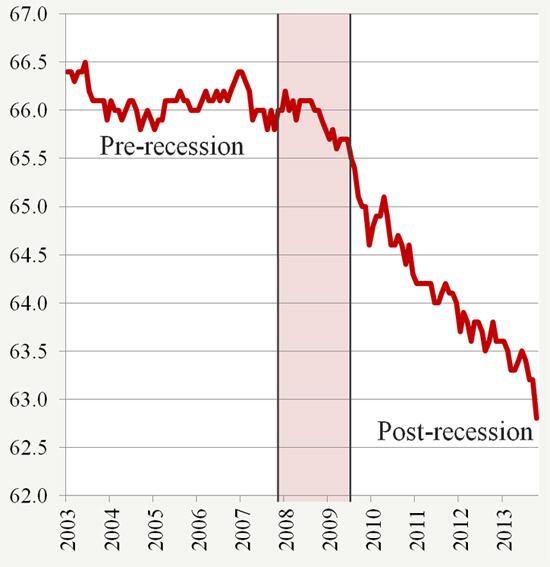
Labor Force Participation down to 62.8%

Will Obama’s plan to raise minimum wage help people?

From the Daily Caller. (H/T Conway)

Excerpt:

The Obama administration’s proposal to raise the minimum wage to $10.10 an hour could result in as many 1,084,000 jobs eliminated from the work force, according to a new study conducted by the Employment Policies Institute (EPI)

“No amount of denial by the president and his political allies — and no number of ‘studies’ published by biased researchers — can change the fact that minimum wage hikes eliminate jobs for low-skill and entry-level employees. Non-partisan economists have agreed on this consensus for decades, and the laws of economics haven’t changed,” Michael Saltsman, research director at EPI, said in a statement.

He offered an alternative to the president’s plan: “Instead of raising small businesses’ labor costs and creating more barriers to entry-level employment, the president and the Senate should focus on policies that help reduce poverty and create jobs.”

The  study was released in the wake of an expected vote on a Senate bill that aims to raise the federal minimum wage from the current $7.25 an hour to $10.10 an hour — a nearly 40 percent increase.

Many Democrats argue that increasing the federal minimum will reduce poverty without having an adverse effect on unemployment.

EPI’s report, which used analysis from economists at Miami and Trinity University, reached a different conclusion.

Researchers used recently updated Census Bureau data from 2012 and 2013 to calculate how each individual state would be impacted by the proposed wage hikes. As a lump sum, Americans would see a loss of at least 360,000 jobs, and perhaps even over one million if hourly wages are increased to $10.10.

The number of job losses would be the most dramatic in large states, such as California and Texas. Economists found that California could lose as many as 100,016 jobs and Texas could see up to 128,617 jobs disappear from its economy.

But’s it’s not just this proposal that is the problem, it’s his past policies.

After FIVE YEARS of Obamanomics, we still have a record 100 MILLION people still out of work from when he became President. There has been NO RECOVERY since the housing bubble, which was caused by the Democrats in Congress. Policies like raising the minimum wage only make that worse, although it sounds great to Obama’s low information supporters.

Minimum wage raises cause higher unemployment

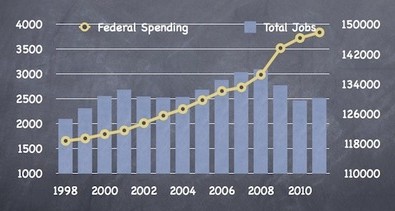
Government Spending Vs Jobs

From Investors Business Daily.

Excerpt:

How amusing to watch Democrats wring their hands over what they can do to get businesses to create jobs, when one of the biggest job killers is the minimum wage they keep hiking.

Recall that it was Democrats who raised the federal wage floor a whopping $2.10 an hour in the middle of the recession. The record 41% increase has led to record unemployment among young people, especially black teens.

Congress started ratcheting up the minimum wage from $5.15 an hour in mid-2007, arguing it would help abate poverty. But retailers looking to slash costs eliminated low-skilled, entry-level jobs rather than pay the mandated increases.

Now 1.5 million fewer teens are working. Last year’s unemployment rate for workers ages 16 to 19 shot up to 26% from 2007’s 15%.

As for black teens, their joblessness soared to a record 43% after the final raise to $7.25 took effect in mid-2009. It helped put more than half of young black men out of work — a first.

The president proposes cranking the minimum wage even higher to $9.50. Then he wants to raise it every year thereafter as a “living wage” indexed to inflation.

Yes, this is the problem that happens when you elect someone who knows nothing whatsoever about economics. And when I say nothing, I mean he is in disagreement with virtually all economists across the ideological spectrum.

A large majority of economists agree

Moderate economist Gregory Mankiw of Harvard University lists the policies that are accepted by virtually all economists.

Here’s Greg’s list, together with the percentage of economists who agree:

  1. A ceiling on rents reduces the quantity and quality of housing available. (93%)
  2. Tariffs and import quotas usually reduce general economic welfare. (93%)
  3. Flexible and floating exchange rates offer an effective international monetary arrangement. (90%)
  4. Fiscal policy (e.g., tax cut and/or government expenditure increase) has a significant stimulative impact on a less than fully employed economy. (90%)
  5. The United States should not restrict employers from outsourcing work to foreign countries. (90%)
  6. The United States should eliminate agricultural subsidies. (85%)
  7. Local and state governments should eliminate subsidies to professional sports franchises. (85%)
  8. If the federal budget is to be balanced, it should be done over the business cycle rather than yearly. (85%)
  9. The gap between Social Security funds and expenditures will become unsustainably large within the next fifty years if current policies remain unchanged. (85%)
  10. Cash payments increase the welfare of recipients to a greater degree than do transfers-in-kind of equal cash value. (84%)
  11. A large federal budget deficit has an adverse effect on the economy. (83%)
  12. A minimum wage increases unemployment among young and unskilled workers. (79%)
  13. The government should restructure the welfare system along the lines of a “negative income tax.” (79%)
  14. Effluent taxes and marketable pollution permits represent a better approach to pollution control than imposition of pollution ceilings. (78%)

You can find out more about how raising the minimum wage increases unemployment, especially for young people and minorities, from this comprehensive, 50-year, government study.

This is why it is important for voters to understand economics. When you raise the price of labor, fewer employers will purchase labor. Supply and demand. This is so basic, that I am surprised that someone as educated as Obama doesn’t understand it. It’s probably because he has virtually no experience working in the private sector.