Tag Archives: Work

Only 74,000 jobs added in December, lowest in 3 years

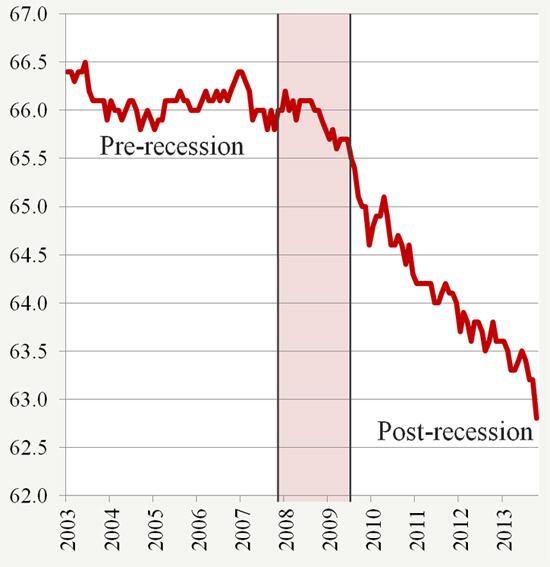
Labor Force Participation down to 62.8%

CNS News reports on the disappointing job numbers.

Excerpt:

The economy added only 74,000 non-farm jobs in December, the fewest in three years. Yet the unemployment rate dropped 0.3 points to 6.7 percent — the first time in 60 months it has dropped below 7 percent, the Labor Department announced on Friday.

With so few jobs added, the jobless rate still went down because people stopped looking for work.

The Bureau of Labor Statistics says the number of unemployed persons declined by 490,000 to 10.4 million in December, indicating that many of them dropped out of the labor force.

The government counts people as unemployed only if they are actively searching for work.

[…]In 2013, job growth averaged 182,000 per month, about the same as in 2012, when it averaged 183,000 a month.

I am thinking about whether the Obama administration has done anything in the last 5 years to create any jobs. I know they could have suspended the employer portion of payroll taxes. They didn’t do that. They could have allowed the Keystone XL pipeline. They didn’t do that. They could have repealed Obamacare so that employers didn’t have to reduce worker hours to avoid having to pay penalties. They didn’t do that. They could have stopped borrowing over a trillion dollars a year. They didn’t do that.

So I am just wondering what exactly this government has done to create jobs. I know the economy is resilient, and some jobs get created every month, no matter what. But I would like someone to tell me how this government has encouraged the private sector to hire more workers. I think if they had done anything to specifically address jobs, then I would know about it.

Can you have an apologetics ministry and still hold down a full-time job?

J. Warner Wallace is passionate about encouraging Christians to keep their day jobs and do their apologetics ministry without financial constraints. He did it, and it worked for him. He has just posted a list of people who have full-time vocations with a part-time apologetics ministry.

He writes:

The Christian community is experiencing an apologetics “renaissance”, and this resurgence of interest in Christian Case Making is being driven by an unexpected group of “tent-making” Christian Case Makers. Like the Apostle Paul, these avocational apologists draw their income from “conventional” careers (Paul was described as a tent-maker inActs 18:1-3) as they evangelize, preach, make a case or serve. I’m proud to be a member of this growing group of “One Dollar Apologists”. In this post, I’d like to bring your attention to many of the tent-making Case Makers having an impact in our world today. If you are interested in apologetics, you’ve undoubtedly visited many of the websites I’ve collected here. In fact, you may not have realized these resources were being provided by people who are working in vocations similar to your own. As you scan this list of tent-making apologetics websites, take note of the variety of occupations held by the men and women behind the scenes…

I checked out the list to see what all the bloggers I read do in their day jobs, and was pleased to see a number of people in the list who are in science, technology and engineering fields. That’s what I do, and I think it’s the best thing to do. So for the rest of this post I want to give some reasons why people who want to be tent-maker case-makers should consider a STEM degree and a STEM job. (STEM = Science, Technology, Engineering, Math).

Why you should prefer a STEM degree

I always recommend that people prefer STEM degrees when they want to do a “tent-maker” model of apologetics ministry, for five reasons:

1. Doing a STEM degree will make you miserable and give you nightmares for life, and nothing you do after you do a STEM degree can ever be as bad as sitting in a lab all night trying to get something to work that doesn’t want to work. Not even changing diapers. It’s good to get you to accept that life is hard, that your feelings don’t matter to anyone and that you can’t have your way all the time.

2. Doing a STEM degree will give you a lot of money for your ministry, so much that you can even give some away to other ministries. Yesterday, I sent $150 to a Ratio Christi chapter that I like and $300 to another apologetics ministry that I like. And that’s not a problem because a STEM job typically pays better than average.

3. Doing a STEM degree will help you to pay back any student loans you take out, which is a big problem these days because the economy is lousy for young graduates.

4. Doing a STEM degree will shield you from a lot of the pressure you might face from the secularists and leftists who dominate the university classroom, because there just isn’t time to talk about politics much in those classes. The only time I ever got any trouble was my machine learning / search algorithms course in graduate school.

5. Doing a STEM degree will give you an advantage in credibility when discussing apologetics. I think that atheists are more impressed when we have some experience with a demanding job in some practical field. I don’t know about you, but I don’t find arguments like “the argument from fantasy literature” and “the argument from desire” persuasive coming from artsy people who don’t know how to do anything practical for money in the real world.

If you are a woman and want to be a stay-at-home mom, that is excellent, but a STEM degree is still for you! I think it’s useful for everyone. I have a friend who is busy doing her nursing degree part-time and she is a stay-at-home mom, and some of my favorite women apologists (Letitia Wong and Melissa Travis) have science backgrounds.

The best degrees for a tent-maker

If you are just picking a STEM field, then here is a list of the majors that lead to higher paying jobs, although other jobs might even help you to study apologetics, like being a police detective.

Top 10 highest-paid college majors

  1. Petroleum Engineering: $120,000
  2. Pharmacy Pharmaceutical Sciences and Administration: $105,000
  3. Mathematics and Computer Science: $98,000
  4. Aerospace Engineering: $87,000
  5. Chemical Engineering: $86,000
  6. Electrical Engineering: $85,000
  7. Naval Architecture and Marine Engineering: $82,000
  8. Mechanical Engineering: $80,000
  9. Metallurgical Engineering: $80,000
  10.  Mining and Mineral Engineering: $80,000

And here are some majors that you should avoid at all costs:

  1. Counseling Psychology: $29,000
  2. Early Childhood Education: $36,000
  3. Theology and Religious Vocations: $38,000
  4. Human Services and Community Organization: $38,000
  5. Social Work: $39,000
  6. Drama and Theater Arts: $40,000
  7. Studio Arts: $40,000
  8. Communication Disorders Sciences and Service: $40,000
  9. Visual and Performing Arts: $40,000
  10. Health and Medical Preparatory Programs: $40,000

If you’re not going to do a STEM degree, then a trade degree in the right area can be just as good. The main thing is to be able to do work, preferably in the private sector, that is valuable enough to someone else that they are willing to pay you for it. I think in this economy, it is particularly reckless to be doing a PhD in the humanities, unless you are already retired and fully-funded from your previous work.

Related posts

J. Warner Wallace: practical advice on becoming an effective one-dollar apologist

Lydia McGrew: we need an army of tentmakers

Lydia McGrew has a post up at What’s Wrong With the World blog that is just excellent. (H/T Apologetics315)

Excerpt:

Apologetics is wonderful and incredibly important. It’s a wonderful thing that a revival of specifically evidentialist apologetics is happening in the United States and even, to some extent, in the Anglophone world at large.

Unfortunately, this revival of interest in apologetics and in being Christian philosophers is coming at a very bad time, economically. Even if you are a genius, your chances in 2013 and following of getting a stable job by the route of going to graduate school in philosophy (or almost any area of the humanities) are pretty darned slim. If you’re not a genius, fuhgetaboutit. Nor were there ever all that many jobs in philosophy. It was always an iffy proposition, but it’s much worse now than it was even twenty years ago.

As for starting ministries, a poor economy makes it extremely hard to do that, too, because people don’t have as much disposable income to donate. Moreover, even in a more robust economy, if all the eager young apologists were to flock to start apologetics and/or campus ministries, they would be competing among themselves for a finite number of available dollars from donors. So that’s not the best idea either.

Let me speak very bluntly here: In my opinion, God doesn’t need a whole raft of impractical idealists out there getting themselves into debt or half starving (or really starving) with no idea of how in the world they are ever going to support even themselves, much less a family, out at the other end of their education. That just burdens the church with a large number of able-bodied but needy Christians who are in a seemingly unending stage of transition, “getting an education for the kingdom” or “hoping to do work for the kingdom” without a viable plan in mind or any fiscal light at the end of the tunnel.

Instead, I believe that we need an army of tentmakers. If you have a job or a marketable skill, for heaven’s sake (literally), don’t quit that job and join the ranks of starving students. Keep your day job, but enrich your mind and prepare yourself to answer people’s questions about Christianity by studying on your own time. If you have entrepreneurial abilities and the capital, start a business. That will support not only yourself but others you employ, and if successful, you will have more money to give to Christian ministries.

But even if you aren’t the entrepreneurial type or don’t have that opportunity, at least make sure (to the extent that one can in today’s world) that you can pay the rent and put food on your own table as well as supporting whatever number of additional people you plan to take on. (In other words, if you are a guy who would like to get married and have children, bear that in mind.) This will inevitably mean spending time at all that distasteful stuff like networking and making a resume. Bookish types don’t enjoy that stuff, because it seems bogus, but it can’t be helped. It will undoubtedly mean, for most people, not being full-time students beyond the undergraduate level, especially not in the humanities, not trying to become full-time academics as a life work, and not going into full-time ministry, even if you would ideally like to do one or more of those three things.

In the end, if we can have this army of tentmakers, there will be (Lord willing) money to allow some people to work in full-time ministry. But it’s going to be quite a small proportion of those who are interested or would ideally like to do so.

[…]Inevitably, the course of action I am suggesting will mean a bifurcation for many between their day job and what they are most passionately interested in. So be it. Indeed, so it has ever been in the world. What proportion of people at any moment in human history have been blessed enough to spend most of their time working on what they are most passionately interested in? The question answers itself. So I think that bifurcation has to be accepted by a great many people and that doing so will lead to what I might call a healthier “Christian economy” among committed Christians than what we could otherwise end up with.

So let’s see her advice in bullet-point form:

  • The job market for philosophers is very bad
  • A bad economy means less support money is available
  • It’s important to have a plan to fund your  ministry
  • Leverage your full-time job to fund your ministry

I often find that when I talk to Christians, there is this sort of hyper-spiritualized way of deciding what to do. People read the Bible, which is good, but then they don’t tend to also look at things like economics, science and public policy. The Bible doesn’t say much about what to study or what job to get, but there is an example of Paul working at tent-making in order to fund his ministry. So there is precedent for the idea of learning a trade and working to earn enough money to support our families, our ministry and even other people’s ministries. I think we have an obligation to take the Bible seriously when it tells us what we can do to please God, but coming up with a plan to please God most effectively is our job. We have to make the plans to serve God. Our plans must be within the bounds of Biblical morality, but they should also reflect our knowledge of how the world really works, too. We’ll be more successful with a good plan and some hard work.

Be sure and listen to the podcast by J. Warner Wallace on this issue, and read my comments too (same post).