
Tag Archives: Student Loan

Tad Hopp accumulates six figures of college debt, wants taxpayer bailout

From: theawkwardyeti.com

Here’s an interesting editorial from a “Christian” left blog. (H/T Acton Institute via Lindsay)

The author, Tad Hopp is graduating a PCUSA seminary – an extremely liberal, left-wing denomination.

He writes:

I graduated college in 2007.

[…] I majored in English, not exactly what most people consider a ‘marketable’ or ‘practical’ degree…

[…]I went to a somewhat expensive private school…

[…]I did what many students in their last year of high school do: I went to the school where I felt I was being called…

[…]I do not regret my four years at my undergraduate institution one bit.

[….]When I graduated college, I owed nearly $50,000 in student loan debt and was unemployed for almost six months before I finally found a low-paying office job.

[…]“Can’t find a job? Well, you should have majored in something more ‘practical’, like economics or business or medicine.” Yeah, that would be great…if those were the subjects where my skills and passions lie. They’re not.

[…]I felt called to go to seminary.

[…]I will graduate seminary with close to six figures worth of student loan debt.

Let’s take stock of what he’s said so far:

  • he studied English, a language that he already spoke, which has one of the lowest employment rates
  • he was warned by people who knew something about earning and saving money not to study English
  • he went to a school he couldn’t afford to go to, and he graduated with $50,000 in debt
  • he went to seminary, another subject that doesn’t pay, and added another $50,000 or so of debt
  • he says that he doesn’t have to study subjects that lead to a career because he isn’t “passionate” about them
  • he “followed his heart” by going to the school that he had mystical, emotional, intuitions about = “calling”

My advice to Tad at this point would be for him to take the Bible seriously when it says this:

2 Thessalonians 3:10:

10 For even when we were with you, we used to give you this order: if anyone is not willing to work, then he is not to eat, either.

And 1 Timothy 5:8:

8 But if anyone does not provide for his own, and especially for those of his household, he has denied the faith and is worse than an unbeliever.

Now, for a Bible-believing Christian, these are inerrant and cannot be denied. But we have to go outside the Bible and learn how the world really works in order to figure out how to achieve those stated goals. Why should anyone hire us? What is working really about?

But even before looking at economics, Tad needs to push away all his friends who tell him to “follow his heart” and stick close by his friends who understand economics, who have jobs already, who have savings already, and so on. Don’t look for advice from dreamers, you look to advice from doers – people who can read the times, run the numbers and who have demonstrated the ability to create plans that work to achieve results that please God. When it comes to planning about the future, look at the past accomplishments. Weaving a happy narrative sounds nice, but judge future predictions based on past performance.

I would recommend that Tad read an economist like Thomas Sowell, especially on work, prices, etc., and realize that work means providing value to others. It then follows that he is obligated by the Bible to NOT “follow his heart”, but to instead do something that offers value to his fellow man. Prices are a way of determining what is most valued by your fellow man. And we know what careers have the highest value:

Petroleum Engineering – Starting Salary: $103,000 / Mid-Career Salary: $160,000
Actuarial Mathematics – Starting Salary: $58,700 / Mid-Career Salary: $120,000
Nuclear Engineering – Starting Salary: $67,600 / Mid-Career Salary: $117,000
Chemical Engineering – Starting Salary: $68,200 / Mid-Career Salary: $115,000
Aerospace Engineering – Starting Salary: $62,800 / Mid-Career Salary: $109,000
Electrical Engineering – Starting Salary: $64,300 / Mid-Career Salary: $106,000
Computer Engineering – Starting Salary: $65,300 / Mid-Career Salary: $106,000
Computer Science – Starting Salary: $59,800 / Mid-Career Salary: $102,000
Physics – Starting Salary: $53,100 / Mid-Career Salary: $101,000
Mechanical Engineering – Starting Salary: $60,900 / Mid-Career Salary: $99,700

English and seminary are dead last on the list – he literally could not have chosen worse than he did. I don’t mind if a woman studies these things, but Tad is a man – he has the Biblical obligation to be the primary provider, as we saw in the verse above.

More Tad:

Is the PCUSA doing anything to address this crisis?

[…]What has our government done to address this issue?

[…]I, like so many in my generation, voted for Obama…

[…]It seems to me that we’ve bought into the lie that student loan debt is brought on by the individual person…

[…]You know what I think might stimulate the economy? Automatically cancelling every single outstanding student loan!

[…]If we can spend $640 billion dollars on defense spending, why can’t we find the money to better support public education?

It’s important to understand that an English degree and a seminary degree do not prepare a person to make statements on economics and government. Tad has never studied these things, has no experience in them. He cannot state what the impact of his suggestions would be to all groups, i.e. – he cannot answer “and then what happens?” for every impacted group. Thinking economically is a valuable skill, but as Tad’s personal life shows, it’s not an area he is really knowledgeable about. But he wants to shift money from defense spending (which he knows nothing about) so that he can have a personal bailout. I personally doubt that taxpayers would be better served by paying for his English degree and liberal seminary degree than they would be if a peace-loving democracy could project power abroad to deter aggression from countries like North Korea, Iran, Russia, China and Syria.

Here is the solution to Tad’s problems:

  • we need to put Tad to work in a minimum wage job and confiscate his entire salary, until his loans are paid off.
  • we need to put Tad on a watch list such that he is never allowed to borrow money from anyone ever again.
  • once Tad’s loans are paid off, he should be taxed on his future earnings at the top tax rate for the rest of his life. The money we tax from him can fund education – that’s what he said he wanted.
  • Tad and his household should all be barred from collecting any money for unemployment, welfare or other social programs.

That’s the only bailout Tad should get. It would actually be in his best interest that he encounter real life as quickly as possible, because the longer he waits, the harder it’s going to be for him to recover to independence. He needs to stop his crazy retreat from adult responsibilities, and start working and saving now. I would say that at this point, marriage and parenting is out of the question for him (in another post, he comes out as gay, so that also complicates things). And he can thank the politics of the secular left for marriage and family being less affordable now, thanks to laws like Obamacare, which raised the cost of health care by thousands of dollars. I found it interesting that he actually did work at some point but he mocked the job as a “dead-end job” – as if it was beneath him.

I know some of you will be thinking, “but God called him things and so of course God is going to bail him out with $100,000 for his student loans”. But the thing is, God doesn’t usually work like that. First, I don’t accept that he is a Christian at all. Second, just because you have feelings that your plan will work, that isn’t a calling. The truth is that you certainly can assess the feasibility of things that you feel “called” to do, and if the plan looks crazy, then don’t do it. If you find yourself at odds with wise, practical people when explaining your calling to them, then you’re probably doing it wrong.
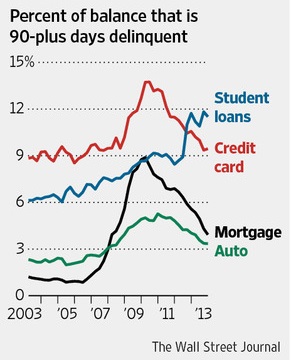
Americans using student loans to pay for living expenses

Student Loan Bubble
Student Loan Bubble

The Wall Street Journal reports on the $1.1 trillion of student loan debt.

Excerpt:

Some Americans caught in the weak job market are lining up for federal student aid, not for education that boosts their employment prospects but for the chance to take out low-cost loans, sometimes with little intention of getting a degree.

[…]A number of factors are behind the growth in student debt. The soft jobs recovery and the emphasis on education have driven people to attain more schooling. But borrowing thousands in low-rate student loans—which cover tuition, textbooks and a vague category known as living expenses, a figure determined by each individual school—also can be easier than getting a bank loan. The government performs no credit checks for most student loans.

College officials and federal watchdogs can’t say exactly how much of the U.S.’s swelling $1.1 trillion in student-loan debt has gone to living expenses. But data and government reports indicate the phenomenon is real. The Education Department’s inspector general warned last month that the rise of online education has led more students to borrow excessively for personal expenses. Its report said that among online programs at eight universities and colleges, non-education expenses such as rent, transportation and “miscellaneous” items made up more than half the costs covered by student aid.

The report also found the schools disbursed an average of $5,285 in loans each to more than 42,000 students who didn’t log any credits at the time. The report pointed to possible factors such as fraud in addition to cases of people enrolling without serious intentions of getting a degree.

Capella Education Co., which runs online schools, examined student costs and debt at institutions— public and private —in Minnesota and concluded that between a quarter and three-quarters of loans taken out by students were for non-education expenses. At one of Capella’s master’s programs, the typical graduate left with about $30,200 in student debt even though tuition, fees and book costs totaled roughly $18,800. Borrowers are prohibited under federal law, except in rare instances, from discharging student debt through bankruptcy.

The share of student borrowers taking out the maximum amount of loans—$12,500 a year for undergraduates—has risen since the recession. In the 2011-12 academic year, federal Education Department data show, 68% of all undergraduate borrowers hit the annual loan ceiling, up from 60% in 2008.

Research suggests a fair chunk of that is going to non-education expenses. In 2011-12, about a quarter of student borrowers took out loans that exceeded their tuition, after grants, by $2,500, according to research by Mark Kantrowitz, a higher-education analyst and publisher of the education site Edvisors.com.

Some students say they intend to get a degree but must borrow as much as possible because they can’t find decent-paying jobs to cover day-to-day expenses.

Here are some examples of how this is working out:

Tommie Matherne, a 32-year-old married father of five in Billings, Mont., has been going to school since 2010, when he realized the $10 an hour he was making as a mall security guard wasn’t covering his family’s expenses. He uses roughly $2,000 in student loans each year to stock his fridge and catch up on bills. His wife is a stay-at-home mother who also gets loans to take online courses.

“We’ve been taking whatever we can for student loans every year, taking whatever we have left over and using it to stock up the freezer just so we have a couple extra months where we don’t have to worry about food,” says Mr. Matherne, who owes $51,600 in federal loans.

Some students end up going deeper into debt. Early last year, when Denna Merritt lost her long-term unemployment benefits, the 49-year-old Indianapolis woman enrolled part-time at the Art Institute of Pittsburgh’s online program, aiming for a degree in graphic design. She took out $15,000 in federal loans, $2,800 of which went to catch up on unpaid bills, including utilities, health-insurance premiums and cable.

Mr. Selent, of Fort Lauderdale, knows he is getting himself deeper in a hole but prefers that to the alternative of making minimum wage. In his 20s, he earned a bachelor’s degree in communications from a local for-profit school but couldn’t find a job in the field after graduating and began falling behind on his student-loan bills. He is now taking courses for a degree in theater so he can become an actor.

Meanwhile, federal loans allow him to cover any needs that arise during the semester. Says Mr. Selent: “It keeps me from falling apart.”

Wow. Communications and Theatre. Do you think a private bank would have given him money to do a degree in theater? I don’t think so. A private banker might give a loan to someone trying to get a STEM degree, like computer science or nursing, but not for theater. So how did the theater major get the loan, then, if no sane private sector banker would give it to him?

This article from the Heritage Foundation think tank explains how he got the money.

Excerpt:

The Obama Administration’s overreach into the student loan industry has been wide-sweeping. In what The Wall Street Journal deemed “that other government takeover,” a provision buried deep in Obamacare effectively nationalized the student loan industry by ending government subsidies to private lenders and putting the federal government in charge of originating and servicing federally backed student loans.

The Obamacare provision came in addition to the Administration’s decision in 2011—made through executive order—to forgive student loan debt after 20 years. And it comes in addition to the Administration’s gainful employment regulations restricting access to student loans for students attending for-profit institutions.

But the current debate’s origins are in separate legislation passed in 2007 whereby the federal government set interest rates on student loans artificially low, cutting the rates in half temporarily for four years. Now that the interest rates are set to increase, President Obama is pressing Congress to keep rates low.

So the Democrats are repeating the mortgage lending recession they caused in 2008 by again transferring risk away from private banks and onto the backs of the taxpayers. Anybody can get a loan for anything, whether it be basket-weaving or women’s studies or… theater.

It’s just more vote-buying from the Democrat party

The government is giving away these loans to students, no questions asked, in order to buy their votes. These are the students who cheered when Obama promised that they could stay on their parents’ insurance plans until they were 26. The Democrats get the moocher vote, and the students get their loans forgiven in 20 years. Everybody wins – except that the next generation of Americans gets stuck with the bill for this vote buying scheme.

One-third of recent college graduates say they should have skipped college and gone to work

From Forbes magazine, a word of caution to young people, especially to young men who intend to marry and have children.

Excerpt:

Here’s an indication of how burdensome student loans have become: About one-third of millennials say they would have been better off working, instead of going to college and paying tuition.

That’s according to a new Wells Fargo study which surveyed 1,414 millennials between the ages of 22 and 32. More than half of them financed their education through student loans, and many say the if they had $10,000 the “first thing” they’d do is pay down their student loan or credit card debt.

That’s no surprise when you consider student borrowing topped the $100 billion threshold for the first time in 2010, and total outstanding loans exceeded $1 trillion for the first time in 2011.  Student loan debt now exceeds credit card debt in the U.S. which stands at about $798 billion.

The problem sometimes is that not all college educations are worth their cost since they can’t guarantee a high-paying job to help pay off that student debt. A report from the National Association of Consumer Bankruptcy Attorneys says the rising student debt problem can have a bad impact on the economy. Even in the best of economic times when jobs are plentiful, young people with considerable debt burdens end up delaying life-cycle events such as buying a car, purchasing a home, getting married and having children.

There’s nothing wrong with a good education in a trade school or community college.

The actual number for outstanding student loan debt is about $600 billion, and it’s gone up a lot under Obama.

Excerpt:

The outstanding balance for all of the direct student loans the federal government has issued topped $600 billion in April, according to newly released data from the U.S. Treasury.

The total balance hit $600.457 billion by the end of April, says the Treasury, up from $592.142 billion at the end of March.

The Federal Direct Student Loan Program already has built-in debt forgiveness plans for people who end up earning low incomes or for those who entered lines of work preferred by the government.

In January 2009, when Obama was inaugurated, the balance was $119.803 billion and has since increased more than fivefold.

The $480.654 billion increase since January 2009 in what is owed to the Treasury in direct student loans represents a climb of about 250 percent in just over four years.

Before Obama’s first term, federally guaranteed student loans were made both by the government directly and by private lenders using their own capital through what was called the Federal Family Education Loan program. Language inserted into the the Obamacare law signed in March 2010, however, abolished the latter type of federally guaranteed student loan, giving the U.S. Treasury a monopoly over those loans.

As the Congressional Research Service has described it, this Obamacare provision made the U.S. Treasury the exclusive “banker” for federally guaranteed student loans. Thus, U.S. taxpayers essentially own these loans.

The troubling thing is that since the schools have spent all the time teaching children about global warming and the proper use of contraceptives, it’s unlikely that they will be able to find real jobs in order to pay off their loans. They aren’t learning how to manage money in school, and parents aren’t taking the responsibility to teach kids about money at home. The sad thing is that they have been taught by their teachers to keep voting for more politicization of education and more government spending on fashionable causes. But at least they feel superior about it. For now.