The largest lesbian, gay, bisexual, and transgender activist group in the country is calling on the Department of Education to address what it calls a “disturbing trend” on college campuses.
Specifically, the Human Rights Campaign is calling for more transparency towards what it sees as a trend of schools citing religious reasons for not adhering to Title IX.
The Human Rights Campaign believes that in granting such exemptions, schools are given a “license to discriminate.”
Title IX prohibits discrimination on the basis of sex in educational programs that receive federal funding. If schools are found in violation of the statute, their federal dollars could be at risk.
To address these concerns, the Human Rights Campaign wants the Department of Education to issue public reports stating which institutions request or receive religious exemptions, and to detail the scope of those exemptions.
Conservatives reacted to this news so:
Hunter Baker, a fellow for religious liberty at Union, told The Daily Signal that the erosion of religious liberty exemptions, would make it “illegal” for schools to operate in accordance to their religious beliefs.
“If we were unable to choose faculty members who both live out and have a traditional view of Christian sexual morality, then that really damages our ability to pursue our mission as an institution,” Baker said. “You’re making it illegal for us to insist on a Christian life and worldview.”
Baker said it would be a “major intrusion” on the school’s standards of conduct for its student body. Union University, a Baptist college in Jackson, Tenn., follows a traditional Christian view of marriage and sexuality, for example.
“Any kind of activity that would occur between two same-sex individuals would be unacceptable by our standards of conduct,” he said.
Roger Severino, director of the DeVos Center for Religion and Civil Society at The Heritage Foundation, calls the Human Right Campaign’s requests an attempt to “blacklist religiously-affiliated schools.”
You might remember that the Human Rights Campaign previously denounced the socially conservative Family Research Council as a “hate group” after they were attacked by a gay activist who was later convicted of domestic terrorism. The Human Rights Campaign was never charged with hate speech by the Obama administration.
Unfortunately, the Human Rights Campaign enjoys broad support from many American companies, as well as prominent Democrats like Barack Obama and Hillary Clinton. It’s difficult for me to see how religious liberty can survive if we keep electing Democrats who want to give gay activists what they want: an end to religious liberty and freedom of conscience.
This is from Aeon magazine. The author writes for several ultra-leftist publications, including the New York Times, the Los Angeles Times, Salon and Slate.
She writes:
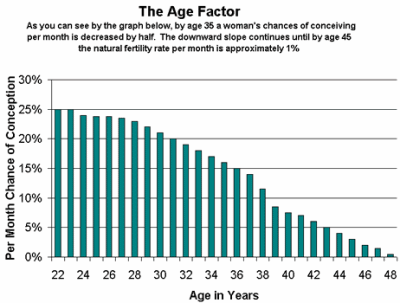
Many studies show that women are not only woefully ignorant when it comes to fertility, conception and the efficacy of assisted reproductive technologies (ART) – but they overestimate their knowledge about the subject.For instance, a 2011 study in Fertility and Sterility surveyed 3,345 childless women in Canada between the ages of 20 and 50; despite the fact that the women initially assessed their own fertility knowledge as high, the researchers found only half of them answered six of the 16 questions correctly. 72.9 per cent of women thought that: ‘For women over 30, overall health and fitness level is a better indicator of fertility than age.’ (False.) And 90.9 per cent felt that: ‘Prior to menopause, assisted reproductive technologies (such as IVF) can help most women to have a baby using their own eggs.’ (Also false.) Many falsely believed that by not smoking and not being obese they could improve their fertility, rather than the fact that those factors simply negatively affect fertility.
Fertility fog infects cultures and nations worldwide, even those that place more of a premium on reproduction than we do in the West. A global study published for World Fertility Awareness Month in 2006 surveyed 17,500 people (most of childbearing age) from 10 countries in Europe, Africa, the Middle East and South America, revealing very poor knowledge about fertility and the biology of reproduction. Take Israel, a country that puts such a premium on children that they offer free IVF to citizens up to age 45 for their first two children. According to a 2011 study in Human Reproduction, which surveyed 410 undergraduate students, most overestimated a women’s chances of spontaneous pregnancy in all age groups, but particularly after receiving IVF beyond age 40. Only 11 per cent of the students knew that genetic motherhood is unlikely to be achieved from the mid-40s onward, unless using oocytes or egg cells frozen in advance. ‘This can be explained by technological “hype” and favourable media coverage of very late pregnancies,’ the authors concluded.
[…]For a woman over 42, there’s only a 3.9 per cent chance that a live birth will result from an IVF cycle using her own, fresh eggs, according to the American Society of Reproductive Medicine (ASRM). A woman over 44 has just a 1.8 per cent chance of a live birth under the same scenario, according to the US National Center for Chronic Disease Prevention and Health Promotion. Women using fresh donor eggs have about a 56.6 per cent chance of success per round for all ages.
Indeed, according to research from the Fertility Authority in New York, 51 per cent of women aged between 35 and 40 wait a year or more before consulting a specialist, in hopes of conceiving naturally first. ‘It’s ironic, considering that the wait of two years will coincide with diminished fertility,’ the group says.
[…]‘No one talks about fertility,’ said [reproductive endocrinologist Janelle Luk, medical director of Neway Fertility in New York City], who does not believe women are really open to hearing about it. ‘I don’t think women know that there’s a limit: the message is equal, equal, equal. Women say: “We want to go to college, we want to work on our careers, we want to be equal to men.” But our biological clock is not.’
[…]Another way women might even out the fertility playing field is by focussing on the so-called male biological clock. But is there one? Although there have been recent news stories about how advanced age in men (over 40 or 50) increases time to conception and the incidence of autism and schizophrenia, the absolute risk is negligible. ‘When you look at the numbers, you have to separate what the absolute risk and the increased risk is,’ said Natan Bar-Chama, director of male reproductive medicine and surgery at Mount Sinai Medical Center in New York. ‘The absolute risk is still really very small.’
I think if I ever have a daughter, I will be sure to urge her to be skeptical of her emotions and intuitions, to learn how to assess probabilities, to disregard exceptional cases when making plans, to resist the feminism in the culture, to get wisdom from older married women with children instead of young unmarried childless women, to accept that she is not so special that laws and rules don’t apply to her, and to accept that the universe is not malleable according to her needs and desires. I hope my wife will see the value of reining our daughter in before the catastrophes like infertility happen.
Where does the organized opposition to educating young women about fertility facts come from?
‘We feel that women should be able to talk to their ob/gyn about fertility,’ said Sandra Carson, ACOG’s vice president for education. ‘We certainly want to remind women gently that, as they get older, fertility is compromised, but we don’t want to do it in such a way that they feel that it might interfere with their career plans or make them nervous about losing their fertility.’ In other words, there are no guidelines for talking to a woman about her fertility unless she herself brings it up.
All this talk of ‘gentle’ reminders and ‘appropriate’ counselling has a history – a political one. Back in 2001, the ASRM devoted a six-figure sum to a fertility awareness campaign, whose goal was to show the effects of age, obesity, smoking and sexually transmitted diseases on fertility. Surprisingly, the US National Organization for Women (NOW) came out against it. ‘Certainly women are well aware of the so-called biological clock. And I don’t think that we need any more pressure to have kids,’ said Kim Gandy, then president of NOW. In a 2002 op-ed in USA Today, she wrote that NOW ‘commended’ doctors for ‘attempting’ to educate women about their health, but thought they were going about it the wrong way by making women feel ‘anxious about their bodies and guilty about their choices’.
We don’t want women to feel bad, so it’s best to let them follow their hearts. That view is not helpful to women! If we want to help women, we must tell them the truth, and take the consequences.
All this talk about fertility could be accompanied by a discussion of the hard fact that a woman’s attractiveness will decline as she ages. This is a troubling lesson that countless women have had to learn the hard way. When you are young, you stand a much better chance of finding a successful male with good values and who is willing to commit to marriage and parenting. Many women will testify that, as you get older, this convenience deteriorates quickly. The good men will be claimed by the responsible women who don’t waste their youthful years seeking thrills. Men who are contemplating marriage value a woman’s appearance, fertility, vulnerability and submissiveness to his leadership. Women need to be careful not to embark on a course that will reduce their ability in any of these areas that are important to men, e.g. – careerism, premarital promiscuity, etc.
Here a good study on relationship tempo and relationship quality.
Abstract:
Rapid sexual involvement may have adverse long-term implications for relationship quality. This study examined the tempo of sexual intimacy and subsequent relationship quality in a sample of married and cohabiting men and women. Data come from the Marital and Relationship Survey, which provides information on nearly 600 low- to moderate-income couples living with minor children. Over one third of respondents became sexually involved within the first month of the relationship. Bivariate results suggested that delaying sexual involvement was associated with higher relationship quality across several dimensions. The multivariate results indicated that the speed of entry into sexual relationships was negatively associated with marital quality, but only among women. The association between relationship tempo and relationship quality was largely driven by cohabitation. Cohabiting may result in poorer quality relationship because rapid sexual involvement early in the romantic relationship is associated with entrance into shared living.
The authors are from Cornell University and University of Wisconsin – Madison. Prestigious schools, and very far to the left.
Here’s another recent study that shows that if a woman has more partners than just her husband as a premarital sex partner, the risk of divorce increases.
Conclusion:
Using nationally representative data from the 1995 National Survey of Family Growth, I estimate the association between intimate premarital relationships (premarital sex and premarital cohabitation) and subsequent marital dissolution. I extend previous research by considering relationship histories pertaining to both premarital sex and premarital cohabitation. I find that premarital sex or premarital cohabitation that is limited to a woman’s husband is not associated with an elevated risk of marital disruption. However, women who have more than one intimate premarital relationship have an increased risk of marital dissolution.
Data from the 1988 US National Survey of Family Growth (NSFG) were utilized to assess the impact of premarital sexual activity on subsequent marital stability. Among white NSFG subjects first married in 1965-85, virgin brides were significantly less to have become separated or divorced (25%) than women who had not been virgins at marriage (35%).
[…]The lower risk of divorce on the part of white women with no premarital sexual experience persisted even after numerous intervening and background variables were controlled.
And I am going to save the best study for last. This marvelous PDF is from August 2014, and is put out by the National Marriage Project at the University of Virginia. It is comprehensive, and links to many papers from decades ago to the state of the art today. It seems like people are really rushing into sex these days, without much thought. They want to have fun, feel accepted, be like their friends, conform to the culture. But sometimes, it’s better to be practical than to be governed by the desire for fun and thrills. If you want to do something, look at the research and find out what the consequences are before you do it. That’s what a sensible person does.
When it comes to discussing the Bible’s rules on sex, evidence is very important. Evidence is what convinces even non-Chrsitian people to take the Bible seriously when it comes to putting sex in its proper place. That’s why we need to know what the Bible says, and we need to augment that with real-world evidence so that it is applied to our own decision-making, and so that we can be persuasive when discussing it with others.



 WINTERY KNIGHT