Tag Archives: Sex

Philosopher Doug Groothuis explains the logic of the pro-life position

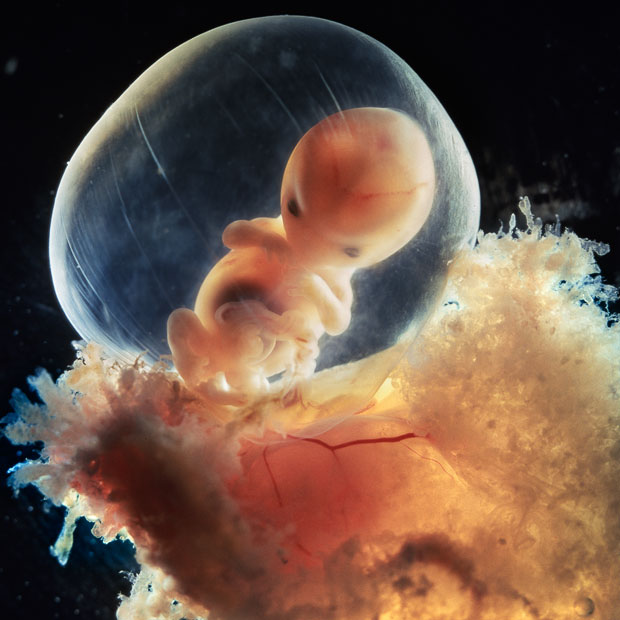
I'm Scheming Unborn Baby, and I approve this study
I’m Scheming Unborn Baby, and I approve this message

At Christian Post, an article by Douglas Groothuis. (H/T Mary)

Here’s the most useful bit:

When we separate personhood from humanity, we make personhood an achievement based on the possession of certain qualities. But what are these person-constituting qualities? Some say a basic level of consciousness; others assert viability outside the womb; still others say a sense of self-interest (which probably does not obtain until after birth). All of these criteria would take away humanity from those in comas or other physically compromised situations.4 Humans can lose levels of consciousness through injuries, and even infants are not viable without intense and sustained human support. Moreover, who are we to say just what qualities make for membership in the moral community of persons?5 The stakes are very high in this question. If we are wrong in our identification of what qualities are sufficient for personhood and we allow a person to be killed, we have allowed the wrongful killing of nothing less than a person. Therefore, I argue that personhood should be viewed as a substance or essence that is given at conception. The fetus is not a lifeless mechanism that only becomes what it is after several parts are put together—as is the case with a watch or an automobile. Rather, the fetus is a living human organism, whose future unfolds from within itself according to internal principles. For example, the fertilized ovum contains a complete genetic code that is distinct from that of the mother or father. But this is not a mere inert blueprint (which is separable from the building it describes); this is a living blueprint that becomes what its human nature demands.

Yet even if one is not sure when personhood becomes a reality, one should err on the side of being conservative simply because so much is at stake. That is, if one aborts a fetus who is already a person, one commits a deep moral wrong by wrongfully killing an innocent human life. Just as we do not shoot target practice when we are told there may be children playing behind the targets, we should not abortion fetuses if they may be persons with the right not to be killed. As I have argued, it cannot be disputed that abortion kills a living, human being.

Many argue that outside considerations experienced by the mother should overrule the moral value of the human embryo. If a woman does not want a pregnancy, she may abort. But these quality of life considerations always involve issues of lesser moral weight than that of the conservation and protection of a unique human life (which considers the sanctity or innate and intrinsic value of a human life).6 An unwanted pregnancy is difficult, but the answer is not to kill a human being in order to end that pregnancy.

I think that the real question in the abortion debate right now is whether a living organism with a human nature and a human genetic code that is distinct from its mother and father deserves the right to life, or whether it needs to develop some other capability in order to be worthy of protection from violence.

Consider something from philosopher Francis J. Beckwith.

Excerpt:

Some argue that personhood does not arrive until brain waves are detected (40 to 43 days).11Others, such as Mary Anne Warren,12 define a person as a being who can engage in cognitive acts such as sophisticated communication, consciousness, solving complex problems, self-motivated activity and having a self-concept. This would put the arrival of personhood at some time after birth. Still others, such as L. W. Sumner, 13 hold a more moderate position and argue that human personhood does not arrive until the fetus is sentient, the ability to feel and sense as a conscious being. This, according to Sumner, occurs possibly as early as the middle weeks of the second trimester of pregnancy and definitely by the end of that trimester.

Although these criteria differ from each other in important ways, they all have one thing in common: each maintains that if and only if an entity functions in a certain way are we warranted in calling that entity a person. Defenders of these criteria argue that once a human being, whether born or unborn, acquires a certain function or functions–whether it is brain waves, rationality, sentience, etc.– it is then and only then that a person actually exists. Those who defend these personhood criteria typically make a distinction between “being a human” and “being a person.” They argue that although fetuses are members of the species homo sapiens, and in that sense are human, they are not truly persons until they fulfill a particular set of personhood criteria.

Although functional definitions of personhood may tell us some conditions that are sufficient to say that a being is a person, they are not adequate in revealing to us all the conditions that are sufficient for a particular being to be called a person. For example, when a human being is asleep, unconscious, and temporarily comatose, she is not functioning as a person as defined by some personhood criteria. Nevertheless, most people would reject the notion that a human being is not a person while in any of these states. In other words, while personhood criteria, such as the ones presented by Warren can tell us that a being is a person, these criteria are not adequate to declare a being a non-person: The exercise of rational thought tells us that a being is a person; when that person is sleeping, and thus is not exercising rational thought, that lack of exercise of the thought function does not make her a non-person at that time. Consequently, it seems more consistent with our moral intuitions to say that personhood is not something that arises when certain functions are in place, but rather is something that grounds these functions, whether or not they are ever actualized in the life of a human being. Thus, defining personhood strictly in terms of function is inadequate.

If you are pro-life because of your feelings, or because someone told you to be, you ought to know that being pro-life is quite rational and supported by medical evidence. People who are pro-abortion are pro-abortion because they want recreational sex without the complications of having to care for the consequences (babies!) of their own actions. Even if they do not engage in the sex and the abortions themselves, they advocate for abortion rights, and they are guilty of encouraging a culture where 57 million unborn children have died since 1973. We’re long past Stalin numbers with this thing now.

We ought to care about not hurting other people. If grown-up’ selfish pursuit of happy feelings conflicts with another person’s right to life, then maybe we need to take a step back from being happy and start trying to be good instead.


Study: remaining a virgin longer leads to more satisfying relationships

Boys and girls playing the famous co-operative board game
Boys and girls playing the famous co-operative board game “Pandemic”

OK, so this week I got to be a facilitator between a man and a woman in a relationship. I got to hear a bit about what they thought was appropriate in the area of physical touching. These two had made great decisions, and it protected them both. Anyway, thinking about them caused me to think about the studies I had posted about boundaries in sexual matters a few years back. So I’m going to re-post them to remind everyone not to be in a rush to say yes to premarital sex.

The first article from the UK Daily Mail is about study showing the benefits of abstinence for relationship quality.

Excerpt:

People who lose their virginity later than their teenage years are more likely to enjoy satisfying relationships later in life, according to a new study.

Researchers found that people who didn’t have sex until they turned 20 or even later are more likely to end up in a happy relationship.

[…]Previous research suggests that there may be cause for concern, as timing of sexual development can have significant immediate consequences for adolescents’ physical and mental health.

However, until now little had been done to study long-term outcomes, and how early sexual initiation might affect romantic relationships in adulthood.

Psychological scientist Paige Harden, of the University of Texas in the United States, set about changing this.

She wanted to investigate whether the timing of sexual initiation in adolescence might predict romantic outcomes – such as whether people get married or live with their partners, how many romantic partners they’ve had, and whether they’re satisfied with their relationship – later in adulthood.

Doctor Harden used data from the National Longitudinal Study on Adolescent Health to look at 1,659 same-sex sibling pairs who were followed from around the age of 16 to about the age of 29.

Each sibling was classified as having an ‘early’ (younger than 15), ‘on-time’ (age 15 to 19), or ‘late’ (older than 19) first experience with sexual intercourse.

Those who lost their virginity later on in life were more likely to have a well-paid job.

They found, as expected, later timing of first sexual experience was associated with higher educational attainment and higher household income in adulthood when compared with the early and on-time groups.

People who had a later first sexual experience were also less likely to be married and they had fewer romantic partners in adulthood.

Among the participants who were married or living with a partner, later sexual initiation was linked with significantly lower levels of relationship dissatisfaction in adulthood.

This sounds a lot like the results from the previous studies that were featured in this UK Daily Mail article.

Excerpt:

“Courtship is a time for exploration and decision-making about the relationship, when partners assess compatibility, make commitments and build on emotional and physical intimacy.”

“The rapid entry into sexual relationships may, however, cut short this process, setting the stage for “sliding” rather than “deciding” to enter co-habiting unions.”

“Around a third of the men and women said they’d had sex within the first month of dating, while about 28 per cent waited at least six months, the Journal of Marriage and Family reported.”

“Analysis of the data clearly showed the women who had waited to have sex to be happier. And those who waited at least six months scored more highly in every category measured than those who got intimate within the first month. Even their sex lives were better.”

“The link was weaker for men. However, those who waited to get physically involved had fewer rows.

[…]‘A strong sexual desire may thwart the development of other key ingredients of a healthy relationship such as commitment, mutual understanding or shared values,’ the report said. ‘Good sex is sometimes confused with love; some couples overlook problematic aspects of their relationship that ultimately matter more in the long run.’”

So, it looks like you lose some stability if you push too hard on the premarital sex. Is stability important to you? Well, divorce is a financial disaster for men and women – so that’s one reason to care about stability. If your plan for marriage is to provide a stable environment for your kids, then that’s another good reason to care about stability. If you are getting married in part to advance your cause through effective children, then you have to control yourself now in order to be the person who can give them what they need later. This is not out of your control, this is not unpredictable. There are best practices.

If you keep rushing into things and experiencing painful break-ups, you will naturally stop the behaviors that allow you commit out of self-preservation. You will begin to resent having to care for that other person, except maybe when it makes you feel good. When you invest a lot and break up, you become less willing to invest in that other person. You retreat into your shell. You resent having responsibilities and obligations to that other person. You expect things to work on their own, apart from your efforts to make them work, because that’s how you avoid getting hurt. You try not to invest too much, because you imagine that things will fall apart and you’ll get hurt again. You focus on just feeling good now, so that when the relationship fails, you come out “ahead”. But this is not the way to make a stable marriage.

Marriage requires you to give 100% and regardless of how you feel. That’s what a commitment is – it’s a decision to perform regardless of feelings. To get stability, you want to be comfortable with investing in that other person – taking on responsibilities, satisfying expectations, performing obligations. Both of you have to be comfortable with the selflessness of commitment, and be ruled by your own decisions, instead of your feelings. And your goal here is not to find someone who gives you good feelings right now. Your goal is to find someone who will not hurt you the more that you give of yourself, up to an including marriage. It’s not good feelings that you are looking for, it’s the safety to commit everything you have to this other person, and not get hurt. The real joy of a relationship is not fun and thrills, it’s giving everything you have to another person, and knowing that if you fall, they will catch you.

If you choose candidates carefully, involve wise mentors, and set proper boundaries, you’ll find that relationships are a lot less painful, and that when you really want to commit, then you will be able to commit with your whole heart, and to be content with the commitment. There are plenty of ways to love and serve another person other than sex, as you both get to know each other and size each other up for a life-long commitment. Premarital sex is counterproductive… it’s speaking in a language that is designed for two people who have already made a lifelong commitment to have a common plan and a common purpose. Sex makes sense when you have that commitment, but it undermines communication and objective evaluation if it’s done before that commitment commitment is in place.

Baby elephant in China cries for 5 hours after being stomped by his mom

Baby elephant rejected by his mother
Baby elephant cries after being attacked by his own mother

From the New York Daily News. (Printable version linked)

Excerpt:

Little Zhuangzhuang, a newborn elephant at a wildlife refuge in China, was inconsolable after his mother rejected him and then tried to stomp him to death.

Tears streamed down his gray trunk for five hours as zookeepers struggled to comfort the baby elephant.

They initially thought it was an accident when the mom stepped on him after giving birth, according to the Central European News agency.

Employees removed him, cleaned him up and treated his injuries, then reunited the baby with his momma.

But she was having none of it, and began stomping him again.

So the game keepers stepped in once more and permanently separated the two.

“We don’t know why the mother turned on her calf but we couldn’t take a chance,” an employee told CEN.

“The calf was very upset and he was crying for five hours before he could be consoled,” he said.

“He couldn’t bear to be parted from his mother and it was his mother who was trying to kill him.”

The petite pachyderm, born in August, is now doing well. The zookeeper who rescued him from his violent mother adopted him and helped him thrive at the Shendiaoshan wild animal reserve in Rong-cheng, China.

I found another photo of the baby elephant here:

Baby elephant's birthday is supposed to be happy
A baby elephant’s birthday is supposed to be happy

And Sun News added this:

Elephants rejecting their young is not uncommon, either in captivity or in the wild. In 2004, baby elephant Keemaya died at the Calgary Zoo after its mother refused to care for it.

I guess a lot of my views on ethics are rooted in the obvious needs that children have. When I look at an unborn baby, I can tell what it needs. So, I am careful not to cause a pregnancy before I can supply its needs. The needs of the little unborn creature are driving these moral boundaries on me. And the same with born children. I oppose gay marriage because when I look at little children, I want them to have a stable environment to grow up in with a mother and father who are biologically related to them (in the best case). I permit lots of arrangements, but I promote one arrangement over the others because that’s what’s best for children. Anyone can look at unborn and born children and see that, just like anyone can look at a crying baby elephant and understand – “I have to govern my behavior so that I don’t hurt you”. If that means cutting off the premarital sex and making decisions that are likely to produce a stable marriage, then that’s what we should do.

Children cry too, you know. They cry when we hurt them. They cry when we make bad decisions and when we don’t provide them with what they need. Children need mothers and fathers who care about them. Making a safe environment for a child isn’t an accident. It isn’t random and unpredictable. We have to control our desires before we have children, so that we provide children with what they need. It would be nice if men and women were more thoughtful and unselfish about children and marriage before they started in with sex.