Tag Archives: Self-Control

Should Christians be motivated by the fear of missing out (FOMO)?

Theology that hits the spot

Dina was off from her stressful job last week, so we spent some time talking over some articles that we found on the culture. We specifically talked about what is motivating young people, so I wanted to write something about that.

FOMO: Fear Of Missing Out

Here’s a leftist New York Times article explaining where FOMO comes from:

It’s known as FOMO, or “fear of missing out,” and refers to the blend of anxiety, inadequacy and irritation that can flare up while skimming social media like Facebook, Twitter, Foursquare and Instagram. Billions of Twitter messages, status updates and photographs provide thrilling glimpses of the daily lives and activities of friends, “frenemies,” co-workers and peers.

[…]When we scroll through pictures and status updates, the worry that tugs at the corners of our minds is set off by the fear of regret, according to Dan Ariely, author of “Predictably Irrational” and a professor of psychology and behavioral economics at Duke University. He says we become afraid that we’ve made the wrong decision about how to spend our time.

[…]A friend who works in advertising told me that she felt fine about her life — until she opened Facebook. “Then I’m thinking, ‘I am 28, with three roommates, and oh, it looks like you have a precious baby and a mortgage,’ ” she said. “And then I wanna die.”

It’s like they want to run a race to do fun and exotic things with their peers, and not finish last.

Anyway, I want to begin this post with examples of FOMO behavior I have personally encountered.

FOMO Travel

Dina and I read and discussed this article by Alain de Botton in The European – notice the emphasis on travel and having fun, sophisticated experiences:

We’re continually being bombarded with suggestions about what we might do (go jet skiing, study in Colorado, visit the Maldives or see the Pyramids). We’re always hearing of the amazing things friends have done or are going to do: ‘there was this great bar we all went to …’; ‘she’s getting married in a little country church, then we’re having a picnic…’; ‘the sun was glinting on Sydney Harbour…’ There are endless hints of the allure of life in other places: an article about family-friendly restaurants in Brooklyn, a crime novel set in Trieste, the departure board at the airport with its list of places only a plane trip away: Moscow, Bangkok, Addis Ababa… The modern world makes sure we know at all times just how much we’re missing. It is a culture in which intense and painful doses of FOMO (Fear Of Missing Out) are almost inevitable.

What’s interesting is this – how does FOMO travel affect young, unmarried Christians?

Travel through missions work seems to be the FOMO activity of choice for at least a few young, unmarried Christians. One of my best friends who is married to another of my best friends told me about her missions trip to a European country. I asked her why she did it, since it meant lost savings, lost earnings, lost work experience, etc. (She gave up a year of earnings, and she had a great job in engineering). Her answer was that she did it for the adventure. I have a hard time hearing Jesus say that he was going to do something because he was bored and wanted an adventure. Especially when it’s $30,000 in costs, $60,000 of lost income, and lost work experience – per year. This was before the time of the Internet, though, when missionary work actually made sense. I just don’t think it’s worth spending that kind of money for the impact you make. The people I know who went on missionary trips just wanted to feel spiritual, look spiritual, and have a fun “life experience” vacation. One missionary told me that she was desperate to get away from her boring mid-Western roots.

If you really want to share Christ effectively with people in other countries, then you can start a blog and pay the tiny costs for it out of your earnings from your day job – that’s what I do. I get more people from Europe reading my blog than I could contact in a year of missionary work. I Skype with the people who are interested in Christianity from these countries (Scotland, Northern Ireland, England, Canada, etc.), as well. Meanwhile, I keep working my not-exciting job, so my savings increase, and my resume remains gap-less. This is good stewardship of finances, and self-denial prepares your character for the hard work of marriage and parenting. The Bible says that those who do not work should not eat. And Paul says that he built tents so that no one could accuse him of taking on missionary work for financial gain.

You can tell whether a person is sincere in their missionary intentions by looking at how responsible they’ve been in their decision-making. If a person has gone into debt paying for fun, thrilling activities like skydiving, ziplining, surfing, etc., then it’s FOMO travel. We must look past the spiritual smokescreen, and tell young people to grow up.

After all, if defending God’s honor was the missionary’s main goal, then the real battlefield would be the university.

Bill Craig puts it best:
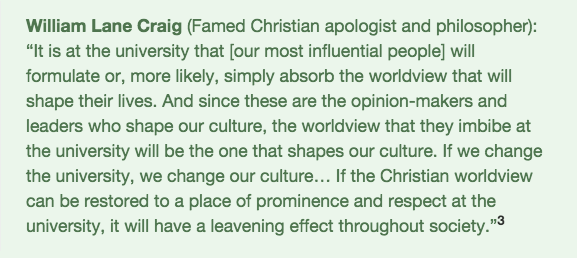
If serving God is your goal, look to the university

There is already a perfectly fine university right next door – no need to fly to Europe to find one! Remember, the university that took your faith away, or maybe the faith of someone you cared about? Yeah, it’s still there in your home town! And it’s still ruining the lives of thousands of young people. It seems to me that it’s better stewardship to stay here and work, then give money to groups like Reasonable Faith. And you can start a blog, teach in church and invite scholars to the local university, too. That costs almost nothing, and it produces better results.

What about Jesus?

Sometimes, it’s a good idea to look beyond the words of the Bible and reflect on the overall message of it at a higher level. When I look in the Bible, I see that Jesus went through a lot of suffering in obedience to God in order to secure the salvation of people who did not even like him. And it’s from this sacrifice on our behalf that his claim on our obedience comes. There are things that I don’t like to do that I do anyway because they work to serve God. Jesus life’s ambition was not to do things that were easy, or that made him happy. Experienced Christians do things that are not fun, because these things are right and because they solve the real problem.

New study: prayer improves self-control and emotional stability

Mysterious WGB posted this article from the UK Daily Mail.

Excerpt:

Praying helps people stay in control of their emotions and behaviour, according to a new study.

People turn to prayer ‘as a coping response to the high demands in life’ and are rewarded with increased strength and ability to resist temptation, researchers said.

Previous findings have shown that when people try hard to control their emotions and thoughts, the risk of aggressive outbursts and binge drinking or eating rises.

But the latest study, by German psychologists at Saarland University and the University of Mannheim, found that praying helps people maintain self-control.

‘A brief period of personal prayer buffered the self-control depletion effect’, wrote the team, whose findings are published in the Journal of Experimental Social Psychology online.

‘These results are consistent with and contribute to a growing body of work attesting to the beneficial effects of praying on self-control.’

Praying has already been linked in the past to reduced levels of infidelity and alcohol consumption.

Also, I feel that I should mention this interesting study, if we are going to have a Twilight Zone post today. (H/T STR)

Excerpt:

Abstract

We examined whether atheists exhibit evidence of emotional arousal when they dare God to cause harm to themselves and their intimates. In Study 1, the participants (16 atheists, 13 religious individuals) read aloud 36 statements of three different types: God, offensive, and neutral. In Study 2 (N = 19 atheists), ten new stimulus statements were included in which atheists wished for negative events to occur. The atheists did not think the God statements were as unpleasant as the religious participants did in their verbal reports. However, the skin conductance level showed that asking God to do awful things was equally stressful to atheists as it was to religious people and that atheists were more affected by God statements than by wish or offensive statements. The results imply that atheists’ attitudes towards God are ambivalent in that their explicit beliefs conflict with their affective response.

Now, I am blogging about this because it’s interesting, but I would classify this as being in the camp of near-death experiences and the Shroud of Turin. It’s interesting, but it’s not something that I would use to prove anything in a debate. Ever since I read this article from Christianity Today a while back, I’ve been sort of cautious about using prayer studies to argue for anything. Take this prayer study with a grain of salt.

Baby elephant in China cries for 5 hours after being stomped by his mom

Baby elephant rejected by his mother
Baby elephant cries after being attacked by his own mother

From the New York Daily News. (Printable version linked)

Excerpt:

Little Zhuangzhuang, a newborn elephant at a wildlife refuge in China, was inconsolable after his mother rejected him and then tried to stomp him to death.

Tears streamed down his gray trunk for five hours as zookeepers struggled to comfort the baby elephant.

They initially thought it was an accident when the mom stepped on him after giving birth, according to theCentral European News agency.

Employees removed him, cleaned him up and treated his injuries, then reunited the baby with his momma.

But she was having none of it, and began stomping him again.

So the game keepers stepped in once more and permanently separated the two.

“We don’t know why the mother turned on her calf but we couldn’t take a chance,” an employee told CEN.

“The calf was very upset and he was crying for five hours before he could be consoled,” he said.

“He couldn’t bear to be parted from his mother and it was his mother who was trying to kill him.”

The petite pachyderm, born in August, is now doing well. The zookeeper who rescued him from his violent mother adopted him and helped him thrive at the Shendiaoshan wild animal reserve in Rong-cheng, China.

I found another photo of the baby elephant here:

Baby elephant's birthday is supposed to be happy
A baby elephant’s birthday is supposed to be happy

And Sun News added this:

Elephants rejecting their young is not uncommon, either in captivity or in the wild. In 2004, baby elephant Keemaya died at the Calgary Zoo after its mother refused to care for it.

I am posting this because of the abortion issue (human abortion). I thought that by feeling sad for this baby elephant, it would remind us what abortion is really about. To me, abortion is about men and women having sex before they are able to take care of a child. When the child comes along “unexpectedly”, then the child is viewed as an enemy who needs to be killed before she can interfere with the happiness of her parents. Yes, they are the child’s parents. And yes, they are treating sex as recreational.

I guess a lot of my views on ethics are rooted in the obvious needs that children have. When I look at an unborn baby, I can tell what it needs. So, I am careful not to cause a pregnancy before I can supply its needs. The needs of the little unborn creature are driving these moral boundaries on me. And the same with born children. I oppose gay marriage because when I look at little children, I want them to have a stable environment to grow up in with a mother and father who are biologically related to them (in the best case). I permit lots of arrangements, but I promote one arrangement over the others because that’s what’s best for children. Anyone can look at unborn and born children and see that, just like anyone can look at a crying baby elephant and understand – “I have to govern my behavior so that I don’t hurt you”. If that means cutting off the premarital sex and making decisions that are likely to produce a stable marriage, then that’s what we should do.

Children cry too, you know. They cry when we hurt them. They cry when we make bad decisions and then they don’t get what they need. Children need mothers and fathers who care about them. Making a safe environment for a child isn’t an accident. It isn’t random and unpredictable. We have to control our desires before we have children, so that we provide children with what they need. It would be nice if men and women were more thoughtful and unselfish about children and marriage before they started in with sex.