
Tag Archives: Secularism

Canada’s Supreme Court bans Christians from practicing law in Canada

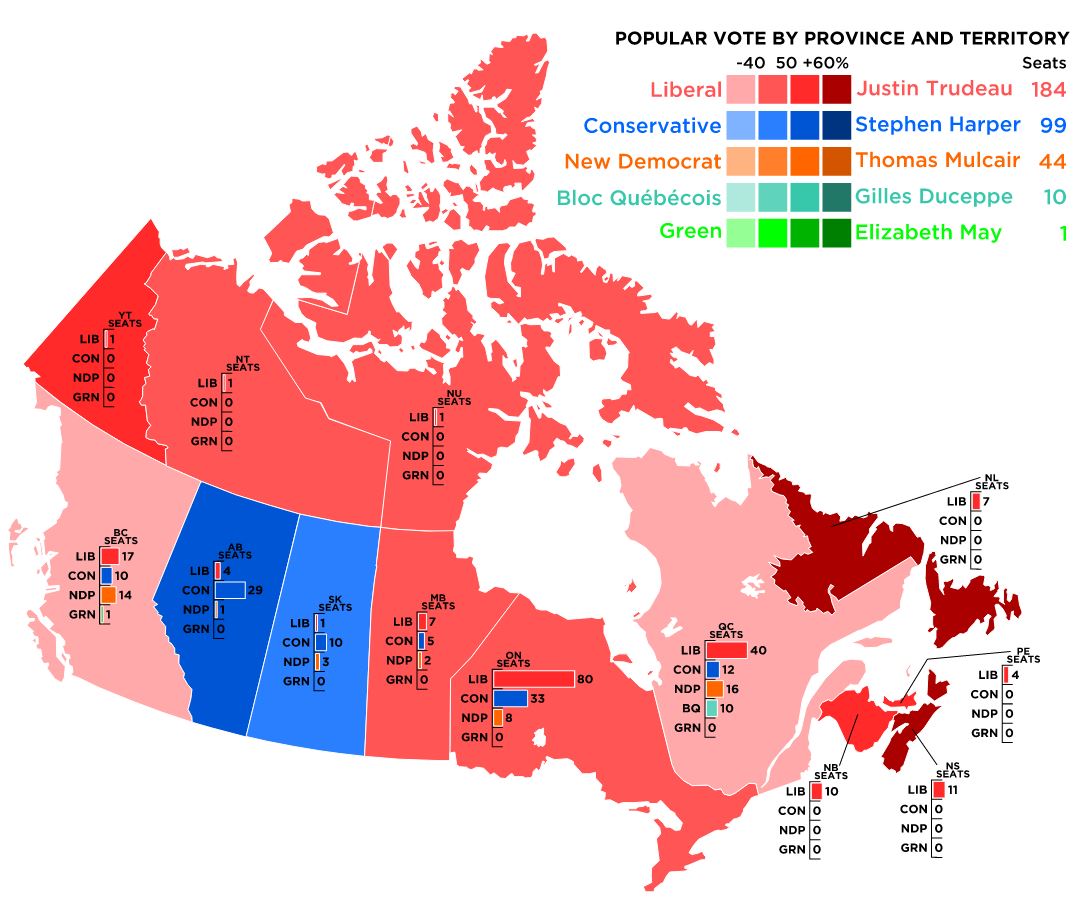
Canada election results 2015

The headline is a bit broad, but give me a minute, and I’ll explain what the judges decided. For one thing, it’s only in Ontario and British Columbia where the ban is in effect. Also, the basis of the ban is that Christians cannot be lawyers if they believe that sex before marriage  or outside of marriage is morally wrong. Let’s take a look at an article from the less leftist of Canada’s National newspapers, the National Post.

Excerpt:

Trinity Western University suffered a stinging loss in the Supreme Court of Canada on Friday, which found that law societies in B.C. and Ontario were justified in not accrediting the university’s prospective law school because of its policy on premarital sex. But no one should harbour any illusions that the pain will be limited to the small Christian school in B.C.’s Fraser Valley.

The impact of the court’s decision against TWU will seriously afflict the engagement of religious communities with public life across this country, regardless of whether it’s the Catholic Church, the Salvation Army or Muslim and Jewish charitable organizations.

The Supreme Court was asked to decide whether TWU’s Christian “community covenant,” in which students and staff agree to the understanding that sexual relations must be limited to heterosexual marriage — which, by definition, excludes homosexual relations — was a legitimate prerogative for an accredited law school. In layman’s terms, the court had to discern the balance between Charter-protected religious freedoms and emerging rights of sexual minorities to live their identities freely and fully.

The court ruled that the refusal of the two law societies to accredit TWU’s law school was a “reasonable” balancing of rights. Its logic was that LGBTQ students would be unlikely to apply to TWU given the community-covenant requirement, so they effectively would have 60 fewer spaces available to them. Other students have access to the 16 current law schools, plus TWU’s 60 spots, and that therefore constitutes an inequality. By compiling that perceived inequality with the fact that students at TWU commit to reserving sexual intimacy for within traditional Christian marriage, the court concluded that the TWU covenant created a “public interest” harm to the reputation of and public confidence in the legal profession. These outweighed, in the court’s assessment, the “minor” consequences of denying religious freedom to the TWU community.

The effect of this ruling is that Bible-believing Christians who study law at the only Bible-believing law school in Canada cannot practice law in two of the most populated provinces. But Ontario is the province that contains the large city of Toronto, as well as the capital city of Ottawa. This basically means that Trinity Evangelical Law School graduates would be unable to be lawyers or judges at the Supreme Court.

The Supreme Court is fine with LGBT people practicing law in Ontario and British Columbia, including at the Supreme Court, just not Christians who believe in the Bible. But those Bible-believing Christians should definitely have to pay taxes, including the taxes that go to pay for the salaries of their overlords on the Supreme Court. Basically, if you’re an evangelical Christian in Canada, then you’re good enough to be a slave, but not much else. You can work to pay for your secular slave masters, but you can’t have the same rights as people who don’t believe the Bible.

I think it goes without saying that the Supreme Court judges weren’t able to get this ruling from the text of the Canadian Charter of Rights and Freedoms. They just made it up from their own secular leftist values. This is actually normal for judges in Canada. There are no judges on the Canadian Supreme Court who accept that the Charter overrules the will of the judges.

Here’s a reaction to the ruling that I thought was interesting:

“Perhaps most disappointing from our perspective, the majority failed to account for or even address the equality rights of prospective TWU students or TWU’s freedom of association. These were issues we raised in our oral and written arguments to the court,” says Schutten. “The majority says it need not address those rights claims, because it is sufficient to ask whether the violation of freedom of religion is justified.” ARPA Canada believes that these other rights should play an important part in the “proportionality” analysis of the law societies’ decisions.

There is no freedom of religion in Canada. And there is no freedom of association in Canada. From previous rulings by Canadian Human Rights Commissions, we know that there is no freedom of speech in Canada. There is no right to self-defense from criminals in Canada. And there are no parental rights to educate your own children according to your Christian worldview in Canada. In Ontario, the man who wrote the education curriculum is now behind bars for child pornography, and the Supreme Court had nothing to say about whether that was morally wrong. For a long time, there has been covert discrimination against Bible-believing Christians in Canada, and now the Supreme Court has just shown what has been going on for decades and decades in universities and in government, in order to keep serious Christians out of positions of influence. From classroom teachers, to business owners to Supreme Court judges, Christians have been banned from the public square. Just like what happened to Jews in 1930s Germany.

Any Bible-believing Christian born in Canada has one mission: to get educated in a STEM skill that America needs, and then get out of that godless country. Kudos to those wise Christians who saw what was coming and got out early. It’s not the place for Christians to have a full and meaningful Christian life.


Ten scientific problems with global warming alarmism

Satellite measurements of global climate from U of Alabama Huntsville

My friend Bruce posted this article from the the Daily Wire, and I think it’s a good summary of the scientific evidence against global warming alarmism. After we go over this, I’ll take a stab at explaining why so many non-scientists desperately want to believe that global warming is true, and why they try to push everyone else to believe it, too.

First, the list:

  1. Temperature records from around the world do not support the assumption that today’s temperatures are unusual.
  2. Satellite temperature data does not support the assumption that temperatures are rising rapidly
  3. Current temperatures are always compared to the temperatures of the 1980’s, but for many parts of the world the 1980’s was the coldest decade of the last 100+ years
  4. The world experienced a significant cooling trend between 1940 and 1980
  5. Urban heat island effect skews the temperature data of a significant number of weather stations
  6. There is a natural inverse relationship between global temperatures and atmospheric CO2 levels
  7. The CO2 cannot, from a scientific perspective, be the cause of significant global temperature changes
  8. There have been many periods during our recent history that a warmer climate was prevalent long before the industrial revolution
  9. Glaciers have been melting for more than 150 years
  10. “Data adjustment” is used to continue the perception of global warming

So, we can’t look at all of these in one post. Obviously, the satellite measurements are the best thing to look at, since they cannot be tampered with as easily as the ground measurements, and they show no warming for 18 years.

But let’s look at number 8 instead:

Even in the 1990 IPCC report a chart appeared that showed the medieval warm period as having had warmer temperatures than those currently being experienced.  But it is hard to convince people about global warming with that information, so five years later a new graph was presented, now known as the famous hockey stick graph, which did away with the medieval warm period.  Yet the evidence is overwhelming at so many levels that warmer periods existed on Earth during the medieval warm period as well as during Roman Times and other time periods during the last 10,000 years.  There is plenty of evidence found in the Dutch archives that shows that over the centuries, parts of the Netherlands disappeared beneath the water during these warm periods, only to appear again when the climate turned colder.  The famous Belgian city of Brugge, once known as “Venice of the North,” was a sea port during the warm period that set Europe free from the dark ages (when temperatures were much colder), but when temperatures began to drop with the onset of the little ice age, the ocean receded and now Brugge is ten miles away from the coastline.  Consequently, during the medieval warm period the Vikings settled in Iceland and Greenland and even along the coast of Canada, where they enjoyed the warmer temperatures, until the climate turned cold again, after which they perished from Greenland and Iceland became ice-locked again during the bitter cold winters.  The camps promoting global warming have been systematically erasing mention of these events in order to bolster the notion that today’s climate is unusual compared to our recent history.

That’s right, the world was much warmer than it is now during the Medieval Warming Period… so warm that you could actually farm on Greenland. But now it’s all frozen over.

Bruce also posted this article from Forbes magazine about the so-called consensus about global warming among scientists.

It says:

It is becoming clear that not only do many scientists dispute the asserted global warming crisis, but these skeptical scientists may indeed form a scientific consensus.

[…]Only 36 percent of geoscientists and engineers believe that humans are creating a global warming crisis, according to a survey reported in the peer-reviewed Organization Studies. By contrast, a strong majority of the 1,077 respondents believe that nature is the primary cause of recent global warming and/or that future global warming will not be a very serious problem.

The survey results show geoscientists (also known as earth scientists) and engineers hold similar views as meteorologists. Two recent surveys of meteorologists (summarized here and here) revealed similar skepticism of alarmist global warming claims.

According to the newly published survey of geoscientists and engineers, merely 36 percent of respondents fit the “Comply with Kyoto” model. The scientists in this group “express the strong belief that climate change is happening, that it is not a normal cycle of nature, and humans are the main or central cause.”

The authors of the survey report, however, note that the overwhelming majority of scientists fall within four other models, each of which is skeptical of alarmist global warming claims.

[…]Taken together, these four skeptical groups numerically blow away the 36 percent of scientists who believe global warming is human caused and a serious concern.

Most people who get excited about the threat of global warming have something to gain financially from the hysteria. For example, Democrat campaign donors who own stock in solar or wind power companies that get fat government subsidies. Solyndra was one example of that.

Why do people believe weird things?

So why do people believe these things? People believe these things for the same reason that primitive people would sacrifice animals in order to get a bountiful harvest or be spared being struck by lightning. They fear the future, and they want to believe that they are doing something in order to save themselves from doom. There is something credulous in us that seeks to know and control the future. When we are told a noble lie by grant-seeking, attention-craving academics, we believe it because we want to believe it. We want to believe that the future is going to be OK, especially when all we have to do to make it OK is recycle cans and turn off our lights when we are not using them.

This is the real psychological motivation behind the desperate desire to believe in the global warming myth. We are scared, and we want someone to save us from the future. And we jump at the chance of controlling the future, especially when it means recycling cans, rather than having to deal with our own sinfulness. We invent a new morality that justifies us rather than having to comply with the old morality. Freedom to commit adultery, as long as we recycle cans to save the planet. Sanctification through purchasing carbon credits, instead of  sanctification through chastity, sobriety and self-control.

The Mysterious Drew lectures on Christianity and the culture war in Defenders

Investigation in progress

Drew taught Dr. William Lane Craig’s Defenders class for two weeks in a row while Dr. Craig was in Australia. He chose to focus on secularism.

Note: Drew has some problems with the microphone for the first 2.5 minutes of part 1. Be patient.

Part 1 deals with how Europe and America became secular in different ways.

Part 1 topics:

  • Secularism: the attempt to take values based on religion (e.g. – Judeo-Christian values) out of the public square
  • Television programs that are targeted to more thoughtful viewers favor secular or liberal worldviews
  • Consider the sexual revolution – a new set of beliefs about sex are being pushed into the culture
  • Sex revolution includes: same-sex marriage, pornography, hookup culture, no-fault divorce
  • The effect of the sexual revolution has been to introduce widespread fatherlessness, which is very bad for children
  • The sexual revolution is being pushed in the popular culture, but also in the school sexual education programs
  • You can see where secularism has led to by looking at Europe, which has largely rejected its Christian roots
  • For example, Germany and Sweden are very aggressive about stamping out homeschooling
  • They do this because they are trying to push a government-approved set of beliefs and meanings onto children
  • How bad could it get? You can look at how Orthodox Judaism was persecuted in Russia after the communist revolution
  • How did Europe become so secular?
  • Wars in Europe between Protestants and Catholics caused people to think that theistic religion was bad
  • Secularists first attacked theism philosophically by trying to replace it with deism – the view that miracles do not occur
  • Secularists then pushed a radical empirism which attempted to reduce religious claims to meaningless irrationality
  • The Christian church responded by retreating from philosophical and theological claims and focusing on moral claims
  • That’s how Europe became secular, but how did America become secular?
  • America became secular because Christianity was transformed from a knowledge tradition to an emotional tradition
  • Pastors started to move away from presenting Christianity as true and instead presented it as emotionally fulfilling
  • Pastors emphasized personal experiences instead of philosophical theology and apologetics
  • European ideas arrived: deism, Darwinism, Bible criticism, etc.
  • Christianity responded to this by abandoning the centers of learning it had founded (universities) into pious isolation
  • As the universities became more secular, they turned out the next generation of influencers, including the media
  • This retreat from intellectual engagement was augmented by a fixation on end-times speculation (e.g. Left Behind)
  • (Drew talks to Jeremy, a philosophy student at Georgia State University, about whether Christianity is respected in his classes)
  • How politicians and the media used the Scopes Monkey Trial to marginalize Christianity as anti-science
  • The perception of Christians in the public square changed – they were viewed as ignorant, irrational and anti-science
  • Instead of causing Christians to work harder at science, they became even more fundamentalist, and less influential
  • Christians today are a tiny minority of influential groups, e.g. – scientists, media, etc.
  • In contrast, secular Jews, who tend to grow up in a culture that values learning, have a much greater influence
  • Even if Christians try to retreat to the country where they can homeschool, there is no hiding from the Internet
  • Which organizations are working against secularism today?
  • Example of what Christians can do: Plantinga’s refutation of the problem of evil
  • Example of what Christians can do: widespread use of ultrasound to move people to the pro-life view
  • Example of what Christians can do: Liberty University’s effort to produce Christians who can work in media
  • A story about William Lane Craig and a secular physicist who had lost her faith

People must have liked what they heard and saw in the first week, because he got a big turnout in the second week.

Part 2 deals with practical tips for engaging in the culture.

Topics in Part 2:

  • The real root cause of opposition to Christianity is from the sexual revolution
  • For example, moral relativism is so popular in the university, but it is almost entirely driven by sexual liberation
  • Evangelism and culture-shaping are not the same thing – each requires a different set of skills
  • Where do people get their information? Public school, news media, late night comedy shows, etc.
  • Two things for every Christian need to do: 1) Get informed, and 2) Get involved
  • First: you do not need to be smarter than average. Dr. Craig is a leading scholar because he studies 9 hours a day
  • Implying that people with influence are “smart” just provides us with an excuse not to try if we are not “smart”
  • Ordinary Christians need to be willing to give up fun more than they need to be naturally “smart”
  • Asks Cody: what about that Christian apologist who hung out mostly with internet atheists and then became one
  • Famous quantum chemist: you’re right, I am not much smarter than most people, I just work a lot harder at it
  • Drew: to get informed, you should follow good Christian blogs like Apologetics 315 and Wintery Knight
  • Drew knows Wintery Knight personally and WK is someone who knows apologetics but he also knows other things
  • WK connects the Christian worldview to lots different things, e.g. = marriage – he can find you the right people and books
  • (Drew holds up “What is Marriage?” book) This is the best book to argue the same-sex marriage issue
  • (Drew hold up “The Case for Life” book) This is the best book to argue the pro-life position
  • Slacktivism: don’t just send people links that you find on the Internet – read the articles and books and then talk about them
  • (Drew holds up the Lee Strobel “Case for” books) These are the best introductory books on basic Christian apologetics
  • Audio books are a great way for people to take in the information, and you can get them for free from the library
  • The Internet is not the best place for arguing about the things you learn – face to face conversations are much better
  • Biola’s apologetics certificate program is an excellent resource, and it’s all audio lectures so you just listen to them
  • You can get free apologetics audio from Apologetics 315 and Phil Fernandes
  • We also need to learn how to how to change the culture and how the other side changes the culture
  • To really make a difference, then a graduate degree might be for you – especially the M.A. in apologetics from Biola
  • The university is also very important – Christianity needs to be represented in the university
  • Influential people like Supreme Court justices come out of the university, which is why we need to be there
  • The Discovery Institute is doing the most to provide a credible rival to naturalistic science
  • They have a budget of $4 million dollars and they are punching way above their weight
  • If every evangelical sent them $20, they’d have a budget of $1.2 billion – what could they do with that?
  • (Drew puts a check for $20 for Discovery Institute in an envelope and seals it, to show how it’s done)
  • The Truth Project, which is put out by Focus on the Family – it’s another excellent training resource
  • When it comes to politics, focus on discussing policy issues, not on pushing particular candidates
  • If every evangelical Christian just pulled their own weight, it would make a big difference
  • It all starts by making the decision to take some leisure time to do things that really work

I could not agree with him more on his selections on the marriage debate and the abortion debate. I have bought at least a half-dozen of each of those for people. And I highly recommend getting the Strobel books on audio, especially the Case for a Creator. Love that book. Listen to it a bunch a times and you will start to talk like Lee Strobel.

I listened to all the Biola University lectures before they even had the certificate program, along with the Stand to Reason Masters Series in Christian Thought and about 60 Veritas Forum leture sets. Those things probably did the most for me to become a capable defender of Christianity.

The point he made about giving money to the Discovery Institute is important. In the last month, I sent out $300 to a Ratio Christi chapter for a lecture they gave, and $500 for a Christian group in Canada that put on an apologetics conference.

I think he’s right when he talks about everyone pulling their own weight. I spend about 2-3 hours a day reading and blogging. I donate a portion of my earnings to Christian scholars who study and/or speak at the university. I support Christian students who are doing degrees in philosophy, science and engineering. In church, I don’t anything yet, but I have a network of friends who do things in church, like organize lectures, debates and apologetics book studies. My current pastor is aware of my abilities, and he’s already asked me to help them with an evangelism program they are starting up.

I got started on apologetics by putting in the time on some of the things he mentioned in part 2 of his talk. The basic things to do are reading introductory books on apologetics, especially the ones on philosophy of religion, historical Jesus and physical sciences. If you can’t read, then at least get hold of lectures from Biola University and listen to those, along with Lee Strobel audio books, Brian Auten interviews, William Lane Craig debates. Just put them in the car and listen, and soon you’ll be sounding just like them.