

Tag Archives: Reason

Serial sexual relationships, multi-partner fertility, single motherhood and fatherlessness

A man leading a woman upward

Here’s an article from the policy journal National Affairs (editor is Yuval Levin) that has some statistics about single motherhood by choice. When you are reading the article, keep in mind that most people who lean left are so influenced by feminism that they seem to think that women trip and fall accidentally, and end up pregnant from random men. I don’t think that we should minimize the fact that most women freely choose the men who treat them badly.

Excerpt:

Pew Foundation and Centers for Disease Control and Prevention surveys indicate that, on a range of measures, a very large share of fathers who do not live with their children have virtually no meaningful relationship with their non-custodial children. More than one-half report that they had not shared a meal with their non-custodial children in the last four weeks, while nearly two-thirds had not read to their children and a full three-quarters had not done homework with them. Moreover, these are self-reported figures, so the share of fathers with no relationship to their non-custodial children is most likely even higher.

When fathers form new romantic partnerships, their involvement with children from previous relationships declines. Jo Jones and William Mosher report that, while 39% of fathers in new romantic relationships had shared a meal with their non-custodial 5- to 18-year-old children at least once in the past month, 62% of those not in a new romantic relationship had. While 55% of fathers in a new romantic relationship had spoken with their 5- to 18-year-old non-custodial children, 77% of those not in a new romantic relationship had.

In addition, men with less education are more likely to exhibit absent-father behavior. Whereas 70% of fathers with at least some college had talked to their non-custodial 5- to 18-year-old children at least once in the past month, 59% of those with no more than a high-school degree had done so. While 74% of fathers with at least some college had played with their non-custodial child under 5 years old at least once in the past month, only 53% of those fathers with no more than a high-school degree had.

Multi-partner fertility is not only associated with father abandonment, it also adversely impacts child-maltreatment rates. Women attempting to balance work, the demands of new relationships, and the challenges of raising children are faced with a set of chronic stressors that often lead to child abuse and neglect. The shift from welfare to work increased these stresses. Partially as a result, between 1993 and 2005, the rate of overall abuse, physical abuse, sexual abuse, and serious abuse, respectively, rose by 22%, 14%, 49%, and 34% for children living with single mothers. By contrast, for children living in two-parent households, child-abuse rates fell on each of the four measures (by 42%, 24%, 62%, and 37%, respectively). By 2005, the child-abuse rate was 2.9 per 1,000 for children living with married biological parents but 10.2 for those living with a single parent and no partner, according to the U.S. Department of Health and Human Services. This disparity cannot be explained solely by socioeconomic status since the abuse rate for children in families of all kinds in the lowest socioeconomic group was still lower than that for children living in single-parent households.

Multi-partner fertility also increases child-abuse rates in a second way: the presence of non-biological fathers in the house. Child abuse in households with single mothers triples when they live with a man other than the child’s father. Child-maltreatment rates are actually lower in black than white households when the mother lives alone. But unfortunately, many men bring their job and other frustrations into the home, creating abusive situations. As a result, when a partner is present, the black rates on all three measures of child maltreatment — emotional, physical, and endangerment — are almost double the white rates. In addition, rates of intimate violence are over 12 times higher for single mothers than for married mothers.

Edin and Nelson ignore the subject of abusive behavior in men. Instead, despite the fathers’ caring attitudes, we are told, the mothers kick them out because they don’t earn sufficient income. And on the impact of multi-partner fertility on children, Doing the Best I Can offers one benign sentence: “Kids are amazingly resilient, but the rate of family change among children of unwed fathers has become so rapid, and now leads to such complicated family structures, that kids might have a hard time adjusting.”

Academic studies paint a much grimmer picture. After surveying the evidence, Sara McLanahan and Christopher Jencks concluded earlier this year,

[A] father’s absence increases antisocial behavior [among children], such as aggression, rule breaking, delinquency, and illegal drug use. These antisocial behaviors affect high school completion independent of a child’s verbal and math scores. Thus it appears that a father’s absence lowers children’s educational attainment…by disrupting their social and emotional adjustment and reducing their ability or willingness to exercise self-control.

The effects of growing up without both parents when it comes to aggression, rule breaking, and delinquency are also larger for boys than for girls. Marianne Bertrand and Jessica Pan found in 2011 that the behavior of boys is far more dependent upon good parenting practices — spending time with a child, emotional closeness, and avoiding harsh discipline — than that of girls. Such parenting habits are far more common in two-parent families, which helps to explain why boys with absent fathers are more likely to be suspended and have other behavioral problems than boys who have both parents at home.

The evidence also indicates that the outcomes are most negative when a man other than the biological father is present. Cassandra Dorius and Karen Guzzo found that “adolescents with a half-sibling with a different father are about 65 percent more likely to have used marijuana, uppers, inhalants, cocaine, crack, hallucinogens, sedatives, or other drugs by the time of their 15th birthday than those who have only full siblings.” Cynthia Harper and Sara McLanahan reported in 2004 that, among fatherless boys, those who lived with stepfathers were at an even greater risk of incarceration than those who lived with a single mother.

I think in today’s society, there seems to be a lot of fear and trembling to speak about moral standards. And it seems to be especially true that men are not allowed to tell women about their moral obligations. I know that at least when I speak to young women, they are often very rebellious. The attitude I encounter most often is that they feel that they should be able to trust their feelings and act in the way that their feelings dictate. Any destructiveness that results – which I warned them about – is dismissed as “unexpected”.

I can clearly remember the first time this happened to me, when I was in high school. I was friends with a girl named Tara who would come over and speak to me before morning announcements. She would tell me about her stock car driving boyfriend. One day, she told me that she was moving in with him. I warned her against it, and listed off a bunch of statistics about how this would cause problems. She stopped coming to talk to me, and so did her best female friend. Well, a few years later I ran into her again at one of our local universities where I was an undergraduate. She filled me in on what had happened. He had cheated on her with her best friend in their house. He got her pregnant. She had an abortion. She knew better now, but back in high school I was easily dismissed, and all of her friends sided with her.

Whenever I try to produce evidence to say that something is likely to cause harm, the response is usually “well I know a person who broke the rules and nothing happened”. I produce statistics about some likely consequence of following your heart, and it’s dismissed because some Hollywood celebrity managed to escape the probabilities. “Don’t judge me!” they say. Happiness comes first, and the best way to decide how to be happy in the long-term is apparently to do what makes a person feel happy right now. But statistics are there to tell a story of how the world normally works – dismissing it all with individual cases is bad logic. There are consequences to following your feelings and dismissing moral obligations.

What got me started on apologetics? William Lane Craig debate transcripts

To have informed views, listen to both sides
To have informed views, you should listen to both sides

Yes, William Lane Craig debate transcripts. In fact, I still read them from time to time to keep up my skills.

Here’s one of my favorites, the Craig-Nielsen debate on grounding morality without God

Summary:

THE CRAIG-NIELSEN DEBATE: GOD, MORALITY, AND EVIL
William Lane Craig and Kai Nielsen
with annotations by William Lane Craig
February 1991, University of Western Ontario

Best part:

Finally, he raises the issue of immortality and says, “Death doesn’t undermine moral values. In fact, things that we value become all the more precious.” Well, in one sense he’s right. It’s the absence of God that undermines the objectivity of moral values, not death. But let’s suppose that there are objective moral values. What would be undermined by the lack of immortality? I think two things.

First, I think there would be no reason to adopt the moral point of view. Since you’re going to die, everyone ends up the same. It doesn’t make any difference whether you live as a Hitler or a Mother Teresa. There is no relationship between your moral living and your ultimate fate. And so in that sense, death undermines the reason for adopting the moral point of view rather that just being an egoist and living for self.

Second, there’s no basis for self-sacrifice on this point of view. Why should an atheist, who knows everything is going to end in death, do things that are morally right that go against self-interest? For example, a few years ago there was a terrible mid-winter air disaster in Washington, DC, as a plane crashed into a bridge spanning the Potomac River, spilling its passengers into the icy waters. And as the helicopters came to rescue these people, attention focused on one man who again and again passed by the rope ladder rather than be pulled to safety himself. Seven times he did this, and when they came again, he was gone. The whole nation turned its eyes to this man in respect and admiration for the noble act of self-sacrifice that he did. And yet on the atheistic view, that man wasn’t noble. He did the stupidest thing possible. He should have gone for the rope ladder first, pushed others away, if necessary, in order to survive! But to give up all the brief existence he will ever have for others he didn’t even know? Why? It seems to me, then, that it’s not simply the absence of God that undermines objective moral values, but ethical living is also undermined by the atheistic point of view because you then have no reason to adopt the moral point of view and you have no basis for acts of self-sacrifice.

By contrast, on the Christian view, where you have both God and immortality, you have the necessary presuppositions for the affirmation of objective moral values and for consistent living of the ethical life.

And another of my favorites, the Craig-Taylor debate on the ontological grounding of morality.

Summary:

Is The Basis Of Morality Natural Or Supernatural?
Richard Taylor and William Lane Craig
October 1993, Union College, Schenectady, New York

Sample Craig:

(2) I argued that moral accountability also exists under the supernaturalist view, and Professor Taylor didn’t deny the point.

(II) What about my critique, then, of naturalism? I said that naturalism doesn’t provide a sound foundation for morality, and here I made two points:

(1) On the naturalist view, objective right and wrong do not exist. Again, Professor Taylor doesn’t deny this point; he just says, “Well, to say that they’re conventional doesn’t mean they’re contemptible.” Well, granted; but it does mean they’re arbitrary, they’re non–objective. There’s no more difference between moral right and wrong than driving on the right–hand side of the road versus the left–hand side of the road. It’s simply a societal convention. And the modern evolutionist thinks these conventions are just based in socio–biological evolution. According to Michael Ruse, a professor of the philosophy of science,

The position of the modern evolutionist…is that humans have an awareness of morality…because such an awareness is of biological worth. Morality is a biological adaptation, no less than are hands and feet and teeth…. Considered as a rationally justifiable set of claims about an objective something, [ethics] is illusory. I appreciate that when somebody says, ‘Love thy neighbor as thyself,’ they think they are referring above and beyond themselves…. Nevertheless…such reference is truly without foundation. Morality is just an aid to survival and reproduction and…any deeper meaning is illusory….{26}

This is essentially the same view as Professor Taylor’s. Moral values are simply rooted in socio–biological evolution, that have passed down as certain taboos and certain commands, but they have no objective validity in terms of their moral rightness or wrongness. Professor Taylor says, “But I have a high regard for people who are truly moral and decent.” I don’t deny that. Of course he does! But the point is that in his ethics, in his philosophy, he has no basis for that affirmation. What I bring is not a new set of values—I think we pretty much hold those in common—but I’m offering a secure foundation for those values that we all want to hold dear.

You see, on Professor Taylor’s view, there really isn’t any objective morality. I think every one of us here tonight would agree that it’s wrong to kill babies and that the holocaust was morally wrong. But in his book Professor Taylor says, “The infanticide practiced by the Greeks of antiquity did not violate their customs. If we say it was nevertheless wrong, we are only saying that it is forbidden by our ethical and legal rules. And the abominations practiced by the Nazis…are forbidden by our rules, and not, obviously, by theirs.”{27} I submit that that is simply a patently false view of moral values and that naturalism, therefore, can’t provide any objective basis for right and wrong.

And another of my favorites, the Craig-Tooley debate on the problem of evil.

Summary:

A Classic Debate on the Existence of God
Dr. William Lane Craig & Dr. Michael Tooley
November 1994, University of Colorado at Boulder

Sample Craig:

(2) Christian doctrines increase the probability of the coexistence of God and the evils in the world. Let me just mention a couple of these.

(i) On the Christian view, the purpose of life is not happiness as such in this life. Rather it is the knowledge of God—which will ultimately produce true and everlasting happiness. What that means is that many evils occur in this life which might be utterly pointless with respect to producing human happiness. But they might not be pointless with respect to producing the knowledge of God. Dr. Tooley assumes when he talks about changes that would make this world a better place, that the purpose of life is basically to be happy in this life. And I certainly admit that you could make changes that might appear to make this life a better place, make it happier. But that’s not God’s purpose. So if you understand that the purpose of life is not happiness as such, I think that you can see that the existence of evil doesn’t necessarily cast any improbability upon God’s existence.

(ii) It’s also the Christian view that God’s purpose spills over into eternal life. In the afterlife God will bestow a glory and happiness upon us that is incomparable to what we’ve suffered here on earth. And the longer we spend in eternity with Him, the more the sufferings in this life shrink by comparison to an infinitesimal instant. Dr. Tooley admits in his article that it is possible that immortality could justify such evils. But, he says, it’s “very unlikely” that there is life after death. Well, I have two comments. First, I’d like him to prove that it’s unlikely that there is life after death.{26} Second, I suggest that the resurrection of Jesus gives us grounds for hoping in life after death, and I’ve attempted to justify that historically. So given these Christian doctrines, I think you can see that the existence of God and evil is not so improbable after all.

[…](4) Finally, I think that there is actually an argument for God from evil. It would go like this:

(i) If God does not exist, objective moral values do not exist. If there is no God, moral values are either socio-biological by-products or just expressions of personal preference.

(ii) Evil exists. That’s the premise of the atheist. There is real evil in the world.

(iii) Therefore, objective values do exist. Some things are really wrong.

(iv) Therefore, God exists.

Thus the presence of evil in the world actually demonstrates God’s existence because in the absence of God, there wouldn’t be any distinction objectively between good and evil, between right and wrong. So although evil in one sense calls into question God’s existence, in a much deeper sense, I think, it actually requires God’s existence.

So in the light of these four responses, I think that the argument from evil, as difficult and emotionally pressing as it might be, in the end doesn’t constitute a good argument against the existence of God. So I think the four arguments given against the existence of God by Dr. Tooley are inconclusive. You’ve still got my six arguments for God’s existence, and therefore I still think that on balance the evidence favors theism as the more rational worldview.

You can find more debates here.

What is the best introductory book about pro-life apologetics?

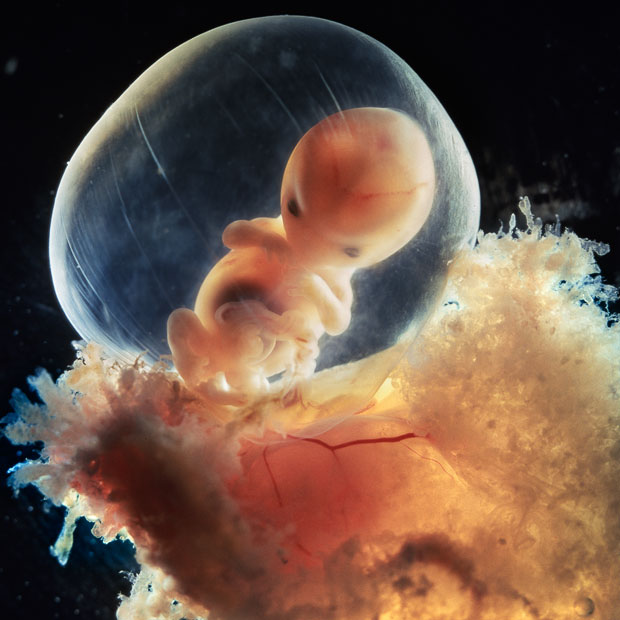
I'm Scheming Unborn Baby, and I approve this decision
I’m Scheming Unborn Baby, and I approve this message

Do you like to argue about controversial things? Of course you do. And so does Scheming Unborn Baby.

Here’s an excellent book review of the best pro-life book for ordinary people. It’s by Scott Klusendorf of the Life Training Institute.

Excerpt:

The Case for Life by Scott Klusendorf is an absolutely outstanding defense of the pro-life position with regard to the abortion debate. Being familiar with Scott’s work through Stand to Reason I was looking forward to this book with much anticipation. Scott is one of the most able, articulate, persuasive, and winsome pro-life speakers in the country and his book does not fail to deliver.

He’s got chapter-by-chapter breakdowns, so let’s look at some of them:

In chapter five Scott addresses the nature of truth and the topic of moral relativism, a view of morality our culture is saturated with to the core. Addressing this topic becomes absolutely necessary given its prevalence and the fact that often the claims of pro-lifers are misunderstood. This is seen in such cliches as “Don’t like abortion? Don’t have one!” or “I’m personally opposed to abortion but I think it should remain legal.” In short, pro-lifers are not making subjective preference claims when they say abortion is morally wrong but rather objective truth claims. Scott lays out some fundamental problems with moral relativism as well as a brief history outlining the move from moral realism to moral non-realism.

In chapter six Scott exposes the myth of moral neutrality. Both sides of the abortion debate have views they want to legislate and it is impossible for the state to remain neutral. However, it is often pro-lifers who are accused of trying to “legislate morality” while pro-abortion choice advocates get a free pass. In short, pro-lifers are dismissed as “religious” because of an unwillingness by pro-abortion choice advocates to address the issues. This is intellectually dishonest. How bout we stick with science?

And more:

In chapters ten through fifteen Scott addresses some of the most common arguments put forth by pro-abortion choice advocates. These include “Women will die from illegal abortions,” “You shouldn’t force your view on others,” “Pro-lifers should broaden their focus,” “Rape justifies abortion,” “Men can’t get pregnant,” and “It’s my body, I’ll decide.” The fundamental problem with most of these objections is that they beg the question. They assume the unborn is not a human person.

One more chapter – I’ve never seen chapters like this before:

In chapter sixteen Scott outlines four essential tasks that pastors concerned with biblical truth need to accomplish:

First, Christian pastors need to emphasize a biblical view of human value and ensure their congregation understands that abortion unjustly takes the life of an innocent human being. Second, they need to equip their congregation with pro-life apologetics so they can compete in the marketplace of ideas. Third, they need to emphasize the healing power of the gospel of Jesus Christ and preach repentance and forgiveness for post-abortion men and women. Finally, Christian pastors need to overcome their fear that abortion is a distraction, their fear of driving people away who might otherwise hear the gospel, and their fear of offending people with abortion-related content.

If you want to see Scott speak, here’s a new-ish 42-minute lecture:

If you like that, consider getting the book. Scheming Unborn Baby recommends it, and so do I.