
Tag Archives: Reason

Should Christians expect to know God’s will by means of feelings and intuitions?

There are two views on the topic of decision making and the will of God. The view you learn in the church is called “the traditional view”. I call this view the feelings/intuition view. This view that elevates feelings / intuitions to the level of divine communications from God. The more practical view is called “the wisdom view”. I call this view the battlefield commander view. I am a proponent of the wisdom / commander view.

Let’s learn about the two different views:

[The traditional view is] that God has a plan for our lives and that we receive guidance through methods such as “open and closed doors”, “feeling led” and “the still, small, voice”.

[The wisdom view] holds that God does not have an “individual will” for our lives, but rather that all of God’s will can be summed up within two categories, God’s sovereign will and God’s moral will. Basically God’s sovereign will is all the things that god decrees will happen. It is hidden (mostly) from us, and does not play an active part in our decision, although some of it is revealed in the bible. God’s moral will is the part that we must concern ourselves with in making decisions. It is fully revealed in the bible and our decisions must be made within it. We may use wisdom in applying god’s moral will to our lives, or we may be in an area not covered by god’s moral will. We must finally submit in advance to God’s sovereign will, being prepared for him to sovereignty intervene and redirect us through whatever means he wills (see James).

Here’s a bit more from someone else:

Regarding the view that God has a personal will for us individually that we have to discern and find, J.I. Packer says, “The first thing to say is that the idea of guidance is actually a novelty among orthodox evangelicals. It does not go back farther than the last century. Second, it has led people to so much foolish action on the one hand, and so much foolish inaction on the other, as well as puzzlement and heartbreak when the ‘hotline’ to God seems to go silent, that it has to be discredited. Third, it must be said that Scripture gives us no more warrant constantly to expect personal ‘hotline,’ ‘voice-from-the-control-tower’ guidance than to expect new authoritative revelations to come our way for the guidance of the whole church.” (Hot Tub Religion, page 118).

As to the point of the question, how do I make decisions, I attempt to make decisions in light of three factors: God’s moral will, wisdom, and my personal desires. If something is opposed to God’s moral will, then I should obviously flee from it. If it’s not opposed, then I consider the wisdom of the choices. For example, would it be wise for me to marry a woman who loves Jesus, though we have nothing else in common? Probably not. If the options pass the criteria of wisdom, then I’m free to choose how I wish. If I’m offered two jobs, and both are honoring to God, and both would be wise to take, then I’m free to choose the job I would like more. I don’t need to put out a fleece or await some other confirmation from God. If it’s moral and wise, then the only question as to whether or not it will honor Him is my attitude.

Some examples of this model used in the Bible (in theological circles referred to as the Wisdom Model) are in Paul’s planning of a mission to Rome in Romans 1:9-15, 15:22-24, the Jerusalem Council (Acts 15:1-29), and Paul’s instructions for legal disputes (1 Cor 6:3-6).

The best book on this topic is Garry Friesen’s “Decision Making and the Will of God”. In it, you’ll find a full assessment about what the Bible teaches on this topic.

When I am trying to decide what will be effective, I look at Christian scholars, at their papers, books, and public debates. That’s effectiveness because it is addressed to a non-Christian audience in public with the force of reason and evidence. It is persuasion and it is addressed to rational minds. I want to change the minds of people who have a large influence on society on the whole. I don’t think that offering Christianity as life-enhancement or self-help is really “having an influence”. I think that offering Christianity as truth, with support, is “having an influence”.

So let me be clear about what I believe:

  • I don’t think that God normally talks to people directly
  • I don’t believe that life is an Easter egg hunt, filled with clues accessible only to emotion and intuition
  • I don’t believe that God expects people to discover a specific will for their lives using non-rational means
  • I think that people make up their own life plan that is consistent with the Bible
  • The goal of the life plan is to be effective, and there are no other considerations
  • I think that there are many good things a person can do, but that some are more effective than others
  • I think that with respect to the goal of serving God effectively, my happiness is expendable
  • I don’t think that the purpose of doing something for the Lord is to feel good about ourselves
  • I don’t think that people should choose ineffective things to do just because they like them
  • I don’t think that people should choose ineffective things to do just because they are good at them
  • I think people should do hard things that they don’t like – as long as it’s more effective
  • I don’t think that any course of action is as effective as any other – some plans accomplish more
  • I don’t think that life is totally unpredictable and irrational and subjective
  • I think that we can know what is or is not effective by studying and learning about the world
  • I think life is like a battlefield that must be surveyed, understood and acted upon deliberately

I think that every person is the commanding officer of his or her own life, and each person must study everything they can, make a plan that is consistent with the Bible’s moral prescriptions, execute the plan and achieve whatever they can achieve for the Lord. And the goal is not comfort or happy feelings, but real achievements. Not for the purpose of being saved, of course, because salvation is a free gift of God because of what Jesus did on the cross. Life is more like a battle than a vacation resort or a buffet or a shopping center. God’s will for us is not have happy feelings, but that we freely choose to sacrifice ourselves out of obedience and service to him. In my case, that means studying hard things, making money, saving money, and giving money away to good scholars, sponsoring good events and being persuasive to non-Christians. None of this necessarily makes me happy, but it does work to bring glory to God. I cried when I had to learn calculus, because it was so hard. But who cares? The main thing is that I have money now to sponsor Christian speakers or to give books to Christians to read, and God is happy with that.

I think that it is very important to realize that God is not impressed by our not being smart and not being effective. If we have the ability to be smart, then we should be smart, whether it makes us happy or not. If we have the ability to make money, then we should make money, whether it makes us happy or not. If we have the ability have a great influence, then we should have a great influence, whether it makes us happy or not. There will be plenty of time for happiness after we’re dead. But this life is a time of serving, and we should try to serve effectively, whether it makes us happy or not. With respect to God’s purposes in the world, my happiness is expendable.

Whenever someone questions my goals and plans by saying that I am asserting my will over God’s will, the first question I want to ask that person is this: “how do you know what God’s will is?” and “what is your basis for thinking that my plan to serve will not be effective?”. I want to know if I have misunderstood something about the way the world is, or miscalculated in some way. I want someone to look at my calculations and show where they are going to produce a less optimal result for the Lord. That’s the only concern I have – effectiveness for the Lord. Usually what I have found is that the other person wants to make the purpose of life their own happiness, and it makes them happier to choose what to do moment by moment, without having to study anything or make plans. It’s not that they have better goals (for God) or better plans (for God). It’s that they want their goals to be above God, and they don’t want to make plans other than to do whatever makes them happy.

This article by Greg Koukl may be helpful.

And I also found this summary of the Friesen book useful:

In nine parts.
Why do atheists like Dan Barker abandon their faith?

Unbelievable’s latest radio show featured a discussion with former Christian Dan Barker, the founder and co-President of the Freedom From Religion Foundation.

The MP3 file is here. (60 minutes)

I thought that I would make some general comments about why I think that many people leave the Christian faith, and what you should be careful of in order to avoid following in Dan Barker’s footsteps, specifically.

Basically, there are four major reasons why people leave Christianity.

  1. They want to do something immoral with impunity. This type of person wants to do something immoral that is forbidden by Christianity, like pre-marital sex. They dump Christianity in order to feel better about seeking happiness in this life, apart from God and his moral duties.
  2. They want to pursue happiness in irresponsible ways. This type of person thinks that God’s job is to save them when they act irresponsibly while pursuing happiness. When God disappoints them by not giving them what they want in order to be happy, they leave the faith.
  3. They want to be loved by people, not by God. This type of person thinks that Christianity is a tool that they can use to become popular. When they first try to articulate the gospel in public, they find that people don’t like them as much, and they feel bad about offending people with exclusive truth claims that they cannot back up using logic and evidence. So, they water down Christianity to get along with atheists, liberal Christians and other religions. Finally, they jettison Christianity completely and focus on making everyone feel good about whatever they believe.
  4. They don’t want to learn to defend their faith. This type of person is asked questions by skeptics that they cannot answer. Usually this happens when people go to university after growing up in the shelter of the Church. The questions and peer pressure make them feel stupid. Rather than investigate Christianity to see if it’s true and to prepare to defend it in public, they dump it so they can be thought of as part of the “smart” crowd.

Now listen to the discussion and see if you can identify some of these factors from Barker’s own carefully-prepared words. He is trying very hard to make himself look honest and moderate, because he wants Christians to be sympathetic with his story and his motives for leaving Christianity. But I think that there is enough in his statements to construct a different hypothesis of why he left Christianity.

I’ve grouped the data by risk factor. (These are not his exact views)

Non-rational, emotional approach to Christianity

  • he was raised in a devout Christian family where he probably wouldn’t have faced skeptical questions
  • he converted to Christianity at age 15 as a result of a religious experience, not a serious investigation
  • his idea of God was probably idealized and uninformed, e.g. – a loving God who wants us to be happy
  • he wandered around from church to church preaching, with no fixed address or source of income
  • he earned money by collecting “love offerings” from churches where he performed his music
  • he wrote Christian songs and Christian musicals, but nothing substantive on apologetics and theology
  • he worked in three churches known for being anti-intellectual and fundamentalist
  • there’s no evidence that of any deep study of philosophy, science and history during this time

Desire to gain acceptance from non-Christians

  • he began to notice that some people were uncomfortable with sin and Hell
  • he began to avoid preaching about sin and Hell in order to make these people comfortable
  • he watered-down the gospel to focus on helping people to be happy in this life
  • his manic approach to Christian ministry was challenged by the “real life” needs of his growing family
  • he met liberal pastors while performing his music in their churches
  • he found it difficult to disagree with them because they seemed to be “good” people
  • he watered down his message further in order to appeal to people across the theological spectrum

Ignorance of Christian apologetics

  • he began to think that if there are many different views of religion, then no view can be correct
  • he was not intellectually capable of using logic and evidence to test these competing claims to see which was true
  • he decided to instead re-interpret Christian truth claims as non-rational opinions, so they could all be “valid”
  • he became a theological liberal, abandoning theism for an impersonal “ground of being”
  • he embraced religious pluralism, the view that all religions are non-rational and make no testable truth claims
  • he began to see God as a “metaphor” whose purpose is to make people have a sense of meaning and purpose
  • he jettisoned God completely and focused more on helping people find meaning and morality apart from God
  • seems to think that religion is about having a “great life”, and felt that you can have a “great life” without religion
  • seems to think that religion is about being “good”, and felt that you can be “good” without religion
  • religion makes people feel bad by telling them what to do instead of letting them do anything they want
  • religion makes people feel bad by telling them what is true, instead of letting them believe whatever they want
  • religion makes people feel bad by telling them that God will hold them accountable for their beliefs and actions

So what do I think happened?

I think he abandoned his faith because he wanted people to like him and because he needed to be invited to liberal churches in order to make money to pay for the “real life” needs of his family.

He seems to have thought that Christianity is about having his needs met and being liked by others. I think he wanted to feel good and to make people feel good with his preaching and singing. He seems to have become aware that the exclusive claims of Christianity made other people feel offended, so he cut them out. He hadn’t studied philosophy, science or history so that he would have been able to demonstrate to other people whether what he was saying was true. It’s hard to offend people when you don’t really know whether your claims are true or not, and when you don’t know how to demonstrate whether they are true or not.

I also think money was a factor. It seems to me that it would have hurt his career and reduced his invitations from liberal churches if he had kept up teaching biblical Christianity. In order to appeal to a wider audience, (like many Christian singers do – e.g. – Amy Grant, Jars of Clay, etc.), he would have felt pressured to water down the unpleasant parts of his preaching and singing. Lacking apologetics skill, he instead abandoned his message. He needed to account for his family’s needs and “real life”, and exclusive truth claims and Hell-talk would probably have reduced his ability to do that. It seems to me that he should have scaled back his extreme schedule of preaching and singing, and instead gotten a steady job so that he could afford “real life” and a family without being pressured into altering his message.

Life isn’t a fairy tale. God isn’t there to reward risky behavior. We need to be more shrewd about financial matters so that we have the ability to not care about what people think of us. Look at this blog. I work all day as a senior software engineer with two degrees in computer science so that I can refuse donations. I save most of what I make in case a tragedy strikes. Since I am financially secure, I can say what I think, and disregard anyone who wants me to change my message because they are offended. Becoming a Christian isn’t a license to behave irrationally and immaturely with money. For some people, (like William Lane Craig), stepping out in faith works. But if it doesn’t work, it’s better to retreat and re-trench, rather than to compromise your message for money.

Barker didn’t seem to make any effort to deal intellectually with typical challenges like the existence of Hell and religious pluralism. He just wanted to be liked by people instead of being liked by God. He seemed to have thought that being a Christian would make him happy and that other people would all respond to him and like him without having to do any work to explain why Christianity is true. But that’s not Biblical. When the singing and preaching is over, you still have to know how to give an answer to non-Christians. But Barker couldn’t give an answer – not one that allowed him to retain his beliefs. He had not prepared a defense.

What does Dan Barker think about Christianity today?

Many atheists today are interested in eradicating public expressions of Christian beliefs in the public square, because they hate Christianity and believe that Christians should not be allowed to make them feel bad by exercising their rights of free speech. Is Dan Barker one of these militant atheists?

Well, take a look at this video, in which he objects to a nativity scene and demands that an atheistic denunciation of theism be posted alongside it. In the video, Barker explains that the nativity scene is hate speech, and that the baby Jesus is a dictator. He seems to be totally oblivious to the the idea that if Christianity is true, then it doesn’t matter whether it’s mean and exclusive. And this seems to me to have been his problem all along, from the day of his “conversion”.

So the real question is this: is it true? Barker seems to be much more interested in asking “is it nice?” and “will it make me happy?”.

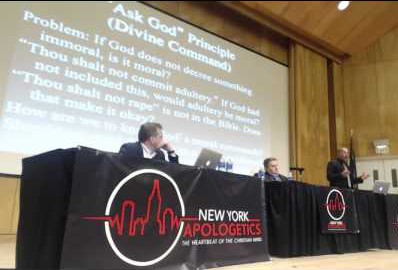
Atheist Michael Shermer tries to rationally ground morality in debate with Frank Turek

Michael Shermer debates Frank Turek: atheism and morality

The topic of the debate was on the grounding of morality – which worldview (theism or atheism) is better at grounding morality?

And here is the MP3 for the cross-examination only, which is what I will be summarizing. (12.5 Mb)

The full debate can be seen here and can be heard here.

Turek’s cross-examination period starts at 74m22s and ends at 89m20s.

Shermer’s cross-examination period starts at 89m50s and ends at 105m0s.

Topics of Turek’s cross-examination:

  • evolution produces Shermer’s moral sense and Hitler’s moral sense
  • why does Shermer think his is better than Hitler’s, since both were produced by the same evolution?
  • what makes right or wrong if evolution is the source of morality?
  • why is Stalin’s opinion of right and wrong less valuable than the herd’s opinion of right and wrong?
  • do the Founding Fathers ground inalienable rights in a Creator, or in evolution?
  • can atheism ground the existence of inalienable rights?
  • can you ground objective moral values and objective moral duties by asking people how they feel?
  • can you ground objective human rights on atheism by shouting like a madman and interrupting?
  • how can you trust your thinking if they are the result of an unguided, random process of evolution?
  • how can you have rational thoughts if materialism is true, and you are a machine made out of meat?
  • can you ground objective moral values and objective moral duties on personal preferences?
  • how do the personal preferences of some individuals create an objective moral duty for other individuals?
  • does naturalistic evolution orient human beings toward survival or truth?
  • on materialism, what is the chemical composition of justice?

Topics of Shermer’s cross-examination:

  • Radical muslims are exactly the same as evangelical Christians, and have the same God (Allah is the same as the Triune Christian God)
  • Radical muslims would assert that their God is the same as the Triune Christian God, with Jesus and the Holy Spirit also being God
  • Therefore, we can lay the blame for what radical muslims do on the backs of evangelical Christians
  • Radical muslims and evangelical Christians are the same, because “you’re enthusiastic, they’re enthusiastic”
  • The Bible’s notion of indentured servitude to pay off debt is the identical to the idea of slavery based on race
  • The Bible’s notion that masters and slaves are equal in the sight of God forms a basis for thinking they are unequal
  • The Bible teaches things that I disagree with, like the idea that marriage should provide children with a mother and a father
  • Gay marriage is solidly grounded in evolution, even though the morality that evolution produces varies by time and place
  • Atheists can ground objective moral values and objective moral duties by asking people how they feel
  • Can atheists who want to legalize gay marriage because “they’re in love” prohibit polygamy or incest as marriage?
  • Is shouting “you’re on the wrong side of history” a way to rationally ground morality in an accidental atheistic universe?
  • Is it loving for atheists to celebrate a lifestyle that exposes gay men to sickness and premature death?
  • Is it “bigotry” for the Center for Disease Control to warn men who have sex with men about higher health risks?
  • How do Christians decide what is right and wrong when they are confronted with a moral dilemma?
  • How do humans sense the objective moral standard that is required for them to make moral judgments
  • Can enlightenment philosophers who merely imagine human rights actually create those human rights?
  • If revelations change over time for Mormons, does that undermine the need for God to ground objective morality?

I apologize for the poor quality of the video and audio. The moderator was extremely ineffective, letting Shermer go on and on making speeches instead of asking questions during his questioning time. Also, Shermer apparently thought that shouting at Turek and waving his finger at Turek was a good strategy to defend against Turek’s use of logic and evidence.

My thoughts on Michael Shermer

I do want to make some general comments about what Shermer said. Shermer’s view of morality is “what is best for the greatest number of people”. There are no inalienable rights that act as a break on the will of the majority. Shermer has no objection to anything that the majority has decided in any time or in any place. If he were there, he would agree that whatever they decided was morally right.

Two hundred years ago, Shermer would have endorsed slavery. And if he were in Germany 50 years ago, he would have endorsed the Holocaust. If he lived in a Pakistan today, he would endorse stoning women for wearing the wrong clothes. Atheists always think that whatever the majority is doing in a particular time and place is right for them. There are no inalienable human rights that exist apart from human opinions, on atheism.

Another problem is that Shermer is constantly making moral judgments when his own view is that morality is constantly changing in different times and places. He condemns the moral values of other times and places without having any standard in his worldview that can decide between different moral values and duties. It is like saying that lunch is better than breakfast because lunch is here and now, and breakfast was then and there. That is literally what atheists do when they make moral judgments. They have no standard that applies to different times and places, just the ever evolving opinions of the majority of people in different times and places.

Is Michael Shermer concerned about morality?

Finally, I want people to understand what kind of person Michael Shermer is. You can read a post by PZ Myers on his blog Pharyngula to get the picture. I think it’s useful to know about Shermer’s own morality since he seems to like to make moral judgments so much during debates. In my own experience in dealing with atheists, although they will talk about slavery and the Crusades, there is nothing in an atheist’s moral system that makes things wrong for all times and all places. They bring it up to stop you from judging them about the things that they care about. When an atheist says “the Crusades! Slavery!” what they really mean is “I need to shame you for having a basis for moral judgments against me, so that you won’t say anything about me getting married women drunk then raping them”. That’s what atheistic use of moral language is really about.

What atheists really think about morality

Atheist Richard Dawkins says atheists have no objective moral standards:

In a universe of blind physical forces and genetic replication, some people are going to get hurt, other people are going to get lucky, and you won’t find any rhyme or reason in it, or any justice. The universe that we observe has precisely the properties we should expect if there is, at bottom, no design, no purpose, no evil and no good, nothing but blind, pitiless indifference… DNA neither knows nor cares. DNA just is. And we dance to its music. (Richard Dawkins, River Out of Eden: A Darwinian View of Life (1995))

So, when Shermer tries to shame Christians for behaviors in other times and places which our society here and now disagrees with, what he really means is “morality, objectively speaking, is nonsense, but I will use your moral sense that comes from your non-atheistic worldview to shame you, so that you won’t have the confidence to judge me for my immoral behavior”. And we need to get used to understanding this about atheists. Morality is nonsense to them, and their real goal is to get you off their back for their hedonism. For atheists, morality is just complying with arbitrary social customs which vary by time and place. There is nothing more to it than aping their neighbors (at least when their neighbors are watching). And they would have aped slave-owners, widow-burners and Nazi prison guards too, if they lived in that time and place. And shouted at Christians for disagreeing with them, just like Shermer did about gay marriage.

If you like the way that Frank Turek debates, then be sure and check out his new book “Stealing From God“. I highly recommend it.