
Tag Archives: Reason

Serial sexual relationships, multi-partner fertility, single motherhood and fatherlessness

A man leading a woman upward

Here’s an article from the policy journal National Affairs (editor is Yuval Levin) that has some statistics about single motherhood by choice. When you are reading the article, keep in mind that most people who lean left are so influenced by feminism that they seem to think that women trip and fall accidentally, and end up pregnant from random men. I don’t think that we should minimize the fact that most women freely choose the men who treat them badly.

Excerpt:

Pew Foundation and Centers for Disease Control and Prevention surveys indicate that, on a range of measures, a very large share of fathers who do not live with their children have virtually no meaningful relationship with their non-custodial children. More than one-half report that they had not shared a meal with their non-custodial children in the last four weeks, while nearly two-thirds had not read to their children and a full three-quarters had not done homework with them. Moreover, these are self-reported figures, so the share of fathers with no relationship to their non-custodial children is most likely even higher.

When fathers form new romantic partnerships, their involvement with children from previous relationships declines. Jo Jones and William Mosher report that, while 39% of fathers in new romantic relationships had shared a meal with their non-custodial 5- to 18-year-old children at least once in the past month, 62% of those not in a new romantic relationship had. While 55% of fathers in a new romantic relationship had spoken with their 5- to 18-year-old non-custodial children, 77% of those not in a new romantic relationship had.

In addition, men with less education are more likely to exhibit absent-father behavior. Whereas 70% of fathers with at least some college had talked to their non-custodial 5- to 18-year-old children at least once in the past month, 59% of those with no more than a high-school degree had done so. While 74% of fathers with at least some college had played with their non-custodial child under 5 years old at least once in the past month, only 53% of those fathers with no more than a high-school degree had.

Multi-partner fertility is not only associated with father abandonment, it also adversely impacts child-maltreatment rates. Women attempting to balance work, the demands of new relationships, and the challenges of raising children are faced with a set of chronic stressors that often lead to child abuse and neglect. The shift from welfare to work increased these stresses. Partially as a result, between 1993 and 2005, the rate of overall abuse, physical abuse, sexual abuse, and serious abuse, respectively, rose by 22%, 14%, 49%, and 34% for children living with single mothers. By contrast, for children living in two-parent households, child-abuse rates fell on each of the four measures (by 42%, 24%, 62%, and 37%, respectively). By 2005, the child-abuse rate was 2.9 per 1,000 for children living with married biological parents but 10.2 for those living with a single parent and no partner, according to the U.S. Department of Health and Human Services. This disparity cannot be explained solely by socioeconomic status since the abuse rate for children in families of all kinds in the lowest socioeconomic group was still lower than that for children living in single-parent households.

Multi-partner fertility also increases child-abuse rates in a second way: the presence of non-biological fathers in the house. Child abuse in households with single mothers triples when they live with a man other than the child’s father. Child-maltreatment rates are actually lower in black than white households when the mother lives alone. But unfortunately, many men bring their job and other frustrations into the home, creating abusive situations. As a result, when a partner is present, the black rates on all three measures of child maltreatment — emotional, physical, and endangerment — are almost double the white rates. In addition, rates of intimate violence are over 12 times higher for single mothers than for married mothers.

Edin and Nelson ignore the subject of abusive behavior in men. Instead, despite the fathers’ caring attitudes, we are told, the mothers kick them out because they don’t earn sufficient income. And on the impact of multi-partner fertility on children, Doing the Best I Can offers one benign sentence: “Kids are amazingly resilient, but the rate of family change among children of unwed fathers has become so rapid, and now leads to such complicated family structures, that kids might have a hard time adjusting.”

Academic studies paint a much grimmer picture. After surveying the evidence, Sara McLanahan and Christopher Jencks concluded earlier this year,

[A] father’s absence increases antisocial behavior [among children], such as aggression, rule breaking, delinquency, and illegal drug use. These antisocial behaviors affect high school completion independent of a child’s verbal and math scores. Thus it appears that a father’s absence lowers children’s educational attainment…by disrupting their social and emotional adjustment and reducing their ability or willingness to exercise self-control.

The effects of growing up without both parents when it comes to aggression, rule breaking, and delinquency are also larger for boys than for girls. Marianne Bertrand and Jessica Pan found in 2011 that the behavior of boys is far more dependent upon good parenting practices — spending time with a child, emotional closeness, and avoiding harsh discipline — than that of girls. Such parenting habits are far more common in two-parent families, which helps to explain why boys with absent fathers are more likely to be suspended and have other behavioral problems than boys who have both parents at home.

The evidence also indicates that the outcomes are most negative when a man other than the biological father is present. Cassandra Dorius and Karen Guzzo found that “adolescents with a half-sibling with a different father are about 65 percent more likely to have used marijuana, uppers, inhalants, cocaine, crack, hallucinogens, sedatives, or other drugs by the time of their 15th birthday than those who have only full siblings.” Cynthia Harper and Sara McLanahan reported in 2004 that, among fatherless boys, those who lived with stepfathers were at an even greater risk of incarceration than those who lived with a single mother.

I think in today’s society, there seems to be a lot of fear and trembling to speak about moral standards. And it seems to be especially true that men are not allowed to tell women about their moral obligations. I know that at least when I speak to young women, they are often very rebellious. The attitude I encounter most often is that they feel that they should be able to trust their feelings and act in the way that their feelings dictate. Any destructiveness that results – which I warned them about – is dismissed as “unexpected”.

I can clearly remember the first time this happened to me, when I was in high school. I was friends with a girl named Tara who would come over and speak to me before morning announcements. She would tell me about her stock car driving boyfriend. One day, she told me that she was moving in with him. I warned her against it, and listed off a bunch of statistics about how this would cause problems. She stopped coming to talk to me, and so did her best female friend. Well, a few years later I ran into her again at one of our local universities where I was an undergraduate. She filled me in on what had happened. He had cheated on her with her best friend in their house. He got her pregnant. She had an abortion. She knew better now, but back in high school I was easily dismissed, and all of her friends sided with her.

Whenever I try to produce evidence to say that something is likely to cause harm, the response is usually “well I know a person who broke the rules and nothing happened”. I produce statistics about some likely consequence of following your heart, and it’s dismissed because some Hollywood celebrity managed to escape the probabilities. “Don’t judge me!” they say. Happiness comes first, and the best way to decide how to be happy in the long-term is apparently to do what makes a person feel happy right now. But statistics are there to tell a story of how the world normally works – dismissing it all with individual cases is bad logic. There are consequences to following your feelings and dismissing moral obligations.

96% of political donations by Cornell University faculty go to Democrats

Donations by Cornell University faculty
Political donations by Cornell University faculty

I’m going to introduce a lecture by Dr. George Yancey by linking to an article from the Cornell University campus newspaper. (H/T Dennis Prager)

It says:

Of the nearly $600,000 Cornell’s faculty donated to political candidates or parties in the past four years, over 96 percent has gone to fund Democratic campaigns, while only 15 of the 323 donors gave to conservative causes.

The Sun’s analysis of Federal Election Committee data reveals that from 2011 to 2014, Cornell’s faculty donated $573,659 to Democrats, $16,360 to Republicans and $2,950 to Independents. Each of Cornell’s 13 schools — both graduate and undergraduate — slanted heavily to the left. In the College of Arts and Sciences, 99 percent of the $183,644 donated went to liberal campaigns.

OK, now with that out of the way, let’s watch a 28-minute lecture from Dr. George Yancey about bias against religion in academia:

If you watch 5 minutes, then you’ll definitely stay and watch the whole thing. It’s fascinating.

Details:

Join Dr. George Yancey in an in depth discussion of the bias taking place within academia against religion in general, but more specifically Christianity. Within the discussion Dr.Yancey uses brief explanations of his previous book, Compromising Scholarship and many other excerpts of his past research as well as his forthcoming research to give us a new viewpoint on academia and religion.

I found a quick description of Dr. Yancey’s work in this New York Times article from July 2011.

It says:

Republican scholars are more likely than Democrats to end up working outside academia,as documented by Daniel Klein, an economist at George Mason University. Dr. Klein, who calls himself a classical liberal (a k a libertarian), says that the university promotes groupthink because its system of “departmental majoritarianism” empowers the dominant faction to keep hiring like-minded colleagues. And when a faculty committee is looking to hire or award tenure, political ideology seems to make a difference, according to a “collegiality survey” conducted by George Yancey.

Dr. Yancey, a professor of sociology at the University of North Texas, asked more than 400 sociologists which nonacademic factors might influence their willingness to vote for hiring a new colleague. You might expect professors to at least claim to be immune to bias in academic hiring decisions.

But as Dr. Yancey reports in his new book, “Compromising Scholarship: Religious and Political Bias in American Higher Education,” more than a quarter of the sociologists said they would be swayed favorably toward a Democrat or an A.C.L.U. member and unfavorably toward a Republican. About 40 percent said they would be less inclined to vote for hiring someone who belonged to the National Rifle Association or who was an evangelical. Similar results were obtained in a subsequent survey of professors in other social sciences and the humanities.

Dr. Yancey, who describes himself as a political independent with traditional Christian beliefs and progressive social values, advises nonliberal graduate students to be discreet during job interviews. “The information in this research,” he wrote, “indicates that revealing one’s political and religious conservatism will, on average, negatively influence about half of the search committee one is attempting to impress.”

Dr. Yancey’s research was a survey, not a field experiment, so it’s impossible to know how many of those academics who confessed to hypothetical bias would let it sway an actual decision. Perhaps they’d try to behave as impartially as the directors of graduate studies in Dr. Gross’s experiment.

The lecture is a real eye-opener. It turns out that in academia, you are likely to be viewed the same way as blacks were viewed by slave-owners, and Jews were viewed by Nazis.

We have a lot of work to do to correct these perceptions, but that’s not going to happen unless churches and Christian parents start to take the life of the mind more seriously.

UPDATE: Papa Giorgio posts the Dennis Prager audio:

Philosopher Doug Groothuis explains the logic of the pro-life position

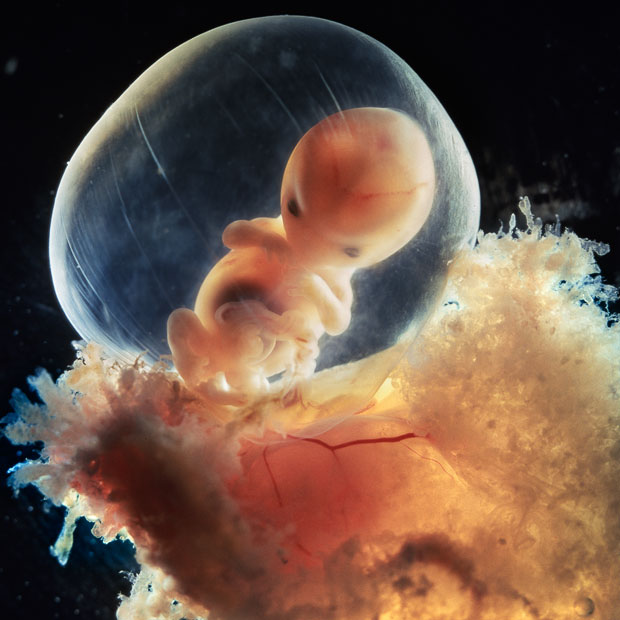
I'm Scheming Unborn Baby, and I approve this study
I’m Scheming Unborn Baby, and I approve this message

At Christian Post, an article by Douglas Groothuis. (H/T Mary)

Here’s the most useful bit:

When we separate personhood from humanity, we make personhood an achievement based on the possession of certain qualities. But what are these person-constituting qualities? Some say a basic level of consciousness; others assert viability outside the womb; still others say a sense of self-interest (which probably does not obtain until after birth). All of these criteria would take away humanity from those in comas or other physically compromised situations.4 Humans can lose levels of consciousness through injuries, and even infants are not viable without intense and sustained human support. Moreover, who are we to say just what qualities make for membership in the moral community of persons?5 The stakes are very high in this question. If we are wrong in our identification of what qualities are sufficient for personhood and we allow a person to be killed, we have allowed the wrongful killing of nothing less than a person. Therefore, I argue that personhood should be viewed as a substance or essence that is given at conception. The fetus is not a lifeless mechanism that only becomes what it is after several parts are put together—as is the case with a watch or an automobile. Rather, the fetus is a living human organism, whose future unfolds from within itself according to internal principles. For example, the fertilized ovum contains a complete genetic code that is distinct from that of the mother or father. But this is not a mere inert blueprint (which is separable from the building it describes); this is a living blueprint that becomes what its human nature demands.

Yet even if one is not sure when personhood becomes a reality, one should err on the side of being conservative simply because so much is at stake. That is, if one aborts a fetus who is already a person, one commits a deep moral wrong by wrongfully killing an innocent human life. Just as we do not shoot target practice when we are told there may be children playing behind the targets, we should not abortion fetuses if they may be persons with the right not to be killed. As I have argued, it cannot be disputed that abortion kills a living, human being.

Many argue that outside considerations experienced by the mother should overrule the moral value of the human embryo. If a woman does not want a pregnancy, she may abort. But these quality of life considerations always involve issues of lesser moral weight than that of the conservation and protection of a unique human life (which considers the sanctity or innate and intrinsic value of a human life).6 An unwanted pregnancy is difficult, but the answer is not to kill a human being in order to end that pregnancy.

I think that the real question in the abortion debate right now is whether a living organism with a human nature and a human genetic code that is distinct from its mother and father deserves the right to life, or whether it needs to develop some other capability in order to be worthy of protection from violence.

Consider something from philosopher Francis J. Beckwith.

Excerpt:

Some argue that personhood does not arrive until brain waves are detected (40 to 43 days).11Others, such as Mary Anne Warren,12 define a person as a being who can engage in cognitive acts such as sophisticated communication, consciousness, solving complex problems, self-motivated activity and having a self-concept. This would put the arrival of personhood at some time after birth. Still others, such as L. W. Sumner, 13 hold a more moderate position and argue that human personhood does not arrive until the fetus is sentient, the ability to feel and sense as a conscious being. This, according to Sumner, occurs possibly as early as the middle weeks of the second trimester of pregnancy and definitely by the end of that trimester.

Although these criteria differ from each other in important ways, they all have one thing in common: each maintains that if and only if an entity functions in a certain way are we warranted in calling that entity a person. Defenders of these criteria argue that once a human being, whether born or unborn, acquires a certain function or functions–whether it is brain waves, rationality, sentience, etc.– it is then and only then that a person actually exists. Those who defend these personhood criteria typically make a distinction between “being a human” and “being a person.” They argue that although fetuses are members of the species homo sapiens, and in that sense are human, they are not truly persons until they fulfill a particular set of personhood criteria.

Although functional definitions of personhood may tell us some conditions that are sufficient to say that a being is a person, they are not adequate in revealing to us all the conditions that are sufficient for a particular being to be called a person. For example, when a human being is asleep, unconscious, and temporarily comatose, she is not functioning as a person as defined by some personhood criteria. Nevertheless, most people would reject the notion that a human being is not a person while in any of these states. In other words, while personhood criteria, such as the ones presented by Warren can tell us that a being is a person, these criteria are not adequate to declare a being a non-person: The exercise of rational thought tells us that a being is a person; when that person is sleeping, and thus is not exercising rational thought, that lack of exercise of the thought function does not make her a non-person at that time. Consequently, it seems more consistent with our moral intuitions to say that personhood is not something that arises when certain functions are in place, but rather is something that grounds these functions, whether or not they are ever actualized in the life of a human being. Thus, defining personhood strictly in terms of function is inadequate.

If you are pro-life because of your feelings, or because someone told you to be, you ought to know that being pro-life is quite rational and supported by medical evidence. People who are pro-abortion are pro-abortion because they want recreational sex without the complications of having to care for the consequences (babies!) of their own actions. Even if they do not engage in the sex and the abortions themselves, they advocate for abortion rights, and they are guilty of encouraging a culture where 57 million unborn children have died since 1973. We’re long past Stalin numbers with this thing now.

We ought to care about not hurting other people. If grown-up’ selfish pursuit of happy feelings conflicts with another person’s right to life, then maybe we need to take a step back from being happy and start trying to be good instead.