Tag Archives: Pop Culture

Paul Copan explains some responses to postmodernism

Four articles from Paul Copan over at the UK site “BeThinking”. Each article responds to a different slogan that you might hear if you’re dealing with non-Christians on the street.

“That’s just your interpretation!”

Some of his possible responses:

  • Gently ask, ‘Do you mean that your interpretation should be preferred over mine? If so, I’d like to know why you have chosen your interpretation over mine. You must have a good reason.’
  • Remind your friend that you are willing to give reasons for your position and that you are not simply taking a particular viewpoint arbitrarily.
  • Try to discern if people toss out this slogan because they don’t like your interpretation. Remind them that there are many truths we have to accept even if we don’t like them.
  • ‘There are no facts, only interpretations’ is a statement that is presented as a fact. If it is just an interpretation, then there is no reason to take it seriously.

More responses are here.

“You Christians are intolerant!”

Some of his possible responses:

  • If you say that the Christian view is bad because it is exclusive, then you are also at that exact moment doing the very thing that you are saying is bad. You have to be exclusive to say that something is bad, since you exclude it from being good by calling it bad.
  • There is a difference, a clear difference between tolerance and truth. They are often confused. We should hold to what we believe with integrity but also support the rights of others to disagree with our viewpoint.
  • Sincerely believing something doesn’t make it true. You can be sincere, but sincerely wrong. If I get onto a plane and sincerely believe that it won’t crash then it does, then my sincerity is quite hopeless. It won’t change the facts. Our beliefs, regardless of how deeply they are held, have no effect on reality.

More responses are here.

“That’s true for you, but not for me!”

Some of his possible responses:

  • If my belief is only true for me, then why isn’t your belief only true for you? Aren’t you saying you want me to believe the same thing you do?
  • You say that no belief is true for everyone, but you want everyone to believe what you do.
  • You’re making universal claims that relativism is true and absolutism is false. You can’t in the same breath say, ‘Nothing is universally true’ and ‘My view is universally true.’ Relativism falsifies itself. It claims there is one position that is true – relativism!

More responses are here.

“If you were born in India, you’d be a Hindu!”

Some of his possible responses:

  • Just because there are many different religious answers and systems doesn’t automatically mean pluralism is correct.
  • If we are culturally conditioned regarding our religious beliefs, then why should the religious pluralist think his view is less arbitrary or conditioned than the exclusivist’s?
  • If the Christian needs to justify Christianity’s claims, the pluralist’s views need just as much substantiation.

More responses are here.

And a bonus: “How do you know you’re not wrong?“.

UK survey: nearly 60% of working moms would cut their work hours if they could afford to

Dina tweeted this UK Daily Mail article that made me think about how women vote.

Excerpt:

More than a third of working mothers would like to give up their jobs completely and stay at home with their children, a major Government survey has found.

It showed that millions of mothers of young children who go out to work do so only because they need to work to pay the bills.

The research for the Department for Education found that, far from being anxious to get out of their homes and into employment, the great majority of mothers are only reluctant workers.

Nearly six out of ten of all working mothers would cut down their hours to spend more time with their families if they could afford to, it said.

The yearning among mothers to leave their jobs and look after their children instead is even more pronounced among the highest achieving women, the  survey indicated.

More than two-thirds of those in senior and middle management roles would spend fewer hours in the office and devote more time to their children if they had enough money, it said.

[…]Yesterday’s survey also undermines the claims that prejudice and discrimination against women in male-dominated companies is the reason why women are heavily outnumbered in the boardroom.

Rather, it suggests that many women who could get to the top in business choose instead to put their children before their careers.

The problem is that when government gives people free stuff, people who work have to work more to pay for it. And the strangest thing is that even though women seem to want to stay home with their kids (which is good), when it comes time to vote, they actually vote NOT to stay home with their kids. How? By growing the size of government, which results in higher taxes. To find out what women really think about staying home with their kids, we can look at how they vote. 

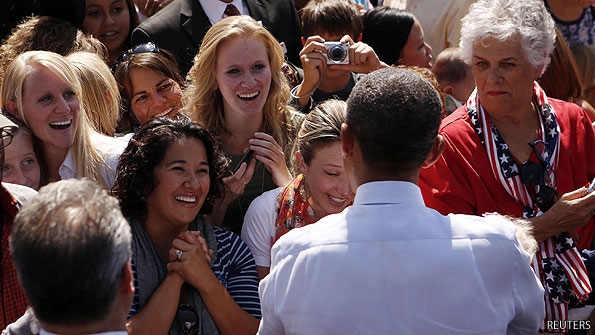
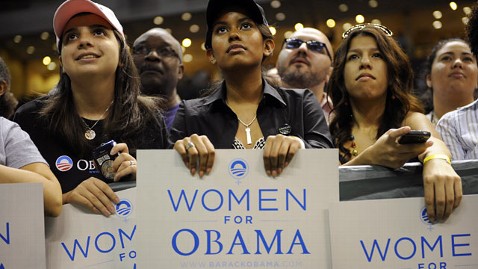
Women voted 55 to 44 for Obama
Women voted 56-44 for more government spending in 2012

CNN reports on how women voted in the 2012 election:

According to CNN’s exit polls, 55% of women and 45% of men voted for Obama and 44% of women and 52% of men voted for Romney. That level of female support for the president made an especially big impact in swing states like Ohio where the gender breakdown mirrored the national figures.

[…]There are some indications that social issues directly impacting women might have helped sway votes in some states.

Tuesday’s early exit polls showed 51% of Missouri voters said they believed abortion should be legal all or most of the time. Of those voters, exit polls showed 76% supported Democratic incumbent Claire McCaskill, who won Tuesday night, while 19% voted for Akin.

Forty-seven percent of Missouri’s voters said abortion should be illegal. Exit polls showed Akin netted 67% of this group’s votes while 27% of people who think abortion should be illegal supported McCaskill.

But much more than social issues, pocketbook economic issues most concerned women voters, exit polling showed.

“Women like all voters felt the economics were most important,” Swers said. “Women tend to be more supportive of government spending… than men are … so they were less responsive to Romney in that way and more responsive to Obama’s message on empathy and helping the middle class.”

Gallup reported that the gender gap in the 2012 election was actually 20 points. That was the largest ever measured in a Presidential election. The actual vote for Obama among women, according to Gallup, was 56-44.

More government means higher taxes
Women are also more pro-abortion more than men

Here is a peer-reviewed research paper that shows the problem that we need to warn women about, so that they vote smarter.

The abstract reads:

This paper examines the growth of government during this century as a result of giving women the right to vote. Using cross‐sectional time‐series data for 1870–1940, we examine state government expenditures and revenue as well as voting by U.S. House and Senate state delegations and the passage of a wide range of different state laws. Suffrage coincided with immediate increases in state government expenditures and revenue and more liberal voting patterns for federal representatives, and these effects continued growing over time as more women took advantage of the franchise. Contrary to many recent suggestions, the gender gap is not something that has arisen since the 1970s, and it helps explain why American government started growing when it did.

When people vote for government to do more for everyone else, then men who work have to pay more in taxes.

Women for bigger government, higher taxes
Women vote for higher taxes, so they have to work more

If women want to stay home with their children more, then they need to vote for their husbands (present or future) to pay less in taxes when they work. That means voting for smaller government, more liberty and more personal responsibility. Until women get to the point of connecting their future plans (marriage and parenting) for their lives with their current voting, this situation is not going to change. Marriages run on money. It’s no good to urge men to “man-up” and then take away their ability to provide by taxing more of their earnings to pay for Sandra Fluke’s birth control pills and abortions. Keep the money in the family, and then you can stay home with the kids more.

My experiences with Christian women in church and campus ministries

A friend of mine sent me some horror stories from his time dealing with single Christian women during seminary, and I thought I would write something about the horror stories from my experiences with single Christian women in campus ministries during my BS and MS programs, and in several evangelical churches that I attended in my 20s.

The biggest problem I’ve had with unmarried Christian women in college and in church is that it is impossible to impress them by being a competent, effective Christian man. Every skill and ability that seems to me to be useful and effective for the kingdom (or for marriage) seems to cut no ice with them. I had women in my youth group, in IVCF and in Campus Crusade have told me that being an engineer is bad, being chaste is bad, not drinking is bad, talking too much about apologetics is bad, and especially trying to get them to learn apologetics – that was really, really bad. They hated that. And forget trying to talk to them about abortion and homosexuality. They were very proud to be non-judgmental. It was a badge of honor, saying “I don’t judge” as if they were saying “I am good person”.

Everything that you might think makes sense for a man to be skilled at from a marriage point of view is viewed as creepy and weird by these church/campus-club unmarried Christian women, in my experience. I am a colored guy, so I always put their messed up standards down to the fact that I was colored and therefore was not allowed to talk to them, period. I was also surprised to see how little the command to “love your neighbor” was implemented by the unmarried Christian women. Here I was, struggling through a tough engineering program, and obviously coming from an unchurched background, yet these woman never had a supportive word for me. My interests in theology and apologetics and moral issues and politics were viewed by them with suspicion.

In retrospect, I would say the biggest argument against God’s existence I ever faced was the complete disconnect between what these women professed and how they treated others.

There was one exception. When I was a teen, I had an older college student mentor me and she helped me pick up my grades – especially in English. She eventually fell away from her faith (she was a cradle Catholic). But other than her, I basically was in my mid-30s before I met a Christian woman who had any respect for me because of the things that I could do as a Christian. And that was after over a decade of donations, organizing, training, mentoring, apologetics, etc. By that time, I had my BS and MS and a boatload of savings, and yet up till then, no unmarried Christian woman had ever given me the time of day. I was sort of stuck looking to white Christian women for validation, because most colored girls are liberal. But what I found is that they had no standard in their worldview that I could be graded against favorably, other than physical appearance.

That was the scariest thing for me, to find out that there was no worldview there that distinguished between William Lane Craig and Jim Wallis, for example. There was just the outward appearance – that was the sole criterion that unmarried Christian women were using to decide whether a man had value or not. And their agenda for men was never a mentoring/discipling agenda. It was the standard secular boyfriend agenda. And very often, they chose standard secular boyfriends for that agenda. I later found out that they found men with definite moral positions and definite apologetics ability intimidating. Any man with fixed, entrenched positions – either about truth or moral issues – frightened them.

Even now, I find this such a weird thing, because in my own life, I act as a mentor to younger Christians regardless of their appearance or other such criteria. Mentoring other Christians is what Christians ought to be doing! I mentor about a dozen promising young Christians (women and men) in different countries. On a given night, you’ll find me reading something they asked me to read, sending them links to evidence to help them argue, proof-reading their essays, buying them books, hearing about their school assignments, picking their elective courses, or ordering them not to take the summer off and to work instead, etc. Right now, I have two of my experienced pro-life friends helping one of them take over a pro-life club at a university. Another of my friends who does Internet consulting is helping another friend start his web site. And so on, with me or my friends mentoring other Christians just for the sake of honoring that command to love others upward. It doesn’t even matter how great the person is right now, because we mentor Christians at all levels of ability. No one is left out, and no oneis turned down.

But this idea that other Christians have value simply because they are Christians was NOWHERE to be found among unmarried Christian women when I was in university and in my 20s. It’s totally foreign to them that Christianity imposes those mentoring/discipling obligations on them, regardless of appearances. They are feelings-driven, not obligation-driven. They are concerned with their own agenda, and not looking to God to see what he wants them to do for their fellow Christians.

I was always the same Wintery Knight back them as I am today, just at an earlier stage of development, and yet no unmarried Christian women in the church or in a campus Christian ministry gave me so much as an affirming glance while I was working out my plans. In fact, church women often stood in the way of things I tried to do, like bring in professors to speak at IVCF or show William Lane Craig debates at Campus Crusade. Focusing on evidential issues was deemed “too divisive”. It was prayer walks, hymn sings and testimonies by postmodern relativists every week. I learned not to count on unmarried Christian women for support of any kind for the things I was trying to do. No matter how good the things I wanted to do were, they always had a reason why I shouldn’t be allowed to do them.

I am always surprised when I meet a woman and she wants me to read the Bible, or read a book, or do anything like that. (That actually happened to me again last week!) I’ve had a handful of women do that to me in my whole life. Unmarried Christian women are, in my experience, running a very secular playbook, making decisions about how to treat others from their feelings. And then if you question them about it, they attribute their feelings to the work of the Holy Spirit. You don’t really see how bad it is until you hear them tell you that God told them to move in with the atheist guy, etc. It’s striking to me how far the Holy-Spirit-wrapping of their feelings goes, and yet they don’t see a problem with it. I think the answer to this problem is that we really need to help women to think through their worldview and think about how to act on Christian convictions with other people, and men in particular, and men who are committed to building the Kingdom effectively and intelligently above all others.