
Tag Archives: Politics

What your political views say about your suitability for marriage and parenting

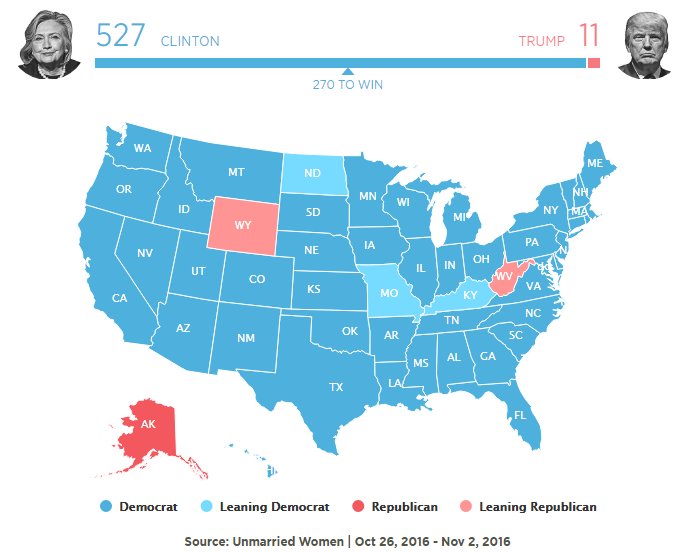
SurveyMonkey election poll cross tabs for unmarried women Nov 2016

Would you like your marriage to be long-lasting and fulfilling? Marriage isn’t just about two people who have a lot in common getting together to have fun. Marriage is a commitment, and it requires specific character traits like the willingness to take responsibility to care for others self-sacrificially. Some of these marriage-friendly character traits can be difficult to detect, but you can evaluate a person’s character by asking them about what policies they oppose and support.

1. Are you opposed to no-fault divorce laws?

No-fault divorce laws allow one spouse to leave the marriage at any time, for any reason, or for no reason at all. If you support no-fault divorce, then your view of marriage is that it’s something to be entered into lightly, because it can be exited easily. You’ll be walking down the aisle thinking “oh well, if it doesn’t work out, I can always get a divorce”. If you oppose no-fault divorce laws, then your view of marriage is that there is no escape hatch. You’ll probably be a lot more careful about getting married. Since you are convinced that marriage is built to last forever, you’ll have a courtship of at least 12 months, and involve both sets of parents in the process. If you put commitment above happiness, you’re ready for marriage.

2. Are you opposed to abortion laws?

Abortion laws basically make it easy for two people to have recreational sex, and then get rid of any complications that result quickly and easily. This way, both the people that created the effect can escape the responsibility for what they did, and keep right on pursuing their goals and dreams. If you support abortion laws, you’re really saying that you can engage in recreational sex with people who are unwilling to accept responsibility for any children that result. If you are pro-life, then you’re saying that people should be careful about having sex, and be ready to take responsibility for a child, should one appear. Being responsible is good preparation for marriage.

3. Are you supportive of daycare for young kids?

Daycare services are essential for couples who need both the father and the mother to be working. The advantage of both parents working is that you can afford lots of shiny new stuff – like vacations, boats, shoes and handbags. Studies show that children don’t die during daycare, although if you put a child in daycare, there will be effects on the child’s behavior, such as higher anxiety and aggression. If you oppose daycare, you’re putting the needs of your children above your need for shiny stuff. Putting the needs of children first is a sign that you are ready for the self-sacrifice that marriage requires.

4. Are you in favor of smaller government?

If you’re in favor of smaller government, then you would rather keep taxes low so that more money stays in the family. If you support bigger government, then you think that government knows how to spend your money better than you and your spouse do. Additionally, government usually likes to spend more money than they take in. For example, in the last 8 years, we’ve added $10 trillion dollars to the debt, which is now $20 trillion. If you oppose higher taxes and bigger government, then you want government to pass on less debt to your children. Putting your kids’ financial well-being over your own is pro-marriage.

5. Are you in favor of school choice?

If you’re opposed to school choice, then you think that government should decide which schools your children will attend. School choice laws allow parents to give money to the schools they think are best for the children. If a school has excellent teachers and teaches students skills that they can use in their professional lives, then parents can choose that school. Schools have to compete to provide higher quality to parents, for lower cost. If you support giving parents more choice, then you put the needs of children – especially poor, minority children – above the needs of education administrators and teacher unions. Putting kids fist is pro-marriage.

6. Are you in favor of premarital sex?

Premarital sex is really fun (so I’m told). You can have sex with people who are just really attractive, even if these people have lousy character. Your friends will be impressed, and you’ll feel more attractive – like you were climbing a ladder of attractiveness with each new partner. If you combine sex with being drunk, then you can’t remember anything after. And you can’t feel guilty if the booze made you do it, right? On the other hand, if you present yourself to your spouse as a virgin, you are telling them that you have self-control, that you take sex as communication rather than recreation, and that they can trust you to be faithful by keeping sex inside the marriage. Trust is important for a good marriage.

7. Are you in favor of welfare for single mothers?

Sometimes, women find themselves pregnant before they are married. If you think that giving taxpayer money to women who have babies before they have husbands is a good idea, then you are rewarding behavior that creates fatherless children. Raising a child without a father causes serious behavioral problems. Boys tend to become more violent, and are more likely to commit crimes. Girls tend to engage in sex at earlier ages. If you oppose encouraging fatherlessness with welfare, you want women to get married before they have kids. Taking the needs of children seriously is pro-marriage.

8. Are you in favor of same-sex marriage?

When a man and a man get married and acquire children, those children will not be raised with their birth mother. Similarly with lesbians, the children will not grow up with their birth father. Studies show that children suffer from not being raised by their biological parents. For example, children of same-sex parents have lower graduation rates than children raised by heterosexual couples. If you think that children have a right to a stable relationship with their biological mother and father, then you place a higher value on the needs of children as opposed to the needs of adults. That’s a good sign you’re ready for marriage.

9. Are you in favor of radical feminism?

This one comes to us from Lindsay, who blogs at Lindsay’s Logic. She says that opposing radical feminism “shows that you do not think the purpose of marriage is to make women happy, but to work as a team to serve God and raise good children.” Indeed. Marriage doesn’t work if the woman approaches it as an accessory. Marriage is about a man and a woman sacrificing their own interests and compromising in order to work together as a team. Husbands and children have needs that women should care about. Feminism teaches women that husbands and children are less important than their careers, hobbies and interests. Feminism is anti-marriage.

10. Are you responsible with earning, saving and giving away money?

This one comes to us from Bob P. He says that marriages work better when both spouses are “committed to financial planning, budgeting and a renunciation of debt to support a lifestyle. Disagreement about financial issues is one of the greatest causes of marital stress.” If you’re able to choose a college major or a trade that you don’t like, but that pays well, that’s a positive. If you’re able to string together jobs so that your resume is gap-less, that’s a positive. If you’re able to save money even though it means you’re having less fun, that’s a positive. If you’re able to give away money to others to support them, that means you’re able to sacrifice your interests for the benefit of others. That’s pro-marriage.

Well, how did you do? Leave your ideas for more policies and points of view that are marriage-friendly in the comments.

Stephen Baskerville: five myths about no-fault divorce

Marriage and family
Marriage and family

From the Catholic News Agency.

Introduction:

Almost four decades after the “no-fault” divorce revolution began in California, misconceptions abound. Even the many books about divorce, including myriad self-help manuals, are full of inaccurate and misleading information. No public debate preceded the introduction of no-fault divorce laws in the 1970s, and no debate has taken place since.

Yet divorce-on-demand is exacting a devastating toll on our children, our social order, our economy, and even our constitutional rights. A recent study estimates the financial cost of divorce to taxpayers at $112 billion annually. Recent demands to legitimize same-sex marriage almost certainly follow from the divorce revolution, since gay activists readily acknowledge that they only desire to marry under the loosened terms that have resulted from the new divorce laws. Divorce also contributes to a dangerous increase in the power of the state over private life.

Here are the five myths about no-fault divorce:

  • No-fault divorce permitted divorce by mutual consent, thus making divorce less acrimonious
  • We cannot force people to remain married and should not try
  • No-fault divorce has led men to abandon their wives and children
  • When couples cannot agree or cooperate about matters like how the children should be raised, a judge must decide according to “the best interest of the child”
  • Divorce must be made easy because of domestic violence

And the details about number three:

Myth 3: No-fault divorce has led men to abandon their wives and children.

Fact: This does happen (wives more often than children), but it is greatly exaggerated. The vast majority of no-fault divorces — especially those involving children — are filed by wives. In fact, as Judy Parejko, author of Stolen Vows, has shown, the no-fault revolution was engineered largely by feminist lawyers, with the cooperation of the bar associations, as part of the sexual revolution. Overwhelmingly, it has served to separate large numbers of children from their fathers. Sometimes the genders are reversed, so that fathers take children from mothers. But either way, the main effect of no-fault is to make children weapons and pawns to gain power through the courts, not the “abandonment” of them by either parent.

Al Mohler wrote about the history of no-fault divorce a while back, and I think it’s worth reviewing why we have this lousy law.

The story behind America’s love affair with no-fault divorce is a sad and instructive tale. As Baskerville documents, no-fault divorce laws emerged in the United States during the 1970s and quickly spread across the nation. Even though only nine states had no-fault divorce laws in 1977, by 1995, every state had legalized no-fault divorce.

Behind all this is an ideological revolution driven by feminism and facilitated by this society’s embrace of autonomous individualism. Baskerville argues that divorce “became the most devastating weapon in the arsenal of feminism, because it creates millions of gender battles on the most personal level.” As far back as 1947, the National Association of Women Lawyers [NAWL] was pushing for what we now know as no-fault divorce. More recently, NAWL claims credit for the divorce revolution, describing it as “the greatest project NAWL has ever undertaken.”

The feminists and NAWL were not working alone, of course. Baskerville explains that the American Bar Association “persuaded the National Conference of Commissioners on Uniform State Laws [NCCUSL] to produce the Uniform Marriage and Divorce Act.” Eventually, this led to a revolution in law and convulsions in society at large. This legal revolution effectively drove a stake into the heart of marriage itself, with inevitable consequences. In effect, no-fault divorce has become the catalyst for one of the most destructive cultural shifts in human history. Now, no-fault divorce is championed by many governments in the name of human rights, and America’s divorce revolution is spreading around the world under the banner of “liberation.”

And note that Democrats oppose any effort to reform laws that make it easy to break up marriages:

A basic dishonesty on the question of divorce pervades our political culture. Baskerville cites Michigan governor Jennifer Granholm as referring to divorce as a couple’s “private decision.” Granholm’s comments came as she vetoed a bill intended to reform divorce law in her state. The danger and dishonesty of referring to divorce as a couple’s “private decision” is evident in the fact that this supposedly private decision imposes a reality, not only on the couple, but also on children and the larger society. Indeed, the “private decision” is really not made by a couple at all–but only by any spouse demanding a divorce.

So, no-fault was pushed by two groups: feminists and trial lawyers.

There’s a lot of talk these days about gay marriage and how it undermines marital norms and normalizes raising children without either their biological father or biological mother. But before there was gay marriage, there was no-fault divorce, which deprives children of their biological father. There is no provision for no-fault divorce in the Bible, so it seems to me that Christians should be against frivolous divorce just like we are against same-sex marriage.

Why are social conservatives unable to exert political pressure?

Hillary Clinton and her ally, the Human Rights Campaign

Right now, social liberals are having great success pushing through their agenda. Social conservatives seemed to be getting coerced and/or punished so effectively that many are wondering whether the tide can be turned at all.

Ben Shapiro, who writes at the Daily Wire, explains what’s been happening lately:

Leftists, the most tolerant people in America, are now demonstrating their tolerance by boycotting entire states that do not govern in accordance with leftist social policy. On Tuesday, New York Governor Andrew Cuomo announced that he would bar non-essential state-funded travel to Mississippi after the state passed a bill re-enshrining First Amendment protections for freedom of religion and association. Cuomo, who termed the law “sad, hateful,” isn’t the only big government leftist to utilize the power of taxpayer-funded nastiness: the mayor of San Francisco, Ed Lee, did the same.

Lee and Cuomo also announced travel bans to North Carolina, where the governor recently signed a bill that mandates that local governments may not allow people to use single-sex bathrooms based on subjective gender identity rather than biological sex; that bill also makes state anti-discrimination law supreme and exclusive over local anti-discrimination laws that would compel businesses to hire people regardless of sexual orientation or gender identity.

It’s not just government, either. Icons like the wildly overrated Bruce Springsteen are cancelling concerts in North Carolina; businesses like PayPal, which do business in countries like Saudi Arabia and Malaysia, which actually prosecute homosexuality. States like Virginia and Georgia have vetoed similar legislation out of fear of corporate and governmental blowback from companies ranging from Apple to Disney.

The left has ratcheted up their pressure on states to crack down on Americans who don’t want their daughters peeing next to grown men, to prosecute businessowners who don’t want to cater same-sex weddings. They’ve utilized their economic power to punish private actors who may or may not even agree with the left in an attempt to coax those actors into putting indirect pressure on their representatives.

Maggie Gallagher, a pro-marriage activists who has written some great books on marriage that I really liked, has some practical advice for social conservatives in National Review.

She has five points – here are four and five:

4) Social conservatives aren’t doing politics.

Before I explain what I mean, let me ask you to answer a simple question: What is the national organization that fights for religious-liberty protections by spending money in federal elections? Currently, there is none. There are many good nonprofits who issue voter guides or get pastors together. There are public-interest law firms galore. These are all good things to have — but there is a hole in the center of our movement.

How big is the hole? For my own amusement, I tried to figure out how much money social conservatives (excluding pro-life groups) spent in national elections in 2014 compared to what they spend on 501(c)3 and other nonprofit strategies. I looked for every organization I could find that has marriage or religious liberty in its mission statement and then compared it with election expenditures by either c(4)s or political-action committees (PACs). Then I asked around to major social-conservative donors I know to see if I had overlooked any major organization.

How big is the hole in the center of our movement?

In 2014 pro-family social conservatives invested $251,633,730 in tax-deductible 501(c)3 efforts (excluding pro-life efforts).

How much was spent on direct political engagement, counting both state and federal organizations? $2,484,359.

That 100-to-one ratio of doing politics by indirect versus direct means explains a lot about the relative powerlessness of social conservatism.

Social conservatives can’t get much out of politics because we aren’t in politics. We just talk like we are on television, when the Left allows us to get on television. Meanwhile, we don’t build political institutions that matter.

Social conservatives need to think like a minority and organize politically to protect our interests. Which leads me to Maggie’s fifth Big Truth of social-conservative politics:

5) The most important thing social conservatives could do in the 2016 cycle is to demonstrate to Democrats that extremism in pushing unisex showers on public schools or oppressing gay-marriage dissenters will cost them the White House.

In theory, this shouldn’t be hard to do: A July 2015 Associated Press–GFK poll showed that 59 percent of independents and 32 percent of Democrats agree that when gay rights and religious liberty conflict, religious liberty should have priority. Social conservatives should use the issue on offense — not just to gin up “the base,” but to persuade soft Democrats to abandon the party of anti-religious aggression. If intensive messaging to Democratic voters in a key swing state could move just 10 percent of them to switch their votes, the whole political dynamic of this issue would change.

But proving that would require raising a significant amount of money — say at least $2 million — and demonstrating in a key swing state, such as Ohio or Pennsylvania or Florida, that the Democrats’ anti-religion intolerance against gay-marriage dissenters could cost them something they care about: The White House. Power.

I see no signs yet that any such thing is happening among social conservatives.

But it could.

We should fill the hole in the center of the social-conservative movement by getting into politics for the first time in 50 years. It could happen.

I noticed that Maggie’s web site “The Pulse” is very pro-Cruz. They do not like John Kasich at all on social issues, and they were not fans of Marco Rubio’s tepid response to the gay marriage ruling.