
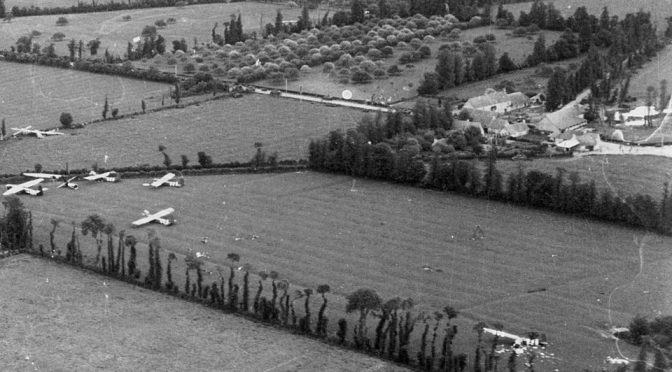
Despite being somewhat retired, I am keeping up with my reading on evidential apologetics and military history. You can always find out what I am reading in the “What I am Reading” page on this blog. Previously, I wrote a post about the top 20 heroic actions of the U.S. armed forces. The book I am reading now is “Nothing But Courage” and it described an action that I think is very suitable for a Memorial Day post.
The action I’m going to write about below happened in the days just after the D-Day invasion of France on June 6th, 1944. At that time, airborne units (parachute and glider) were being used to seize vital targets. There were two goals for this. To prevent German reinforcements from attacking the Allied forces on the beaches, and to allow the Allied forces to break out and seize objectives. One of the most important objectives being the nearby port of Cherbourg, which the allies could use to unload men and equipment to continue their advance.
First, a map where you can make note of the locations of Utah Beach, the city of Sainte-Mère-Église and the port of Cherbourg:
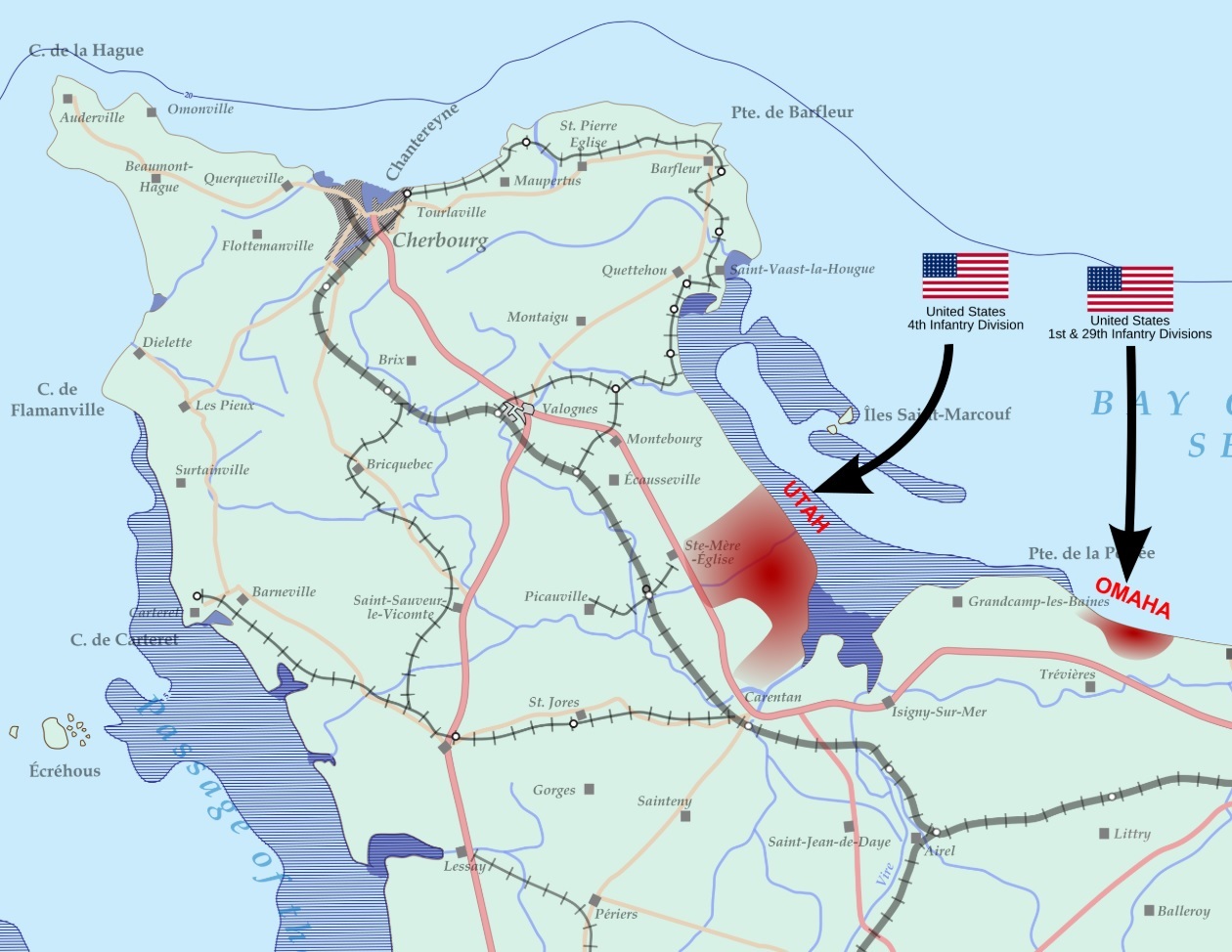
(Source: Map created by Philg88 and Hogweard, licensed under the Creative Commons Attribution 4.0 International license, I cropped the relevant part)
Basically, the 82nd Airborne are dropped west of Sainte-Mère-Église and their objective is to seize and hold the La Fière Bridge and Causeway. If the Airborne troops achieve their mission, then the Germans would no longer be able to approach Ste. Mère-Église from the west, or reach the roads needed to attack the invasion beaches.
Here is an closer map showing the beach and causeway, courtesy of Brooklyn Wargaming. This is the “after” map on June 9th. I cropped the relevant part of the map:
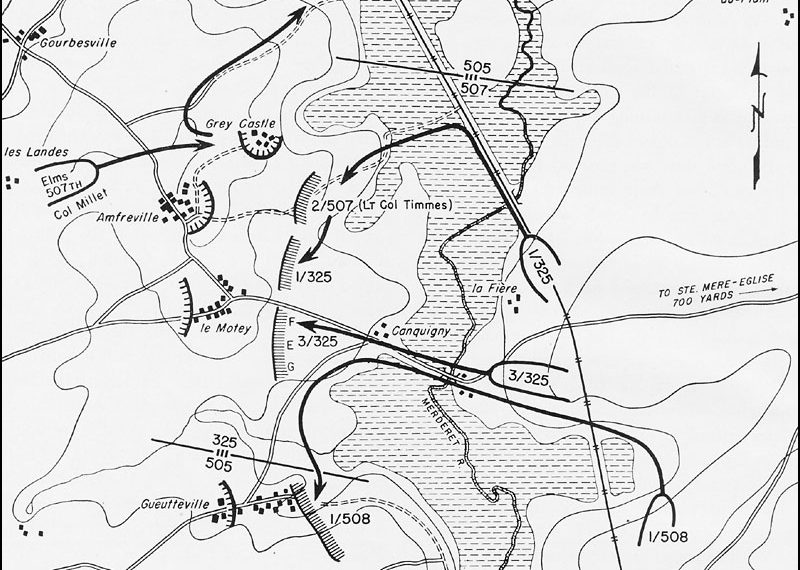
The Americans are deployed on the east side of the bridge and causeway, and you can see some troops on the west side to the north in an orchard. The audio book I’m listening to pronounces the name of the leader of that group “Timmies” but as you can see it’s spelled Timmes. The key thing to note is that the bridge is tiny. The causeway is long and elevated. It’s basically a shooting gallery with no cover for the attackers.
Since I can’t paste the whole book in this blog post, I found a good article at Havok Journal to summarize what happened in the days before the attack across the bridge and causeway.
It says:
75 years ago, units of the American Paratroopers had already landed behind German lines in France. One such unit was the 505thParachute Infantry Regiment (PIR), a seasoned element of the 82ndAirborne Division.
[…]In total, the U.S. Paratroopers numbered approximately 13,400, well below 10% of the invading land force on D-Day. “A” Company, 1-505 PIR represented a much smaller slice, but in the midst of the chaotic first 72 hours from 06-09 June 1944, theirs is a story worth telling. Led by First Lieutenant John “Red Dog” Dolan, “A” Company, and the rest of the 1stBattalion, 505 PIR quickly assembled 90% of their force and headed towards their objective, La Fiere Bridge.
The action starts on June 6th:
[…]Around daybreak, they managed to link in with a group of about 300 Paratroopers from the 508thPIR, including the Assistant Division Commander, Brigadier General James “Slim Jim” Gavin, and a contingent of 45 Troopers from the 507th. They converged on a manior, or manor, near the east side of the Merderet River and La Fiere bridge. The manior consisted of a farmhouse and surrounding buildings, barns, and pens.
[…]After consolidation on the manior…. They set up a 57 mm anti-tank gun brought in by a glider the morning of D-Day about 150 meters to the rear of the A Company element to provide supporting fires across the bridge.
[…]A Company’s defenses near La Fiere bridge consisted of two, two-man bazooka teams set up near the marsh on the north and south sides of the eastern bridgehead. Bazooka gunner PFC Lenold Peterson occupied a position on the south side of the bridge with his assistant gunner, PVT Marcus Heim, Jr., while gunner PFC John Bolderson and assistant/loader PVT Gordon Pryne occupied the position to the north.
Shortly after 2 PM…
[…][A]rtillery and mortars began falling around the A Company fighting positions. As the indirect attack lifted, three French Renault tanks seized by Germans back in 1940 began creeping across the causeway towards La Fiere bridge and the A Co positions.
[…]In the ensuing melee, the A Co bazooka teams got to work. Springing into action both bazooka teams opened up on the tanks canalized on the causeway. Moving to exposed positions from their foxholes, the gunners and loaders put bazooka rounds on the first two tanks as fast as they could, eventually disabling both along the causeway, setting them on fire and killing the crews. The 57 mm anti-tank gun, put into action from the support by fire position, managed to destroy the third tank.
I like Private Heim’s description of what he thought he was achieving:
“Our job was to be in the forward position with our bazooka and stop the Germans from using La Fiere bridge. This we accomplished despite the tremendous and continual firing by the enemy. When the Germans retreated, Peterson and I were still in our positions at the bridge, and as we looked around we could not see anyone so we moved back to our foxhole… We found later that of the few men holding the bridge, most were either killed or wounded… This was one of the toughest days of my life. Why Peterson and I were not wounded or killed, only the Good Lord knows why.”
[…]As a result of their actions during the German attack, all four members of the two bazooka teams, all survivors of the battle despite their heroic actions, received the Distinguished Service Cross. After A Co and its supporting element destroyed the enemy vehicles, the Germans pulled back towards Cauquigny and set up their own defensive positions.
The defense of the east part of the bridge continued the next morning, with heavy losses:
On the morning of the 7thof June, Another indirect barrage came in around 0800 and lasted for two hours. Around 1000, the Germans launched another attempt at taking back the eastern side of La Fiere bridge, and ran into A Co, along with B, C, and HHC of the 1-505thPIR. Two additional French Renault tanks and approximately 200 German soldiers began moving towards La Fiere bridge. Coming across the causeway, the bazooka teams, machine guns, and 57 mm anti-tank guns fired on the tanks, disabling the lead tank. At this time, the causeway road was littered enough with German tanks and the treeline, that the German infantry managed to get within 40 meters of the bridge and the A Co positions.
After repulsing the counterattack on D-Day, the night indirect barrages, and the ongoing German assault, A Company was in bad shape. 1st Platoon lost their Platoon Leader, 2LT Oakley, which eventually found SGT William Owens, a squad leader, in charge of the 15 men from their platoon still capable of bearing arms. Due to suffering high numbers of casualties and running alarmingly low on ammunition, the will of some of the Paratroopers began to waiver. Many contemplated falling back to safer positions further east towards Saint Mere Eglise and requested to fall back. During this time, small unit leaders faced pressure from their fatigued and scared subordinates shifting their focus on self-preservation.
[…]In the bleakest moment for A Company on the morning of June 7th, SGT Owens sent Private Murphy as a runner to 1LT Dolan’s position to let him know the platoon ran low on ammo and would not be able to hold their positions much longer. 1LT Dolan responded by telling Private Murphy, “No stay where you are.” He then scribbled a note to Sergeant Owens, handed it to Private Murphy, and sent him back through the hail of gunfire. Sergeant Owens read the note, telling the platoon they would remain in place. Lieutenant Dolan’s response to 1stPlatoon’s request to displace stated, “We stay. There is no better place to die.”
However, it was at that point that the Germans decided to cease offensive operations. Despite their losses, the Americans cannot stop there, they have to take the other side of the bridge in order to hold it. But who is left to do the job at this point?
I found another article from HistoryNet for that part of the story (June 9th):
Captain John Sauls crouched low behind a stone wall, the rest of G Company, 325th Glider Infantry Regiment, 82nd Airborne Division, strung out alongside him, as scores of shells rattled over their heads toward the Germans. Twelve M4 Sherman medium tanks, lined up on a ridge behind the soldiers, bombarded the opposite shore of the little Merderet River in Normandy. There, German troops had taken up defensive positions at the end of a 500-yard causeway–the only means of crossing the flooded plain beyond the swollen river. It was June 9, 1944, three days after D-Day, and the paratroopers were fighting to capture the La Fiére causeway.
Mortars, Browning Automatic Rifles (BARs), bazookas and machine guns helped the tanks plaster the German positions. But what Sauls and his men really needed was a smoke screen. Even though heavy fire was being concentrated on the enemy, crossing that causeway, which offered no cover for its entire length, would be near suicide once the Germans opened up with their own weapons. Nevertheless, at 10:45 a.m. Sauls yelled out ‘Go! Go! Go! and began running for all he was worth, never looking back to see if anyone followed him. The company was to split into two columns, one on each side of the macadam roadway, as soon as they crossed the narrow bridge that spanned the river. After traversing the flooded area, each column would then peel off left and right to roll up the enemy positions along the edge of the flood area.
But Sauls’ plan began to come apart as soon as the men started across the bridge. The Germans opened up with a barrage of mortar, artillery and machine-gun fire that transformed the narrow roadway into a gantlet of destruction. Men fell by the score; some rolled into the river and drowned. The fallen men began to clog the path, and the attack slowed. Soon 100 men were down. Those who were left dashed for what little cover they could find. Sauls, against all odds, had reached the far side, but when he turned around to signal his men into position, he found himself alone.
It’s just such a difficult mission that a lot of very brave men died trying to accomplish it:
One man in the lead platoon, Private Melvin Johnson, rose and began to run but was instantly killed, further paraIyzing the men. Then Lieutenant Frank Amino stood up and shouted, Follow me. Let’s go kill some sons of bitches! and ran off with no more than a dozen men behind him. A weapons company tried to follow them, but weighted down by their equipment, they were too slow and were cut down one by one.
A supporting Sherman tank advanced along the causeway but was soon disabled. Sergeant George Myers, in spite of a wound in the eye, dashed across, then fell from loss of blood. More and more men stopped to seek shelter when the fire became too much for them. As they crowded the edge of the exposed embankment, they left no room for those following them. Slowly, the bodies mounted and blocked the road.
[…]Squads, platoons and companies became hopelessly tangled as some men tenaciously made their way forward while others took cover, straggled back or just started shooting at the shoreline. The congestion increased casualties as some officers lost heart and took their men back while others, many severely wounded, braved fire to encourage their men to keep moving forward. Come on you bastards! Get up there! yelled Lieutenant Bruce Hooker, who had been shot in both legs.
One of the interesting characters from the book is General James Gavin, an orphan who was raised to be an officer from the enlisted ranks. He likes to parachute into battle with his men, leading from the front. After seeing how the attack was getting bogged down, he commits his fresh reserve unit, which was the right decision.
Back to the HistoryNet article:
Thinking that the battle was in danger of being lost, Gavin ordered Rae’s company forward. Forming a flying wedge, Rae’s 90 men bulled their way through the crowd and reached the opposite end of the causeway, believing theirs the first group to make it. By that time, enemy fire on the causeway had considerably lessened, allowing Lieutenant Lee Travelstead’s heavy weapons company to cross almost intact and Ridgway to get out into the open to help clear the road of blasted vehicles–including the disabled Sherman. With the road open, a column of Sherman tanks began to cross the river, sweeping the opposite shoreline with thelr weapons and flushing the remaining Germans from cover.
A heavy German counterattack threatened to push the still disorganized Americans back across the river the next day, but the assault was repulsed. By mid-afternoon, a linkup was finally achieved with Timmes’ men, who were still defending their orchard.
Thus ended the fight for the causeway at La Fiére. Laced with individual stories of both heroism and faintheartedness, the tale, with all its confusion, error and misjudgment, shows human strength and frailty in all its diversity.
I recognized a name from the HistoryNet post, too: Maj. Gen. J. Lawton Collins. I blogged about Maj. Gen. J. Lawton Collins before, in the context of the Battle of the Bulge. Basically, he disobeyed orders in order to stop the German armored offensive from reaching the Meuse river. Sometimes, you have to disobey orders to win the war. I blogged about how Lt. Cdr John Waldron did it at the Battle of Midway.
I also talked about Lt. Col Benjamin Vandervoort (who defended Sainte Mere Eglise) in my post about D-Day heroes. I’m learning the names of all of these heroic people, and it’s just sad that American children don’t learn more about these men in the schools.
Whenever I read about these people, I always think of 1) wanting to experience what they did in a tabletop wargame or computer wargame, and 2) I want to travel to museums or to the battlefield to pay my respects. But the first step is always to hear or read the story or watch a related video. All to properly respect the men who fought.
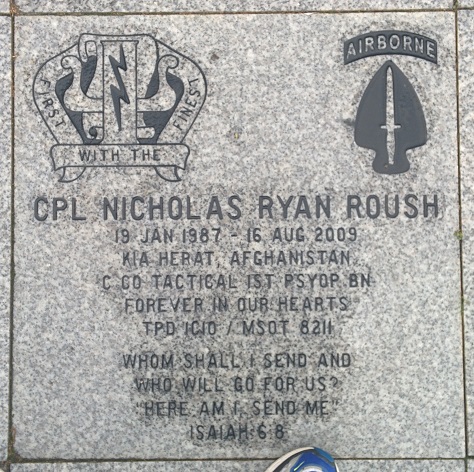
I have 82nd Airborne patches, a flag and a coffee mug, and I can sing their cadence songs. You can visit the Special Operations museum in Fayetteville, NC. I took a picture of a plaque that I found outside the museum (that’s my foot at the bottom).
(Header image Source)

