Tag Archives: Personal Responsibility

What is the difference between capitalism and socialism?

Over 100,000 Venezuelans pouring into Colombia from the Venezuela in order to buy food
Over 100,000 Venezuelans cross into Colombia in order to buy food

(This photo H/T Prager University)

One country that has done a good job of implementing socialism is Venezuela.

Here is an article from March 2013 from Slate, a web site that strongly favors socialism. The headline is “Hugo Chavez’s economic miracle: The Venezuelan leader was often marginalized as a radical. But his brand of socialism achieved real economic gains”. The author is “a senior writer for the International Business Times”.

He writes:

Chavez became the bugaboo of American politics because his full-throated advocacy of socialism and redistributionism at once represented a fundamental critique of neoliberal economics, and also delivered some indisputably positive results. Indeed, as shown by some of the most significant indicators, Chavez racked up an economic record that a legacy-obsessed American president could only dream of achieving.

What did Chavez do, precisely, that caused the Venezuelan economic to boom? Well, he nationalized private industry and redistributed wealth from job creators and entrepreneurs to the poor.

As The Week correctly put it, while “Chavez’s policies of redistribution and nationalization of oil assets endeared him to Venezuela’s working class” and produced many laudable results, the country’s “oil-centric economy has taken away resources from other areas that are badly in need of development.”

OK, so that’s pretty much what the Democrat party wants to do in the United States as well. Nationalize the energy sector, nationalize health care, etc. Let the government take over the private sector industries in order to eliminate “inequalities”. Raise taxes, and redistribute the money to the low income people via social programs, also known as welfare.

So, how does it work? Is socialism really an “economic miracle”?

Here is the latest from Venezuela, as reported by CNN Money. (H/T William)

Excerpt:

Venezuelans cried at the sight of fully-stocked supermarket shelves in Colombia.

Pregnant women, children and even elderly Venezuelans crossed into Colombia on Sunday after the border was temporarily reopened, allowing them to buy basic foods and toiletries — rare commodities in their home country.

Tearful Venezuelans had gone weeks without basic food items like milk, flour and toilet paper. It’s a sad but common part of daily life today in crisis-ridden Venezuela, a country that has the world’s largest proven reserves of oil. Colombian officials estimate that about 100,000 Venezuelans crossed the border.

Venezuela is expected to dive deeper into the abyss this year, according to new projections published Wednesday by the International Monetary Fund.

The IMF forecasts Venezuela’s economy will shrink 10% this year, worse than its previous estimate of 8%. It also estimates that inflation in Venezuela will catapult to 700% this year, up from the earlier guess of about 480%.

“Venezuela’s economic condition continues to deteriorate,” says Alejandro Werner, chief Latin America economist at the IMF. The estimates for growth and inflation are the worst worldwide.

The numbers are just the tip of the iceberg. Venezuela is deep into a humanitarian crisis — people are dying in ill-equipped hospitals and many live without basic food items. Venezuela can’t pay to import goods because its government is desperately strapped for cash after years of mismanagement of its funds, heavy spending on poorly-run government programs, and lack of investment on its oil fields.

[…]It’s all even more tragic given that despite Venezuela’s oil abundance, its state-run oil company, PDVSA, is broke. Venezuela’s oil production fell to a 13-year low in June, according to OPEC, of which it’s a member.

That’s what you get when you let the government take over the free enterprise system, or even when you just stifle the free market with burdensome regulations and high taxes. That’s what socialists in Venezuela did. That’s what the Democrat party would do. They’re  two sides of the same coin.

Dennis Prager

Dennis Prager put out a good video recently explaining the problems with socialism:

Why would anyone prefer a system that encourages some people to feel entitled to what other people create and earn? We want a system that is focused on serving your neighbor – not stealing from them.

Arthur Brooks

If you would like a very brief introduction to capitalism, also known as the free enterprise system or the free market system, then you can watch the videos below, featuring Arthur Brooks, president of the American Enterprise Institute.

Here is the first one, which explains the myths that most Americans are taught about capitalism in school and in the culture:

An important advantage of capitalism is that it lifts people out of poverty. The poorest people in America live much better than the wealthy in Venezuela.

And the second video explains what capitalism offers to individuals for their fulfillment, which socialism does not:

Earned success makes people happier, which is at least as important as the wealth benefit.

We can compare the results of each system by looking at where it’s been tried. Capitalism lifts people out of poverty – all the people in the society who are willing to work are lifted out of poverty. Even the people who can’t work in a capitalist society enjoy the benefits of charity from their neighbors – when people do well, they give more money away. Socialism drives those who work and those who don’t work into poverty, and eliminates charity. No one has anything to share when everyone is poor.

Related posts

Can blacks and Hispanics blame their troubles on racism by whites?

Does government provide incentives for people to get married?
The success of children is due to their parents’ choices, not from outside racism

If the underperformance of blacks and Hispanics in America were caused by racism by whites, then it follows that Asian-Americans would be underperforming as well. But Asian-Americans are outperforming whites. Let’s look at three reasons why, and see if blacks and Hispanics can learn how to succeed by looking at the Asian example.

Here is the summary of this post:

  1. Asian Americans marry before they have children
  2. Asian Americans save more of what they earn
  3. Asian Americans monitor their children’s educational progress

Now let’s take a look at each of these in order.

Asians marry before they have children, so the kids have two parents

1. Asian Americans marry before they have children

This article is from Family Studies.

It says:

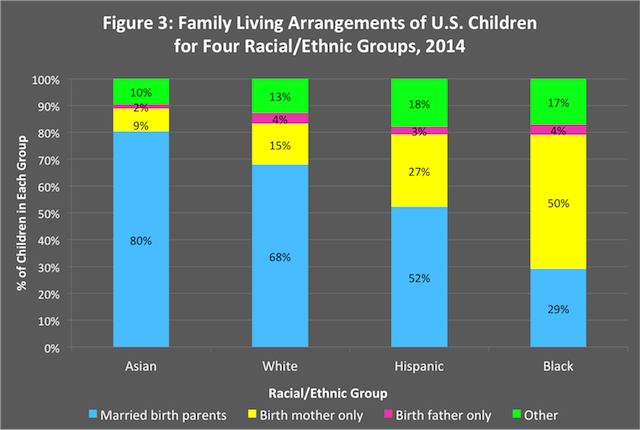
Eight in ten Asian-American kids live with married birth parents, compared with about seven in ten European-American kids, five in ten Hispanic-American kids, and only about three in ten African-American kids. Half of black children live with their mothers only, compared to three in ten Hispanic children, less than two in ten white children and less than one in ten Asian children.

Naturally, children who have two parents to look after them do better, because one parent alone cannot work and do household chores and monitor the children as easily as two parents can. The decision about whether to have sex before marriage is entirely under the control of the grown-ups. It cannot be blamed on racism, poverty and other non-moral pre-occupations of the secular left. Marriage is a moral issue, and Asian-Americans do the moral thing, and marry before they have children.

Asian household wealth set to surpass whites

2. Asian Americans save more of what they earn

This article from CNN Money explains:

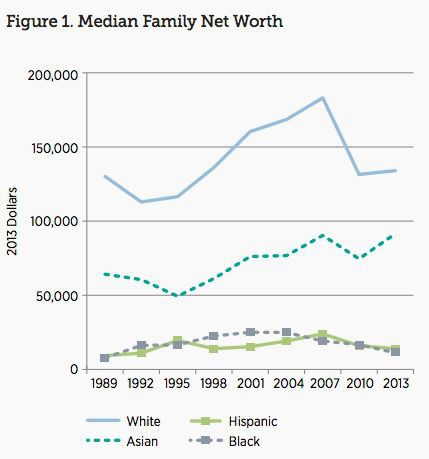
Asians have had higher median incomes than their white counterparts, according to a new study by the Federal Reserve Bank of St. Louis. The typical Asian family has brought home more money for most of the past two decades.

[…][Asians] will surpass whites in net worth in the next decade or two, Fed researchers said.

[…]In 1989, the median Asian family had about half the net worth of its white peer. By 2013, they had more than two-thirds.

The gap between whites and blacks and Hispanics, meanwhile, remained little changed over that time period.

Asians have similar financial habits to whites, in terms of investing and borrowing. Both groups are more likely than blacks and Hispanics to invest in stocks and privately-owned businesses and to have more liquid assets, which serves as a buffer against financial shocks. And, on average, the former have about half as much debt as the later.

As a result, Asians and whites have more financial stability than blacks and Hispanics, which also allows the former to build more wealth.

Everyone has to earn and save money, but in some cultures, it becomes normal to not save part of what you earn. That needs to stop. But it has nothing to do with discrimination due to skin color. In Asian culture, there is no glorification of consumer spending on sparkles, bling and other ostentatious wealth. Asians don’t want to appear to be wealthy, they want to actually be wealthy – by saving money.

Composite SAT scores by race and income levels
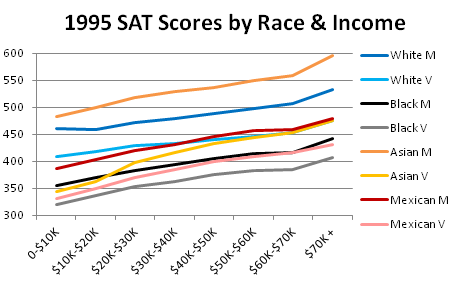
Composite SAT scores by race and income levels: Asians outperform at every income level

3. Asian Americans monitor their children’s educational progress

This article from Investors Business Daily explains how Asian parents don’t just make demands on their kids to learn, they actively monitor their progress and talk to their kids’ teachers:

Asian-American parents tend to oversee their children’s homework, hold them accountable for grades and demand hard work as the ticket to a better life. And it pays off: Their children are soaring academically.

[…]As a group, Americans need to take a page from the Asian parents’ playbook. American teens rank a dismal 28th in math and science knowledge, compared with teens in other countries, even poor countries.

Singapore, Hong Kong, South Korea, Japan and Taiwan are at the top. We’ve slumped. For the first time in 25 years, U.S. scores on the main test for elementary and middle school education (NAEP) fell. And SAT scores for college-bound students dropped significantly.

[…]Many [Asian students]from poor or immigrant families, but they outscore all other students by large margins on both tests, and their lead keeps widening.

In New York City, where Asian-Americans make up 13% of overall students, they win more than 50% of the coveted places each year at the city’s eight selective public high schools, such as Bronx Science and Stuyvesant.

What’s at work here? It’s not a difference in IQ. It’s parenting. That’s confirmed by sociologists from City University of New York and the University of Michigan. Their study showed that parental oversight enabled Asian-American students to far outperform the others.

No wonder many successful charter schools require parents to sign a contract that they will supervise their children’s homework and inculcate a work ethic.

You can see an updated image with the latest scores here.

It’s not enough to just outsource the education of your children to a bunch of non-STEM education-degree-holding teachers. Teachers can be good, and some work very hard. But the Democrat teacher unions prevent the firing of teachers who underperform. This is especially true in non-right-to-work states (Democrat states). So, you cannot depend on teachers to educate your children, and Asian parents don’t. That’s why their kids learn. Performance of children in school is not affected by discrimination against skin color, it’s affected by the level of involvement of parents.

Conclusion

We have learned that the success of Asian-Americans in America is all earned. And this proves that there is no such thing as “racism” that holds back non-whites. If blacks and Hispanics imitated the behaviors of Asians (not whites, but Asians), then they would achieve just as well as Asians do. It’s not a race problem, it’s a behavior problem. It’s not a “racism” problem, it’s a behavior problem. It’s an us problem, it’s not a them problem.

Serial sexual relationships, multi-partner fertility, single motherhood and fatherlessness

A man leading a woman upward

Here’s an article from the policy journal National Affairs (editor is Yuval Levin) that has some statistics about single motherhood by choice. When you are reading the article, keep in mind that most people who lean left are so influenced by feminism that they seem to think that women trip and fall accidentally, and end up pregnant from random men. I don’t think that we should minimize the fact that most women freely choose the men who treat them badly.

Excerpt:

Pew Foundation and Centers for Disease Control and Prevention surveys indicate that, on a range of measures, a very large share of fathers who do not live with their children have virtually no meaningful relationship with their non-custodial children. More than one-half report that they had not shared a meal with their non-custodial children in the last four weeks, while nearly two-thirds had not read to their children and a full three-quarters had not done homework with them. Moreover, these are self-reported figures, so the share of fathers with no relationship to their non-custodial children is most likely even higher.

When fathers form new romantic partnerships, their involvement with children from previous relationships declines. Jo Jones and William Mosher report that, while 39% of fathers in new romantic relationships had shared a meal with their non-custodial 5- to 18-year-old children at least once in the past month, 62% of those not in a new romantic relationship had. While 55% of fathers in a new romantic relationship had spoken with their 5- to 18-year-old non-custodial children, 77% of those not in a new romantic relationship had.

In addition, men with less education are more likely to exhibit absent-father behavior. Whereas 70% of fathers with at least some college had talked to their non-custodial 5- to 18-year-old children at least once in the past month, 59% of those with no more than a high-school degree had done so. While 74% of fathers with at least some college had played with their non-custodial child under 5 years old at least once in the past month, only 53% of those fathers with no more than a high-school degree had.

Multi-partner fertility is not only associated with father abandonment, it also adversely impacts child-maltreatment rates. Women attempting to balance work, the demands of new relationships, and the challenges of raising children are faced with a set of chronic stressors that often lead to child abuse and neglect. The shift from welfare to work increased these stresses. Partially as a result, between 1993 and 2005, the rate of overall abuse, physical abuse, sexual abuse, and serious abuse, respectively, rose by 22%, 14%, 49%, and 34% for children living with single mothers. By contrast, for children living in two-parent households, child-abuse rates fell on each of the four measures (by 42%, 24%, 62%, and 37%, respectively). By 2005, the child-abuse rate was 2.9 per 1,000 for children living with married biological parents but 10.2 for those living with a single parent and no partner, according to the U.S. Department of Health and Human Services. This disparity cannot be explained solely by socioeconomic status since the abuse rate for children in families of all kinds in the lowest socioeconomic group was still lower than that for children living in single-parent households.

Multi-partner fertility also increases child-abuse rates in a second way: the presence of non-biological fathers in the house. Child abuse in households with single mothers triples when they live with a man other than the child’s father. Child-maltreatment rates are actually lower in black than white households when the mother lives alone. But unfortunately, many men bring their job and other frustrations into the home, creating abusive situations. As a result, when a partner is present, the black rates on all three measures of child maltreatment — emotional, physical, and endangerment — are almost double the white rates. In addition, rates of intimate violence are over 12 times higher for single mothers than for married mothers.

Edin and Nelson ignore the subject of abusive behavior in men. Instead, despite the fathers’ caring attitudes, we are told, the mothers kick them out because they don’t earn sufficient income. And on the impact of multi-partner fertility on children, Doing the Best I Can offers one benign sentence: “Kids are amazingly resilient, but the rate of family change among children of unwed fathers has become so rapid, and now leads to such complicated family structures, that kids might have a hard time adjusting.”

Academic studies paint a much grimmer picture. After surveying the evidence, Sara McLanahan and Christopher Jencks concluded earlier this year,

[A] father’s absence increases antisocial behavior [among children], such as aggression, rule breaking, delinquency, and illegal drug use. These antisocial behaviors affect high school completion independent of a child’s verbal and math scores. Thus it appears that a father’s absence lowers children’s educational attainment…by disrupting their social and emotional adjustment and reducing their ability or willingness to exercise self-control.

The effects of growing up without both parents when it comes to aggression, rule breaking, and delinquency are also larger for boys than for girls. Marianne Bertrand and Jessica Pan found in 2011 that the behavior of boys is far more dependent upon good parenting practices — spending time with a child, emotional closeness, and avoiding harsh discipline — than that of girls. Such parenting habits are far more common in two-parent families, which helps to explain why boys with absent fathers are more likely to be suspended and have other behavioral problems than boys who have both parents at home.

The evidence also indicates that the outcomes are most negative when a man other than the biological father is present. Cassandra Dorius and Karen Guzzo found that “adolescents with a half-sibling with a different father are about 65 percent more likely to have used marijuana, uppers, inhalants, cocaine, crack, hallucinogens, sedatives, or other drugs by the time of their 15th birthday than those who have only full siblings.” Cynthia Harper and Sara McLanahan reported in 2004 that, among fatherless boys, those who lived with stepfathers were at an even greater risk of incarceration than those who lived with a single mother.

I think in today’s society, there seems to be a lot of fear and trembling to speak about moral standards. And it seems to be especially true that men are not allowed to tell women about their moral obligations. I know that at least when I speak to young women, they are often very rebellious. The attitude I encounter most often is that they feel that they should be able to trust their feelings and act in the way that their feelings dictate. Any destructiveness that results – which I warned them about – is dismissed as “unexpected”.

I can clearly remember the first time this happened to me, when I was in high school. I was friends with a girl named Tara who would come over and speak to me before morning announcements. She would tell me about her stock car driving boyfriend. One day, she told me that she was moving in with him. I warned her against it, and listed off a bunch of statistics about how this would cause problems. She stopped coming to talk to me, and so did her best female friend. Well, a few years later I ran into her again at one of our local universities where I was an undergraduate. She filled me in on what had happened. He had cheated on her with her best friend in their house. He got her pregnant. She had an abortion. She knew better now, but back in high school I was easily dismissed, and all of her friends sided with her.

Whenever I try to produce evidence to say that something is likely to cause harm, the response is usually “well I know a person who broke the rules and nothing happened”. I produce statistics about some likely consequence of following your heart, and it’s dismissed because some Hollywood celebrity managed to escape the probabilities. “Don’t judge me!” they say. Happiness comes first, and the best way to decide how to be happy in the long-term is apparently to do what makes a person feel happy right now. But statistics are there to tell a story of how the world normally works – dismissing it all with individual cases is bad logic. There are consequences to following your feelings and dismissing moral obligations.