
Tag Archives: Parenting

Overpopulation? Latest research suggests that we face a decline in population

From the left-wing Slate, of all places.

Excerpt:

A report issued last month by the Pew Research Center found that immigrant births fell from 102 per 1,000 women in 2007 to 87.8 per 1,000 in 2012. That helped bring the overall U.S. birthrate to a mere 64 per 1,000 women—not enough to sustain our current population.

Moreover, the poor, highly fertile countries that once churned out immigrants by the boatload are now experiencing birthrate declines of their own. From 1960 to 2009, Mexico’s fertility rate tumbled from 7.3 live births per woman to 2.4, India’s dropped from six to 2.5, and Brazil’s fell from 6.15 to 1.9. Even in sub-Saharan Africa, where the average birthrate remains a relatively blistering 4.66, fertility is projected to fall below replacement level by the 2070s. This change in developing countries will affect not only the U.S. population, of course, but eventually the world’s.

Why is this happening? Scientists who study population dynamics point to a phenomenon called “demographic transition.”

“For hundreds of thousands of years,” explains Warren Sanderson, a professor of economics at Stony Brook University, “in order for humanity to survive things like epidemics and wars and famine, birthrates had to be very high.” Eventually, thanks to technology, death rates started to fall in Europe and in North America, and the population size soared. In time, though, birthrates fell as well, and the population leveled out. The same pattern has repeated in countries around the world. Demographic transition, Sanderson says, “is a shift between two very different long-run states: from high death rates and high birthrates to low death rates and low birthrates.” Not only is the pattern well-documented, it’s well under way: Already, more than half the world’s population is reproducing at below the replacement rate.

If the Germany of today is the rest of the world tomorrow, then the future is going to look a lot different than we thought. Instead of skyrocketing toward uncountable Malthusian multitudes, researchers at Austria’s International Institute for Applied Systems Analysis foresee the global population maxing out at 9 billion some time around 2070. On the bright side, the long-dreaded resource shortage may turn out not to be a problem at all. On the not-so-bright side, the demographic shift toward more retirees and fewer workers could throw the rest of the world into the kind of interminable economic stagnation that Japan is experiencing right now.

It kind of undercuts the need for the leftist fixation on abortion, environmentalism, etc. doesn’t it?

Ari also sent me this article from Foreign Policy magazine that argues that the declining rate of population is actually good news for conservatives.

Excerpt:

Declining birthrates also change national temperament. In the United States, for example, the percentage of women born in the late 1930s who remained childless was near 10 percent. By comparison, nearly 20 percent of women born in the late 1950s are reaching the end of their reproductive lives without having had children. The greatly expanded childless segment of contemporary society, whose members are drawn disproportionately from the feminist and countercultural movements of the 1960s and 70s, will leave no genetic legacy. Nor will their emotional or psychological influence on the next generation compare with that of their parents.

Meanwhile, single-child families are prone to extinction. A single child replaces one of his or her parents, but not both. Nor do single-child families contribute much to future population. The 17.4 percent of baby boomer women who had only one child account for a mere 7.8 percent of children born in the next generation. By contrast, nearly a quarter of the children of baby boomers descend from the mere 11 percent of baby boomer women who had four or more children. These circumstances are leading to the emergence of a new society whose members will disproportionately be descended from parents who rejected the social tendencies that once made childlessness and small families the norm. These values include an adherence to traditional, patriarchal religion, and a strong identification with one’s own folk or nation.

This dynamic helps explain, for example, the gradual drift of American culture away from secular individualism and toward religious fundamentalism. Among states that voted for President George W. Bush in 2004, fertility rates are 12 percent higher than in states that voted for Sen. John Kerry. It may also help to explain the increasing popular resistance among rank-and-file Europeans to such crown jewels of secular liberalism as the European Union. It turns out that Europeans who are most likely to identify themselves as “world citizens” are also those least likely to have children.

Does this mean that today’s enlightened but slow-breeding societies face extinction? Probably not, but only because they face a dramatic, demographically driven transformation of their cultures. As has happened many times before in history, it is a transformation that occurs as secular and libertarian elements in society fail to reproduce, and as people adhering to more traditional, patriarchal values inherit society by default.

At least as long ago as ancient Greek and Roman times, many sophisticated members of society concluded that investing in children brought no advantage. Rather, children came to be seen as a costly impediment to self-fulfillment and worldly achievement. But, though these attitudes led to the extinction of many individual families, they did not lead to the extinction of society as a whole. Instead, through a process of cultural evolution, a set of values and norms that can roughly be described as patriarchy reemerged.

I think that if conservative men and women can get together and raise effective, influential children outside of the public school system, then we have some hope for the future. The welfare that is used to support single motherhood by choice is going to come to an end because of the debt crisis. When that happens, families headed by high-achieving men will be raising a higher proportion of the leaders of the next generation. Men and women who pool their resources and have more children will have more of an influence on the next generation.
New study: fewer than one in ten women staying home with children

Dina sent me this article from the UK Daily Mail.

Excerpt:

Fewer than one in ten women stay at home to look after their children

  • Latest census figures show 300,000 fewer staying home than thought
  • Concerns for well-being of mothers and impact on toddlers in day care
  • Stay-at-home figures dropped from 17 per cent of women 20 years ago

The stay-at-home mother is fast becoming consigned to history, according to the latest census figures.

Returns showed there are 300,000 fewer than officials  had previously estimated, with those who devote their lives to bringing up families now reduced to a tiny minority.

Fewer than one in ten women of working age are stay-at-home mothers.

The collapse follows a decade in which governments urged mothers to take jobs on the grounds that working is the route to fulfilment for women and that families with two incomes are much less likely to fall into poverty.

Critics, however, are concerned for the well-being of mothers who might prefer to be with their families, and the impact on increasing numbers of toddlers who spend long hours in day care.

The 2011 census results found there are 1,598,000 women who do not work because they are looking after their home and family – 298,000 fewer than estimates from the Office for National Statistics.

Note that this is applauded by feminist groups, like the UK Labour Party:

The decline in numbers of stay-at-home mothers will be welcomed by ministers as the Labour drive to push mothers into work has continued under the Coalition.

Childcare minister Elizabeth Truss has made a priority of providing cheaper day care to help mothers into jobs.

In an article earlier this year  she said it was ‘vital’ for mothers to work, adding: ‘To power ahead Britain needs to look at best practice from overseas to discover how to increase women’s participation, especially for those who are parents.’

But critics say the sky-high level of house prices and the lack of help for two-parent families in the tax and benefit systems means most mothers have to work, whether they like it or not.

Earlier this week I blogged studies that showed the importance of fathers to children. But it’s important to remember that mothers are also important to children, especially in the first few years of the child’s life. And we have studies to back that up as well.

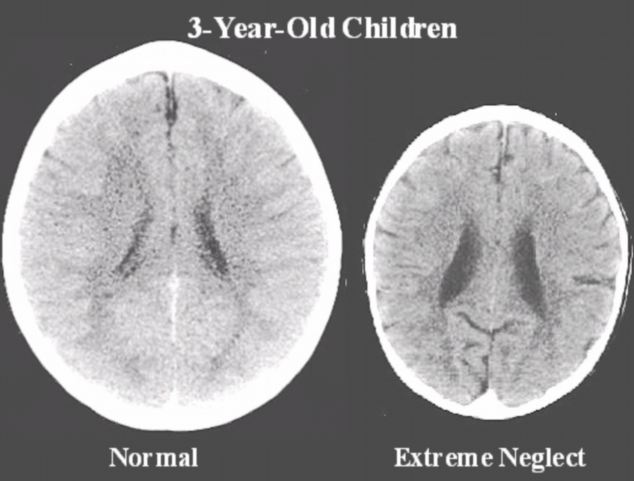
Brain scans of 3-year old children: normal vs neglected

This was discussed before in another article from the UK Daily Mail. (H/T Dina)

Excerpt:

Both of these images are brain scans of a two three-year-old children, but the brain on the left is considerably larger, has fewer spots and less dark areas, compared to the one on the right.

According to neurologists this sizeable difference has one primary cause – the way each child was treated by their mothers.

The child with the larger and more fully developed brain was looked after by its mother – she was constantly responsive to her baby, reported The Sunday Telegraph.

But the child with the shrunken brain was the victim of severe neglect and abuse.

According to research reported by the newspaper, the brain on the right worryingly lacks some of the most fundamental areas present in the image on the left.

The consequences of these deficits are pronounced – the child on the left with the larger brain will be more intelligent and more likely to develop the social ability to empathise with others.

But in contrast, the child with the shrunken brain will be more likely to become addicted to drugs and involved in violent crimes, much more likely to be unemployed and to be dependent on state benefits.

The child is also more likely to develop mental and other serious health problems.

Professor Allan Schore, of UCLA, told The Sunday Telegraph that if a baby is not treated properly in the first two years of life, it can have a fundamental impact on development.

He pointed out that the genes for several aspects of brain function, including intelligence, cannot function.

[…]The study correlates with research released earlier this year that found that children who are given love and affection from their mothers early in life are smarter with a better ability to learn.

The study by child psychiatrists and neuroscientists at Washington University School of Medicine in St. Louis, found school-aged children whose mothers nurtured them early in life have brains with a larger hippocampus, a key structure important to learning, memory and response to stress.

The research was the first to show that changes in this critical region of children’s brain anatomy are linked to a mother’s nurturing, Neurosciencenews.com reports.

The research is published online in the Proceedings of the National Academy of Sciences Early Edition.

Lead author Joan L. Luby, MD, professor of child psychiatry, said the study reinforces how important nurturing parents are to a child’s development.

If we are really interested in providing for the needs of young children, then we have to voluntarily limit the freedom of adults. Traditional marriage is the way that societies have provided for the needs of young children. Marriage puts boundaries on sexual activity (premarital chastity, post-marital fidelity) that are beneficial to children. Children need to have access to their parents over the course of their development.

We should be promoting behaviors and policies that strengthen marriage, like chastity and low tax rates. We should be opposing behaviors and policies that weaken marriages, like hooking-up and no-fault divorce. That’s what we would do if we really had the best interests of children at heart instead of the best interests of adults.

A Dad: the tenth most popular gift requested by children at Christmas

Dina sent me this sad article from the UK Telegraph.

Excerpt:

A study of 2,000 British parents found most children will put a new baby brother or sister at the top of their Christmas list, closely followed by a request for a real-life reindeer.

A “pet horse” was the third most popular choice, with a “car” making a bizarre entry at number four.

Despite their material requests, the tenth most popular Christmas wish on the list was a “Dad”.

[…]A request for a “mum” reached number 23 on the list.

It’s sad. I think that there is a perception among many young women today that it is OK to have recreational premarital sex that may lead to having a child out of wedlock. Many unmarried women have an intuition (not supported by data) that a child will turn out fine without a father in the home. Some think (against the data) that fathers can be substituted with a government welfare check and that children won’t notice the difference. But the research shows that this is a false belief.

Excerpt:

Census data and the Fragile Families survey show that marriage can be extremely effective in reducing child poverty. But the positive effects of married fathers are not limited to income alone. Children raised by married parents have substantially better life outcomes compared to similar children raised in single-parent homes.

When compared to children in intact married homes, children raised by single parents are more likely to have emotional and behavioral problems; be physically abused; smoke, drink, and use drugs; be aggressive; engage in violent, delinquent, and criminal behavior; have poor school performance; be expelled from school; and drop out of high school.[19] Many of these negative outcomes are associated with the higher poverty rates of single mothers. In many cases, however, the improvements in child well-being that are associated with marriage persist even after adjusting for differences in family income. This indicates that the father brings more to his home than just a paycheck.

The effect of married fathers on child outcomes can be quite pronounced. For example, examination of families with the same race and same parental education shows that, when compared to intact married families, children from single-parent homes are:

  • More than twice as likely to be arrested for a juvenile crime;[20]
  • Twice as likely to be treated for emotional and behavioral problems;[21]
  • Roughly twice as likely to be suspended or expelled from school;[22] and
  • A third more likely to drop out before completing high school.[23]

The effects of being raised in a single-parent home continue into adulthood. Comparing families of the same race and similar incomes, children from broken and single-parent homes are three times more likely to end up in jail by the time they reach age 30 than are children raised in intact married families.[24] Compared to girls raised in similar married families, girls from single-parent homes are more than twice as likely to have a child without being married, thereby repeating the negative cycle for another generation.[25]

Finally, the decline of marriage generates poverty in future generations. Children living in single-parent homes are 50 percent more likely to experience poverty as adults when compared to children from intact married homes. This intergenerational poverty effect persists even after adjusting for the original differences in family income and poverty during childhood.[26]

And here’s a bit more data showing that having government replace fathers via higher taxes and more redistribution of wealth doesn’t take away the bad effects of fatherlessness:

Children from low-income, two-parent families outperform students from high-income, single-parent homes. Almost twice as many high achievers come from two-parent homes as one-parent homes. Source: “One-Parent Families and Their Children;” Charles F. Kettering Foundation (1990).

Children reared by a divorced or never-married mother are less cooperative and score lower on tests of intelligence than children reared in intact families. Statistical analysis of the behavior and intelligence of these children revealed “significant detrimental effects” of living in a female-headed household. Growing up in a female-headed household remained a statistical predictor of behavior problems even after adjusting for differences in family income. Source: Greg L. Duncan, Jeanne Brooks-Gunn and Pamela Kato Klebanov, “Economic Deprivation and Early Childhood Development,” Child Development 65 (1994).

After taking into account race, socioeconomic status, sex, age, and ability, high school students from single-parent households were 1.7 times more likely to drop out than were their corresponding counterparts living with both biological parents. Source: McNeal, Ralph B. Jr.”Extracurricular Activities and High School Dropouts.” Sociology of Education 68(1995): 62-81.

I think that these are significant in light of the recent shooting in Connecticut:

In studies involving over 25,000 children using nationally representative data sets, children who lived with only one parent had lower grade point averages, lower college aspirations, poor attendance records, and higher drop out rates than students who lived with both parents. Source: McLanahan, Sara and Gary Sandefur. Growing up with a Single Parent: What Hurts, What Helps. Cambridge: Harvard University Press, 1994.

A 1988 Department of Health and Human Services study found that at every income level except the very highest (over $50,000 a year), children living with never-married mothers were more likely than their counterparts in two-parent families to have been expelled or suspended from school, to display emotional problems, and to engage in antisocial behavior. Source: James Q. Wilson, “In Loco Parentis: Helping Children When Families Fail Them,” The Brookings Review, Fall 1993.

72% of adolescent murderers grew up without fathers. 60% of America’s rapists grew up the same way. Source: D. Cornell (et al.), Behavioral Sciences and the Law, 5. 1987. And N. Davidson, “Life Without Father,” Policy Review. 1990.

The likelihood that a young male will engage in criminal activity doubles if he is raised without a father and triples if he lives in a neighborhood with a high concentration of single-parent families. Source: A. Anne Hill, June O’Neill, “Underclass Behaviors in the United States,” CUNY, Baruch College. 1993.

The shooter in Connecticut hadn’t spoken to his father in two years:

Peter Lanza, the father of Sandy Hook shooter, hadn’t spoken to his son for more than two years and his father is at a loss for what drove Adam to kill 20 students and six teachers at his old elementary school.

[…]Adam, 20, had not spoken to his brother Ryan or father for upwards of two years at the time of the shooting. Adam reportedly distanced himself from his father Peter when he started to become serious with his new girlfriend, and current wife.

Peter and Adam’s mother Nancy split in 2001 but did not formally divorce until November 2008. Court records made the split appear amicable as both parties agreed to put their sons needs above any bitterness, but Adam was apparently the one to cut ties with his father in 2010.

Women need to think ahead and realize that the little children will be impacted by her choice of man, as well of her choice of whether to have recreational premarital sex with a man. If she doesn’t test him adequately and makes poor choices, then the children will be deprived of a father in the home. I don’t think that the sentiment “he makes me happy and horny and my friends approve of him” necessarily translates into “he can do the job of protecting, providing and leading on moral and spiritual issues”. Those are two different sets of criteria, and often at cross-purposes in a culture that despises traditional male roles as “sexist”.