Tag Archives: Parenting

New study: cohabitation produces far inferior outcomes to marriage

Does government provide incentives for people to get married?
Is cohabitation the same thing as a lifelong marriage commitment?

This study is from the American College of Pediatricians.

The Stream writes about the study:

The American College of Pediatricians recently published a paper, Cohabitation, which cautions adolescents and young adults about the negative consequences of cohabitation for both themselves and their children, and urges parents to teach their children about the advantages of waiting until marriage.

More young people are now first cohabiting than are marrying without prior cohabitation, yet research shows that, rather than being a stepping-stone to a healthy marriage, living together before marriage (cohabitation) makes couples more likely to break-up and more likely to divorce if they do marry. It results in lower marital satisfaction and increased negative communication.  Cohabiting couples spend less time together; men are more likely to spend their time on personal pleasure than do married men.

Commitment failure:

Cohabiting couples are now less likely to later marry than 40 years ago. Controlling for other factors that increase risk of divorce, marriages preceded by cohabitation are still 50 percent more likely to end in divorce.  (Some recent studies challenge this, but are scientifically flawed and omit the raw data.)  Also 27 percent of cohabitations dissolve without marriage in the first three years.

Domestic violence:

Cohabiters commit increased violence against their partner. Women are nine times more likely to be killed by a cohabiting partner than by their husband. Severe violence is four times as common among cohabiting couples; any violence is nearly 50 percent more common among couples cohabiting before marrying and doubled among couples continuing to cohabit after five years.

Alcohol abuse:

Men who cohabit without marrying in 5 to 10 years have more than double the rate of alcohol abuse as married men; women who cohabit without marrying have 4 to 7 times the rate of alcohol abuse as married women.

Infidelity:

Cohabiters, both men and women, have rates of infidelity in the preceding year more than triple that of married spouses. Among the married, those cohabiting prior to marriage were 50 percent more likely to be unfaithful as those marrying without cohabiting.

Poverty:

Poverty is more common among cohabitating women and their children. Their male partners have both a higher unemployment rate (15 percent vs 8 percent), and work less hours if employed.

Abortion:

Cohabitating women are ten times more likely to have an abortion than married women, and suffer from its associated mortality and morbidity. In fact, 89 percent of women who have had abortions have at one time cohabited; 40 percent have lived with three or more men. Abortion also puts future children at risk, especially from extremely premature birth.

Harm to children:

Children who survive also suffer due to parental cohabitation.  They have increased risk of losing a parent to divorce or separation, possibly multiple times.  Children born of cohabiting parents are over four times more likely to suffer separation of their parents by their third birthdays (49 percent) than those born to married parents (11 percent).

[…]Nearly one-third of couples enter into cohabitation with a child from a previous relationship, as do half of those cohabitating for six years or longer. Children living with a parent and unmarried partner (live-in boyfriend) have 20 times the risk of sexual abuse and eight times the risk of all maltreatment compared to children living with married biological parents.  Even if the couple marries, stepchildren have over eight times the risk of sexual abuse and triple the overall risk of abuse of neglect. Girls living with a stepparent had 60 percent higher risk of being raped than girls living with their biological parents.

Depression:

Women in cohabiting relationships have more depression than married women, and poorer responsiveness to their children’s emotional needs.  Children whose mothers are depressed have increased cortisol responses to stress (which may explain their increased hypertension in adulthood). Children with unmarried mothers are half as likely to be breastfed, leading to higher rates of asthma, pneumonia, ear and intestinal infections, diabetes, obesity, and lower intelligence.

Please believe me when I say that you should click through to the Stream and read the entire article.

So what do I want to say about this in my 500 words? Well, I want to say that the cohabitation issue is a good opportunity for us to reason about whether there should be any rules around sexuality and relationships.

Our culture is absolutely poisoned right now with a kind of feelings-oriented non-judgmentalism that prevents debate. Everything has been reduced to people feeling “offended” and using the power of government to stifle debate. Nowhere is this more evident than on the university campus, which is the source of the problem. This hyper-tolerance and emotional non-judgmentalism leaves people open to making poor decisions that cause self-destruction and harm to others. As a result, young people are blindly accepting a script for sexuality and relationships from the culture, e.g. – Hollywood, celebrities, and ideologically-driven academics. A script made by professional story-tellers insulated from the consequences of their ideas.

As Christians, we seem to have so much trouble talking to young people about rules around sexuality and relationships. So many young people think that premarital sex is benign. That cohabitation is no big deal. And that redefining marriage cannot be opposed. Christian parents and pastors are not preparing themselves to discuss these things with young people. If there is a battle of ideas, and one side shows up with a bunch of feelings and lies, that side still wins – if the other side doesn’t show up at all. Don’t be so focused on your career and your own self that you fail your children by failing to discuss and debate with them about the issues. Don’t assume that just because your children look OK on the surface that there are not serious questions underneath.

There is so much I could say about this problem of talking to young people. As I argued in a previous post, I truly believe that apologists should not neglect these social / cultural / fiscal issues. We have to study them and know how to argue for our values using secular arguments and evidence, such as you see in the study above. Once young people have decided that Christian teachings on sexuality (e.g. – chastity, courting) are primitive and irrational, or worse, then getting them to accept Christianity becomes that much harder. And that goes double for marriage. If they think that cohabitation, no-fault divorce, same-sex marriage and gay adoption are opposed for no other reason than blind prejudice or even hatred, then we’ve lost before we even begin to make our first philosophical argument.
Can blacks and Hispanics blame their troubles on racism by whites?

Does government provide incentives for people to get married?
The success of children is due to their parents’ choices, not from outside racism

If the underperformance of blacks and Hispanics in America were caused by racism by whites, then it follows that Asian-Americans would be underperforming as well. But Asian-Americans are outperforming whites. Let’s look at three reasons why, and see if blacks and Hispanics can learn how to succeed by looking at the Asian example.

Here is the summary of this post:

  1. Asian Americans marry before they have children
  2. Asian Americans save more of what they earn
  3. Asian Americans monitor their children’s educational progress

Now let’s take a look at each of these in order.

Asians marry before they have children, so the kids have two parents

1. Asian Americans marry before they have children

This article is from Family Studies.

It says:

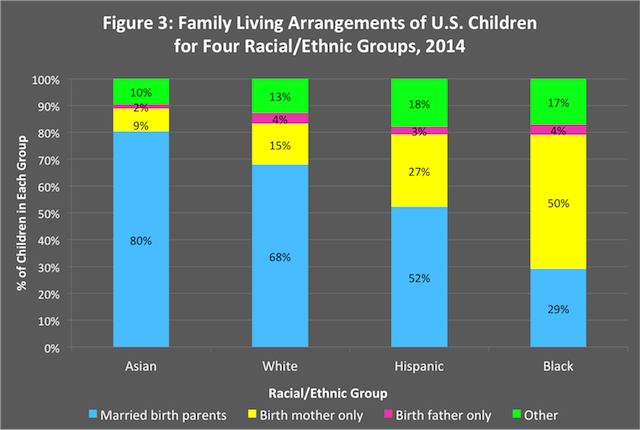
Eight in ten Asian-American kids live with married birth parents, compared with about seven in ten European-American kids, five in ten Hispanic-American kids, and only about three in ten African-American kids. Half of black children live with their mothers only, compared to three in ten Hispanic children, less than two in ten white children and less than one in ten Asian children.

Naturally, children who have two parents to look after them do better, because one parent alone cannot work and do household chores and monitor the children as easily as two parents can. The decision about whether to have sex before marriage is entirely under the control of the grown-ups. It cannot be blamed on racism, poverty and other non-moral pre-occupations of the secular left. Marriage is a moral issue, and Asian-Americans do the moral thing, and marry before they have children.

Asian household wealth set to surpass whites

2. Asian Americans save more of what they earn

This article from CNN Money explains:

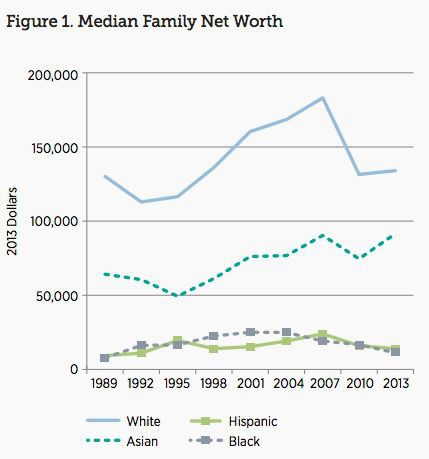
Asians have had higher median incomes than their white counterparts, according to a new study by the Federal Reserve Bank of St. Louis. The typical Asian family has brought home more money for most of the past two decades.

[…][Asians] will surpass whites in net worth in the next decade or two, Fed researchers said.

[…]In 1989, the median Asian family had about half the net worth of its white peer. By 2013, they had more than two-thirds.

The gap between whites and blacks and Hispanics, meanwhile, remained little changed over that time period.

Asians have similar financial habits to whites, in terms of investing and borrowing. Both groups are more likely than blacks and Hispanics to invest in stocks and privately-owned businesses and to have more liquid assets, which serves as a buffer against financial shocks. And, on average, the former have about half as much debt as the later.

As a result, Asians and whites have more financial stability than blacks and Hispanics, which also allows the former to build more wealth.

Everyone has to earn and save money, but in some cultures, it becomes normal to not save part of what you earn. That needs to stop. But it has nothing to do with discrimination due to skin color. In Asian culture, there is no glorification of consumer spending on sparkles, bling and other ostentatious wealth. Asians don’t want to appear to be wealthy, they want to actually be wealthy – by saving money.

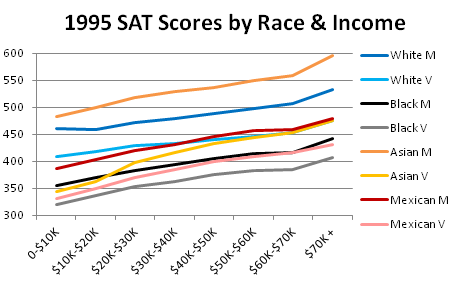
Composite SAT scores by race and income levels
Composite SAT scores by race and income levels: Asians outperform at every income level

3. Asian Americans monitor their children’s educational progress

This article from Investors Business Daily explains how Asian parents don’t just make demands on their kids to learn, they actively monitor their progress and talk to their kids’ teachers:

Asian-American parents tend to oversee their children’s homework, hold them accountable for grades and demand hard work as the ticket to a better life. And it pays off: Their children are soaring academically.

[…]As a group, Americans need to take a page from the Asian parents’ playbook. American teens rank a dismal 28th in math and science knowledge, compared with teens in other countries, even poor countries.

Singapore, Hong Kong, South Korea, Japan and Taiwan are at the top. We’ve slumped. For the first time in 25 years, U.S. scores on the main test for elementary and middle school education (NAEP) fell. And SAT scores for college-bound students dropped significantly.

[…]Many [Asian students]from poor or immigrant families, but they outscore all other students by large margins on both tests, and their lead keeps widening.

In New York City, where Asian-Americans make up 13% of overall students, they win more than 50% of the coveted places each year at the city’s eight selective public high schools, such as Bronx Science and Stuyvesant.

What’s at work here? It’s not a difference in IQ. It’s parenting. That’s confirmed by sociologists from City University of New York and the University of Michigan. Their study showed that parental oversight enabled Asian-American students to far outperform the others.

No wonder many successful charter schools require parents to sign a contract that they will supervise their children’s homework and inculcate a work ethic.

You can see an updated image with the latest scores here.

It’s not enough to just outsource the education of your children to a bunch of non-STEM education-degree-holding teachers. Teachers can be good, and some work very hard. But the Democrat teacher unions prevent the firing of teachers who underperform. This is especially true in non-right-to-work states (Democrat states). So, you cannot depend on teachers to educate your children, and Asian parents don’t. That’s why their kids learn. Performance of children in school is not affected by discrimination against skin color, it’s affected by the level of involvement of parents.

Conclusion

We have learned that the success of Asian-Americans in America is all earned. And this proves that there is no such thing as “racism” that holds back non-whites. If blacks and Hispanics imitated the behaviors of Asians (not whites, but Asians), then they would achieve just as well as Asians do. It’s not a race problem, it’s a behavior problem. It’s not a “racism” problem, it’s a behavior problem. It’s an us problem, it’s not a them problem.

New study: negative effects of day care on children not caused by quality of day care

Does government provide incentives for people to get married?
Mom is staying home because Dad can afford to let her: do kids benefit?

New study using National Institute of Child Health and Human Development data is discussed on the Family Studies web site.

First, let’s get the two views:

Parents, policymakers, and academics interested in how day care and preschool affect child development often embrace one of two competing—and exaggerated—claims about the childrearing circumstances that are now normative in America: that of non-family care being initiated early in a child’s first year of life on a full-time or near-full-time basis and continuing, in one form or another (e.g., family day care, center care, preschool), until the start of formal schooling.

Critics of such arrangements highlight the fact that developmental risks, like increased rates of insecure attachment and elevated levels of aggressive behavior, have been found to be associated with the extensive use of non-family care in America. Advocates, in contrast, stipulate, usually without qualification, that if the quality of care is good, then children benefit; and, indeed, that it is the limited quality of care available to too many parents in the USA that is responsible for any negative effects on children that emerge in the research literature.

All right, so the big-government, anti-family people say that day care as such isn’t bad for kids, the negative effects that are observed are not caused by too much day care, but by the low quality of the day care. The conservative, pro-family, limited-government crowd thinks that quality doesn’t matter as much as quantity – too much day care is bad for kids, regardless of quality.

The study details:

[…][T]he National Institute of Child Health and Human Development (NICHD) funded, to the tune of at least $150 million, the NICHD Study of Child Care and Youth Development. It recruited more than 1,000 children (along with their mothers) in 1991 from 10 different research sites, and followed them from the first month of life to age 15. Among other purposes, the NICHD Study was designed to investigate the claim that long hours of day care initiated very early in life posed risks to children’s social and emotional development; and, should this prove so, to evaluate the proposition that such negative effects would be due to the poor quality of care that children received, not the quantity of care they experienced across the first five years of life.

And the conclusion:

NICHD Study’s findings on the effects of day care proved more consistent than inconsistent with my “developmental risk” claim. And they provided virtually no support for the idea that it was poor quality care that accounted for the negative effects of “early, extensive, and continuous” care (initiated very early in life, for long hours, and continuing for many years).2 Specifically, our many research reports revealed that the more time children spent in any kind of non-familial child care, and sometimes specifically in centers, the more aggressive and disobedient they proved to be at two (but not three) and 4.5 years of age, as well as across their elementary school years; and the more impulsive they proved to be at age 15, at which age they also engaged in more “risky” behavior than children who experienced far less non-familial care across their first five years of life. Critically, despite spending millions to carefully measure the quality of care, using methods and measures developed by the proponents of the “it’s quality, stupid” view, the study never found that the quality of care accounted for these quantity-of-care effects. In other words, the problem behavior associated with early, extensive, and continuous care emerged irrespective of whether quality of care was good or bad.

Read the whole thing, and don’t feel guilty if you can’t do the best for your kids. I am sure that everyone reading this post is going to do the best they can for their kids. But for those who have not yet had kids, let this be a lesson to you about what you should be studying in school, where you should be working, how much you should borrow, how much you should spend. A stay-at-home mom is expensive. It cannot be finessed with feelings and following your heart to fun and thrills.

When it comes to children, money is important

I know there are lots of Christians around the world who read the Bible and understand that there are certain goals laid out in the Bible for Christian parents who are raising their kids. As far as I can tell, young Christians seem to think that these goals will sort themselves out all by themselves through God’s mysterious predestination, or some other such fideistic wishing. What it really boils down to is that young people want to do what they want to do, and they can sound pious about it by saying God will somehow make their crazy plan work out. Well, that’s not effective, and young Christians would never act so ineffectively in any other area of their lives – ignoring how things really work.

Look the Bible has information about the specification that God expects you to implement. Part of that spec involves requirements for your kids. If you decide that the Bible is not trying to give you a spec, you’ll fail to deliver. If you decide that you don’t need to read studies to know how the world works, you’ll fail to deliver. If you decide that following your heart is something that God rewards more than intelligent thought, you’ll fail to deliver. You cannot feelings your way out of this assignment, you’ve got to solve the problem, and that means reading the studies and making a plan that delivers results.

So, young people. If you want to do the best for your kids, you better stop doing what feels good, and start engaging in some serious self-denial and self-sacrifice. Fumbling around chasing happy philosophy bubbles to Europe through your teens, 20s and 30s is not the right way to prepare professionally and financially for kids. Your love for your future kids begins with your decision to grow up and do hard, boring things that need to be done. You won’t be able to fix the child care costs problem at the 11th hour if you follow your heart for the first 10 hours. Keep in mind what child care looks like in places like Ontario, and what your children would be learning, and who they would be learning it from. Make a plan now.