
Tag Archives: Marriage

Lori Alexander is right: serious Christian men prefer debt-free virgins without tattoos

Marriage stability vs sexual partners,(Teachman et al. JAMF, August 2010)

Christian writer Lori Alexander recently wrote a blog post (H/T Lindsay) urging Christian women to do 3 things:

  1. be a virgin before marriage
  2. be debt-free before marriage
  3. don’t get any tattoos

She also urged women to be cautious about college, because it often gets them into debt. I disagree with her a little here. I always urge young women to earn a STEM degree in college, then work a few years to pay off their loans (if any) before marrying. This is because women, like men, need to have the experience of doing something hard that they don’t “feel” like doing, in order to grow. STEM degrees teach young people that the world doesn’t revolve around them, and that their feelings don’t matter when trying to solve a problem in the real world. It’s a very useful way for women and men to break themselves out of the desire for free and easy happiness that is so common in our time.

Lori’s article drew enormous opposition from both secular and Christian sources. So far, the only people defending her are men’s rights sites, like Dalrock (Christian) and Spawny (non-Christian). Every other “Christian” blog or news site that I read disagreed her article, and argued that premarital sex was no big deal, that having debt was no big deal, and that having tattoos was no big deal.

Let’s take a look at her three points, then I’ll explain why her article is largely correct, and why she is correct about what she asserts about the criteria that godly men have for women.
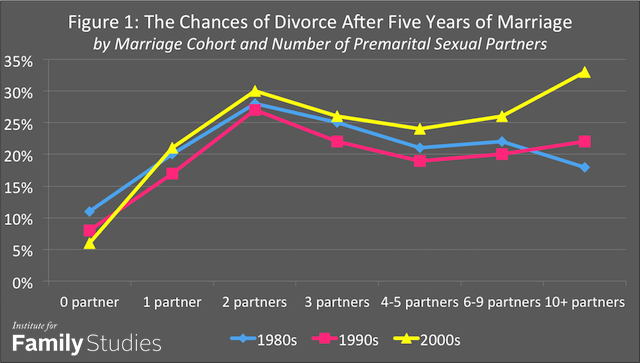
Even one non-husband premarital sex partner raises risk of divorce

Virginity

Regarding her first point, virginity is commanded by the Bible, it’s in line with peer-reviewed studies on marriage quality and stability. The reason that people find this difficult is that they want the freedom to give in to sexual desires without feeling shame. They want to believe that there is no permanent effect. It doesn’t help that parents and pastors are terrified of telling young people, and young women in particular, that promiscuity harms marital stability. Right now, the culture is drowning in feminism. Feminism tells women that the traditional male roles of provider, protector, and spiritual leader are “sexist”. The “best” men are good-looking pro-abortion bad boys. If a Christian woman is not able to think through the meaning of sex with respect to marriage enough to control herself, it seriously harms the stability of her future marriage.

Starting and Mid-Career salaries by profession (click for larger image)

Debt-free

Regarding her second point, almost everything a serious Christian man might plan to do for Christ with his marriage is impacted by finances. From education, to marriage timing, to number of children, to home ownership, early investment, to the success of children. to age of retirement. Less money means fewer choices, and less ability to counter challenges. Think of how important money for legal defense is to Christian-owned businesses who are being persecuted, for example. The reason that many people find the Bible’s teaching on stewardship difficult is that they don’t want to exercise self-control with money if they don’t feel like it. They want to waste money seeking fun and thrills, and then act like their poverty could not be avoided. Being debt-free is an indicator of practical wisdom and self-control in a woman.
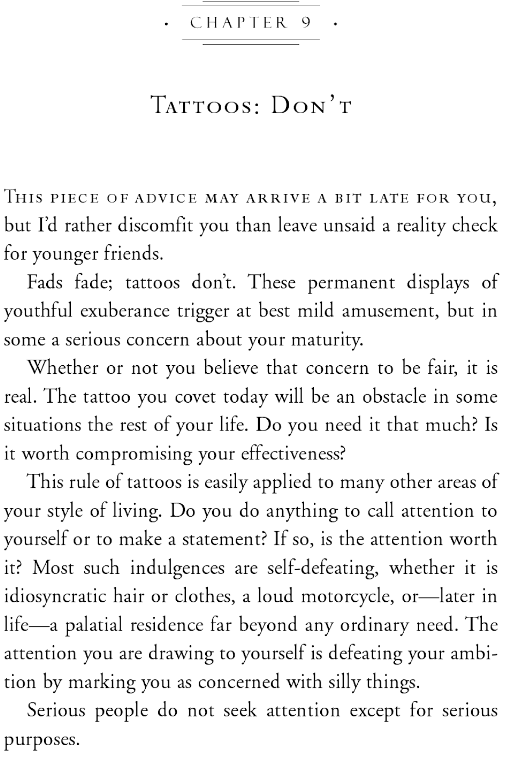
Hugh Hewitt's "In, But Not Of", Chapter 9: Tattoos, Don't
Chapter 9 of Hugh Hewitt’s “In, But Not Of: A Guide to Christian Ambition”

Tattoos

Tattoos are a problem for serious Christian men for several reasons. First, they cost money and for no gain, and can even cause you losses in your career. Second, most people get them because of low self-esteem or vanity or to look rebellious or to look dangerous. None of these motivations should be acted upon by someone with a robust Christian worldview. The money could be better used on charity, or investments, etc. Women show what their priorities really are by how they spend their money and time. Show me a woman’s bookshelf, and I’ll tell you how seriously she has thought about what it means to be a Christian in all areas of life. Instead of showing me your tattoos to demonstrate your “spirituality”, show me your apologetics books, to demonstrate your intellectual engagement. And tell me how you used that information to engage in conversations with educated non-Christians to answer their challenges to your faith. That way I’ll know that you use your money to train do hard things in order to have an influence for Christ in serious, practical, effective ways. A woman who can defend her faith and discuss Christianity with non-Christians is demonstrating her ability to raise Christian children in a secular society.

A family praying and reading the Bible

The goal of marriage is to serve God

Today, young people have been taught to follow their hearts, and to deny that there is any authority or practical wisdom that should govern their decisions. They always imagine themselves to be exempt from moral rules, statistics, cause and effect, etc. They think they know better than everyone else – even though they do almost no research on their own. Every adviser who tells them to study computer science instead of creative writing is wrong. Their same-age friends know more about what causes divorces than peer-reviewed research papers. And money should be spent on skydiving and zip-lining, regardless of what financial experts like Dave Ramsey might say.

A woman who has made many mistakes cannot fix those mistakes with words. Rationalizations, evasions, and blame-shifting do not work to show that there has been real repentance. The man can only assess whether grace has caused any real re-prioritization of goals by evaluating her outward actions over a long period of time. Furthermore, if a woman who has made mistakes attacks those who correct her from Bible’s teachings on chastity, stewardship, etc., then it’s a sign that there is no real repentance.

Choosing a wife wisely doesn’t mean that Christian men treat OTHER Christian women poorly. Christian men love all the Christian women. We care for them and support them. But when a man chooses a wife, he is choosing someone who will have more influence on his ability to serve God than anyone else. In my case, the goals for my marriage involve making a difference with apologetics in the church, having many children who will receive the educations and careers they need to have an influence, influencing government to promote Christian-friendly policies, charitable giving, mentoring young Christians, modeling a good marriage to others, and having a home that can serve to host discussions about issues that matter. These things are not free – they take careful planning and execution to achieve.

Lori’s advice is  intended for men who are serious about making their marriage produce a return for God. Men who are chaste themselves. Men who accept the Bible as an authority. Men who earned STEM degrees, instead of easy nonsense degrees that don’t lead to good careers. Men who earn 6-figure salaries, who buy houses for cash, and who are on track have a 7-figure net worth by age 50. Men who made good decisions cannot risk marrying someone who hasn’t prepared for marriage. The wrong woman in the home could ruin the man’s effort to produce a marriage that gives glory to God.

Not every man intends to achieve something for God with his marriage, but those who do need to choose a woman who has demonstrated ability at doing the job. For example, if the job requires marital fidelity, then chastity is a good indicator that the woman has the necessary self-control. If the job requires frugality, and practicality, then being debt-free, having a STEM degree, and having some private sector work experience are good indicators that she’s qualified for the role. Nothing valuable in life is ever been achieved by being lazy, wild and irresponsible. Serious Christian men look for wives who have applied themselves to difficult tasks that they didn’t feel like doing, who achieved success by remaining committed to the plan, in spite of their unhappy feelings and unmet desires.

We have a problem in the church such that we aren’t serious about teaching young people to develop marriage-ready character and to make serious plans for marriage. We are teaching them to follow their hearts, and that their feelings and desires are clues about God’s will for their happiness. We are teaching them to be uncomfortable with responsibilities, expectations and obligations to others. We are teaching them not to do their own research. We are teaching them not to make practical, wise plans. We are teaching them to ATTACK those who try to get them to be serious about doing what is likely to work. This approach is not working.

My own criteria for a wife are more demanding than Lori’s. My advice there is only for serious Christian men who want their marriage to serve God.

New study: what lifestyle choices lead to happiness for women?

Marriage and family
Marriage and family

In preparation for this blog post, I read an article from a far-left source about the decline of women’s happiness.

Excerpt:

As women gain political, economic and social freedoms, one would expect that they should feel even more contented relative to men. But this isn’t so.

The “paradox of declining female happiness” was pointed out by economists Betsey Stevenson and Justin Wolfers, who also happen to share a house and kids. They analyzed the happiness trends of US citizens between 1970 and 2005 and found a surprising result.

Stevenson and Wolfers discovered that American women rated their overall life satisfaction higher than men in the 1970s. Thereafter, women’s happiness scores decreased while men’s scores stayed roughly stable. By the 1990s, women were less happy than men. This relative unhappiness softened after the turn of the century, but men continue to enjoy a higher sense of subjective wellbeing that is at least as high — if not higher — than women’s.

Those 35 years saw advances in American women’s rights and financial power.

Let’s take a look at a recent study that the Daily Wire reported on, to see what really makes women happy:

Despite the onslaught of propaganda telling young girls otherwise, a recent research paper distilling data from over 30 European countries concluded that mothers find homemaking preferable to working full-time.

Doc. PhDr. Dana Hamplová, Ph.D., a senior scientist at the Institute of Sociology, ASCR, and a current representative of the Czech Republic in the International Social Science Program, authored the paper. Addressing Betty Friedan’s narrative in the book The Feminine Mystique, which claims that women are happiest and most fulfilled at work, Hamplová “explores the link between employment and subjective well-being among mothers with children under 3 years of age,” reads the paper’s abstract.

“Analyzing multiple measures of subjective well-being, the paper shows that homemakers are generally happier than full-time workers,” the scientist found.

“Contrary to our expectations, homemaking was positively associated with happiness particularly among mothers who left higher quality employment for childcare. Though some variation across countries exists, it is not linked to the provision of formal childcare, duration of parental leave, or tax system,” Hamplová explains.

[…]”Thus, similarly to several other studies, the ESS [European Social Survey] data do not corroborate Betty Friedan’s idea that domesticity and housekeeping leaves women unhappy and unsatisfied,” she writes. “As all 12 measures of happiness/satisfaction point to the same direction, the conclusion that mothers with younger children tend to be better off if they are not engaged in paid employment seems to be robust.”

We’ve had lots of advancements in women’s power, often coming at the expense of men (i.e. – husband candidates). For example, anti-male schools staffed by feminist administrators and feminist teachers might be great for women, but they don’t produce high-earning men for women to marry. And when women vote to expand government, taxes must increase to pay for all the spending. This reduces even further the pool of men who can take on a wife and family shrinks even more because of the increased tax burden.

This article from the leftist The Atlantic explains:

In the view that has prevailed in American education over the past decade, boys are resented, both as the unfairly privileged sex and as obstacles on the path to gender justice for girls. This perspective is promoted in schools of education, and many a teacher now feels that girls need and deserve special indemnifying consideration.

[…]A review of the facts shows boys, not girls, on the weak side of an education gender gap. The typical boy is a year and a half behind the typical girl in reading and writing; he is less committed to school and less likely to go to college. In 1997 college full-time enrollments were 45 percent male and 55 percent female. The Department of Education predicts that the proportion of boys in college classes will continue to shrink.

Data from the U.S. Department of Education and from several recent university studies show that far from being shy and demoralized, today’s girls outshine boys. They get better grades. They have higher educational aspirations. They follow more-rigorous academic programs and participate in advanced-placement classes at higher rates. According to the National Center for Education Statistics, slightly more girls than boys enroll in high-level math and science courses. Girls, allegedly timorous and lacking in confidence, now outnumber boys in student government, in honor societies, on school newspapers, and in debating clubs. Only in sports are boys ahead, and women’s groups are targeting the sports gap with a vengeance. Girls read more books. They outperform boys on tests for artistic and musical ability. More girls than boys study abroad. More join the Peace Corps. At the same time, more boys than girls are suspended from school. More are held back and more drop out. Boys are three times as likely to receive a diagnosis of attention-deficit hyperactivity disorder. More boys than girls are involved in crime, alcohol, and drugs. Girls attempt suicide more often than boys, but it is boys who more often succeed. In 1997, a typical year, 4,483 young people aged five to twenty-four committed suicide: 701 females and 3,782 males.

It’s important to note that women are not victims here, they are actually the ones who created the shortage of men who could earn enough money to support a family, and allow them to stay home with their children. Their “advancements in power” came at a cost: they undermined the system that produced men who were capable of handling the financial demands of a family where the wife can raise her own children.

Look at this study of how women have voted to expand government and therefore raise taxes on working men for social programs that replace husbands:

This paper examines the growth of government during this century as a result of giving women the right to vote. Using cross‐sectional time‐series data for 1870–1940, we examine state government expenditures and revenue as well as voting by U.S. House and Senate state delegations and the passage of a wide range of different state laws. Suffrage coincided with immediate increases in state government expenditures and revenue and more liberal voting patterns for federal representatives, and these effects continued growing over time as more women took advantage of the franchise. Contrary to many recent suggestions, the gender gap is not something that has arisen since the 1970s, and it helps explain why American government started growing when it did.

Bigger government means higher taxes means men earn less money, after taxes. How are you supposed to keep your wife home to watch over the little ones when taxes are higher? You can’t.

Matthew Vines and Michael Brown debate homosexuality and the Bible on Moody radio

The audio of the Matthew Vines vs Michael Brown debate is streamed here on the Moody site.

Details:

Can you be gay and Christian? Matthew Vines says you can and he’s created a viral video and best-selling book defending his view. This Saturday on Up for Debate, Vines joins host Julie Roys to debate author and leading evangelical apologist, Dr. Michael Brown. Is gay monogamy an option for Christians? Is it unloving to reject gay marriage? Listen and join the discussion this Saturday at 8 a.m. Central Time on Up for Debate!

Summary key: Julie Roys (JR), Matthew Vines (MV), Michael Brown (MB)

Summary:

Opening speeches:

  • JR: Why should Christians be open to reinterpreting the Bible on homosexuality?
  • MV: Consider the lives and testimonies of gay Christians. Here is my personal story.
  • MV: According to the Bible, a person with same-sex attractions would have to embrace lifelong celibacy. I refuse to do that.
  • MV: There are 6 passages in the Bible that are relevant to the goodness of homosexuality. All are negative.
  • MV: None of these passages address gay relationships that are “long-term” and “faithful” that are based on “commitment” and “love”.
  • JR: You say that it is “damaging” for Christians to disagree with you views, is that true?
  • MV: Yes. One of my friends declared his homosexuality and he did not feel safe to come home. He felt pain because Christians disagreed with him.
  • MV: You cannot ask a person with same-sex attractions to be celibate, it causes too much harm to ask gays to abstain from sexual relationships.
  • JR: Respond to Matthew.
  • MB: The Bible only permits heterosexual sexuality and in every case condemns homosexual acts.
  • MB: Matthew is taking his sexual preferences and activities as given, and reinterpreting the Bible to fit it.
  • MB: Genesis talks about women being made to help men, and to fulfill God’s commandment to procreate and fill the Earth.
  • MB: The Bible speaks about the complementarity of the sexes when talking about how two become one in marriage.
  • MB: I am very sensitive to the stories of people who are gay who experience discrimination as “gay Christians”.
  • MB: You can feel sad for people who have two conflicting commitments, but that doesn’t mean we should redefine what the Bible says.
  • JR: Stop talking, we have a break.

JR takes a caller for the next topic:

  • Caller 1: I had same-sex attractions and I was able to change my sexuality.
  • JR: Matthew, respond to that.
  • MV: Alan Chambers of Exodus International says that 99.9% of people he worked with had not changed their gay orientation.
  • MV: Lifelong celibacy is not acceptable to gays, so the Bible must be reinterpreted to suit gays.
  • MB: Matthew thinks that God himself did not understand the concept of sexual orientation and inadvertently hurt gays because of his lack of knowledge.
  • MB: There is a solution in the Bible for people who cannot be celibate, and that solution is heterosexual marriage
  • MB: If a person is only attracted to pre-teen girls, do we then have to re-write the Bible to affirm that so they won’t be “harmed”?
  • MB: Alan Chambers was speaking for his own group, and his statement does not account for the fact that thousands of people DO change.
  • JR: What about the Jones/Yarhouse study that found that 38% of reparative therapy subjects were successful in changing or chastity?
  • MV: (no response to the question)
  • MV: (to Brown) do you accept that the Bible forces gays to live out lifelong celibacy

Another break, then Brown replies:

  • MB: Yes. But change is possible.
  • MV: Do you know of any Christian who acknowledged that this was the consequence of the Bible’s teaching for gays?
  • MB: Paul’s explanation that the options for ALL Christians are 1) celibacy or 2) heterosexual marriage. For 2000 years.
  • MV: Paul (in Romans 1) is talking about people who are not “long-term”, “faithful” gay relationships.
  • MV: Paul was not aware of “long-term”, “faithful” gay relationships at the time he wrote his prohibitions in Romans 1.
  • JR: How do you know that fixed sexual orientation is true? And that the Biblical authors would written different things if they knew?
  • JR: Are there any references in the first century to “long-term”, “faithful” gay relationships?
  • MB: Yes, in my book I quote prominent historian N. T. Wright who documents that those relationships were known.
  • MB: Matthew’s view requires that God did not know about sexual orientation when ordaining the Bible’s content.
  • MB: Leviticus 18 is for all people, for all time. This was not just for the Jews, this was for everyone.
  • MV: I am not saying that Paul was wrong because he was ignorant.
  • MV: Paul was writing in a context where “long-term”, “faithful” gay relationships were unknown.
  • MV: NT Wright does not cite first century texts, he cites a problematic 4th century text.
  • MV: Absence of 1st-century references to “long-term”, “faithful” gay relationships means that God did not intend to prohibit them.
  • MB: Whenever the Bible speaks about homosexuality, it is opposed to it – Old Testament and New Testament.

Another break, then the conclusion:

  • JR: Respond to the Leviticus prohibition, which prohibits homosexuality for everyone, for all time.
  • MV: It is a universal prohibition on male same-sex intercourse, but it does not apply to Christians.
  • MV: For example, Leviticus prohibits sex during a woman’s menstrual period. And Christians are not bound by that.
  • MV: What is the reason for this prohibition of male-male sex in Leviticus? It’s not affirm the complementarity of the sexual act.
  • MV: The Bible prohibits male-male sex because it is written for a patriarchal culture.
  • MV: In a patriarchal culture, women are viewed as inferior. That’s why the Bible prohibits a man from taking the woman’s role in sex.
  • MB: The prohibition in Leviticus is a universal prohibition against male-male sex, applicable in all times and places.
  • MB: Homosexual sex is a violation of the divine order.
  • MB: We can see already the consequences of normalizing this: gay marriage, and supports for polygamy and polyamory.
  • MV: So the earliest reference there is to a “long-term”, “faithful” gay relationship is a 4th century text.
  • MV: But that gay relationship is not like modern gay relationships.

I have a few comments about Vines’ points below.

My comments:

Even heterosexuals who have not married are called upon to embrace lifelong celibacy. I am in my early 40s and am a virgin because I have not married. I wouldn’t seek to reinrepret the Bible to allow premarital sex just because what I am doing is difficult. I would rather just do what the Bible says than reinterpret it to suit me. And it’s just as hard for me to be chaste as it would be for him to be. In short, it’s a character issue. He takes his right to recreational sex as non-negotiable, and reinterprets the Bible to suit. I take the Bible as non-negotiable, and comply with it regardless of whether it seems to make me less happy. With respect to the purposes of God for me in this world, my happiness is expendable. If I don’t find someone to marry, I’m going to be “afflicted” with the lifelong celibacy that Vines seems to think is torture, but let me tell you – God is happy with the contributions I am making for him, and if I have to be chaste through my whole life, I am 100% fine with that. I serve the King. And not the reverse.

Notice that he talks about “long-term” but not permanent relationships, and “faithful” but not exclusive. This is important because the statistics show that gay relationships (depending on whether it is female-female or male-male) are prone to instability and/or infidelity. I just blogged on that recently, with reference to the published research on the subject. Vines is talking about a situation that does not obtain in the real world – according to the data. Gay relationships do not normally value permanence and exclusivity in the way that opposite-sex marriage relationships do, especially where the couple regularly attends church. The divorce rate and infidelity rate for religious couples is far below the rates for gay couples, depending on the sexes involved. Vines is committed to the idea that marriage is about feelings, e.g. – “love”, but that’s not the public purpose of marriage. Marriage is not about love, it’s about complementarity of the sexes and providing for the needs of children. We have published studies like this one showing that there are negative impacts to children who are raised by gay couples, which dovetails with studies showing that children need a mother and that children need a father. We should not normalize any relationship that exposes children to harm. We should prefer to inconvenience adults than to harm children.

Matthew Vines made an argument that Christians have to stop saying that homosexuality is wrong, because it makes gay people feel excluded. I wrote previously about the argument that gay activists use where they say “if you don’t agree with me and celebrate me and affirm me, then I’ll commit suicide”. In that post, I quoted a prominent gay activist who made exactly that argument. I don’t find the threats to self-destruction to be a convincing argument for the truth of the view that gay marriage being the same as heterosexual marriage. In fact, this is confirmed by a recent study which showed that features of gay relationships themselves, and not social disapproval, is to blame for high rates of suicide in the gay community.

Vines seems to want to argue that the context in which the Bible authors were writing did not allow them to address the problem of gays in “long-term”, “faithful” relationships. Well, we have already seen that statistically speaking, those relationships are in the minority. One British study mentioned in the post I linked to above found that only 25% of gay couples were intact after 8 years. The number is 82% for heterosexual marriages, and that doesn’t filter by couples who abstain from premarital sex and who attend church regularly. If you add those two criteria, the number is going to be well above 82% in my opinion. Studies show that premarital chastity and church attendance vastly improve the stability and quality of marriages.

In addition, Vines is trying to argue that 1) the Bible authors were not aware of “long-term”, “faithful” gay relationships and 2) their failure to explicitly disqualify these “long-term”, “stable” gay sexual relationships means that the Bible actually condones them. A friend of mine pointed out that this is a textbook case of the argument from silence, where someone asserts that because something is not explicitly condemned, then it must be OK. Carried through to its logical end, that would mean that things like identity theft are OK, because they are not mentioned explicitly. Brown asserted that there was a blanket prohibition on homosexual acts. He is arguing from what we know. Vines says that “long-term”, “faithful” homosexual relationships are not mentioned, and are therefore OK. He is arguing from what we don’t know. And he is trying to reverse the burden of proof so that he doesn’t have to show evidence for his view. Brown wouldn’t take the bait. The fact of the matter is that no one for the last 2000 years of church history have taken Vines’ view. Every single Christian before Vines, who were closer to Jesus’ teachings than Vines, understood the verses that Brown cited to be providing a blanket prohibition on homosexual sex acts. If Vines wants to claim that the Bible condones what he wants it to condone, he has to produce some positive evidence from the text or from church history or church fathers. He has nothing to support his case that could convince anyone that this is what Christians have believed, and ought to believe.

Finally, if you are looking for another debate, I blogged about a debate between Michael Brown and Eric Smaw. There’s a video and summaries of the opening speeches in that post.