Dr. Frank Turek is a dynamic speaker and award-winning author or coauthor of four books: Stealing from God: Why Atheists Need God to make their Case, I Don’t Have Enough Faith to be an Atheist, Correct, Not Politically Correct and Legislating Morality. As the President of CrossExamined.org, Frank presents powerful and entertaining evidence for Christianity at churches, high schools and at secular college campuses that often begin hostile to his message. He has also debated several prominent atheists including Christopher Hitchens and David Silverman, president of American Atheists.
Frank hosts an hour-long TV program each week called I Don’t Have Enough Faith to Be an Atheist that is broadcast Wednesday nights on DirecTV Channel 378 (the NRB Network). His radio program called CrossExamined with Frank Turek airs on 122 stations every Saturday morning at 10 a.m. eastern and is available continuously on the free CrossExamined App.
A former aviator in the US Navy, Frank has a master’s degree from the George Washington University and a doctorate from Southern Evangelical Seminary. He and his wife, Stephanie, are blessed with three grown sons.
Frank Turek is one of my favorite speakers, and I admire him for being willing to take a public stand on controversial issues like gay marriage. He’s actually had to pay a price for that in his professional life, and I blogged about that before.
Here’s the lecture on gay marriage, featuring Christian apologist Frank Turek.
Outline:
Outline of Frank Turek’s lecture on same sex marriage
Introduction:
how to present your case against marriage safely
Christians are required to go beyond tolerance
loving another person can mean opposing the person when they want to do something wrong, even if they hate you
what did Jesus say about marriage? (see Matt 19:4-6)
what did Jesus say about sexual morality? (Matt 15, Matt 19)
Summary:
the same-sex marriage debate is about whether to compel people who disagree with the gay lifestyle to validate and normalize it
P1: the government has an interest in marriage because it perpetuates and stabilizes society – this is the purpose of marriage
P2-4: government can take 3 kinds of stances towards behaviors: promote, permit or prohibit
government promotes behaviors when it has an interest in them
same-sex relationships should be permitted, but not promoted
Q1: if same-sex marriage had serious negative consequences, would you reconsider their position?
Q2: are heterosexual relationships the same as homosexual relationships?
Q3: what would society be like if everyone married according to the natural marriage definition: one woman, one man, for life?
Q4: what would society be like if everyone married according to the same-sex marriage definition: man/man and woman/woman?
Should Christians care about law and politics? or should they just preach the gospel?
They should care because people often get their cues about what is moral and immoral based on what is legal and illegal
Many of the social problems we see today can be traced back to problems with marriage and family
Children do much better when they have a relationship with their mother and their father
Same-sex marriage necessarily destroys the relationship between a child and its mother or its father
When a country embraces same-sex marriage, it reinforces the idea that marriage is not about making and raising children
same-sex marriage shifts the focus away from the needs of the children to the feelings of desires of the selfish adults
does homosexuality impose any health and mental health risks?
what has the impact of legalizing same-sex marriage been in Massachusetts to individuals, schools, businesses and charities?
how same-sex marriage poses a threat to religious liberty
how should you respond to the view that homosexuality is genetic?
And at the very end, he shows this short video, which is only 5 minutes and explains the logic of opposing the redefinition of marriage:
My biggest concern is religious liberty, and we are seeing how same-sex marriage has proven to be incompatible with religious liberty. But I also care about children… I want them to have mothers and fathers who put their needs first. Marriage is about a commitment – it is the subjugation of feelings and desires to responsibilities and obligations. It is a promise. A promise to commit to love your spouse and children regardless of feelings and desires. It requires more self-denial, self-control and self-sacrifice. Not less.
In the last few months, I’ve met 5 different Christian women in their 30s who all asked me the same question: where are all the good men who want to marry me?
Christian men’s rights blogger Dalrock had two different posts where he described the answer to this question.
Here is the first post from Dalrock that concisely illustrates the problem:
As I wrote in A very long season, feminists don’t want to waste a day more of their youth and fertility on their husbands than absolutely necessary. As if to prove this very point, 30 year old Mona Chalabi writes in the NY Times* I Want My 2.3 Bonus Years:
If I could prolong my time as a young adult by, say, 2.3 years, here is a list of things I would like to do:
• Go to more parties. Preferably wild parties that I can think about, years later, at mild parties.
[…]• Have more romantic partners.
[…]• Get a bit higher up the career ladder a bit earlier on. That would probably boost my earnings, giving me more financial security. I could use that money to go to more parties, get a membership to a fancy gym and maybe even meet a romantic partner on the ab machines.
To drive the message home, the image at the top of the article is a cartoon of a resentful Chalabi giving her future husband the side eye for her lost years of sampling penises!
Surely, this must be an isolated case just for New York Times feminists, right? It’s not widespread, is it?
Margaret Wente at the Globe and Mail* asks where all the good men have gone. Wente comes to the conclusion that women need a sex cartel:
…it’s up to us to make the rules. “Why buy the cow when you can get the milk for free?” my father used to say. It drove me crazy when he said that. Now, it’s dawned on me that he was right.
Since the women’s cartel collapsed, women’s bargaining power has seriously eroded. That’s why so many single women hate Tinder, which has further commodified sex for the benefit of men. Women are just another consumer good in the shop window.
The apex fallacy aside, Wente is partially right. Women (as a group) have signaled to men that what they really want are exciting sexy badboys, not boring loyal dudes. It isn’t that women no longer want to marry beta providers, they just don’t want to waste a day more of their youth and fertility on their husband than absolutely necessary.
As a result, some up and coming boring loyal dudes aren’t knocking themselves out in their twenties while they wait for their future wife to tire of having sex with other men.
If you wonder why men are no longer performing in school, and exchanging careers for video games, the answer is simple. Men have realized that young women today, under the influence of feminism, are not interested in traditional husbands during their late teens and 20s. During these years, women are interested in travel, fun, drinking, hook-ups and cohabitation with amoral atheists. This is what I have personally observed. In the minds of young women, the highest value men are good-looking men who have no religion, and make no moral judgments, and are left of center politically – especially on abortion.
There are actually many other men who don’t meet this standard – marriage-minded men – who want to get married young and have children. But when these men see what young women really want, they just give up on school and work, since doing the traditional male roles has no value to young women. Many good men even give up on morality and Christianity, because they want a relationship with a woman so badly. They know that women don’t want marriage-minded men when women are youngest and prettiest.
More from second post:
What Wente doesn’t understand is that timing is everything. From an economic point of view, women are dividing up sexual access that traditionally would have been reserved only for their husband into two blocks. The first block contains their most attractive and fertile years, and it is dedicated to no strings sex with exciting badboys. Then, once women reach what Rollo calls the epiphany phase, they want to bargain sexual access in their remaining (older and less fertile) years for maximum beta bucks.
The problem with this strategy is (generally speaking) not that the previously overlooked beta men will refuse to marry the suddenly reformed party girls. The problem is that young men now look at the men 3-5 (and even 5-10) years older than them and don’t see an indication that signaling provider status will make them attractive to women. They also see a society that holds married fathers in contempt**. Most of these men are still working hard in their late teens and twenties to prepare to signal provider status in their 30s. But a growing minority of young men are no longer doing so. These men are instead working like women. Once the reformed party girls are ready to find Mr. Beta Bucks, there is a shortage of 30 something men who fit the bill. Even worse, no amount of complaining or shaming will cause the missing beta providers to go back in time and spend the prior decade preparing for this moment.
I’m one of the last men who followed the marriage-preparedness script for traditional men who wanted to marry and have four children and have a stay-at-home homeschooling mom to raise them from birth to graduate school. I find myself now in my mid-40s, with a 6-figure income and a 7-figure net worth. I never used my success to play the field with hot bad girls. I wanted to keep my sexual past completely clean for my eventual wife. However, what I observed in my late teens and 20s and even early 30s was a complete lack of interest in marriage ability, from non-Christian women and Christian women alike. Christian women aren’t learning to value early marriage from their married parents or their evangelical churches. None of the traditional husband skills are valued by young women, i.e. – chastity, gapless resume, alcohol abstinence, undergraduate and graduate STEM degrees, experience nurturing and mentoring others, stewardship of earned income.
I recently caused an uproar on my Facebook page by saying that even if the perfect woman showed up right now to marry me, I would not pursue her because the critical time where the woman could have applied maximum youth, beauty and fertility as a wife to make an impact on my education, early career, health, and finances has passed. A younger woman develops value to her husband precisely by applying herself to him and to her family in these critical early years. Men who have experienced this self-sacrificial love and support are loyal to their wives even after their wives lose their youth and beauty. Why? Because the men know that they are much better than they could have been, having enjoyed that early investment of value made by their young wives.
Young women very supportive of premarital sex
As Christian writer Matt Walsh notes in a recent article at the Daily Wire, this “follow your heart” focus on happiness in women is lethal to marital stability, and men know it.
Excerpt:
There was an article in Cosmo this week with a title that summarizes all that’s wrong with Cosmo and modern society as a whole: “I eloped at 25, divorced at 26, and dated my way across Europe all summer.” Of course, by “dated my way across Europe” she means that she slept with half the continent.
The author, Elise, says she “started fighting” with her husband and within a few months they both decided that their differences were irreconcilable. Despite counseling, she says, “neither of us was happy.” So, exhausted from 12 whole months of marriage, Elise embarked on a voyage of self-discovery and STD cultivation. She met random dudes in half a dozen countries and had sex with them, learning quite a lot as she went, though she can’t really explain what exactly she learned or why sex was a necessary component in learning it. Finally, she came home and started dating some other guy. The end.
Well, not really the end. 20 years from now I’m sure we’ll get the follow up article: “I’m alone and miserable and it’s everyone’s fault but mine.” After all, you may be able to fill the emptiness in your soul with frivolous sex when you’re young and physically desirable, but that phase is fleeting. People who don’t want to “waste” their beauty and youth on a spouse, so they waste it instead on strangers who don’t love them or even care what happens to them tomorrow, will be shocked when a tomorrow comes where even strangers aren’t interested anymore. This is where the single-minded, utterly selfish pursuit of “happiness” at all costs inevitably leads: to rejection, despair, and a quiet, unnoticed death on a lonely hospital bed.
As Elise helpfully demonstrated, “do what makes you happy” is poison in a marriage. Many a vow has been broken because one or both partners decide to chase “happiness” instead of commitment, fidelity, and love. “I deserve to be happy,” reports the legion of serial divorcees, as they drift on to the next spouse, and the next, and the next, and the next, looking for the one — the one, finally — who might cure the misery they’ve inflicted on themselves. Increasingly unhappy, yet increasingly convinced that they deserve to be.
And this follow your heart to happiness situation is alive and well in the church today. Marriage-minded Christian men who have prepared for husband roles are surprised to find that there is often little or no difference between Elise and the Christian women the church produces. Christian men who desire to invest in a marriage that is stable, productive and influential have nowhere to turn for a wife who is able and willing to help. In my experience, the problem with happiness-focused women who delay marriage is never discussed in churches from the pulpit. The “good men to marry” that today’s 30-something women are looking for were plentiful back when those same women were in their early-to-mid 20s.
These days, everyone seems to think that being good to the poor means looking around to see what people are saying is good to the poor, then loudly shouting your agreement with it. People want to look good to others more than they want to help others. Besides, looking good by loud virtue signaling is free. If we really wanted to help people, though, we should tell them to do what will work.
So let’s talk about poverty in America, with help from famous black economist Walter Williams.
First, he says real poverty is not common in America:
There is no material poverty in the U.S. Here are a few facts about people whom the Census Bureau labels as poor. Dr. Robert Rector and Rachel Sheffield, in their study “Understanding Poverty in the United States: Surprising Facts About America’s Poor”, report that 80 percent of poor households have air conditioning; nearly three-quarters have a car or truck, and 31 percent have two or more. Two-thirds have cable or satellite TV. Half have one or more computers. Forty-two percent own their homes. Poor Americans have more living space than the typical non-poor person in Sweden, France or the U.K. What we have in our nation are dependency and poverty of the spirit, with people making unwise choices and leading pathological lives aided and abetted by the welfare state.
Second, the “poverty” is not caused by racism, but by poor choices:
The Census Bureau pegs the poverty rate among blacks at 35 percent and among whites at 13 percent. The illegitimacy rate among blacks is 72 percent, and among whites it’s 30 percent. A statistic that one doesn’t hear much about is that the poverty rate among black married families has been in the single digits for more than two decades, currently at 8 percent. For married white families, it’s 5 percent. Now the politically incorrect questions: Whose fault is it to have children without the benefit of marriage and risk a life of dependency? Do people have free will, or are they governed by instincts?
There may be some pinhead sociologists who blame the weak black family structure on racial discrimination. But why was the black illegitimacy rate only 14 percent in 1940, and why, as Dr. Thomas Sowell reports, do we find that census data “going back a hundred years, when blacks were just one generation out of slavery … showed that a slightly higher percentage of black adults had married than white adults. This fact remained true in every census from 1890 to 1940”? Is anyone willing to advance the argument that the reason the illegitimacy rate among blacks was lower and marriage rates higher in earlier periods was there was less racial discrimination and greater opportunity?
Third, avoiding poverty is the result of good choices:
No one can blame a person if he starts out in life poor, because how one starts out is not his fault.
If he stays poor, he is to blame because it is his fault. Avoiding long-term poverty is not rocket science. First, graduate from high school. Second, get married before you have children, and stay married. Third, work at any kind of job, even one that starts out paying the minimum wage. And finally, avoid engaging in criminal behavior. It turns out that a married couple, each earning the minimum wage, would earn an annual combined income of $30,000. The Census Bureau poverty line for a family of two is $15,500, and for a family of four, it’s $23,000. By the way, no adult who starts out earning the minimum wage does so for very long.
Fourth, what stops people from making good choices is big government:
Since President Lyndon Johnson declared war on poverty, the nation has spent about $18 trillion at the federal, state and local levels of government on programs justified by the “need” to deal with some aspect of poverty. In a column of mine in 1995, I pointed out that at that time, the nation had spent $5.4 trillion on the War on Poverty, and with that princely sum, “you could purchase every U.S. factory, all manufacturing equipment, and every office building. With what’s left over, one could buy every airline, trucking company and our commercial maritime fleet. If you’re still in the shopping mood, you could also buy every television, radio and power company, plus every retail and wholesale store in the entire nation”. Today’s total of $18 trillion spent on poverty means you could purchase everything produced in our country each year and then some.
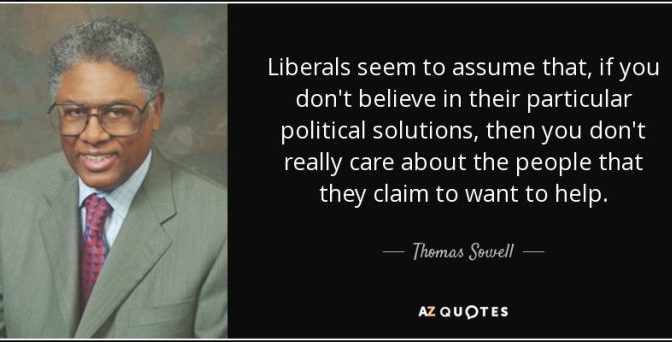
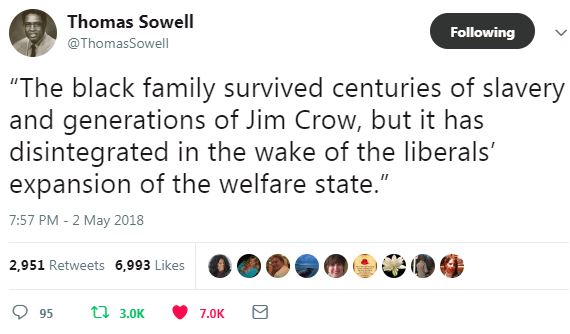
Regarding those last two points, here is another famous black economist, Thomas Sowell:
Economist Thomas Sowell blames welfare for killing the black family
To illustrate this point, here’s a graph with some helpful data taken from the U. S. Census.
In fact, there is a whole video featuring Thomas Sowell to go with this graph:
Black women were more likely to be married before welfare programs
If we wanted to be serious about evidence, we might compare where blacks stood a hundred years after the end of slavery with where they stood after 30 years of the liberal welfare state. In other words, we could compare hard evidence on “the legacy of slavery” with hard evidence on the legacy of liberals.
Despite the grand myth that black economic progress began or accelerated with the passage of the civil rights laws and “war on poverty” programs of the 1960s, the cold fact is that the poverty rate among blacks fell from 87 percent in 1940 to 47 percent by 1960. This was before any of those programs began.
Over the next 20 years, the poverty rate among blacks fell another 18 percentage points, compared to the 40-point drop in the previous 20 years. This was the continuation of a previous economic trend, at a slower rate of progress, not the economic grand deliverance proclaimed by liberals and self-serving black “leaders.”
Ending the Jim Crow laws was a landmark achievement. But, despite the great proliferation of black political and other “leaders” that resulted from the laws and policies of the 1960s, nothing comparable happened economically. And there were serious retrogressions socially.
Nearly a hundred years of the supposed “legacy of slavery” found most black children being raised in two-parent families in 1960. But thirty years after the liberal welfare state found the great majority of black children being raised by a single parent.
The rest of the article points out how even crime rates among blacks were caused by the implementation of soft law enforcement policies by progressives. Just look at the big cities if you want to know what it is like for blacks to be ruled by Democrats. It sucks!
If everybody started to read more Thomas Sowell books, we would be much better off as a country! Only good things happen when people stop watching TV and listening to music and watching movies, and instead settle down in a chair with a Thomas Sowell book. I recommended a bunch of them in a previous post.



 WINTERY KNIGHT