Tag Archives: Liberal Party

A look at redistribution of wealth from the workers to the non-workers in Canada

Canada election 2011: Conservatives in Blue, Socialists in Red, Communists in Orange
Election 2011: Conservatives in Blue, Socialists in Red, Communists in Orange

I found two examples of policies that promote the redistribution of wealth from producers to non-producers in Canada. I think it’s worth taking a look at their policies so that we understand more about our own redistribution policies.

The first example of redistribution has to do with unemployment insurance, where productive taxpayers who choose low-risk, high-pay jobs must subsidize other citizens who get high-risk, low-pay jobs. Their program is called “Employment Insurance”. Canadians who work have to pay into the system, and when any of them loses their jobs, then they get to take money out of it. Those who work more pay more, those who work less pay less. Those with safe jobs collect nothing, and those with risky jobs collect more.

Is this program fair? In this article from Brian Lilley’s Lilley Pad blog, Canadian columnist Lorne Gunter explains what’s wrong with this program.

Excerpt:

Employment Insurance is a lot of things, but an insurance plan to encourage employment it is not.

For one thing, the premiums aren’t based on the risk of making a claim.

Young drivers pay higher auto insurance premiums because they are much more likely to get in an accident. Yet Canadians in high-unemployment industries and high-unemployment regions make no higher EI contributions than those who live where they are never likely to be without work.

Indeed, those most likely to make EI claims will make far lower lifetime contributions than those who are unlikely ever to claim. That makes EI a welfare program underwritten by a tax on employment, rather than an insurance plan.

In the 1990s, I interviewed a Statistics Canada researcher who had made the study of EI his life’s work. He told me that he had discovered one New Brunswick town of 3,000 people where every adult had made at least one EI claim. Most had claimed three or more times.

In some areas, EI is an accepted part of the culture. It’s that entitlement mentality the Tories’ changes are aimed at breaking.

In the CBC’s fawning 1994 biography of Pierre Trudeau, St. Pierre admitted that one of the goals of his government’s ’70s-era reforms to Unemployment Insurance (as it was more accurately known then) was to enable Canadians to stay in their home regions if they wanted to, even if they were never likely to find steady work there.

So the scheme is also an interregional transfer of wealth — from have to have-not provinces.

Of course, every year thousands of Canadians move from have-not regions to more prosperous areas in search of better jobs and higher pay. So it is not as though everyone who could collects EI to stay put.

But the question is why should hard-working Canadians be compelled to subsidize anyone who refuses to move or turns down locally available work?

It’s very similar to their health care programs, which transfers wealth from producers to health care users – and remember that not all health care is from stuff like car accidents. Abortions, IVF and sex changes are entirely voluntary – based on lifestyle choices.

But this is not the only program that transfers wealth from workers to non-workers. It turns out that there is an entire province of Canada that has a majority of secular socialist slackers who can’t pay their own way, but must instead depend on the rest of Canada to support them.

Eric Duhaime explains in this article on the Lilley Pad.

Excerpt:

Although we live in the same house, we certainly don’t sleep in the same room anymore. Our romantic days are long gone. Quebec and the rest of Canada have grown apart. Young Quebecers have no appetite for constitutional quarrels, although they define themselves more and more as Quebecois and less and less as Canadians. They have even invented the word “decanadianization.”

Conversely, English-Canadians are becoming more and more fed up with paying for Quebec, which receives more than half the money given through the so-called equalization program, the equivalent of $8 billion a year.

The solution might not be to ask Quebec to become an independent nation but to become less dependent on its neighbours and more fiscally autonomous. To calm English Canada down, the equalization formula — which will be reviewed before 2014 anyway — could be modernized.

Canada has evolved over the years. The need for interprovincial welfare is not as necessary as it used to be. The principle of redistribution is part of our Constitution but could focus exclusively on funding very essential social programs, which wouldn’t include $7-a-day daycare or a fully subsidized year of parental leave after the birth of each child.

I think it would be an excellent idea to cut Quebec loose. Whatever goods and services they produce could still be bought by the rest of Canada – if there are any such things. Let them pay for their own exorbitant abortion and day care costs, for a start.

Why am I posting about Canada? I think it’s important for us to look at other countries so that we understand how public policies that are sold to us as “compassionate” actually punish hard work, thrift and risk-taking while at the same time rewarding ignorance, wastefulness and sloth. In fact, one could argue that Obamacare itself is nothing more than a way to transfer wealth from those who are take care of their health and work hard for their money, to those who are unemployed and want free contraceptives, abortions and sex changes. You can get all three of those things in the Canadian province of Ontario, and in the UK as well. But the UK goes even further and provides taxpayer-funded IVF and breast implants. This is what liberal compassion really means: pillaging those who sacrifice their leisure to work, in order to buy votes from unproductive, reckless and lazy special interest groups.
Will McGuinty revive plan for no-parental-notification, no-opt out sex education?

Remember a while when I blogged about the Ontario Liberal government’s plan to push sex education onto kindergarden and elementary children, with no parental notification and no opt-out option for parents? The end result of that was that Dalton McGuinty, the Liberal leader, backed down. But, apparently there is an election going on up there, and McGuinty might get another chance to appease his gay-rights special interest groups with some new education proposals put forward by the Toronto District School Board.

Here’s Michael Coren explaining: (H/T Blazing Cat Fur)

Brian Lilley interviews a Toronto pastor about McGuinty’s plan: (H/T Blazing Cat Fur)

Prince Albert now explains what’s in the proposed standards:

Excerpt:

As the Ontario election campaign moved into the final two weeks Friday, Dalton McGuinty, the self-proclaimed education premier, was accused of keeping parents in the dark about a new policy to combat homophobia in schools.

The Toronto District School Board developed a 219-page curriculum resource guide for the new school year to cover kindergarten through Grade 12 called “Challenging Homophobia and Heterosexism.”

Among other things, it recommends schools not advise parents when teachers will be introducing concepts such as gender discrimination, homophobia and non-traditional families in the classroom.

[…]The school board guide recommends schools not send home notes or permission slips before starting any class work on lesbian, gay, bisexual transgendered or queer issues.

If a school treats sexual orientation or anti-homophobia differently from the other curriculum topics “this could be construed as discriminatory practice,” concludes the curriculum guide.

The guide also says there should be no accommodations for parents who want their children exempted from the anti-homophobia discussions because of religious reasons or for teachers who feel it contradicts their beliefs.

“If a parent asks for his or her child to be exempted for any discussions of LGBTQ family issues as a religious accommodation, this request cannot be made because it violates the human rights policy,” states the guide.

I think that this proposal will become Ontario law if the Ontario Liberal Party wins the election on October 6th.

McGuinty is also pushing the cap-and-trade carbon tax, which will wreck the Canadian economy even more by raising the price of electricity even higher than he already has raised it, with his existing green energy policies.

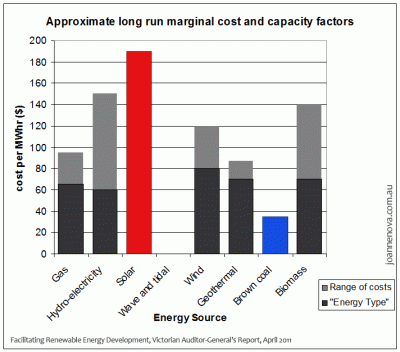
New report compares cost of coal power to renewable wind and solar power

Map of Australia
Map of Australia

From the Victorian Auditor-General’s Report, April 2011. (H/T Joanne Nova)

Here’s the chart:

Cost of renewable wind and solar energy

Click here for a bigger version.

Compared to coal, wind power is incredibly expensive, and solar power is even worse.

What happened when the Canadians embraced wind and solar power?

What happened to consumer energy prices in Ontario when the Liberal government embraced unproven wind and solar power?

The Globe and Mail explains:

If you haven’t opened your September hydro bill yet, you’re in for a shock. Rates have risen 18 per cent this year to date, and that’s just the start. By this time next year – election time – Ontario power consumers will be forking over about twice as much (in nominal terms) as they did when Dalton McGuinty took office in 2003.

[…]Power expert Tom Adams may know more about this subject than any other living being. And he’s steamed. Ontario’s rates, he says, have already surpassed the U.S. average and are headed for European levels – “just because of public policy.”

The policy is to go all out on renewables – wind and solar– whether or not it makes sense. The province is paying sky-high rates for power it doesn’t need so we can have wind turbines marching on and on to the horizon, just like Denmark does. “Power demand has been dropping since 2005,” says Mr. Adams. In fact, we have so much excess supply that, from time to time, it threatens to crash the system. Because of this, we’re even paying the neighbours to take the power off our hands.

“Ontario will need new power supplies in the future,” Mr. Adams says. “But why not buy it when we need it?” Instead of waiting, the power authority is signing long-term contracts at the rate of about $1-billion a week, while paying enormous premiums to attract wind and solar producers. In other words, it’s making 20-year commitments to pay stunningly high prices for power we don’t need.

On top of that, the province is building new transmission lines to nowhere while neglecting to ensure that Toronto’s hospitals and banks can keep the lights on. In July, Toronto experienced what Mr. Adams calls “Ontario’s first green blackout.” That blackout occurred because the city’s downtown core is badly underpowered. It has the weakest power system of any financial centre in the developed world.

Why haven’t we done anything about it? Because the green lobby has been campaigning for conservation, instead. And so, when the government started picking sites for transmission upgrades, it decided to build a power line up the shore of Lake Nipigon to connect remote wind turbines to Thunder Bay.

Ever since the days of Adam Beck, the father of public power in Ontario, the province’s energy policy has been linked to economic policy. The motto was reliable power at cost. Now energy policy has been entirely decoupled from economic policy and attached to the runaway train of environmental policy. Everyone in the power system knows it. But they’re so terrified to raise their hands, most of the public is still in the dark.

The National Post wrote about how the Ontario government wastes taxpayer money to subsidize big corporations who experiment with unproven, expensive energy programs, like solar power.

Excerpt:

The Swedish retail giant IKEA announced yesterday it will invest $4.6-million to install 3,790 solar panels on three Toronto area stores, giving IKEA the electric-power-producing capacity of 960,000 kilowatt hours (kWh) per year. According to IKEA, that’s enough electricity to power 100 homes. Amazing development. Even more amazing is the economics of this project. Under the Ontario government’s feed-in-tariff solar power scheme, IKEA will receive 71.3¢ for each kilowatt of power produced, which works out to about $6,800 a year for each of the 100 hypothetical homes. Since the average Toronto home currently pays about $1,200 for the same quantity of electricity, that implies that IKEA is being overpaid by $5,400 per home equivalent.

Welcome to the wonderful world of green economics and the magical business of carbon emission reduction. Each year, IKEA will receive $684,408 under Premier Dalton McGuinty’s green energy monster — for power that today retails for about $115,000. At that rate, IKEA will recoup $4.6-million in less than seven years — not bad for an investment that can be amortized over 20.

No wonder solar power is such a hot industry. No wonder, too, that the province of Ontario is in a headlong rush into a likely economic crisis brought on by skyrocketing electricity prices. To make up the money paid to IKEA to promote itself as a carbon-free zone, Ontario consumers and industries are on their way to experiencing the highest electricity rates in North America, if not most of the world.
The government’s regulator, the Ontario Energy Board, has prepared secret forecasts of how much Ontario consumers are going to have to pay for electricity over the next five years. The government won’t allow the report to be released. The next best estimate comes from Aegent Energy Advisors Inc., in a study it did for the Canadian Manufactures and Exporters group. Residential rates are expected to jump by 60% between 2010 and 2015. Industrial customers will be looking at a 55% increase.

Going back to 2003, based on numbers dug up by consultant Tom Adams, the price of residential electricity in Ontario hovered around 8.5¢ a kWh in 2003 — the first year of the McGuinty Liberal regime. By 2015, Aegent Energy estimates the price will be up to 21¢, an increase of 135%. Doubling the price of electricity in a decade is no way to spur growth and investment. In this age of global economic competition IKEA may end up with fewer sales of its Billy bookshelves in Toronto because its customers will be bogged down with soaring power bills and a sliding economy.

How about wind power in a coastal province like New Brunswick? Is that any better? The National post explains the costs and drawbacks of wind power.

Excerpt:

A $200-million wind farm in northern New Brunswick is frozen solid, cutting off a potential supply of renewable energy for NB Power.

The 25-kilometre stretch of wind turbines, located 70 kilometres northwest of Bathurst, N.B. has been completely shutdown for several weeks due to heavy ice covering the blades.

[…]Wintery conditions also temporarily shutdown the site last winter, just months after its completion. Some or all of the turbines were offline for several days, with “particularly severe icing” blamed.

The accumulated ice alters the aerodynamics of the blades, rendering them ineffective as airfoils. The added weight further immobilizes the structures.

[…]Melissa Morton, a spokeswoman for the utility, says the contract isn’t based on power delivered during a specific period, but rather on an annual basis.

“Our hopes is that it will balance out over the 12-month period and, historically, that has been the case.”

Despite running into problems in consecutive winters, Ms. Morton says NB Power doesn’t have concerns about the reliability of the supply from the Caribou Mountain site.

It’s a waste of taxpayer money.