
Tag Archives: Judicial Activism

Indian auto sales surge 71.9% while free trade vaults Chile into the first world

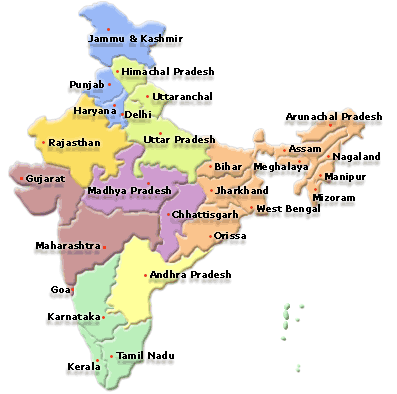
Map of India
Map of India

Before, I wrote about India’s election results and the decision of the ruling Congress Party to drastically cut income taxes. And I also wrote about China’s decision to cut taxes on purchases of new automobiles. So did those tax cuts work out for India and China?

Story from the Associated Press

Excerpt:

China extended its lead over the U.S. as the world’s biggest auto market in November, with production and sales both surpassing 1 million vehicles, and India saw sales jump 71.9-percent.

[…]China’s auto market is sizzling, thanks largely to tax cuts and subsidies aimed at supporting the industry and encouraging use of more fuel-efficient vehicles. The boom has clinched China’s status as the world’s biggest vehicle market due to languishing sales in the U.S.

[…]The surge is also a sign of how the Indian consumer — encouraged by government tax cuts, a big disbursement of back pay for government employees and falling interest rates — is fueling economic growth in Asia’s third-largest economy.

As everyone knows, the Democrats chose to bail out auto companies with taxpayer money and reward people with taxpayer money for destroying fully functional vehicles. And we all know how well that has worked out.

Chile poised to jump from the third world to the first world

Check out this editorial from Investors Business Daily. (podcast here)

Excerpt:

Chile is expected to win entry to OECD’s club of developed countries by Dec. 15 — a great affirmation for a once-poor nation that pulled itself up by trusting markets. One thing that stands out here is free trade.

[…]It’s not like Chile was born lucky. Only 30 years ago, it was an impoverished country with per capita GDP of $1,300. Its distant geography, irresponsible neighbors and tiny population were significant obstacles to investment and growth. And its economy, dominated by labor unions, wasn’t just closed, but sealed tight.

In the Cato Institute’s 1975 Economic Freedom of the World Report it ranked a wretched 71 out of 72 countries evaluated.

Today it’s a different country altogether. Embracing markets has made it one of the most open economies in the world, ranking third on Cato’s index, just behind Hong Kong and Singapore. Per capita GDP has soared to $15,000.

Besides its embrace of free trade, other reforms — including pension privatization, tax cuts, respect for property rights and cutting of red tape helped the country grow not only richer but more democratic, says Cato Institute trade expert Daniel Griswold.

But the main thing, Griswold says, is that the country didn’t shift course. “Chile’s economy is set apart from its neighbors, because they have pursued market policies consistently over a long period,” he said. “Free trade has been a central part of Chile’s success.”

Democrats oppose free trade, and their hostility to free trade angers many other countries in the world.

What does it take for a country to succeed?

I gave my Dad my copy of “Money, Greed and God” by Jay Richards, and although he thought that it started out slow, he’s warmed up to it. He calls me on the phone at least twice a day, and last night he alerted me to this web site, where you can track each countries average citizen’s life span and per-capita GDP over time. My Dad was pretty liberal on economics before, so naturally I’ve been working on him with lots of introductory books on economics. He’s read about a dozen now, and Thomas Sowell is his favorite.

Anyway, my Dad says that this is what a country needs to succeed:

  • free trade with other nations
  • the rule of law
  • low judicial activism
  • low tax rates
  • private property protections
  • currency not threatened by inflation
  • low government spending
  • minimal regulation of commerce

And at that web site, you can track the success of countries like Singapore and Hong Kong, which embrace conservative small government free market fiscal policies, and compare them with countries like Zimbabwe and North Korea, which embrace big government protectionist fiscal policies. Countries fail because they adopt the wrong policies. They succeed when they adopt the right policies. It doesn’t matter how poor they start, if they have the right policies, they grow rich over time.

Why are the Democrats so incompetent on economic policy?

Well, it’s because there is almost no one in the Obama socialist regime who has ever run a business or worked in a business. Check out this graphic. (H/T Flopping Aces)
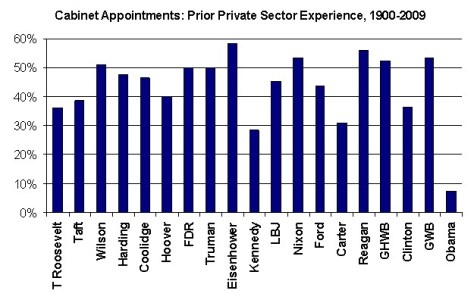
You can read more about the Obama administration’s ignorance of business and economics here in Forbes magazine.

This Reuters article discusses the price of economic ignorance: (H/T Gateway Pundit)

Excerpt:

Hunger is spreading while the number of homeless families is increasing as a result of the recession and other factors, according to a report on Tuesday.

The U.S. Conference of Mayors said cities reported a 26 percent jump in demand for hunger assistance over the past year, the largest average increase since 1991.

Middle-class families as well as the uninsured, elderly, working poor and homeless increasingly looked for help with hunger, which was mainly fueled by unemployment, high housing costs and low wages.

Democrats really don’t know what they are doing. It’s like putting pre-schoolers in charge of Amazon.com. It doesn’t work. Their ivory tower, silver-spoon worldview cannot comprehend real-world, grown-up complexities. So long as the Democrats continue to attack the businesses that employ citizens while redistributing wealth from people who produce to people who vote Democrat, our economic troubles will continue.

Related Cato Institute podcasts

If you want to understand who Obama is, look at his judicial nominees

Michelle Malkin tells about Obama’s new judicial appointment, with links: (H/T Andrew)

David Hamilton is a hard Left, former ACORN fund-raiser and abortion radical who was rated “not qualified” by the ABA.

LifeNews.com reports on the Republican efforts to block the appointment:

As he promised he would do, pro-life Sen. Jeff Sessions of Alabama led the filibuster and said Hamilton should be opposed in part because of his pro-abortion views.

Sessions noted how Hamilton kept an informed consent measure from being enforced in Indiana, thereby prohibiting women from getting information about abortion’s risks and alternatives so they can find positive alternatives.

“And for seven years, through a series of rulings, Hamilton kept it form being enforced. This case is a blatant example of allowing personal views to frustrate the will of the people and the popularly elected representatives of the government of Indiana,” Sessions said. “This appeared to me to be obstructionism.”

Sen. Jim DeMint, a pro-life senator from South Carolina, agreed.

“Judge Hamilton is the definition of an activist judge and is clearly not qualified to sit on a court of appeals,” DeMint said during the debate. “Hamilton, who spent years working with the ACLU and ACORN, has used his position on the bench to drive his personal political agenda.”

The pro-life group Susan B. Anthony List objected to Hamilton and said it worries about future Obama nominees.

“If Judge David Hamilton is considered a blueprint for the next judge President Obama will nominate for the U.S. Supreme Court, America is in trouble,” Marjorie Dannenfelser, president of the organization, told LifeNews.com.

This is the real Barack Obama. Radically pro-abortion.

he British government has gone to court to prevent the publication of statistics on abortions of children with mild disabilities like cleft palates and club foot. The Department of Health has asked the High Court to overturn a Freedom of Information Act ruling that gave the Information Tribunal permission to publish the information.

The Information Tribunal is a government body that hears appeals under the Freedom of Information Act 2000. It ruled last monththat the Pro-Life Alliance could review the abortion statistics.

The Department of Health refused to release the information claiming that it could lead to women who have late abortions being identified. Department lawyers argued that the information was “sensitive, personal and private.”


Why did 77% of young unmarried women vote for Obama in 2008?

Consider this analysis from a left-wing site of the 2008 election.

Excerpt:

On Tuesday, the nation made history. It made history in electing the first African American president; it made history in building a bigger margin for the first female Speaker of the House; it made history in delivering the biggest Democratic margin since 1964; it made history in sending a record number of people to the polls and the highest percentage turnout since the 1960 election.

[…]But one thing is immediately clear. Unmarried women played a pivotal role in making this history and in changing this nation. They delivered a stunning 70 to 29 percent margin to Barack Obama and delivered similarly strong margins in races for Congress and the U.S. Senate. Although unmarried women have voted Democratic consistently since marital status has been was tracked, this election represents the highest margin recorded and a 16-point net gain at the Presidential level from 2004.

In particular, note the chart that shows that younger unmarried women voted 77-22 for Obama. 77-22 for Obama. This is actually in keeping with my previous post on this topic, which documented how women have continuously voted for bigger and bigger government since they started voting. The problem with big government policies is that they drain money from the family which is then redistributed outside of the family.

To have a strong family, you need more than just money. You need independence so that you can keep your vision distinct and separate from the vision of the government. If a family depends on the government, then they are beholden to the government’s values. The government can even overrule conscience rights and religious liberty. Keeping the family strong and separate from government is especially important for Christian parents who have a specific goal of passing on their faith to their children.

Here are just a few of the things I thought of that help make a marriage strong: (there are many more)

  • low taxes so the household has more money to spend on the things we need for our plan
  • access to low cost energy provided by domestic energy production by private firms
  • access to low cost, high quality consumer goods through increased free trade
  • the ability to choose homeschooling or private schools (and the more school choice, the better)
  • the ability to fund a retirement plan that covers the family – not anyone else
  • the ability to purchase a health care plan that covers the family – not anyone else
  • the ability to own firearms for protection of the home and the family
  • the ability to pass Christian convictions on to children without interference from the state
  • the ability to speak and act as a Christian in public without reprisals from secular left special interest groups
  • low threat of being the victim of criminal activity
  • low threat of being bankrupted by the costs of divorce court
  • low threat of being arrested on a false domestic violence charge (e.g. – verbal abuse)
  • low threat of never seeing your children because of loss of custody after a divorce
  • low threat of being imprisoned due to failure to pay alimony and child support after a job loss

It seems to me that a vote for Obama is a vote against all of these things. So then why did unmarried women (especially Christian women) vote for him? It seems as thought they are less interested in marriage and family and more interested in having the government provide incentives for anti-child, anti-family behaviors like pre-marital sex, contraceptives, abortions, welfare for single mothers, divorce courts, government coercion of husbands, state-run day-care, government-run schools, in-vitro fertilization, etc. I don’t mind if people need these things, but they should pay for it themselves. but I don’t see why unmarried women should favor family money being spent on government programs that help other people to avoid the cost and consequences of their own decisions.