
Tag Archives: Hook-Up

CDC reports: STD rates hit all-time high for the fourth straight year

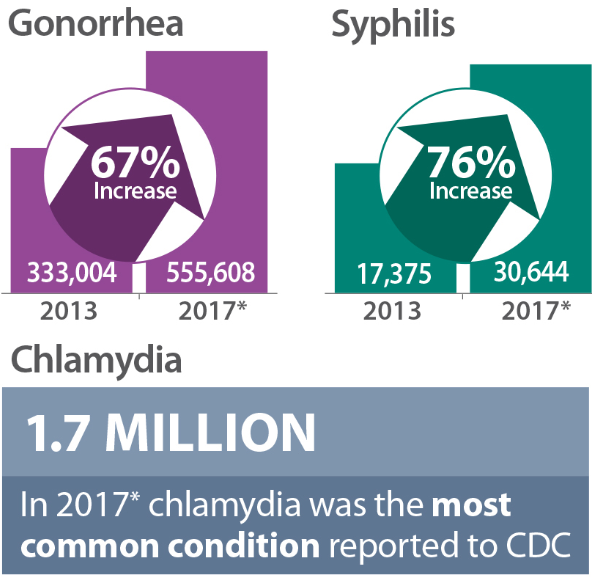
Preliminary CDC numbers for STDs in 2017

I’ve been blogging about skyrocketing rates of sexually-transmitted-diseases for the last few years, and particularly how it impacts high risk groups, e.g. – men who have sex with men. The attitude that the culture is taking towards this is to not make any moral judgments, but someone is going to have to pay for all the health care that is required to “fix” this problem.

Fox News reports on the latest numbers:

Sexually-transmitted diseases continue to hit all-time highs in the U.S. with the Centers for Disease Control and Prevention (CDC) reporting a 10 percent spike for chlamydia, gonorrhea and syphilis in 2017. The federal health agency said in a report released Tuesday that the numbers, which include nearly 2.3 million new cases of the aforementioned diseases, reflect a “steep, sustained increase” in STDs since 2013.

“We’re sliding backward,” Jonathan Mermin, director of CDC’s National Center for HIV/AIDS, Viral Hepatitis, STD and TB Prevention, said. “It is evident the systems that identify, treat and ultimately prevent STDs are strained to near-breaking point.”

The data, which was presented at the 2018 STD Prevention Conference, found a 67 percent increase in gonorrhea diagnoses, which officials sounded alarm over due to the growing threat of untreatable strains.

The CDC gives us the numbers well enough, but like all government agencies, their attitude is not to tell the selfish adults to behave morally. They blame “stigma and discrimination” for the rise in STDs, and recommend more government as the solution. I.e. – they think that people who disapprove of sex outside of marriage are to blame for the skyrocketing rates of STDs. If we all stopped making the irresponsible, reckless people feel bad with our ignorant moral judgments, then the STD problem would immediately be solved.

Anyway, here is an article that talks about untreatable strains of gonorrhea in particular:

Scientists have found a “superbug” strain of gonorrhea in Japan that is resistant to all recommended antibiotics and say it could transform a once easily treatable infection into a global public health threat.

The new strain of the sexually transmitted disease — called H041 — cannot be killed by any currently recommended treatments for gonorrhea, leaving doctors with no other option than to try medicines so far untested against the disease.

[…]Gonorrhea is a bacterial sexually transmitted infection and if left untreated can lead to pelvic inflammatory disease, ectopic pregnancy and infertility in women.

British scientists said last year that there was a real risk of gonorrhea becoming a superbug — a bacteria that has mutated and become resistant to multiple classes of antibiotics — after increasing reports of gonorrhea drug resistance emerged in Hong Kong, China, Australia and other parts of Asia.

Now, I know it’s tempting (for some people who like tolerance) to say that we should let people do whatever they want to do, and not judge them. After all, we can just take some money from the wealthy in order to solve these problems without making anyone feel bad. I hear this a lot from the the “don’t judge” crowd. But this time, it looks like no amount of money is going to solve this problem, and maybe the judgers were right to warn.

Syphilis is also a problem in certain high risk groups:

The sometimes-deadly disease syphilis is exploding in the United States, with most of the increase since 1995 among men who have sex with men (MSM), according to a new report from the Atlanta-based Center for Disease Control (CDC).

As recently as 2000, researchers believed the total elimination of syphilis was within reach. The recent dramatic increases in infections, coupled with the observation that syphilis closely tracks with other diseases like AIDS, have the medical and scientific community deeply concerned. The CDC report considers “the increase in syphilis among MSM is a major public health concern.”

According to the report, “During 2005-2013, the number of primary and secondary syphilis cases reported each year in the United States nearly doubled, from 8,724 to 16,663; the annual rate increased from 2.9 to 5.3 cases per 100,000 population.”

The report also says that “men contributed an increasing proportion of cases, accounting for 91.1% of all primary and secondary syphilis cases in 2013.” Most of the increases came from men who have sex with men, which were responsible for 77% of cases in 2009 but 83.9% in 2012, what the report calls “the vast majority of male… syphilis cases.”

HIV is also a problem for this same group:

A fact sheet released at the end of June by the US Centers for Disease Control (CDC) warns that HIV rates, already at epidemic proportions, are continuing to climb steadily among men who have sex with men (MSM).

“Gay and bisexual men remain at the epicenter of the HIV/AIDS epidemic,” says Jonathan Mermin, the director of the CDC’s division of HIV/AIDS prevention.

The CDC notes that while homosexual men make up only a very small percentage of the male population (4%), MSM account for over three-quarters of all new HIV infections, and nearly two-thirds (63 percent) of all new infections in 2010 (29,800).

“Men who have sex with men remain the group most heavily affected by HIV in the United States,” the fact sheet states.

We do have certain segments of the population who think that normal sexuality means having sex with dozens, hundreds and even thousands of partners. Just on the grounds of “they’re hot”. And naturally, these people are at higher risk for STDs.

Jennifer Roback Morse lectures on sex and sexuality at Harvard University

Dr. Jennifer Roback Morse

Dr. Morse delivers a talk based on her book “Smart Sex” at Harvard University.

The MP3 file is here. (21 Mb) (Link in case that doesn’t work)

Topics:

  • the hook-up culture and its effects on men and women
  • cohabitation and its effect on marriage stability
  • balancing marriage, family and career
  • single motherhood by choice and IVF
  • donor-conceived children
  • modern sex: a sterile, recreation activity
  • the real purposes of sex: procreation and spousal unity
  • the hormone oxytocin: when it is secreted and what it does
  • the hormone vassopressin: when it is secreted and what it does
  • the sexual revolution and the commoditization of sex
  • the consumer view of sex vs the organic view of sex
  • fatherlessness and multi-partner fertility
  • how the “sex-without-relationship” view harms children

52 minutes of lecture, 33 minutes of Q&A from the Harvard students. The Q&A is worth listening to – the first question is from a gay student, and Dr. Morse pulls a William Lane Craig to defeat her objection. It was awesome! I never get tired of listening to her talk, and especially on the topics of marriage and family.

New study: college students drink more before casual sex than relationship sex

Sex events measured against intimacy level (for women only)

It turns out that college students use MORE alcohol and drugs when they have sex with strangers, and LESS alcohol and drugs when they have sex with people they are in a relationship with.

This study was reported by the far-left Psychology Today.

Excerpt:

A recent study published in the Journal of Sex Research sheds some light on these questions. A research team headed by Jennifer Walsh analyzed alcohol use in almost 500 casual and 1400 romantic sexual intercourse events that happened to 300 college women on a monthly basis over a period of 12 months. Alcohol use was not very common during romantic sex: 20% of romantic encounters involved some drinking and only 5% involved heavy drinking (defined as four or more drinks). Hookups, on the other hand, were a different story: Women drank during 53% of their hookups, and drank heavily during 38% of all hookups.

But not all hookups are created equal. There was an almost perfect linear relationship between drinking and partner closeness: The less known the partner, the more likely women drank before sex, and the more likely they drank a lot. Look at the graph I created based on their data. When the casual partner was an ex-boyfriend, for example, only 30% of hookups involved drinking and 17% heavy drinking. When the partner was a random stranger, however, 89% of hookups involved drinking and 63% involved four or more drinks!

The writer explains why this happens:

Alcohol also provides an excuse to those who need one. In a world that encourages hooking up but also judges those (especially women) who engage in it too much, many seem to need it. You’re a slut if you hook up with people just because you want to: Good girls don’t actively want to hook up, and being sober means taking full responsibility for your actions. But if you can blame it on the alcohol, you’re absolved of guilt. You can still be a good girl who just happened to make a mistake.

This study agrees with a study I blogged about before from the University of Virginia, which explained that college students drink before hook-ups in order to be able to explain to their friends why it wasn’t their fault:

A Rutgers University student commented, “If you’re drinking a lot it’s easier to hook up with someone… [and] drugs, it’s kind of like a bonding thing… and then if you hook up with them and you don’t want to speak to them again, you can always blame it on the drinking or the drugs.”

Other women observed that being drunk gives a woman license to act sexually interested in public in ways that would not be tolerated if she were sober. For instance, a University of Michigan student said, “Girls are actually allowed to be a lot more sexual when they are drunk…”

A University of Chicago junior observed, “One of my best friends… sometimes that’s her goal when we go out. Like she wants to get drunk so I guess she doesn’t have to feel guilty about [hooking up].”

Now, the first thing I thought of when I saw this article in Psychology Today was: “I wonder what criteria these college students are using in order to decide which strangers they have sex with”. And then I realized. For perfect strangers, it would have to be something obvious, like physical appearance. A study found that it takes a woman 3 minutes to decide if she likes a man or not. Whatever assessment is being made in that 3 minutes surely isn’t adequate for long-term plans for marriage, children and church attendance.

Don’t judge me, it wasn’t my fault

It reminds me of something I read a while back in a Theodore Dalrymple book. Theodore Dalrymple is the famous psychiatrist who writes books about culture in the UK. One of his books about the complete lack of personal responsibility among criminals is actually posted online.

In the chapter “Tough Love“, he talks about the nurses he works with:

All the more surprising is it to me, therefore, that the nurses perceive things differently. They do not see a man’s violence in his face, his gestures, his deportment, and his bodily adornments, even though they have the same experience of the patients as I. They hear the same stories, they see the same signs, but they do not make the same judgments. What’s more, they seem never to learn; for experience—like chance, in the famous dictum of Louis Pasteur—favors only the mind prepared. And when I guess at a glance that a man is an inveterate wife beater (I use the term “wife” loosely), they are appalled at the harshness of my judgment, even when it proves right once more.

This is not a matter of merely theoretical interest to the nurses, for many of them in their private lives have themselves been the compliant victims of violent men. For example, the lover of one of the senior nurses, an attractive and lively young woman, recently held her at gunpoint and threatened her with death, after having repeatedly blacked her eye during the previous months. I met him once when he came looking for her in the hospital: he was just the kind of ferocious young egotist to whom I would give a wide berth in the broadest daylight.

Why are the nurses so reluctant to come to the most inescapable of conclusions? Their training tells them, quite rightly, that it is their duty to care for everyone without regard for personal merit or deserts; but for them, there is no difference between suspending judgment for certain restricted purposes and making no judgment at all in any circumstances whatsoever. It is as if they were more afraid of passing an adverse verdict on someone than of getting a punch in the face—a likely enough consequence, incidentally, of their failure of discernment. Since it is scarcely possible to recognize a wife beater without inwardly condemning him, it is safer not to recognize him as one in the first place.

This failure of recognition is almost universal among my violently abused women patients, but its function for them is somewhat different from what it is for the nurses. The nurses need to retain a certain positive regard for their patients in order to do their job. But for the abused women, the failure to perceive in advance the violence of their chosen men serves to absolve them of all responsibility for whatever happens thereafter, allowing them to think of themselves as victims alone rather than the victims and accomplices they are. Moreover, it licenses them to obey their impulses and whims, allowing them to suppose that sexual attractiveness is the measure of all things and that prudence in the selection of a male companion is neither possible nor desirable.

Often, their imprudence would be laughable, were it not tragic: many times in my ward I’ve watched liaisons form between an abused female patient and an abusing male patient within half an hour of their striking up an acquaintance. By now, I can often predict the formation of such a liaison—and predict that it will as certainly end in violence as that the sun will rise tomorrow.

At first, of course, my female patients deny that the violence of their men was foreseeable. But when I ask them whether they think I would have recognized it in advance, the great majority—nine out of ten—reply, yes, of course. And when asked how they think I would have done so, they enumerate precisely the factors that would have led me to that conclusion. So their blindness is willful.

If Dalrymple’s observations about female patients and nurses can be applied more broadly, then it explains why women initiate 70% of divorces. Women who don’t want to be “forced” to be self-controlled and responsible with their choices will want an easy way to get out of it. According to Dalrymple’s experience, it’s not that women don’t know that bad boys are lousy at marriage and fatherhood. They know it, but they choose to blind themselves to it, because it’s just too much self-denial to have to be serious about making responsible choices with men and sex and marriage.

Right now, we are $20 trillion in debt, half of that thanks to Barack Obama’s administration. I believe that the majority of this debt was accrued because people wanted to do what felt good to them in the moment, and then pass off the costs of their “unpredictable” mistakes onto their neighbors. The truth is that these costs will be paid by generations of young people not yet born. People shouldn’t talk about how much they care about children, if their voting will force all the children of tomorrow into slavery.

One last piece of advice to men. My best friend Dina told me to always evaluate women based on their past choices, not based on the picture of themselves that they paint with words. Wise advice.