Tag Archives: Health

Selling single-payer health care with lies

Holy Snark!

You will watch this 3 minute video about the Democrats’ plan for single-payer health care right now! (H/T Heritage Foundation)

This video is courtesy Verum Serum, the same guys who brought us that Jan Schakowsky video where she admits that Obama’s plan will destroy private medical insurance. They seem to be a Christian blog, so I blogrolled them, along with Bush White House economist Keith Hennessey, who I linked to twice.

Quick quote from Heritage Foundation’s post:

As Yale professor Jacob Hacker says in the video: “Someone once said to me this is a Trojan Horse for single payer and I said well its not a Trojan Horse, right? Its just right there.”

And then later:  “One of the virtues of it though is that you can at least make the claim that there is a competitve system between the public and private sectors.”

Don’t forget some other videos I posted on health care, (that post has a link to Laura’s amazing post on health care that was on Hot Air, which had more helpful videos!).

Michelle Malkin has some ideas about what the grassroots can do! We can fight this.

A comprehensive, point-by-point refutation of government-run health care is here, at the Heritage Foundation.

They cover:

  • the hidden costs of government-run health care, that are paid by the private sector
  • the low efficiency and low quality of existing government plans like Medicare and Medicaid
  • how government-run health care would lead to controls on your private life to reduce health costs
  • the real solution to the health care mess: competition, de-regulation and consumer choice

Some good news on health care

OK, Heritage Foundation had this story on a bill introduced by Republican senators Tom Coburn and Richard Burr. It’s called the “Patient’s Choice Act”.

Excerpt: (I bolded the stuff I liked)

As Galen Institute President Grace-Marie Turner and Joseph Antos with American Enterprise Institute note in The Wall Street Journal, the legislation “provides a path to universal coverage by redirecting current subsidies for health insurance to individuals. It also provides a new safety net that guarantees access to insurance for those with pre-existing conditions.”

By restructuring the tax treatment for health insurance, the plan would give every taxpayer direct assistance to buy private health insurance, and end the inequities that plague the current system. The bill would shift the $300 billion annual tax exclusion for employer-based health benefits toward refundable tax credits for families and individuals. Families would get $5,700 a year and individual consumers would get $2,300 a year to purchase private plans and invest in health savings accounts (HSAs).

Low-income families would receive a supplemental debit card worth up to $5,000 that would help them pay for health coverage and out-of-pocket medical bills. They’d also be incentivized to make the most of their health care dollars since the remaining balance on their card would roll over to the next year. The expected expansion of private health plans would reduce the dependence of many uninsured Americans on the hospital emergency rooms for routine care, saving American taxpayers billions of dollars.

“The combination of the refundable tax credit and debit card gives lower-income Americans a way out of the Medicaid ghetto so they can have the dignity of private insurance,” Turner and Antos add.

This is what Republicans would do if we could elect enough of them.
Why do people oppose same-sex marriage?

UPDATE: The research paper seems to have expired from the FRC web site, but you can see the whole thing here.

I found this research paper at the Family Research Council web site. The paper compares same-sex couples and heterosexual married couples, in the following ways:

  • relationship duration
  • monogamy vs. promiscuity
  • relationship commitment
  • number of children being raised
  • health risks
  • rates of intimate partner violence

Are there really significant differences between the two arrangements? Let’s take a look at the some of the data.

Relationship duration

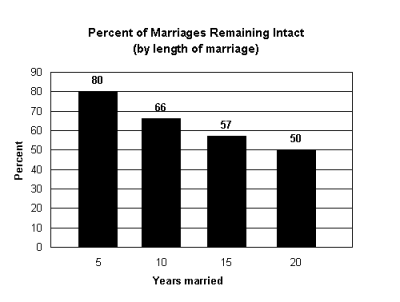
% of Marriages Remaining Intact

Source: National Center for Health Statistics, Centers for Disease Control and Prevention (2001)

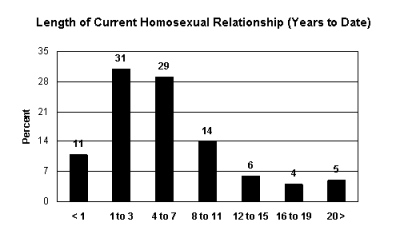
Length of Current Homosexual Relationship

Source: 2003-2004 Gay/Lesbian Consumer Online Census

Monogamy vs Promiscuity

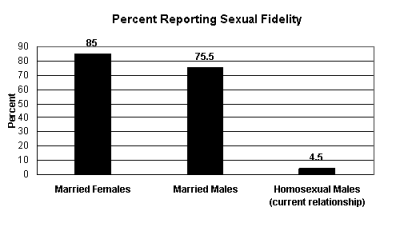
% Reporting Sexual Fidelity

Sources:Laumann, The Social Organization of Sexuality, 216; McWhirter and Mattison, The Male Couple: How Relationships Develop (1984): 252-253; Wiederman, “Extramarital Sex,” 170.

Rates of intimate partner violence

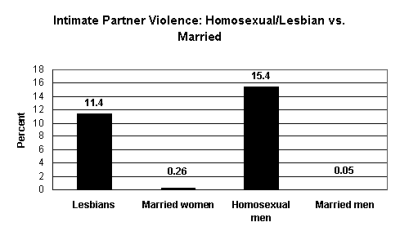
Intimate Partner Violence

Sources: “Extent, Nature, and Consequences of Intimate Partner Violence,” U.S. Department of Justice: Office of Justice Programs: 30; “Intimate Partner Violence,” Bureau of Justice Statistics Special Report:11.

Conclusion

Marriage is a relationship that has a specific purpose. That purpose is to bind together two opposite natures and to produce children that are biologically linked to the parents. The children gain the benefits of being parented by the two different natures, so they get two perspectives. The fact that the children are genetically linked to two parents helps to ensure the stability of the commitment, as we see in the animal kingdom where animals protect their young.

The goal of marriage is not to increase the happiness of the adults, or to “recognize” the love of adults. The goal of marriage is have two people enter into a relationship where they understand that it is not about adults being fulfilled. Marriage is about people having a goal of raising children, which are tremendously stressful to raise. Marriage requires self-denial and sacrifice in order to raise those children – that is the main point of it. It also requires fidelity and chastity, so that the environment is kept stable for the children over a long period of time.

Children benefit from the stability that is more common in traditional marriages than it is in other arrangements, including heterosexual co-habitation which is similarly unstable (50% greater chance of divorce, more domestic violence, etc.). Therefore, it is important to keep the concept of marriage separate from other kinds of relationships so that the focus on commitment for the sake of the children is clear to those who contemplate marriage. Society needs to give special recognition to married couples, in view of their child-focused commitment.

I apologize in advance if this post causes anyone any harm or distress, I am just trying to explain why people have that opinion. They could be wrong, but that is the case they make. Obviously, married couples fall short of the goal, but that is their goal.

Further study

Two much bigger challenges to marriage are big-government socialism and especially no-fault divorce. I also wrote about same-sex marriage and co-habitation before, in the context of European states like Sweden and Norway.

You may also be interested in a recent post about whether homosexuality is caused by a “gay gene”.

Videos showing the folly of government-run health care

Get your butt over to Hot Air right now, and read this post on health care policy by my blog-friend Laura, who blogs at Pursuing Holiness. Laura writes about the myth of the millions of uninsured who cannot afford coverage. She outlines the many ways in which free care is available to everyone, including illegal immigrants, and those who cannot pay the full price. This is a MUST READ post.

Excerpt from Laura’s post:

…basic care and life-saving care is available to every human being who manages to set foot in this country, regardless of their ability to pay.

…Thanks to EMTALA, emergency rooms are required to help you.

…Thanks to hundreds of thousands of charity hospitals and community health centers – via both charities and government – you can get free or sliding-scale payment care.

I wanted to supplement her post with some of my own videos.

Two Women:

The Lemon:

And one more video from On The Fence Films called “Dead Meat“.

Dead Meat is a 25 minute short film which shows the reality of health care under Canada’s socialized medical system: Canadians wait … and wait … and wait. … And sometimes they die while waiting for free government health care.

Previous posts from me: