Tag Archives: Health

Does science support mothers who leave their young children to go to work?

Dina is very concerned about the UK’s leftist coalition government’s attempt to punish women who stay at home with their young children. (H/T Dina)

Excerpt:

Under plans unveiled in the Budget on Wednesday, families will only benefit from the generous new deal, which will come into force in 2015, if ‘all parents’ have a job. If one parent works but the other stays at home looking after their young children, they will get nothing.

It is the second time in just a few months that the Government has triggered controversy with its changes to the tax and benefit systems, which appear to penalise stay-at-home mothers.

As a result of the recent child benefit changes, a couple can both earn £50,000 and keep their child benefit, worth £1,752 a year for two children.

But a couple where one parent earns £60,000 and the other earns nothing – but have a far lower joint income – do not get a penny.

Again, this week’s initiative favours those couples where both parents go out to work. It will even benefit parents who each earn a salary of £149,999.

Note that this plan is being put forward by socialist Liberal Democrat Party, as well as the “Conservative” Party.

Dina thinks that the science is pretty clear that children suffer if their mothers leave them at a young age. Take a look at the video above, and then the brain scan below.
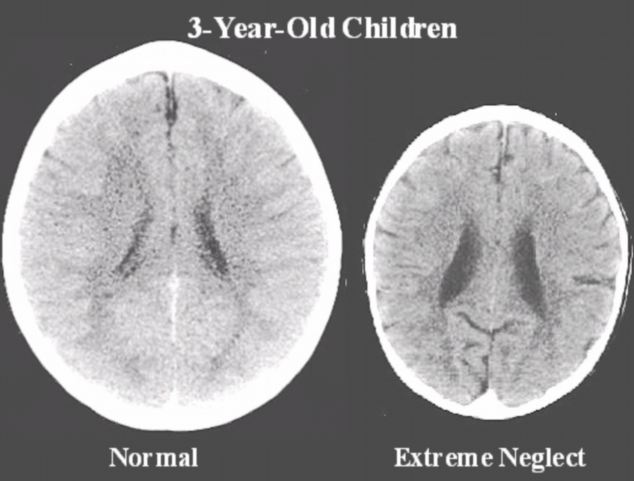
Brain scans of 3-year old children: normal vs neglected

Here’s the article that goes with the brain scan from the UK Daily Mail.

Excerpt:

Both of these images are brain scans of a two three-year-old children, but the brain on the left is considerably larger, has fewer spots and less dark areas, compared to the one on the right.

According to neurologists this sizeable difference has one primary cause – the way each child was treated by their mothers.

The child with the larger and more fully developed brain was looked after by its mother – she was constantly responsive to her baby, reported The Sunday Telegraph.

But the child with the shrunken brain was the victim of severe neglect and abuse.

According to research reported by the newspaper, the brain on the right worryingly lacks some of the most fundamental areas present in the image on the left.

The consequences of these deficits are pronounced – the child on the left with the larger brain will be more intelligent and more likely to develop the social ability to empathise with others.

But in contrast, the child with the shrunken brain will be more likely to become addicted to drugs and involved in violent crimes, much more likely to be unemployed and to be dependent on state benefits.

The child is also more likely to develop mental and other serious health problems.

Professor Allan Schore, of UCLA, told The Sunday Telegraph that if a baby is not treated properly in the first two years of life, it can have a fundamental impact on development.

He pointed out that the genes for several aspects of brain function, including intelligence, cannot function.

[…]The study correlates with research released earlier this year that found that children who are given love and affection from their mothers early in life are smarter with a better ability to learn.

The study by child psychiatrists and neuroscientists at Washington University School of Medicine in St. Louis, found school-aged children whose mothers nurtured them early in life have brains with a larger hippocampus, a key structure important to learning, memory and response to stress.

The research was the first to show that changes in this critical region of children’s brain anatomy are linked to a mother’s nurturing, Neurosciencenews.com reports.

The research is published online in the Proceedings of the National Academy of Sciences Early Edition.

Lead author Joan L. Luby, MD, professor of child psychiatry, said the study reinforces how important nurturing parents are to a child’s development.

This is why I argue that feminism, which is the ideology that demands that women work outside the home in order to be “equal” to men, is harmful to children. If we really cared about children, then we need to not be subsidizing the child abuse schemes of Liberal Democrats like Nick Clegg. We need to be clear that gender feminism (third-wave feminism) is an anti-child ideology and it should be opposed. The science is settled on this issue. Feminism harms innocent young children. And feminism isn’t just opposed to the rights of born children. They oppose the right to life of unborn children, too.

How would legalizing gay marriage affect your marriage?

Here is a comprehensive backgrounder published in National Review.

It answers the following questions in detail:

  1. Why focus on opposing the recognition of same-sex partnerships as marriages? Aren’t widespread divorce and single parenting the real problems?
  2. Why worry so much about policy?
  3. Why wouldn’t you want to recognize committed, monogamous same-sex relationships?
  4. How would recognizing same-sex relationships as marriages hurt marriage?
  5. Isn’t the fight against redefining marriage a losing battle?
  6. Why limit freedom in the name of sectarian values?

Here’s the detail on number 4:

Recognizing same-sex relationships as marriages requires replacing one basic vision of what marriage is (in our law, and hence in our mores, and hence in practice) with another vision of marriage. The new vision is one that equates marriage with the much broader category of companionship. Companionate bonds have great personal value, but they can’t ground in a principled way the norms that set marriage apart.

To the extent that marriage is misunderstood, it will be harder to see the point of its norms, to live by them, and to encourage their strict observance. And this, besides making any remaining restrictions on marriage arbitrary, will damage the many cultural and political goods that first got the state involved in marriage. Here is a summary of those goods.

Real marital fulfillment. No one acts in a vacuum. We all take cues from cultural norms, many of which are shaped by the law. To form a true marriage, one must freely choose it. And to choose marriage, one must have at least a rough idea of what it is. The revisionist view would harm people (especially future generations) by distorting their idea of what marriage is. It would teach that marriage is essentially about emotional fulfillment and cohabitation, without any inherent connections to bodily union or procreation and family life. As individuals internalized this view, their ability to realize genuine marital union would diminish. This would be bad in itself, since marital union is good in itself. It would be the subtlest but also the primary harm of redefining marriage; other harms include the effects of misconstruing marriage.

Spousal well-being. Marriage tends to make spouses healthier, happier, and wealthier. But what does this is marriage, especially through its distinctive norms of permanence, exclusivity, and orientation to family life. As the state’s redefinition of marriage makes these norms harder to understand, justify, and live by, spouses will enjoy less marital stability and less of the psychological and material advantages that flow from it.

Children’s well-being. If same-sex relationships are recognized, not only will the stabilizing norms of marriage be undermined, but the notion that men and women tend to bring different gifts to parenting will not be reinforced by any civil institution. Redefining marriage would soften the social pressures and lower the incentives — already diminished these past few decades — for husbands to stay with their wives and children and for men and women to marry before having children. All this would harm children’s development into happy, productive, upright adults.

Friendship. Misunderstandings about marriage will speed our society’s drought of deep friendship, with special harm to the unmarried. The state will have defined marriage mainly by degree or intensity — as offering the most of what makes any relationship valuable: shared emotion and experience. It thus will become less acceptable to seek (and harder to find) emotional and spiritual intimacy in nonmarital friendships. Instead of being seen as different from marriage and therefore distinctively appealing, they will be regarded simply as less. Only the conjugal view, which gives marriage a definite orientation to bodily union and family life, preserves a horizon richly populated with many types of association and affection, each with its own scale of depth and specific forms of presence and care.

Religious liberty. As the conjugal view of marriage comes to be seen as irrational (“bigoted”), freedom to express and live by it will be curbed. Several states already have forced Catholic Charities to choose between giving up its adoption services and placing children with same-sex partners, against Catholic principles. Some defenders of marriage have been fired or denied employment or educational and career opportunities for publicizing their views. If marriage is redefined, believing what virtually every human society once believed about marriage — that it is a male-female union — will be seen increasingly as a malicious prejudice, to be driven to the margins of culture. The consequences for observant Christians, Jews, Muslims, and others are becoming apparent.

Limited government. The state is (or should be) a supporting actor in our lives, not a protagonist. It exists to create the conditions under which individuals and our freely formed communities can thrive. The most important free community, on which all others depend, is the marriage-based family; and the conditions for its thriving include the accommodations and pressures that marriage law provides for couples to stay together. Redefining marriage will further erode marital norms, thrusting the state further into leading roles for which it is poorly suited: parent and discipliner to the orphaned, provider to the neglected, and arbiter of disputes over custody, paternity, and visitation. As the family weakens, our welfare and correctional bureaucracies grow.

People on both  sides of this issue should be able to articulate the reasons for each point of view. The article is a good place to find the case for natural marriage.

Related posts

Dawn Stefanowicz explains her experience being raised by a gay parent

*** WARNING: This post is definitely for grown-ups only! ***

I was listening to a Dr. J podcast on “Why Marriage Matters”, and I heard about a woman named Dawn Stefanowicz, who was raised by her gay father in Toronto.

So, I looked around and found this interview with Dawn posted on MercatorNet. This is mature subject matter.

Intro:

Gay marriage and gay adoption are being fiercely debated in a number of countries. Usually these issues are framed as a human rights issue. But whose rights? Patrick Meagher, MercatorNet’s contributing editor in Canada, recently interviewed a woman who was raised by a homosexual father. She feels that her rights as a child were completely ignored.

Dawn Stefanowicz (www.DawnStefanowicz.com) grew up in Toronto. Now in her 40s, she has written a book, Out From Under: Getting Clear of the Wreckage of a Sexually Disordered Home, to be released later this year. Stefanowicz has now been married for 22 years, is raising a family, and also works as an accountant. She has also testified about same-sex marriage in Washington and Ottawa.

Sample:

MercatorNet: How did you feel about what was going on around you?

Stefanowicz: You become used to it and desensitised. I was told at eight years old not to talk about this but I knew that something was wrong. I was not thinking “this is right or wrong” but I was disturbed by what I was experiencing. I was unhappy, fearful, anxious and confused. I was not allowed to tell my father that his lifestyle upset me. You can be four-years-old and questioning, “Where is Daddy?” You sense women are not valued. You think Daddy doesn’t have time for you or Daddy is too busy to play a game with you. All this is hard because as a child this is the only experience you have.

MercatorNet: How did this affect your relationship with others?

Stefanowicz: I had a hard time concentrating in school on day-to-day subjects and with peers. I felt insecure. I was already stressed out by an early age. I’m now in my 40s. You’re looking at life-long issues. There is a lot of prolonged and unresolved grief in this kind of home environment and with what you witness in the subcultures.

It took me until I was into my 20s and 30s, after making major life choices, to begin to realise how being raised in this environment had affected me. Unfortunately, it was not until my father, his sexual partners and my mother had died, that I was free to speak publicly about my experiences.

And:

MercatorNet: Why do so few children speak out?

Stefanowicz: You’re terrified. Absolutely terrified. Children who open up these family secrets are dependent on parents for everything. You carry the burden that you have to keep secrets. You learn to put on an image publicly of the happy family that is not reality. With same-sex legislation, children are further silenced. They believe there is no safe adult they can go to.

Have you ever considered what effect it has on a child that they have to grow up without their mother or their father? Is that good for them? Is that something that we should be promoting so that there is more of it? It’s a sad thing to tell adults that they cannot do whatever they want, but it’s a sadder thing to harm children just so that adults can do whatever they want. We need to choose to be careful not to harm children by making poor decisions.

Related posts