Tag Archives: Government

Sandy Hook CT school shooting shows need for tougher fatherlessness laws

If we were really serious about stopping gun crime, then we should go after the root cause of gun crime. So what is that root cause? The answer might surprise you.

Here is Dr. Robert Rector of the Heritage Foundation to explain:

Census data and the Fragile Families survey show that marriage can be extremely effective in reducing child poverty. But the positive effects of married fathers are not limited to income alone. Children raised by married parents have substantially better life outcomes compared to similar children raised in single-parent homes.

When compared to children in intact married homes, children raised by single parents are more likely to have emotional and behavioral problems; be physically abused; smoke, drink, and use drugs; be aggressive; engage in violent, delinquent, and criminal behavior; have poor school performance; be expelled from school; and drop out of high school.[19] Many of these negative outcomes are associated with the higher poverty rates of single mothers. In many cases, however, the improvements in child well-being that are associated with marriage persist even after adjusting for differences in family income. This indicates that the father brings more to his home than just a paycheck.

The effect of married fathers on child outcomes can be quite pronounced. For example, examination of families with the same race and same parental education shows that, when compared to intact married families, children from single-parent homes are:

  • More than twice as likely to be arrested for a juvenile crime;[20]
  • Twice as likely to be treated for emotional and behavioral problems;[21]
  • Roughly twice as likely to be suspended or expelled from school;[22] and
  • A third more likely to drop out before completing high school.[23]

The effects of being raised in a single-parent home continue into adulthood. Comparing families of the same race and similar incomes, children from broken and single-parent homes are three times more likely to end up in jail by the time they reach age 30 than are children raised in intact married families. [24] Compared to girls raised in similar married families, girls from single-parent homes are more than twice as likely to have a child without being married, thereby repeating the negative cycle for another generation.[25]

Finally, the decline of marriage generates poverty in future generations. Children living in single-parent homes are 50 percent more likely to experience poverty as adults when compared to children from intact married homes. This intergenerational poverty effect persists even after adjusting for the original differences in family income and poverty during childhood.[26]

People on the left claim that poverty causes crime, but they don’t look for the root cause of poverty. The root cause of poverty is the decline of marriage. But people on the left favor that, so they can’t admit the truth.

Dr. Michael Tanner of the libertarian Cato Institute explains one of the causes of fatherlessness in his testimony to Congress:

Welfare contributes to crime in several ways. First, children from single-parent families are more likely to become involved in criminal activity. According to one study, children raised in single-parent families are one-third more likely to exhibit anti-social behavior.(3) Moreover, O’Neill found that, holding other variables constant, black children from single- parent households are twice as likely to commit crimes as black children from a family where the father is present. Nearly 70 percent of juveniles in state reform institutions come from fatherless homes, as do 43 percent of prison inmates.(4) Research indicates a direct correlation between crime rates and the number of single-parent families in a neighborhood.(5)

As Barbara Dafoe Whitehead noted in her seminal article for The Atlantic Monthly:

The relationship [between single-parent families and crime] is so strong that controlling for family configuration erases the relationship between race and crime and between low income and crime. This conclusion shows up time and again in the literature. The nation’s mayors, as well as police officers, social workers, probation officers, and court officials, consistently point to family break up as the most important source of rising rates of crime.(6)

At the same time, the evidence of a link between the availability of welfare and out-of-wedlock births is overwhelming. There have been 13 major studies of the relationship between the availability of welfare benefits and out-of-wedlock birth. Of these, 11 found a statistically significant correlation. Among the best of these studies is the work done by June O’Neill for the U.S. Department of Health and Human Services. Holding constant a wide range of variables, including income, education, and urban vs. suburban setting, the study found that a 50 percent increase in the value of AFDC and foodstamp payments led to a 43 percent increase in the number of out-of-wedlock births.(7) Likewise, research by Shelley Lundberg and Robert Plotnick of the University of Washington showed that an increase in welfare benefits of $200 per month per family increased the rate of out-of-wedlock births among teenagers by 150 percent.(8)

The same results can be seen from welfare systems in other countries. For example, a recent study of the impact of Canada’s social-welfare system on family structure concluded that “providing additional benefits to single parents encourages births of children to unwed women.”(9)

The poverty that everyone complains about is not the root cause of crime. The poverty is caused by fatherlessness. The fatherlessness is caused by welfare. Fatherlessness is also caused by laws and policies that make it easier for people to divorce, e.g. – no-fault divorce laws. Again, it’s people on the left who push for no-fault divorce laws. So the left is pushing two policies, welfare and no-fault divorce, which cause crime.

What happened in Sandy Hook

The Connecticut shooter came from a broken home (H/T Tom) and had not spoken to his father in two years (H/T Dina). If we are serious about stopping school shootings, then we need to go after the source.

How do we stop this? We go after the laws and policies that promote fatherlessness. No-fault divorce laws make it easy to get out of a marriage, which means that people rely on “chemistry” and peer-approval to decide who to marry instead of choosing the right person for the actual duties of the job. The divorce court system rewards the person who files for divorce first, which is the women in about 70% of the cases. The incentives all favor fatherlessness.

If we were serious about fixing fatherlessness, we should reform divorce laws to make people take marriage more seriously. Instead of giving alternatives to marriage  the same benefits as marriage, we should give benefits to people who are able to get married, stay married and produce productive, law-abiding children.
How much wealth do the poor in America have?

A recently published paper from the Heritage Foundation.

Excerpt:

Each year for the past two decades, the U.S. Census Bureau has reported that over 30 million Americans were living in “poverty.” In recent years, the Census has reported that one in seven Americans are poor. But what does it mean to be “poor” in America? How poor are America’s poor?

For most Americans, the word “poverty” suggests destitution: an inability to provide a family with nutritious food, clothing, and reasonable shelter. For example, the Poverty Pulse poll taken by the Catholic Campaign for Human Development asked the general public: “How would you describe being poor in the U.S.?” The overwhelming majority of responses focused on homelessness, hunger or not being able to eat properly, and not being able to meet basic needs.[1] That perception is bolstered by news stories about poverty that routinely feature homelessness and hunger.

Yet if poverty means lacking nutritious food, adequate warm housing, and clothing for a family, relatively few of the more than 30 million people identified as being “in poverty” by the Census Bureau could be characterized as poor.[2] While material hardship definitely exists in the United States, it is restricted in scope and severity. The average poor person, as defined by the government, has a living standard far higher than the public imagines.

As scholar James Q. Wilson has stated, “The poorest Americans today live a better life than all but the richest persons a hundred years ago.”[3] In 2005, the typical household defined as poor by the government had a car and air conditioning. For entertainment, the household had two color televisions, cable or satellite TV, a DVD player, and a VCR. If there were children, especially boys, in the home, the family had a game system, such as an Xbox or a PlayStation.[4] In the kitchen, the household had a refrigerator, an oven and stove, and a microwave. Other household conveniences included a clothes washer, clothes dryer, ceiling fans, a cordless phone, and a coffee maker.

The home of the typical poor family was not overcrowded and was in good repair. In fact, the typical poor American had more living space than the average European. The typical poor American family was also able to obtain medical care when needed. By its own report, the typical family was not hungry and had sufficient funds during the past year to meet all essential needs.

Poor families certainly struggle to make ends meet, but in most cases, they are struggling to pay for air conditioning and the cable TV bill as well as to put food on the table. Their living standards are far different from the images of dire deprivation promoted by activists and the mainstream media.

Regrettably, annual Census reports not only exaggerate current poverty, but also suggest that the number of poor persons[5] and their living conditions have remained virtually unchanged for four decades or more. In reality, the living conditions of poor Americans have shown significant improvement over time.

These are the people that the elites on the left are constantly making us feel guilty about. But keep in mind that it is very easy to avoid poverty in America (link no longer active). A person just has to make four decisions, as economist Walter Williams explains.

Excerpt:

Avoiding long-term poverty is not rocket science. First, graduate from high school. Second, get married before you have children, and stay married. Third, work at any kind of job, even one that starts out paying the minimum wage. And, finally, avoid engaging in criminal behavior.

If you graduate from high school today with a B or C average, in most places in our country there’s a low-cost or financially assisted post-high-school education program available to increase your skills.

Most jobs start with wages higher than the minimum wage, which is currently $5.15. A man and his wife, even earning the minimum wage, would earn $21,000 annually. According to the Bureau of Census, in 2003, the poverty threshold for one person was $9,393, for a two-person household it was $12,015, and for a family of four it was $18,810. Taking a minimum-wage job is no great shakes, but it produces an income higher than the Bureau of Census’ poverty threshold. Plus, having a job in the first place increases one’s prospects for a better job.

The Children’s Defense Fund and civil rights organizations frequently whine about the number of black children living in poverty. In 1999, the Bureau of the Census reported that 33.1 percent of black children lived in poverty compared with 13.5 percent of white children. It turns out that race per se has little to do with the difference. Instead, it’s welfare and single parenthood. When black children are compared to white children living in identical circumstances, mainly in a two-parent household, both children will have the same probability of being poor.

How much does racial discrimination explain? So far as black poverty is concerned, I’d say little or nothing, which is not to say that every vestige of racial discrimination has been eliminated. But let’s pose a few questions. Is it racial discrimination that stops black students from studying and completing high school? Is it racial discrimination that’s responsible for the 68 percent illegitimacy rate among blacks?

The 1999 Bureau of Census report might raise another racial discrimination question. Among black households that included a married couple, over 50 percent were middle class earning above $50,000, and 26 percent earned more than $75,000. How in the world did these black families manage not to be poor? Did America’s racists cut them some slack?

In America, poverty is self-inflicted. But that doesn’t mean that the Democrats don’t help the poor to stay poor.

Democrats wants to raise minimum wage, which promotes higher unemployment among younger workers – and more dependence on government programs. They want to subsidize single motherhood and enact no-fault divorce laws, to destroy marriage. And they want to push gay history and green propaganda in the public schools, to diminish the economic value of a high school education. They don’t want the poor to lift themselves out of poverty so that they are independent of government. Redistribution of wealth makes Democrats feel good about themselves – so they need the poor to stay poor. Democrats take money from the wealthy, causing them not to hire workers, and then give that money to the poor, so that they don’t need to work for anything.

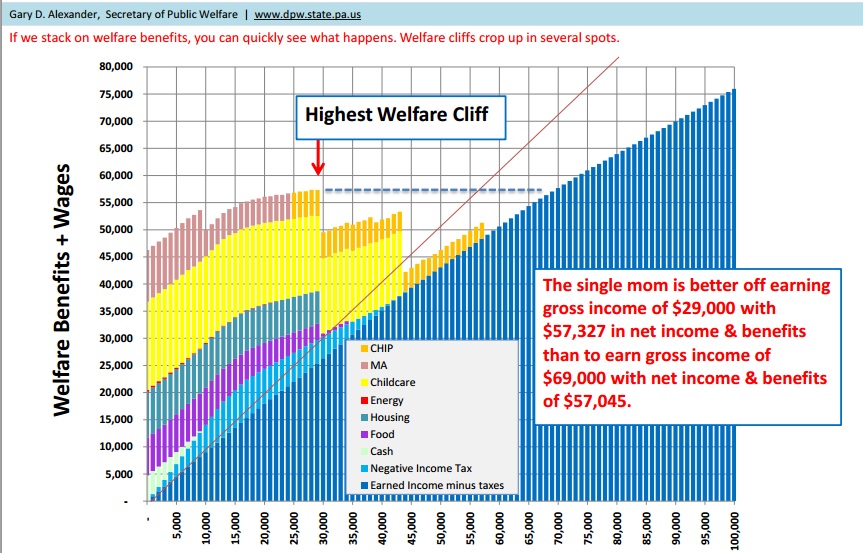
Single mothers are better off with a $29,000 job and welfare than with a $69,000 job

Socialism subsidizes single motherhood by choice

(click for larger image)

James Pethokoukis of the American Enterprise Institute explains how the welfare state discourages women from getting married before they have children.

Excerpt:

The U.S. welfare system sure creates some crazy disincentives to working your way up the ladder. Benefits stacked upon benefits can mean it is financially better, at least in the short term, to stay at a lower-paying jobs rather than taking a higher paying job and losing those benefits. This is called the “welfare cliff.”

Let’s take the example of a single mom with two kids, 1 and 4. She has a $29,000 a year job, putting the kids in daycare during the day while she works.

As the above chart  – via Gary Alexander, Pennsylvania’s secretary of Public Welfare — shows, the single mom is better off earning gross income of $29,000 with $57,327 in net income and benefits than to earn gross income of $69,000 with net income & benefits of $57,045.

It would sure be tempting for that mom to keep the status quo rather than take the new job, even though the new position might lead to further career advancement and a higher standard of living. I guess this is something the Obama White House forgot to mention in its “Life of Julia” cartoons extolling government assistance.

Fatherlessness is absolutely horrible for children across the board. Not just in terms of their development, but also their material well-being and their physical safety. Fatherlessness is a loss in three ways for children. The federal government should NOT be taking money from good married households and transferring it to women who decline to marry before choosing to have reckless, irresponsible recreational sex.