
Tag Archives: Government

Feminist Hanna Rosin debunks the myth of a gender pay gap caused by discrimination

In the far-left Slate, of all places.

Excerpt:

The official Bureau of Labor Department statistics show that the median earnings of full-time female workers is 77 percent of the median earnings of full-time male workers. But that is very different than “77 cents on the dollar for doing the same work as men.” The latter gives the impression that a man and a woman standing next to each other doing the same job for the same number of hours get paid different salaries. That’s not at all the case. “Full time” officially means 35 hours, but men work more hours than women. That’s the first problem: We could be comparing men working 40 hours to women working 35.

How to get a more accurate measure? First, instead of comparing annual wages, start by comparing average weekly wages. This is considered a slightly more accurate measure because it eliminates variables like time off during the year or annual bonuses (and yes, men get higher bonuses, but let’s shelve that for a moment in our quest for a pure wage gap number). By this measure, women earn 81 percent of what men earn, although it varies widely by race. African-American women, for example, earn 94 percent of what African-American men earn in a typical week. Then, when you restrict the comparison to men and women working 40 hours a week, the gap narrows to 87 percent.

But we’re still not close to measuring women “doing the same work as men.” For that, we’d have to adjust for many other factors that go into determining salary. Economists Francine Blau and Lawrence Kahn did that in a recent paper, “The Gender Pay Gap.”.”They first accounted for education and experience. That didn’t shift the gap very much, because women generally have at least as much and usually more education than men, and since the 1980s they have been gaining the experience. The fact that men are more likely to be in unions and have their salaries protected accounts for about 4 percent of the gap. The big differences are in occupation and industry. Women congregate in different professions than men do, and the largely male professions tend to be higher-paying. If you account for those differences, and then compare a woman and a man doing the same job, the pay gap narrows to 91 percent. So, you could accurately say in that Obama ad that, “women get paid 91 cents on the dollar for doing the same work as men.”

I believe that the remainder of the gap can be accounted for by looking at other voluntary factors that differentiate men and women.

The Heritage Foundation says that a recent study puts the number at 95 cents per dollar.

Excerpt:

Women are more likely than men to work in industries with more flexible schedules. Women are also more likely to spend time outside the labor force to care for children. These choices have benefits, but they also reduce pay—for both men and women. When economists control for such factors, they find the gender gap largely disappears.

A 2009 study commissioned by the Department of Labor found that after controlling for occupation, experience, and other choices, women earn 95 percent as much as men do. In 2005, June O’Neil, the former director of the Congressional Budget Office, found that “There is no gender gap in wages among men and women with similar family roles.” Different choices—not discrimination—account for different employment and wage outcomes.

A popular article by Carrie Lukas in the Wall Street Journal agrees.

Excerpt:

The Department of Labor’s Time Use survey shows that full-time working women spend an average of 8.01 hours per day on the job, compared to 8.75 hours for full-time working men. One would expect that someone who works 9% more would also earn more. This one fact alone accounts for more than a third of the wage gap.

[…]Recent studies have shown that the wage gap shrinks—or even reverses—when relevant factors are taken into account and comparisons are made between men and women in similar circumstances. In a 2010 study of single, childless urban workers between the ages of 22 and 30, the research firm Reach Advisors found that women earned an average of 8% more than their male counterparts. Given that women are outpacing men in educational attainment, and that our economy is increasingly geared toward knowledge-based jobs, it makes sense that women’s earnings are going up compared to men’s.

When women make different choices about education and labor that are more like what men choose, they earn just as much or more than men. What does it mean that people on the left keep pushing pseudo-science on us to try to punish men and reward women? Why are men so awful that they need to be denigrated like this? And how will men respond to social expectations when they have to face being told that they are “bad”? It seems to me that putting men down is going to lower their level of engagement.
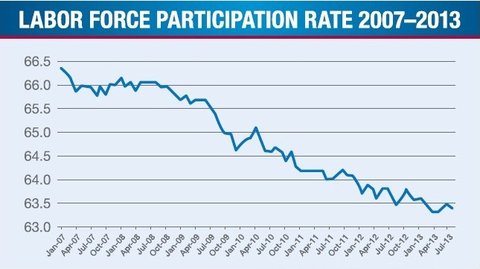
What happened to the economy after Democrats won the House and Senate in 2007?

Labor Force Participation Rate from 2007 (Pelosi/Reid) to 2013

Three data points explain what happens when government gets bigger, and job creators get smaller.

First from Investors Business Daily, Obama’s failure to reduce health insurance premiums with his big government takeover of health care.

Excerpt:

The average employer-provided family health insurance premiums have climbed $2,976 since 2009, according to an annual Kaiser Family Foundation survey released this week. They’re up $3,671 compared with the year before President Obama took office. That’s despite Obama’s repeated promises that the health care reform law he championed would cut premiums by $2,500 in his first term.

And while annual premium increases have moderated over the past two years, that’s due to trends in the insurance market largely unrelated to ObamaCare, and trends the law could actually reverse.

The Kaiser survey found that the average family premium this year is $16,351, up 4% over last year, and up 22% since 2009. After adjusting for inflation, premiums climbed an average 3.2% a year in Obama’s first term, higher than the 2.7% average during President Bush’s last four years in office.

During his first campaign for president, Obama repeatedly claimed that his health reform plan would, as he said at a Virginia rally in 2008 “lower premiums by up to $2,500 for a typical family per year.”

Now, let’s take a look the second failure, as reported by the Weekly Standard.

Excerpt:

President Obama likes to talk about income inequality, but what matters far more is the actual income of the typical American.  And how has the typical American household income fared on Obama’s watch?  Well, the economic “recovery” has now spanned an Olympiad, and during that time the typical American household income has not only dropped—it has dropped more than twice as much as it did during the recession.

New estimates derived from the Census Bureau’s Current Population Survey by Sentier Research indicate that the real (inflation-adjusted) median annual household income in America has fallen by 4.4 percent during the “recovery,” after having fallen by 1.8 during the recession.  During the recession, the median American household income fell by $1,002 (from $55,480 to $54,478). During the recovery—that is, from the officially defined end of the recession (in June 2009) to the most recent month for which figures are available (June 2013)—the median American household income has fallen by $2,380 (from $54,478 to $52,098).  So the typical American household is making almost $2,400 less per year (in constant 2013 dollars) than it was four years ago, when the Obama “recovery” began.

Importantly, these income tallies include government payouts such as unemployment compensation and cash welfare. So Obama’s method of funneling ever-more money and power to Washington, and then selectively divvying some of it back out, clearly isn’t working for the typical American family.

And finally, the third example, from the Daily Caller.

Excerpt:

 In 35 states, welfare benefits pay more than a minimum wage job, according to a new study by the libertarian Cato Institute, and in 13 states welfare pays more than $15 per hour.

“One of the single best ways to climb out of poverty is taking a job, but as long as welfare provides a better standard of living than an entry-level job, recipients will continue to choose it over work,” said Michael Tanner, senior policy analyst and co-author of the study.

The study is an updated version of one Tanner put out in 1995 that estimated the full value of welfare benefits packages across the states. The 1995 study found that such tax-free welfare benefits greatly exceeded the poverty level and “their dollar value was greater than the amount of take-home income a worker would receive from an entry-level job.”

Despite efforts to curb welfare spending, many welfare programs and benefits have continued to outpace the income that many workers can receive for working an entry-level job, which disincentivizes work, according to the study.

“The current welfare system provides such a high level of benefits that it acts as a disincentive for work,” reads the study. “Welfare currently pays more than a minimum-wage job in 35 states, even after accounting for the Earned Income Tax Credit, and in 13 states it pays more than $15 per hour.”

According to the study, the federal government funds 126 separate programs designed to support low-income earners. Seventy-two of these programs provide cash or in-kind benefits to recipients. This is on top of additional welfare programs operated by state and local governments.

Welfare recipients in Hawaii get the most benefits, according to Tanner, at $29.13 per hour — or $60,590 pre-tax income annually. However, the state’s minimum wage is only $7.25 per hour, according to the Labor Department. Hawaiians on welfare also earn 167 percent of the median salary in the state, which is only $36,275.

What if a fireman showed up in front of your house on your birthday and claimed that he wanted to put out the candles on your birthday cake because they were a fire hazard? What if he read out a long, passionate, prepared speech about how much he wanted to put out fires? What if he then dumped a bucket of gasoline on your cake? What if your house caught fire and he claimed that you should let him keep throwing gas on the fire to put it out? What if you found out that this person was a lawyer and a community organizer, and knew nothing at all about putting fires out? Obama was not prepared to run the economy, and, as expected, he spent a ton of money without getting the results he said he was going to get. He gave speeches about jobs and poverty and everything he’s done has been to increase unemployment and increase poverty – and now we are $17 trillion dollars in debt. Speeches about achieving objective X during a campaign don’t necessarily translate into achieving objective X. You actually have to know what you are doing in order to achieve objectives, preferably because you’ve done it before in real life.

New study from the Federal Reserve finds that QE stimulus doesn’t grow the economy

Investors Business Daily reports on our incompetent government’s policies.

Excerpt:

For four years now, we’ve heard policymakers and pundits alike defend the Federal Reserve’s quantitative easing based on the idea that, without it, the nation’s economy would have imploded.

Now, a new study from the Fed itself suggests that’s not the case.

The study, by San Francisco Federal Reserve economist Vasco Curdia and New York Fed economist Andrea Ferrero, suggests that quantitative easing (QE) has done little to boost the economy’s trajectory.

“Asset purchase programs like QE2 appear to have, at best, moderate effects on economic growth and inflation,” the economists wrote in a special research note that was released last week.

In their study, Curdia and Ferrero looked specifically at the impact of the Fed’s QE2 program, which totaled $600 billion.

Assuming the $600 billion program lasts for five years — with the Fed buying bonds the first year, holding them for two, then selling them off for the remaining two — the spending turns out largely to have been a waste.

That level of QE stimulus, even when coupled with the Fed’s promise to hold interest rates at zero, likely boosted GDP by a mere 0.13 percentage point, the study found. It added just 0.03 percentage point to inflation.

Bottom line: $600 billion in QE2 spending boosted GDP by less than $200 billion.

[…]And even that minor amount of growth was due in large part to the Fed’s explicit vow to hold official interest rates at close to 0% until the unemployment rate reaches 6.5% or lower, Curdia and Ferrero said.

Take away that promise, and QE2 added just 0.04 percentage point to GDP and 0.02 percentage point to inflation.

What caused it?

With $17 trillion in total U.S. debt — an amount that’s now growing at a rate of $1 trillion a year — the authors argue that the Fed is essentially trapped into printing money through QE.

If QE — which now pushes $85 billion a month into U.S. Treasury and agency debt — stops, interest rates will soar, dragging the economy down.

Fed Chairman Ben Bernanke has been sanguine about this, suggesting this enormous pile of debt can all be sold off with little disruption.

We’re not so sure. Once the Fed begins selling off its massive $3.6 trillion in assets acquired under the QE program (see chart), it will send interest rates surging and tank the economy.

Even more troubling is what it says about current politics.

The White House and a Democrat-led Senate have boosted spending dramatically — outlays as a share of GDP rose initially by 25% under President Obama

The Fed, by buying up much of the newly issued federal debt, has become the No. 1 enabler of a spendthrift government that’s pushing us to the brink of fiscal disaster.

At $85 billion a month, QE2 spending is roughly equal to the amount of federal debt we add each month.

We elected a Keynesian who thought that government could create economic growth (jobs!) by borrowing money and printing money. The countries of the world largely cheered our decision to elect him. He failed to grow the economy and he failed to create jobs. Eventually, the money he’s been spending to keep a sinking ship afloat is going to run out.