
Tag Archives: God

What is intelligent design? What is capitalism?

Two new books have just come out by two of my favorite people in the whole world:

  • Stephen C. Meyer (Ph.D from Cambridge University)
  • Jay W. Richards (Ph.D from Princeton University).

Meyer’s book is about intelligent design, and Richards’ book is about capitalism. Let’s take a look.

What is intelligent design?

To understand what intelligent design is, you can watch two DVDs that are now online at Youtube. Both videos are by Illustra Media.

Here are the 2 playlists:

I give these videos my highest recommendation. If you have not seen them, you must see them.

Stephen C. Meyer’s new book

The new book by Stephen C. Meyer is called “Signature in the Cell: DNA and the Evidence for Intelligent Design”. It is being published by Harper-Collins.
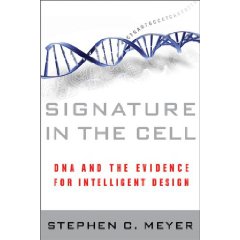
Signature in the Cell

Here is the blurb:

Meyer tells the story of the successive attempts to solve this mystery of DNA and argues that fundamental objections now exist to the adequacy of all purely naturalistic or materialistic theories. The book then proposes a radical alternative based upon developments in molecular biology and the information sciences: it proposes the design hypothesis as the best explanation for the origin of the information necessary to produce the first life.

SIGNATURE IN THE CELL will not merely provide a critique of evolutionary theories. It also shows that, based on our uniform and repeated experience-the basis of all scientific reasoning about the past-there is a strong positive case for intelligent design. From our experience we know that intelligence alone produces large amounts of information. Thus, the book shows that the argument for intelligent design from DNA is not based on ignorance or a desire to “give up on science,” but instead upon just the opposite: our growing scientific knowledge of the inner workings of the cell and our experience-based knowledge of the cause-and-effect structure of the world. For just this reason the argument for design can be formulated as a rigorous and positive scientific argument-specifically one called “an inference to the best explanation.” The book shows, ironically, that the argument for intelligent design from DNA is based on the same method of scientific reasoning that Darwin himself used.

I pre-ordered mine! You can see Stephen Meyer debating against Skeptic magazine’s editor Michael Shermer here.

Now let’s turn to Jay W. Richards’ book.

What is capitalism?

To understand what capitalism is, you can watch this lecture entitled “Money, Greed and God: Why Capitalism is the Solution and Not the Problem” by Jay W. Richards, delivered at the Heritage Foundation think tank, and televised by C-SPAN2. The book has the same title, and is published by Harper-Collins.
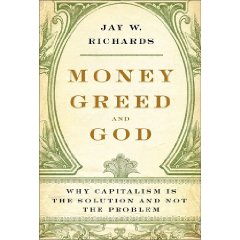
Money, Greed and God

Here is the blurb:

Does capitalism promote greed? Can a person follow Jesus’s call to love others and also support capitalism? Was our recent economic crisis caused by flaws inherent to our free market system? Jay Richards presents a new approach to capitalism, revealing how it’s fully consistent with Jesus’s teachings and the Christian tradition, while also showing why this system is our best bet for renewed economic vigor.

The church is bombarded with two competing messages about money and capitalism:

  • wealth is bad and causes much of the world’s suffering
  • wealth is good and God wants you to prosper and be rich

Richards exposes these myths, and other common misconceptions about capitalism, and reveals the surprising ways that capitalism is, in fact, the best system to respond to the biblical mandates of alleviating poverty and protecting the environment. Money, Greed, and God equips readers to take practical steps in their own lives to conduct business, worship God, and serve others without falling into the “prosperity gospel” trap.

I can hardly wait to get my copy!

If you can’t see the Richards video, here is an audio lecture by Jay Richards on the “Myths Christians Believe about Wealth and Poverty“. Also, why not check out this series of 4 sermons by Wayne Grudem on the relationship between Christianity and economics? (a PDF outline is here)

Why should Christians embrace chastity?

Christians should be chaste because research shows that sex before marriage decreases marital stability.

Story from Life Site News. (H/T Mary)

Excerpt:

Couples who reserve sex for marriage enjoy greater stability and communication in their relationships, say researchers at Brigham Young University.

A new study from the Mormon college found that those couples who waited until marriage rated their relationship stability 22 percent higher than those who started having sex in the early part of their relationship. The relationship satisfaction was 20 percent higher for those who waited, the sexual quality of the relationship was 5 percent better, and communication was 12 percent better.

The study, published in the American Psychological Association’s Journal of Family Psychology, involved 2,035 married individuals who participated in a popular online marital assessment called “RELATE.” From the assessment’s database, researchers selected a sample designed to match the demographics of the married American population. The extensive questionnaire included the question “When did you become sexual in this relationship?”

Couples that became sexually involved later in their relationship – but prior to marriage – reported benefits that were about half as strong as those who waited for marriage.

[…]Sociologist Mark Regnerus of the University of Texas at Austin, who was not involved in the study, responded to its findings, saying that “couples who hit the honeymoon too early – that is, prioritize sex promptly at the outset of a relationship – often find their relationships underdeveloped when it comes to the qualities that make relationships stable and spouses reliable and trustworthy.” Regnerus is the author of Premarital Sex in America, a book forthcoming from Oxford University Press.

Because religious belief often plays a role for couples who choose to wait, Busby and his co-authors controlled for the influence of religious involvement in their analysis.

“Regardless of religiosity, waiting helps the relationship form better communication processes, and these help improve long-term stability and relationship satisfaction,” Busby said.

Research matters when discussing morality

Young men and women growing up really need to be informed by their parents what they are going to want to be doing long term, and what they should be doing today to accomplish those goals. Young people benefit greatly from the guidance of older and wiser people, but in defining goals and defining the steps to reach those goals. To be a convincing parent, you have to be convinced yourself. And to be convinced yourself, you need to be seen as having knowledge, not just opinions, but knowledge. Having the right peer-reviewed papers at hand will help you to be a better parent.

My previous post on research showing how sex before marriage greatly reduces the stability of marriage. That post contains even more research showing that having even ONE pre-marital sex partner can GREATLY reduce the probability that the marriage will last. And it gets worse as you add more partners.

Christians and chastity

What should Christians know about the purpose of chastity?

1. Chastity is not just abstinence

Chastity is not just abstaining from sex. Chastity is the Christian virtue by which Christians take God’s character and goals into account in their relationships with the opposite sex. Probably about 99.9% of the people in the world look at members of the opposite sex and think “what’s in it for me?”. Chastity allows you to look at members the opposite sex, even the unattractive ones, and ask “what’s in it for God?”.

I’ve written about how the goal of life on atheism is to be happy. One of the consequences of this is that atheists look at other people as objects that can make them happy or not, depending on how resistant they are to sticks and carrots. In Christianity, chastity is the gift that allows you to look at people you are not attracted to in the least and to love them enough to help them grow in the knowledge of God.

2. Physical contact clouds the judgment

Chastity allows you to make a better decision about who you are going to marry. When you are desperate to be loved (women) or desperate for physical intimacy (men) it’s easy to hide the bad parts of yourself and to overlook the flaws of others. Physical contact leads to rushed commitments and emotions that are difficult to undo later once you learn more about the other person’s moral and spiritual beliefs.

Chastity allows you to keep God in the picture as you evaluate prospective mates. Instead of looking at candidates who will fulfill your needs, you look for candidates who benefit God, perhaps because they are skilled at explaining Christianity to your future children. Without chastity, women choose men who are amoral, to avoid being judged, and men choose women solely on appearance, who are unqualified for married life.

3. Sex without commitment destroys the capacity for trust and vulnerability

When persons have sex outside of a lifelong commitment, they have to make an effort to separate their emotions from the physical activity. This leads to a kind of “guarded” condition where a person is no longer free to be really engaged emotionally in a relationship. For example, women lose feminine qualities like trust and vulnerability, which are necessary to attract good men without using sex appeal. (Men can tell)

In addition, I would say that when a relationship is kept platonic, the break-ups are going to be a lot less damaging emotionally. All my relationships have been platonic, so even when the break-ups occurred, there was never any physical element to add to the pain. It is important for people to go after the best spousal candidate they can find, not to settle for some amoral loser just to avoid the pain of rejection.

Related posts

How religious faith drives the delusion of Darwinism

Commenter ECM alerted me to Cornelius Hunter’s new blog “Darwin’s God”. Cornelius is a software engineer like me who rose up the ranks of the firm through “sweat equity”, and was able to eventually pursue a PhD in Biophysics from the University of Illinois. I have his first book “Darwin’s God” and I read it. His thesis is basically that theological beliefs about what God would and would not do are the driving force behind evolution.

Evolution and the problem of evil

Here is his latest post about a debate that occured at Westminster Abbey between an atheistic evolutionist and a theistic evolutionist.

Here’s what the theistic evolutionist said:

Alexander is a theist and Jones an atheist. But they both agree that God would not have created what we find in this world. Everything from programmed cell death to the extinction of so many species and the food chain points to a massive economy of death in nature. With this sort of evidence, “What kind of a designer,” asks Alexander, “are you going to end up believing in?

…According to Alexander, this problem of death and evil does not leave much room for a divine creator. Alexander concludes that God did not create the details of the world. He is thus absolved of the world’s many evils. He implemented a framework of sorts, but let unguided processes do the rest.

And here’s what the atheist evolutionist said:

As with Alexander, Jones also finds that biology does not meet with his expectations of divine creation. “The feeblest of designer,” Jones has written, could improve the design of the human eye. This and other examples, says Jones, shows that complex organs are “not the work of some great composer but of an insensible drudge: an instrument, like all others, built by a tinkerer [i.e., the evolutionary process] rather than by a trained engineer.” As with Alexander, Jones’ religious sentiment mandates some sort of evolution to be true.

So let’s think about what causes people to become evolutionists, beyond the normal answers of peer-pressure, career preservation, wanting to be thought of as smart, wanting to rebel against parents, wanting to have sex and drink alcohol, etc. Is it about science? No. It’s about knowing what God would do and observing that the world does not correspond to these ideas of what atheists think God would do.

Remember that post I wrote a while back about Christopher Hitchens’ case against God. None of his arguments against God were based on evidence, but only on his personal preferences. God wouldn’t have done it that way. God should have done it this way. I don’t like this theology. I don’t like that feature of the universe. It’s just a long-running temper tantrum against any kind of authority, regardless of the evidence.

Here’s Dawkins explaining how unobservable aliens must ave evolved, even if Dawkins doesn’t have any evidence:

He doesn’t even need to see the evidence that we evolved. He knows that God wouldn’t have created the life this way, and so the evidence is irrelevant.

Evolution and the problem of sub-optimal design

Another way that assume that evolution is true, other than childhood trauma and the desire to be morally evil, is by assuming that if material forces did not do the creating, then the design must be optimal. Now I am a software engineer, with undergraduate and graduate degrees, a published paper that I presented at the IEEE and a patent in wireless technology. My specialty is architecture. So I will tell you.

There is no such thing as an optimal design.

As part of my graduate course work, I had to study the work done at the Software Engineering Institute at the Carnegie-Mellon University. They have invented an entire methodology for designing software based on analyzing trade-offs between alternative architectural candidates. They use use case scenarios, disaster scenarios, maintenance scenarios and other scenarios in order to evaluate how well each architecture performs.

All of the architectures can satisfy the so-called “functional requirements”. But the architectures differ in their ability to satisfy non-functional requirements, the “-ilities”. These can include performance, maintainability, security, extensibility, testability, simplicity, re-usability. This is the bread and butter that software engineers like me have to deal with every day.

Here’s an excerpt from a related post from Uncommon Descent:

It is simply impossible for one architecture to have all the “ilities” because many conflict. For instance, if I want high “security” I am going to have to give up a good deal of “interoperability”. A large part of architecture is actually deciding what you are going to give up, which incidentally affects how the architecture can change in the future (i.e. usually it cannot “evolve” to conform to different “ilities”). This is all still fairly new, but we are now able to judge architectures in terms of the “ilities” they match and the “ilities” they do not match. A better understanding of the conflicts between certain “ilities” is gradually developing.

When I worked in the embedded space on operating systems like VxWorks, we regularly traded-off memory against speed. It’s the nature of the engineering business. And make no mistake – God is a software engineer. He writes code.

Conclusion

Hunter’s article concludes with this:

Have the theists sold out? Have the theists been duped? Are they afraid to stand up for themselves? Are the atheists taking over? No, no, no, and no. The theists and atheists are united in their religious beliefs about God and how he would interact with the world. They may have their differences, but regarding evolution those differences are irrelevant. Their shared religious convictions mandate evolution. Religion drives science and it matters.

I have an idea. Let’s keep religion out of science and decide how we really got here, no holds barred. Instead of blocking debates and persecuting dissent, let’s actually have a debate about origins, and not rule intelligent causes out before we look at the evidence.

Further study

Atheist responses to scientific arguments for theism are fun to understand. Atheists attribute the beginning of the universe to untestable theories and the fine-tuning to an unobservable multiverse. (And don’t forget their lame responses to galactic, stellar and planetary habitability arguments)