Tag Archives: Feelings

Mark D. Linville: does Darwinian evolution make morality rational?

A conflict of worldviews

Have you ever heard an atheist tell you that naturalistic evolution is an answer to the moral argument? I have. And I found a good reply to this challenge in the book “Contending With Christianity’s Critics“. The chapter that responds to the challenge is authored by Dr. Mark D. Linville. It is only 13 pages long. I have a link to the PDF at the bottom of this post.

First, a bit about the author:

Blog: The Tavern at the End of the World
Current positions:

  • PhD Research Fellow
  • Tutoring Fellow in Philosophy

Education:

  • PhD in Philosophy with a minor in South Asian Studies and a specialization in Philosophy of Religion, University of Wisconsin-Madison
  • MA in Philosophy, University of Wisconsin-Madison
  • MA in Philosophy of Religion, Trinity Evangelical Divinity School
  • MA in Theology, Cincinnati Christian Seminary
  • BA in Biblical Studies, Florida Christian College

Here is his thesis of the essay:

Darwin’s account of the origins of human morality is at once elegant, ingenious, and, I shall argue, woefully inadequate. In particular, that account, on its standard interpretation, does not explain morality, but, rather, explains it away . We learn from Darwin not how there could be objective moral facts, but how we could have come to believe—perhaps erroneously—that there are.

Further, the naturalist, who does not believe that there is such a personal being as God, is in principle committed to Darwinism, including a Darwinian account of the basic contours of human moral psychology. I’ll use the term evolutionary naturalism to refer to this combination of naturalism and Darwinism. And so the naturalist is saddled with a view that explains morality away. Whatever reason we have for believing in moral facts is also a reason for thinking naturalism is false. I conclude the essay with a brief account of a theistic conception of morality, and argue that the theist is in a better position to affirm the objectivity of morality.

And here’s a sample to get your attention:

But even if we are assured that a “normal” person will be prompted by the social instincts and that those instincts are typically flanked and reinforced by a set of moral emotions, we still do not have a truly normative account of moral obligation. There is nothing in Darwin’s own account to indicate that the ensuing sense of guilt—a guilty feeling—is indicative of actual moral guilt resulting from the violation of an objective moral law. The revenge taken by one’s own conscience amounts to a sort of second-order propensity to feel a certain way given one’s past relation to conflicting first-order propensities (e.g., the father’s impulse to save his child versus his impulse to save himself). Unless we import normative considerations from some other source, it seems that, whether it is a first or second-order inclination,one’s being prompted by it is more readily understood as a descriptive feature of one’s own psychology than material for a normative assessment of one’s behavior or character. And, assuming that there is anything to this observation, an ascent into even higher levels of propensities (“I feel guilty for not having felt guilty for not being remorseful over not obeying my social instincts…”) introduces nothing of normative import. Suppose you encounter a man who neither feels the pull of social, paternal or familial instincts nor is in the least bit concerned over his apparent lack of conscience. What, from a strictly Darwinian perspective, can one say to him that is of any serious moral import? “You are not moved to action by the impulses that move most of us.” Right. So?

The problem afflicts contemporary construals of an evolutionary account of human morality. Consider Michael Shermer’s explanation for the evolution of a moral sense—the “science of good and evil.” He explains,

By a moral sense, I mean a moral feeling or emotion generated by actions. For example, positive emotions such as righteousness and pride are experienced as the psychological feeling of doing “good.” These moral emotions likely evolved out of behaviors that were reinforced as being good either for the individual or for the group.2

Shermer goes on to compare such moral emotions to other emotions and sensations that are universally experienced, such as hunger and the sexual urge. He then addresses the question of moral motivation.

In this evolutionary theory of morality, asking “Why should we be moral?” is like asking “Why should we be hungry?” or “Why should we be horny?” For that matter, we could ask, “Why should we be jealous?” or “Why should we fall in love?” The answer is that it is as much a part of human nature to be moral as it is to be hungry, horny, jealous, and in love.3

Thus, according to Shermer, given an evolutionary account, such a question is simply a non-starter. Moral motivation is a given as it is wired in as one of our basic drives. Of course, one might point out that Shermer’s “moral emotions” often do need encouragement in a way that, say, “horniness,” does not. More importantly, Shermer apparently fails to notice that if asking “Why should I be moral?” is like asking, “Why should I be horny?” then asserting, “You ought to be moral” is like asserting, “You ought to be horny.” As goes the interrogative, so goes the imperative. But if the latter seems out of place, then, on Shermer’s view, so is the former.

One might thus observe that if morality is anything at all, it is irreducibly normative in nature. But the Darwinian account winds up reducing morality to descriptive features of human psychology. Like the libido, either the moral sense is present and active or it is not. If it is, then we might expect one to behave accordingly. If not, why, then, as a famous blues man once put it, “the boogie woogie just ain’t in me.” And so the resulting “morality” is that in name only.

In light of such considerations, it is tempting to conclude with C. S. Lewis that, if the naturalist remembered his philosophy out of school, he would recognize that any claim to the effect that “I ought” is on a par with “I itch,” in that it is nothing more than a descriptive piece of autobiography with no essential reference to any actual obligations.

When it comes to morality, we are not interested in mere descriptions of behavior. We want to know about prescriptions of behavior, and whether why we should care about following those prescriptions. We are interested in what grounds our sense of moral obligation in reality. What underwrites our sense of moral obligation? If it is just rooted in feelings, then why should we obey our moral sense when obeying it goes against out self-interest? Feelings are subjective things, and doing the right thing in a real objective state of affairs requires more than just feelings. There has to be a real objective state of affairs that makes it rational for us to do the right thing, even when the right thing is against our own self-interest. That’s what morality is – objective moral obligations overriding subjective feelings. I wouldn’t trust someone to be moral if it were just based on their feelings.

The PDF is right here for downloading, with the permission of the author.

Frequent denial of sex breaks the marriage covenant as much as adultery

Marriage and family
Marriage and family

Let’s start this post by quoting a passage from the Bible.

1 Corinthians 7:1-5:

Now concerning the things about which you wrote, it is good for a man not to touch a woman.

But because of immoralities, each man is to have his own wife, and each woman is to have her own husband.

The husband must fulfill his duty to his wife, and likewise also the wife to her husband.

The wife does not have authority over her own body, but the husband does; and likewise also the husband does not have authority over his own body, but the wife does.

Stop depriving one another, except by agreement for a time, so that you may devote yourselves to prayer, and come together again so that Satan will not tempt you because of your lack of self-control.

So with that in mind, I want to turn to a well-known Jewish talk show host named Dennis Prager, who is much loved and listened to by Christians. Dennis Prager features a lot of discussions about male-female relationships on his show, particularly during the male-female hour. In this two part series on male sexuality, he explains why women should not deprive their husbands of sex without a good reason.

Part 1 is here.

Excerpt:

It is an axiom of contemporary marital life that if a wife is not in the mood, she need not have sex with her husband. Here are some arguments why a woman who loves her husband might want to rethink this axiom.

First, women need to recognize how a man understands a wife’s refusal to have sex with him: A husband knows that his wife loves him first and foremost by her willingness to give her body to him. This is rarely the case for women. Few women know their husband loves them because he gives her his body (the idea sounds almost funny). This is, therefore, usually a revelation to a woman. Many women think men’s natures are similar to theirs, and this is so different from a woman’s nature, that few women know this about men unless told about it.

This is a major reason many husbands clam up. A man whose wife frequently denies him sex will first be hurt, then sad, then angry, then quiet. And most men will never tell their wives why they have become quiet and distant. They are afraid to tell their wives. They are often made to feel ashamed of their male sexual nature, and they are humiliated (indeed emasculated) by feeling that they are reduced to having to beg for sex.

When first told this about men, women generally react in one or more of five ways…

He then explains the 5 ways that women respond to this.

Here’s one:

1. You have to be kidding. That certainly isn’t my way of knowing if he loves me. There have to be deeper ways than sex for me to show my husband that I love him.

I think that this is a common mistake that liberal women make because they think that men are just hairy women. But men are not women, we are different and sex means something different to men than it does to women. In the past, most women understood how men are different than women, but younger women have been taught that there are no differences between the sexes. To think any different is “sexism”.

Here’s another from the list:

4. You have it backwards. If he truly loved me, he wouldn’t expect sex when I’m not in the mood.

Again, this is the common mistake that many younger women today make in thinking that love is a one-way street – flowing from men and children to the woman. If men and children DON’T do what the woman wants, or if they make demands on her, then they don’t “love” her and she is justified in ignoring them.

Liberal women have been taught to believe that they are always victims or some group of oppressors, such as men and children or corporations. It makes them rebel against having to do anything for anyone else, because they don’t want to be “oppressed”. That makes them unable to accept that relationships are give-and-take, Once a commitment to love another person permanently has been made, then each person has responsibilities to provide for the needs of the other.

I actually had a conversation with a Christian woman once who said that women should not be obligated to do things that they didn’t feel like doing. I asked her if men were obligated to go to work when they didn’t feel like going. She said yes, and acted as though I were crazy for asking. I just laughed, because she didn’t even see the inconsistency. The truth is that men often don’t feel like working, but they get up and go to work anyway, whether they like it or not (in most cases). Similarly, a women should feel obligated to have sex with her husband, even if she is not in a perfect mood for it (in most cases). Sometimes, a man stays home from work, and it’s OK. And sometimes a woman says no to sex, and it’s OK. But it’s not OK to stop doing it for months and months with no good reason.

Part 2 is here.

Excerpt:

Here are eight reasons for a woman not to allow not being in the mood for sex to determine whether she denies her husband sex.

He then explains the eight reasons.

Here’s one of them:

7. Many contemporary women have an almost exclusively romantic notion of sex: It should always be mutually desired and equally satisfying or one should not engage in it. Therefore, if a couple engages in sexual relations when he wants it and she does not, the act is “dehumanizing” and “mechanical.” Now, ideally, every time a husband and wife have sex, they would equally desire it and equally enjoy it. But, given the different sexual natures of men and women, this cannot always be the case. If it is romance a woman seeks — and she has every reason to seek it — it would help her to realize how much more romantic her husband and her marriage are likely to be if he is not regularly denied sex, even of the non-romantic variety.

Women have to engage their husbands if they expect their husbands to engage in the marriage as a husband and father. Men can’t do their protector, provider and spiritual leader roles forever unless their needs are met at some point. Performance of these male duties is not free. Wives have to love their husbands in the way that men expect to be loved. That’s what they vowed to do in the wedding, isn’t it?

At the end of the article, Prager makes a general point about women that I think needs to be emphasized over and over and over:

That solution is for a wife who loves her husband — if she doesn’t love him, mood is not the problem — to be guided by her mind, not her mood, in deciding whether to deny her husband sex.

This problem of sex-withholding is so widespread, that it really makes me (although I am a virgin) wonder what women think that marriage is about anyway. When a woman vows to love her husband, what do they think that word really means? Why do women think that men marry? What do men want that marriage provides for them? Which of those needs are the women’s responsibility to provide for? I think these are questions that men should ask women. I think women should be prepared to answer them. Men should expect that women be reading books on men and marriage, and that she has relationships with men where she is giving support, respect, affirmation, affection and approval. You can learn a lot about a woman by how she treats her father, for example.

Unfortunately, many men today haven’t thought through what they need from wives in a marriage. They spend their young years chasing women who are fun and sexually permissive. Every husband I asked about what they need has told me that respect, affirmation, affection and regular sex are more important than appearance and fun. Pre-marital sex, having fun, getting drunk, and going out, etc. are not the right foundation for marriage – which requires mutual self-sacrifice in order to work.

Another point: I have a friend who is very concerned that men are breaking sexual rules, but he seems oblivious to 1 Corinthians 7:1-5. I asked him privately what he thought about sex-withholding, and whether this might cause husbands to turn to pornography and even affairs, and I mentioned 1 Corinthians 7:1-5. He said: “no, it’s not something I take much interest in”. I was tempted to ask him if the Bible was something that he does not take much interest in.

I think he misreads 1 Corinthians 7:1-5 so that it could only be used to condemn men. If that were his view, then it actually worries me if well-meaning men are actually undermining marriage, by teaching women that they have no responsibilities to keep the marriage going, and helping them to feel like victims when their marriages fall apart. Sometimes even people who claim to be pro-marriage can undermine marriage practically-speaking, because of their unBiblical belief that women are “naturally good” and should not have any responsibilities in a marriage.

I thought this attitude was so interesting in view of what I read in the Proper Care and Feeding of Husbands. In that book, Dr. Laura urges women to be sensitive to their husbands’ different male natures in order to avoid them looking at pornography and having affairs. Withholding sex from a man is the equivalent of a man withholding conversation to a woman. Sex is how a man feels loved! What’s remarkable is how female callers on her show are shocked that men react badly to being deprived of sex.

I do think that some men will look at porn and cheat regardless of what their wife does sexually, but then it again falls to the woman to choose a man who has demonstrated that he has self-control – i.e., a virgin who has remained chaste with her throughout the courtship and protected her from doing sexual things outside of the covenant context. Chastity is hard, but it is how a man loves his wife self-sacrificially, before he even meets her. It should be a trait much sought after and respected by women. Basically, women need to be led by their minds, not by their feelings, when choosing a husband.

A man has to get up and go to work every day for his family, regardless of whether he feels like it or not. In fact, the many decisions he has made before getting married are also made not because they make him happy, but because he needs to be responsible to his future wife and children. The decision to study science? Loving obligation. The decision to go to grad school in science? Loving obligation. The decision to work in a demanding, risky career? Loving obligation. The decision to save money and eat instant oatmeal for dinner? Loving obligation. Men don’t do these things because we enjoy them. We do it because we love our wives and children self-sacrificially, before we ever even meet them. I think that women need to do the same.

What is the “feminization of the church”?

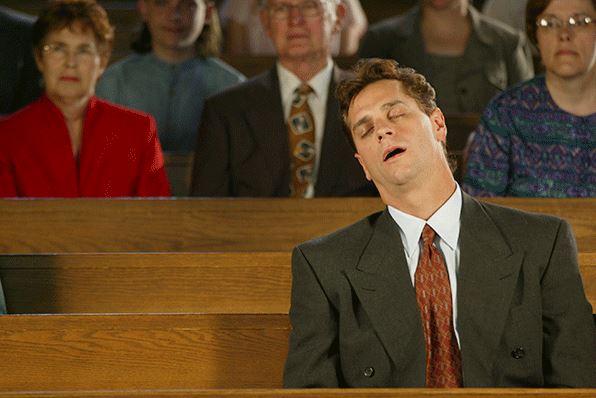
Church sucks, that's why men are bored there
Church sucks, that’s why men are bored there

A friend who shall remain anonymous sent me this article from The Art of Manliness about the feminization of the Christian church. The article is long and detailed. I want to mention one point briefly, and do another more fully.

Brief one first:

While Christians of the past two centuries have complained of a lack of virility in their pastors, there’s also been a statistically certified lack of other kinds of male mentors in the church as well. For example, a survey done in 1920 found that 73% of Sunday School teachers were women, and still today women are around 56% more likely than men to participate in Sunday school and to hold a leadership position in a church (not including the role of pastor).

Does a lack of masculine role models at church negatively effect the recruitment and retention of masculine members? Edwin Starbuck, a prominent psychologist in the early 1900s thought so, positing that “the boy is a hero-worshipper, and his hero can not be found in a Sunday school which is manned by women.” Murrow agrees, citing the research of Dr. Michael Lindsay, who found that:

“the number one reason high-achieving men don’t go to church is they don’t respect the pastor. Those men who did go to church often chose a megachurch because they saw the pastor as their leadership peer. ‘Respecting the senior pastor is vital to predicting whether a man is actively involved,’ Lindsay says.

“Men respect pastors who are properly masculine,” Murrow opines. “They are drawn to men who, like Jesus, embody both lion and lamb. They find macho men and sissies equally repulsive.”

I wrote an article last week where I criticized the education system for being unfair to boys. It turns out that the church and Sunday schools are also unfair to boys. (Not in all cases. My friend Mary teaches Sunday school, loves apologetics, and goes out of her way to affirm the different male nature in her boys).

Here’s the longer passage:

Research has shown that women are more likely to imagine God as characterized by love, forgiveness, and comfort, while men picture him in terms of power, planning, and control. With more women than men belonging to Christian churches, it’s not surprising that the religion’s theology, and the messages heard from the pulpit, have come to emphasize the former qualities over the latter.

Podles argues that men think in terms of dichotomies and conflicts — in or out, black or white. They tend to be more orthodoxic and privilege rules over relationships. Women (and more feminine men) tend do the opposite, and wish to overcome differences and assuage conflict, for the sake of greater acceptance and peaceable relationships.

Consequently, modern sermons tend to deemphasize the contrast between heaven and hell, sin and life, grace and justice, sheep and goats. There are less martial analogies, fewer calls for Christians to take up their cross and become soldiers for Christ. There is less emphasis on the need to suffer, struggle, and sacrifice for the gospel and for others, and more emphasis on how the gospel can be a tool towards greater self-realization and personal fulfillment. The gospel is presented not as heroic challenge, but therapy – the way to “your best life now.” The focus is on rewards over obstacles. All gain, no pain.

[…]Murrow observes that the modern tenor of the gospel turns the faith’s original message on its head: Whereas Jesus “promise[s] suffering, trial, and pain…today’s Christianity is marketed…[as] the antidote to suffering, trial, and pain.”

Indicative of these changes, Murrow says, is the way “the kingdom of God” has fallen into disuse in describing the church, in favor of the “family of God.” In the former, the ethos is more mission directed; in the latter it’s more’s relational. Each member of the “family of God” has a relationship with each other, and with Jesus Christ. And not just any kind of relationship with the savior — a “personal relationship” — a term whose popularity Murrow thinks contributes to the gospel’s lack of appeal to men:

[…][D]espite its extrabiblical roots, personal relationship with Jesus Christ has become the number one term evangelicals use to describe the Christian walk. Why? Because it frames the gospel in terms of a woman’s deepest desire—a personal relationship with a man who loves her unconditionally. It’s imagery that delights women—and baffles men.

[…]When Christ called disciples, he did not say, ‘Come, have a personal relationship with me.’ No, he simply said, ‘Follow me.’ Hear the difference? Follow me suggests a mission. A goal. But a personal relationship with Jesus suggests we’re headed to Starbucks for some couple time.”

[…]“The National Congregations Study found that self-described liberal churches were 14 percent more likely to have a gender gap than conservative ones.” Even when they don’t know it, Murrow says, men “long for a harsh affection—the love of a coach who yells at his players to get every ounce of effort; the love of a drill sergeant who pushes his recruits to the limits of human endurance; the love of a teacher who demands the impossible from his students. As Western society feminizes, it’s getting harder for men to find this kind of love. “

My own view of God is that he is “The General”: the master planner who achieves the salvation of all who can be persuaded without violating their free will. My soteriology is middle knowledge, and my view of God is that he is a great strategist, and a tactical genius. He is expert at orchestrating complex situations where  those who seek him meet the right people, find the right evidence, and have the right experiences. (Read Acts 17:24-28) I respect God as a leader, and look to him frequently to intervene in situations where his honor or his purposes are at stake. I do not expect God to care more about my needs and feelings as he does about achieving his goals.  With respect to God’s purposes in the world, my happiness is expendable. (And I think stating that view offends the feelings of feminized people, but it’s Biblical)

Are women pastors and leaders really liberal? Here’s an example of a female pastor arguing premarital sex and gay rights in the radically leftist Washington Post. This is very common with women in the church, who tend to value compassion over moral standards – acceptance over boundaries. Women generally accept abortion slightly more than men, and gay marriage a lot more than men.  A significant number just aren’t interested in what the Bible says about morality. Women tend to think about how moral standards make people feel, and they don’t want people to feel judged. They don’t usually understand that moral standards and boundaries are there to protect the weak, and to avoid imposing costs on the community to clean up the messes caused by selfishness and recklessness (i.e. – following your heart).