
Tag Archives: Education

Is Rick Santorum conservative or liberal? What are Rick Santorum’s political views?

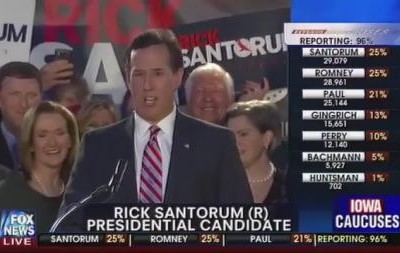
Rick Santorum Iowa Caucuses

Quin Hilyer explains, in the pro-Romney National Review, of all places.

Excerpt:

On taxes, for instance, Santorum has always been superb. The Club for Growth’s white paper on Santorum, calling his tax stances “very strong,” confirms that “Santorum has consistently supported broad-based tax cuts and opposed tax increases either by sponsoring key legislation or by casting votes on relevant bills.”

His record on a host of other conservative issues is as solid as that of any politician in the past two decades. He has been firmly and repeatedly against all sorts of regulatory abuse, against McCain-Feingold and other restrictions on political speech, for school choice, for tort reform, for a strong military, and for a balanced-budget amendment.

Obviously he has been as stalwart a defender of social conservatism, for 20 full years, as any other public figure. And as virtually every conservative involved in the judicial wars during Santorum’s time in the Senate has confirmed, in person or in print, Santorum and his staff were the go-to people in the Senate when you needed to find tireless, committed advocates for conservative jurists. Santorum is, wrote Ed Whelan of the Ethics and Public Policy Center, “the candidate in whom I have by far the greatest confidence” in terms of how likely he would be “to appoint excellent Supreme Court justices and lower-court judges and to work tenaciously to get them confirmed.”

Meanwhile, as Santorum frequently (and entirely accurately) reminds anybody who will listen, his work on the single most important conservative policy reform of the past half century, the 1996 welfare-to-work effort that cut spending and poverty rates simultaneously, was seminal, indefatigable, and remarkably effective. Iowa’s Sen. Chuck Grassley explained to the Des Moines Register a week ago that he was unconvinced about welfare reform until Santorum paid him an office call and “took a lot of time to convince me of his point of view… The sincerity and effort that he has to get his point across in the presidential campaign is almost a total reflection of how he operated as a United States senator.” Grassley yielded and voted for reform.

More broadly, until Rep. Paul Ryan’s recent prominence, nobody in Congress has been as passionate and fearless an advocate for entitlement reform as Santorum. Medicaid block grants. Investment accounts for Social Security. Medicare payments controlled by the beneficiaries rather than third-party payers. Choice rather than government mandates. Indeed, Santorum was the first candidate this year to fully embrace Ryan’s proposed reforms — with this exception, as he reminded me in a phone interview on Thursday: “I’ve criticized Ryan on one thing: waiting ten years [for many of the reforms to kick in]. We can’t afford to wait. We’ve got to start now.”

[…]As for overall spending and his much-discussed history of support for “earmarks” (a position also shared by tightwad Ron Paul), conservative groups’ ratings show that Santorum was better than the average Republican, despite representing a state far bluer than those of most of his Republican colleagues. He demonstrated particular courage in his support for the Freedom to Farm Act and in frequent opposition to floor amendments that would have put additional spending in appropriations bills. Denizens of Capitol Hill in the 1990s fondly remember Santorum’s repeated use of a prop during floor debate called the “Spendometer,” which he used to make a persuasive (and entertaining) case against wasteful federal largesse.

Out of office, he vociferously opposed TARP, the various “stimulus” packages, and the bailouts of car companies and of Fannie Mae and Freddie Mac. All those stances were perfectly in line with the voting record he had established in the House and Senate.

Evangelical Christian stalwart Gary Bauer is endorsing Rick Santorum.

Excerpt:

Social conservative leader and former presidential candidate Gary Bauer will endorse Rick Santorum in South Carolina, he confirmed to The Hill on Saturday.

Bauer said that he didn’t want to get into the details of the endorsement since it was officially still embargoed, but confirmed his support and said he’ll work to get other social conservatives on board for Santorum.

“I want to do whatever I can to convince my colleagues that Sen. Santorum is the right man,” he told The Hill.

[…]Bauer has organized a Friday meeting with top social conservatives in Texas to see if they can coalesce behind one candidate. He said the point of the meeting is not to try to stop Mitt Romney from being the Republican nominee, but that he believes Santorum would be the best candidate to beat President Obama, as well as the best commander in chief.

It’s worth remembering what Rick Santorum did to encourage critical thinking in public school science education, too. This is good news for us who want to have evidence for and against things like naturalistic macro-evolution and anthropogenic catastrophic global warming presented to students. That’s above and beyond the basics of conservatism, right there – and he’s solid on school choice.

The best thing about Santorum, though, is that he has a working class background and he isn’t afraid to debate with people instead of just speaking about his beliefs and generalities. He tries to convince people, and to reason things out with them.

Dept. of Labor: public school teacher compensation doubles average of private sector

From CNS News. (H/T Doug Ross)

Excerpt:

Public school teachers receive greater average hourly compensation in wages and benefits than any other group of state and local government workers and receive more than twice as much in average hourly wages and benefits as workers in private industry, according to a new report from the Bureau of Labor Statistics.

Public primary, secondary and special education teachers are paid an average of $56.59 per hour in combined wages and benefits, BLS said in the report released last week.

That is slightly more than twice the $28.24 in average hourly wages and benefits paid to workers in private industry.

In fact, according the BLS, the $28.24 in average hourly wages and benefits that private-industry workers now earn in the United States is less than the overall national average for hourly wages and benefits of $30.11.

That is because the overall national average compensation is dragged upwards from the private-industry average by the much higher wages and benefits paid to state and local government workers—who take in an average of $40.76 per hour, according to BLS.

[…]According to BLS, private school primary, secondary and special ed teachers worked an average of 1,560 hours per year—or an average of 155 hours more than their public school counterparts.

According to the BLS report, private school teachers were not compensated as highly as public school teachers. When private school primary, secondary and special ed teachers were added to the pool with public teachers, average hourly wages and benefits for teachers dropped from $56.59 to $53.87. The report did not publish the disaggregated average compensation for private school teachers alone.

The $56.59 average hourly compensation for an American public primary, secondary and special education teachers includes $39.69 in wages and $16.90 in benefits, BLS reported.

For each hour at work, according to BLS, the average American public school teacher is paid $4.78 in retirement and savings benefits alone.

The average private sector worker, according to BLS, is paid $1.02 per hour in retirement and savings benefits–or less than one-fourth the average hourly retirement and savings benefits paid to public school teachers.

And what do we get for overpaying public school teachers? ECM sent me this article from the Manhattan Insitute.

Excerpt:

If an out-of-control national debt weren’t reason enough to worry about America’s global competitiveness, here’s another. Virtually all education reformers recognize that America’s ability to remain an economic superpower depends to a significant degree on the number and quality of engineers, scientists, and mathematicians graduating from our colleges and universities—scientific innovation has generated as much as half of all U.S. economic growth over the past half-century, on some accounts. But the number of graduates in these fields has declined steadily for the past several decades. A report by the Information Technology and Innovation Foundation concludes that “bachelor’s degrees in engineering granted to Americans peaked in 1985 and are now 23 percent below that level.” Further, according to the National Center for Education Statistics, only 6 percent of U.S. undergraduates currently major in engineering, compared with 12 percent in Europe and Israel and closer to 20 percent in Japan and South Korea. In another recent study, conducted by the Conference Board of Canada, the U.S. scored near the bottom relative to major European countries, Canada, and Japan in the percentage of college graduates obtaining degrees in science, math, computer science, and engineering. It’s likely no coincidence that the World Economic Forum now ranks the U.S. fifth among industrialized countries in global competitiveness, down from first place in 2008.

Making matters worse is mounting evidence that America’s best students—kids we’re counting on to become those engineers, scientists, and mathematicians—have had a drop-off in academic performance over the past decade. A recent Thomas B. Fordham Institute study finds that the country’s highest-performing students in the early grades are losing some of that advantage as they move through elementary school and into high school.

The teacher unions want taxpayers to give them even more money, which no expectations of better performance. And Obama agrees.

Excerpt:

Our president agrees it’s a good idea. Obama took in more teachers’ union campaign funds than any other donor — $50 million in 2008. Not surprising, he touts pay hikes to teachers as his chief economic plan. “How do we pay them more?” he asked last month.

A quick search of the atmosphere around teachers’ salaries on Google News suggests he’s off base.

  • In Sudbury, Mass., teachers are expected to get an 8% annual raise.
  • Polk County, N.J. — in the same state where Gov. Chris Christie had to explain basic economics to an angry, six-figure teacher unwilling to accept a salary freeze — teachers will get step raises.
  • In Alameda County, Calif., unions are demanding the county drain its rainy day fund to pay teachers.
  • In Richmond, Va., Gov. Bob McDonnell has struggled to find an extra $1.6 billion for teachers’ pensions.

Oh yes, and don’t forget that the largest chunk of the stimulus package of 2009 went to “education.”

Yet educational output isn’t improving.

Why throw more money at a costly and unproductive system without demanding better results?

In reality, it’s like pouring public money into bankrupt Solyndra — money straight down the drain.

This is not good. We have to stop falling for the old canard that if you raise taxes to give the Department of Education more money, then it will automatically result in better student performance. It’s a lie.

Is it moral for a woman to conceive a child from an anonymous sperm donor?

I am opposed to any policy or program that increases the odds that a child will not have a relationship with their biological father as they grow up. This would include anything that makes it easier for parents to divorce or that facilitates single motherhood. Consequently, I oppose premarital sex, abortion, sex education in schools, no-fault divorce, and giving legal recognition to cohabitation or same-sex marriage. I want children to be able to have their biological father and biological mother close at hand, and to be able to rely on them and know them, so that they don’t feel alone and lost in the world. Although I am willing to permit other arrangements, I think society should celebrate traditional marriage – for the sake of the children.

Well, consider one challenge to this ideal situation where a child grows up with a mother and a father: conception via anonymous sperm donor.

Here’s a video that shows how children are hurt when they are denied a relationship with their biological father: (H/T Stacy McCain)

Robert Stacy McCain writes this:

The practice of anonymous sperm donors, and children fathered by them, is certainly legal and has a market. That would lead one to conclude that it is ethical, rather than unethical. In other words I’d say ethical means ‘not illegal’.

But is it moral? […]That is, does anyone think that the Almighty is pleased, and/or glorified by people thumbing their noses at the clear, simple, obvious, form-follows-function beauty of:

Therefore shall a man leave his father and his mother, and shall cleave unto his wife: and they shall be one flesh. Gen 2:24

There is vast capacity to use modern technology to tinker about with the natural order of things. I’d like to fall short of a sweeping judgement here, in the space of a blog post. It’s possible that there may exist a really good case for why using an anonymous sperm donor is not immoral. But it seems that protecting the father’s (or the mother’s in the case of an egg donor) privacy at the expense of dropping a sizable existential dilemma on the offspring is immoral. That is, the biological parents (i.e. DNA providers) are doing to the child emotionally what the government is doing economically: casting debts upon them without any sort of dialogue. A variation on taxation without representation, if you will. Progressivism seems to be about finding the least vocal victim.

I don’t think that it’s enough for the child to just know who their biological father is, or to just see a picture of their biological father. I think it’s important that we promote the best situation for children, where each child has a real relationship with their biological father. And we can do that, if we are serious, in several ways.

Promoting marriage

Here are few wild, shoot-from-the-hip ideas to help children to have access to their fathers:

  1. We can research how fatherlessness affects children
  2. We can research what decisions are likely to lead to stable marriage, e.g. – regular church attendance and chastity
  3. We can repeal laws that are hostile to lasting marriage, e.g. – no-fault divorce
  4. We can enact laws that are hostile to divorce, e.g. – shared custody laws
  5. We can stop paying unmarried women to have babies
  6. We can give tax deductions to married couples who have babies
  7. We can give tax deductions to couples planning on marrying if they undergo marital counseling from a program of their own choosing
  8. We can give tax deductions to married couples whose children earn incomes, e.g. – the parents get a tax deduction for 1% of income earned by each child for life
  9. We can give tax deductions to married couples whose children don’t collect government assistance, e.g. – the parents get a 1% tax deduction on their household income for every child who doesn’t collect government welfare during the year
  10. We ban IVF for women who have not been married for at least 5 years
  11. We ban all taxpayer funding of IVF treatments
  12. We ban ban all private insurance coverage for IVF treatments

And so on, like that. This communicates to women that it is not OK to have a baby with an anonymous sperm donor. It communicates that we as a society want fathers to be around their children. It communicates that cohabitation is not the same thing as marriage. It communicates that marriages are for life. We need to get tough if we want children to be spared from the harm of not knowing their biological fathers.