
Tag Archives: Divorce

New study: regular churchgoers and married people most satisfied with their love life

Marriage and family
Marriage and family

One of the curious things about me is that I love to read studies in order to understand what to do in order to reach a goal. My goal is to find the “best practices” that are likely to achieve good outcomes for things I am trying to do. One of the things that we should all be concerned about is having a good love life. Well, believe it or not, there are studies about that!

Consider this article from Science Daily.

Excerpt:

Regular churchgoers, married people or those who enjoy harmonious social ties are most satisfied with their love life. This also goes for people who are currently in love or who experience the commitment and sexual desire of their partners, says Félix Neto and Maria da Conceição Pinto of the Universidade do Porto in Portugal. Their findings, published in an article in Springer’s journal Applied Research in Quality of Life, look at the influences on love life satisfaction throughout one’s adult life.

The researchers associate love with the desire to enter into, maintain, or expand a close, connected, and ongoing relationship with another person. In turn, love life satisfaction is a purely subjective, overall measurement of someone’s actual enjoyment of love. To investigate the factors that influence this across various age groups, 1,284 adult Portuguese women and men ranging between 18 and 90 years old were asked to evaluate and weigh specific facets of their own love lives by using the Satisfaction With Love Life Scale.

[…]While education does not impact a person’s love life satisfaction, religious involvement does. The finding that believers and regular churchgoers are positive about their love lives is in line with previous studies that associate religious involvement with better mental health and greater satisfaction with life and sexual relationships in general.

Previously, I blogged about a study reported in USA Today, which showed that people who attend church have lower divorce rates than those who don’t attend church.

Excerpt:

It’s been proclaimed from pulpits and blogs for years — Christians divorce as much as everyone else in America.

But some scholars and family activists are questioning the oft-cited statistics, saying Christians who attend church regularly are more likely to remain wed.

[…]The various findings on religion and divorce hinge on what kind of Christians are being discussed.

Wright combed through the General Social Survey, a vast demographic study conducted by the National Opinion Research Center at the University of Chicago, and found that Christians, like adherents of other religions, have a divorce rate of about 42%. The rate among religiously unaffiliated Americans is 50%.

When Wright examined the statistics on evangelicals, he found worship attendance has a big influence on the numbers. Six in 10 evangelicals who never attend had been divorced or separated, compared to just 38% of weekly attendees.

[…]Brad Wilcox, director of the National Marriage Project at the University of Virginia, agrees there’s been some confusion.

“You do hear, both in Christian and non-Christian circles, that Christians are no different from anyone else when it comes to divorce and that is not true if you are focusing on Christians who are regular church attendees,” he said.

Wilcox’s analysis of the National Survey of Families and Households has found that Americans who attend religious services several times a month were about 35% less likely to divorce than those with no religious affiliation.

Nominal conservative Protestants, on the other hand, were 20% more likely to divorce than the religiously unaffiliated.

“There’s something about being a nominal ‘Christian’ that is linked to a lot of negative outcomes when it comes to family life,” Wilcox said.

Whenever I talk to atheists about marital satisfaction and marital stability, they always tell me these myths about how atheists divorce less, have more and better sex, and are happier in their marriages than religious people. But when I ask them for studies, they don’t have any. It’s like they believe things without any evidence at all.

In addition, atheists have lower marriage rates than religious people. That’s not surprising, since marriage only works if both people are willing to give up on pleasure in the moment in order to build something together, over the long term.

Now clearly, there are going to be atheists with great marriages that never break up. But individual cases do not overturn peer-reviewed research studies. The fact is that marriage is an institution that is soaked through with moral values and moral obligations. If you think that morality is just arbitrary customs and conventions that vary by time and place, as is logically consistent with atheism, then the odds are that you won’t be able to stay married for long – if you even get married at all.

New study: children of working single mothers are 25% more likely to be obese

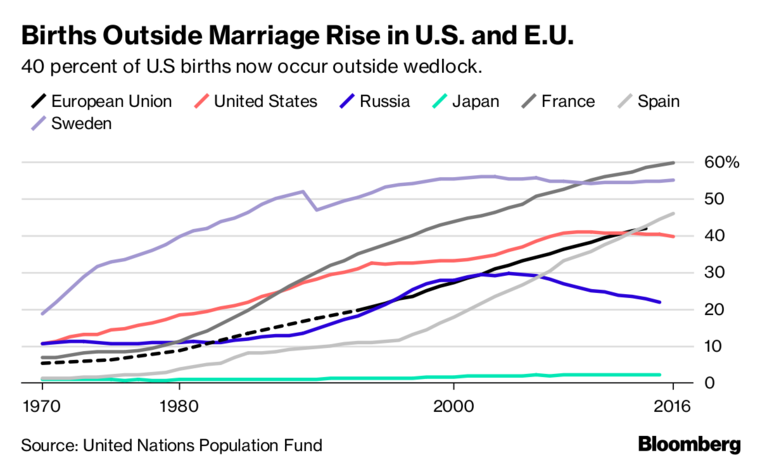
Out-of-wedlocks births rising as cohabitation replaces marriage

It’s getting to be very common for women to have children out of wedlock, especially since many countries increase welfare programs design to encourage single motherhood. That’s because of feminism, which encourages women to ignore the traditional male virtues, like commitment, and tradional commitment itself (because marriage is “sexist”). But do children do well in the fatherless homes created by feminism and welfare?

Here’s a recent study reported in the UK Sun. (H/T Thomas)

Excerpt:

SCIENTISTS have laid the blame for Britain’s childhood obesity epidemic at the door of working mothers, in a new study.

The shocking findings also claim the kids of mums who work are negatively affected – whereas the father’s employment appears to have no “significant effect”.

A study carried out by University College London looked at 20,000 families, and is the first to link mums who work to the weight of their children.

Professor Emla Fitzsimons told The Sunday Times: “We find that children whose mothers work are more likely to have increased sedentary behaviour and poorer dietary habits.”

Researchers said the bizarre findings were more obvious for single mums who work full-time, but also revealed a pattern with mums who work and have a partner.

But the study added it doesn’t matter if mums work full-time or part-time, their child is still more likely to be fatter than that of a non working mum.

It describes obesity as “the most common chronic disease of childhood and likely to persist into adulthood with far-reaching effects”.

And found teens and children have gained weight over the past four decades along with a rise in working mums – with kids of single working mothers 25 per cent more likely to be overweight.

It suggested kids of mums who work full time are 29 per cent less likely to eat a regular breakfast and 19 per cent more likely to watch TV for more than three hours a day.

The UK is one of the countries that most strongly embraced feminism, and sought to encourage fatherlessness with unfair divorce laws, unfair divorce courts, and generous benefits for women who divorced with kids or never bothered to even marry before having kids. It’s common now for UK single mothers to just have sex with the hottest guys they can find, knock out babies with all the different “fathers”, and sit back and collect welfare. Welfare funded by the ever-shrinking supply of working husbands, who typically earn the most, and therefore pay the most in taxes.

But’s not just working SINGLE mothers who have problems.

The UK Daily Mail (reporting on the same study) notes that the increase in obese children mirrors the growth in women working part-time or full-time outside the home:

[…][T]he dramatic increase in the numbers of obese children and teenagers over the past four decades had been accompanied by a similarly sharp rise in the employment of mothers.

In the UK, the proportion of working mothers with children under the age of five rose from 31 per cent in 1980 to 58 per cent in 2008.

The UK prioritized getting women out of the home and working, and handing children off to day cares and public schools. Even the conservative party refused to give women a tax incentive to raise their young children. They gave the tax credit to working mothers instead, encouraging more women to abandon their children for work.

The Root Cause of the Problem

We really need to discourage women from starting up relationships with men who aren’t interested in commitment. When women treat relationships as a source of “fun” instead of as an enterprise aimed at commitment and stability, they often end up raising fatherless kids. The problems begin with the woman’s choice of man, and her purpose for the relationship. If she expects the relationship to be about entertaining her, then she will choose an entertaining man. One who doesn’t expect her to do anything she doesn’t feel like doing, and has no particular plan for her, or raising children well.

Many women today, even Christian women, love to laugh and scorn the idea that there are any “best practices” for relationships. They know everything there is to know – without having to read any studies that might force them to control their desires and make plans to succeed that involve self-denial and wisdom. But if you ignore the studies, you can be certain that you and your children will pay the price. There’s no sense expect hunky fun bad boys to “man up” after you’ve already given them premarital sex. The time to get men to act like a man is when the woman chooses who to have a relationship with. If you choose a MAN, who protects, provides and leads on moral and spiritual issues, then you get a REAL MAN who is already MANNED UP.

The solution to problems like abortion and fatherless children is to encourage young women to make better decisions when choosing men for relationships – and to prioritize marriage as the goal of their relationships, too. It would be nice if pastors preached a little self-control, chastity and anti-feminism to women in churches. So far, though, I’ve never seen it. The Christian church approach to the problems caused by fatherlessness seems to be “let women make poor choices, then tell them it’s not their fault, then blame men”.

Should government get out of the marriage business?

Dr. Jennifer Roback Morse

Here are three articles by Jennifer Roback Morse posted at The Public Discourse. The articles answer the charge from social liberals and libertarians that government should “get the government out of marriage”.

Here’s the first article which talks about how government will still be involved in marriage, even if we get rid of the traditional definition of marriage, because of the need for dispute resolution in private marriage contracts. She uses no-fault divorce as an example showing how it was sold as a way to get government out of the divorce business. But by making divorce easier by making it require no reason, it increased the number of disputes and the need for more government intervention to resolve these disputes.

Here’s the second article which talks about how the government will have to expand to resolve conflicts over decisions about who counts as a parent and who gets parental rights. With traditional marriage, identifying who the parents are is easy. But with private marriage contracts where the parties are not the biological parents, there is a need for the state to step in and assign parental rights. Again, this will require an expansion of government to resolve the disputes.

Here’s the third article which talks about how marriage is necessary in order to defend the needs and rights of the child at a time when they cannot enter into contracts and be parties to legal disputes.

The third article was my favorite, so here is an excerpt from it:

The fact of childhood dependence raises a whole series of questions. How do we get from a position of helpless dependence and complete self-centeredness, to a position of independence and respect for others? Are our views of the child somehow related to the foundations of a free society? And, to ask a question that may sound like heresy to libertarian ears: Do the needs of children place legitimate demands and limitations on the behavior of adults?

I came to the conclusion that a free society needs adults who can control themselves, and who have consciences. A free society needs people who can use their freedom, without bothering other people too much. We need to respect the rights of others, keep our promises, and restrain ourselves from taking advantage of others.

We learn to do these things inside the family, by being in a relationship with our parents. We can see this by looking at attachment- disordered children and failure-to-thrive children from orphanages and foster care. These children have their material needs met, for food, clothing, and medical care. But they are not held, or loved, or looked at. They simply do not develop properly, without mothers and fathers taking personal care of them. Some of them never develop consciences. But a child without a conscience becomes a real problem: this is exactly the type of child who does whatever he can get away with. A free society can’t handle very many people like that, and still function.

In other words I asked, “Do the needs of society place constraints on how we treat children?” But even this analysis still views the child from society’s perspective. It is about time we look at it from the child’s point of view, and ask a different kind of question. What is owed to the child?

Children are entitled to a relationship with both of their parents. They are entitled to know who they are and where they came from. Therefore children have a legitimate interest in the stability of their parents’ union, since that is ordinarily how kids have relationships with both parents. If Mom and Dad are quarreling, or if they live on opposite sides of the country, the child’s connection with one or both of them is seriously impaired.

But children cannot defend their rights themselves. Nor is it adequate to intervene after the fact, after harm already has been done. Children’s relational and identity rights must be protected proactively.

Marriage is society’s institutional structure for protecting these legitimate rights and interests of children.

I recommend taking a look at all three articles and becoming familiar with the arguments in case you have to explain why marriage matters and why we should not change it. I think it is important to read these articles and to be clear that to be a libertarian doctrine does not protect the right of a child to have a relationship with both his or her parents.  Nor does libertarianism promote the idea that parents ought to stick together for their children. Libertarianism means that adults get to do what they want, and no one speaks for the kids.

The purpose of marriage is to make adults make careful commitments, and restrain their desires and feelings, so that children will have a stable environment with their biological parents nearby. We do make exceptions, but we should not celebrate exceptions and we should not subsidize exceptions. It’s not fair to children to have to grow up without a mother or father just so that adults can pursue fun and thrills.