Tag Archives: Discrimination

Wage gap: are women paid less than men because of discrimination?

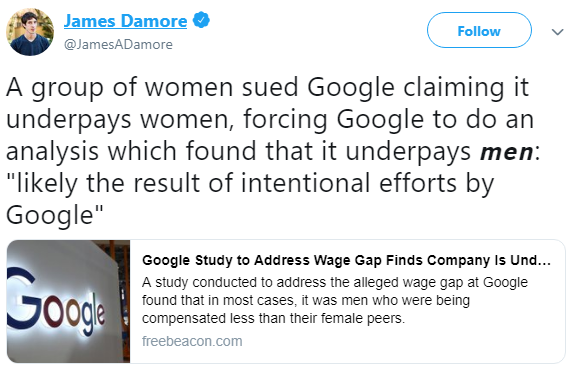
Google pays men less than women
Far-left social media giant Google pays men less than women

Liberal feminist Hanna Rosin takes a look at this question in the far-left Slate, of all places.

Excerpt:

The official Bureau of Labor Department statistics show that the median earnings of full-time female workers is 77 percent of the median earnings of full-time male workers. But that is very different than “77 cents on the dollar for doing the same work as men.” The latter gives the impression that a man and a woman standing next to each other doing the same job for the same number of hours get paid different salaries. That’s not at all the case. “Full time” officially means 35 hours, but men work more hours than women. That’s the first problem: We could be comparing men working 40 hours to women working 35.

How to get a more accurate measure? First, instead of comparing annual wages, start by comparing average weekly wages. This is considered a slightly more accurate measure because it eliminates variables like time off during the year or annual bonuses (and yes, men get higher bonuses, but let’s shelve that for a moment in our quest for a pure wage gap number). By this measure, women earn 81 percent of what men earn, although it varies widely by race. African-American women, for example, earn 94 percent of what African-American men earn in a typical week. Then, when you restrict the comparison to men and women working 40 hours a week, the gap narrows to 87 percent.

But we’re still not close to measuring women “doing the same work as men.” For that, we’d have to adjust for many other factors that go into determining salary. Economists Francine Blau and Lawrence Kahn did that in a recent paper, “The Gender Pay Gap.”.”They first accounted for education and experience. That didn’t shift the gap very much, because women generally have at least as much and usually more education than men, and since the 1980s they have been gaining the experience. The fact that men are more likely to be in unions and have their salaries protected accounts for about 4 percent of the gap. The big differences are in occupation and industry. Women congregate in different professions than men do, and the largely male professions tend to be higher-paying. If you account for those differences, and then compare a woman and a man doing the same job, the pay gap narrows to 91 percent. So, you could accurately say in that Obama ad that, “women get paid 91 cents on the dollar for doing the same work as men.”

I believe that the remainder of the gap can be accounted for by looking at other voluntary factors that differentiate men and women.

The Heritage Foundation says that a recent study puts the number at 95 cents per dollar.

Excerpt:

Women are more likely than men to work in industries with more flexible schedules. Women are also more likely to spend time outside the labor force to care for children. These choices have benefits, but they also reduce pay—for both men and women. When economists control for such factors, they find the gender gap largely disappears.

A 2009 study commissioned by the Department of Labor found that after controlling for occupation, experience, and other choices, women earn 95 percent as much as men do. In 2005, June O’Neil, the former director of the Congressional Budget Office, found that “There is no gender gap in wages among men and women with similar family roles.” Different choices—not discrimination—account for different employment and wage outcomes.

A popular article by Carrie Lukas in the Wall Street Journal agrees.

Excerpt:

The Department of Labor’s Time Use survey shows that full-time working women spend an average of 8.01 hours per day on the job, compared to 8.75 hours for full-time working men. One would expect that someone who works 9% more would also earn more. This one fact alone accounts for more than a third of the wage gap.

[…]Recent studies have shown that the wage gap shrinks—or even reverses—when relevant factors are taken into account and comparisons are made between men and women in similar circumstances. In a 2010 study of single, childless urban workers between the ages of 22 and 30, the research firm Reach Advisors found that women earned an average of 8% more than their male counterparts. Given that women are outpacing men in educational attainment, and that our economy is increasingly geared toward knowledge-based jobs, it makes sense that women’s earnings are going up compared to men’s.

When women make different choices about education and labor that are more like what men choose, they earn just as much or more than men.
Boys underperform at school because feminists block attempts to help them

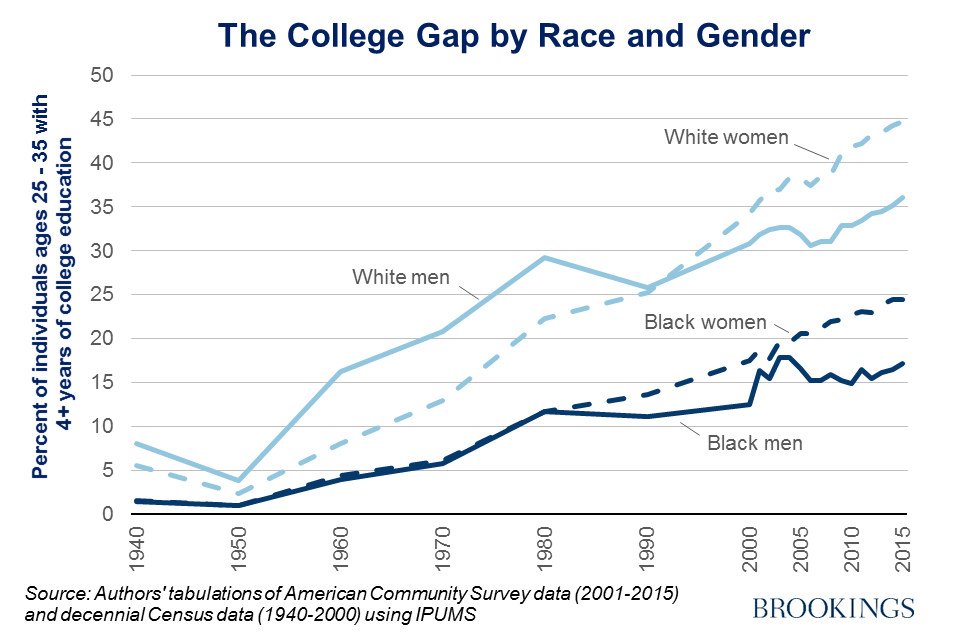
College graduation rates for men and women
College graduation rates for men and women (Source: Brookings Institute)

Britain is a country that is absolutely dominated by radical feminists. And it affects everything from their collectivist views on economic policy, to their pro-criminal views in the justice system, to their open-borders views on immigration, their preference for government-run healthcare, their hatred of self-defense, and so on. So, I wouldn’t expect to see an article about the plight of boys in a feminist society published in a British newspaper.

Nevertheless, here is an article from the UK Telegraph that explains how the public schools are handling the problem of underperforming boys.

It says:

Britain’s education system is failing to tackle the “astonishing” underperformance of boys as feminists have made the topic “taboo”, the former head of the university admissions service has warned.

Mary Curnock Cook, who was chief executive of Ucas until last year, said the fact that boys are falling behind in education is a national scandal – yet it is such an “unfashionable” topic to discuss that it has become “normalised”.

Girls outperform boys in all aspects of education, from primary school to GCSEs and A-level results. Last year, 57 per cent of women went to university compared to 43 per cent of men, a gap that has widened significantly over the last decade.

[…]Ms Curnock Cook said that the debate about gender equality tends to be dominated by issues such as the gender pay gap and the glass ceiling.

“But those are work issues, not education issues,” she said. “Quite often initiatives to support men do meet derision from feminists.”

When attempts are made to address men’s issues, they are ridiculed and are met with the “wrath” of feminist and gender equality groups, she said.

Last month the only university in the UK with a men’s officer scrapped the role after the candidate withdrew due to “harassment”.

But, it’s happening in America as well.

An article from 2013 appeared in the far-left The Atlantic. It explains how the school system punishes boys and favors girls – from kindergarten to the workplace, where women receive affirmative action preferences.

Excerpt:

Boys in all ethnic groups and social classes are far less likely than their sisters to feel connected to school, to earn good grades, or to have high academic aspirations. A recent working paper from the National Bureau of Economic Research documents a remarkable trend among high-achieving students: In the 1980s, nearly the same number of top male and female high school students said they planned to pursue a postgraduate degree (13 percent of boys and 15 percent of girls). By the 2000s, 27 percent of girls expressed that ambition, compared with 16 percent of boys. During the same period, the gap between girls and boys earning mostly A’s nearly doubled—from three to five percentage points.

This gap in education engagement has dire economic consequences for boys. A 2011 Brookings Institution report quantifies the economic decline of the median male: For men ages 25 to 64 with no high school diploma, median annual earnings have declined 66 percent since 1969; for men with only a high school diploma, wages declined by 47 percent. Millions of male workers, say the Brookings authors, have been “unhitched from the engine of growth.”  The College Board delivered this disturbing message in a 2011 report about Hispanic and African-American boys and young adults: “Nearly half of young men of color age 15 to 24 who graduate from high school will end up unemployed, incarcerated or dead.” Working-class white boys are faring only slightly better. When economist Andrew Sum and his colleagues at the Center for Labor Market Studies at Northeastern University examined gender disparities in the Boston Public Schools, they found that for the class of 2007, among blacks and Hispanics, there were 186 females for every 100 males attending a four-year college or university. For white students: 153 females to every 100 males.

Just like in the UK, American feminists oppose doing anything to help boys:

In the U.S., a powerful network of women’s groups works ceaselessly to protect and promote what it sees as female interest. But there is no counterpart working for boys—they are on their own.

Previously, I blogged about a study showing that female teachers grade boys lower than girls.

It’s important for parents to understand that the problem of boys underperforming in school and work is not caused by boys. It’s not with video games, it’s not with sports, or anything else that anti-male people might blame. The problem with boys not learning and boys not working is caused by an education system dominated by anti-male feminists who systematically discriminate against boys, making it harder for them to learn the skills they need to find work.

The problem isn’t going to be fixed by airhead feminist pastors and other male “leaders” telling boys to “man up”. The problem is going to be fixed when parents realize that radical feminism is hostile to boys, and that institutions that are dominated by radical feminism are damaging to boys. I have a Jewish friend named Ari who homeschools all his children. He spends a lot of time and effort on this. He told me that sending boys to public schools is child abuse. I used to laugh at him when he said that. What a funny exaggeration, I thought. Now I’m not so sure he was joking.

Conservative mothers reflect on what frivolous accusations mean for their son’s futures

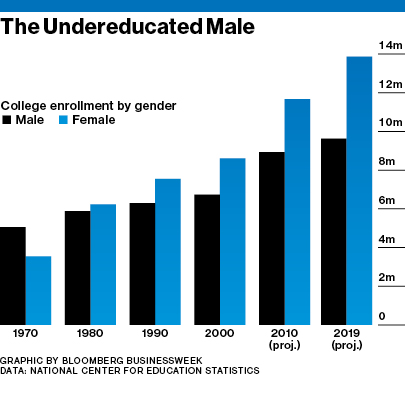
Boys are enrolling in university at a much lower rate than girls

Yesterday, I blogged about Megan Fox, a conservative mother of a son, who had some advice for young men who want to make a difference. She advised them to treat women and sex in accordance with Christian values, to document situations that could be misconstrued later, to live their lives as if they would one day be in a position of influence, and to remember that women “lie and scheme”, especially young, unmarried women.

I noticed that she linked to another article on PJ Media, by another mother of two boys named Sarah Hoyt. Sarah’s article is called “When Every Boy Is Guilty, Every Girl Becomes a Monster”.

She writes:

Let me tell you about my experience with Colorado Springs area public schools while raising two boys:

In Manitou Springs, in first grade, my older son started making poems to girls.

[…]I got a phone call saying he was sexually harassing a girl. Since at 6 he didn’t know how to spell “harassment” and would be uncertain on the meaning of “sexual” (both boys were far less curious than I was at their ages) I begged leave to differ, marched down to the school like the wrath of mom and demanded proof. At which point I was given a very bad, rather innocent poem. I mean the boy didn’t even say he wanted to kiss her. Just that she was pretty and her eyes were like stars.

Writing poems to a girl is harassment, because the boy is 6 years old.

But that’s not all, there’s more:

Next came elementary school in Colorado Springs. Younger son (slower developing than his brother, and at that time completely unaware of the difference in “vive la difference.”) was in third grade.

[…]Apparently, my son had a little friend who happened to be a girl. He was trying to get her attention so they could play the “space game”… There were other kids in the way, and she couldn’t hear him shout. So he reached – through the other kids – and touched her three times.

At which point, all hell broke loose.

Apparently a playground guard thought this girl was “very pretty” and “all the little boys were interested in her” (yes, third grade. Is anyone else getting a creepy vibe?), so when younger son touched her “on the butt” (playground guard’s version) the playground guard KNEW what she had to do.

She descended upon the kids, whisked the little girl to counseling and the little boy to the principal’s office to be threatened with suspension and the police.

I asked my son, right there, in front of all of them, what he’d confessed to.

He said they’d told him touching someone on the butt was sexual harassment so he’d confessed to that.

The child had no idea what sexual harassment even was, but the female playground guard was sure that’s what he had done.  Public schools are 80%+ female teachers and administrators, most of whom have non-STEM degrees and little to no private sector work experience. Are you really going to hand your boys to them? You better come up with a better plan than that if you want your boys to have an influence.

Here’s another article from The Federalist, written by Melissa Danford, a homeschooling mother of four boys.

She writes:

I cannot accept a world in which my sons will be raised under the tyranny of a lawless, vindictive society that wants to subdue and oppress men in the name of equality for women. It’s time to take a stand. Mammas, we have to fight for our men, because they are in danger. My father is, my husband is, and my sons are. Your father is, your husband is, and your sons are. This madness will consume them all.

It would be nice if her views were widespread, but they are not. The Wall Street Journal reports on a recent poll:

By 3 percentage points, men want Republicans rather than Democrats to control Congress, 47% to 44%. Women, by contrast, favor Democratic control by 25 percentage points — 58% to 33%. Among white voters, the gender disparity was the largest since 2008.

I blogged previously about how 77% of young, unmarried women supported Barack Obama in 2008. Women support abortion, gay marriage, and big government in larger numbers than men.

Why do young, unmarried women favor big government? In my experience young, unmarried women struggle with moral rules. They feel that they are exempt from cause and effect, because they are special. They want to do whatever they feel like doing “in the moment”, e.g. – getting drunk and having premarital sex with hot bad boys for fun. And they don’t want to be judged for it, or lose out on anything good further down the road. This attitude leads them to vote for a big government that will pay for their mistakes, and give them life outcomes equal to the married women who made wiser decisions. Unfortunately for men, we are seeing right now what happens when Democrats are put into positions of power by the votes of these young, unmarried women. Conservative Christian young men hoping to have an influence will always have to be watching their backs for their next accuser.