
Tag Archives: Democrat

Is there such a thing as a pro-life Democrat?

Life News reports on a troubling story.

Excerpt:

Democratic Governor Earl Ray Tomblin, who describes himself as pro-life and campaigned as a pro-life candidate, has vetoed a bill that would ban abortions after 20 weeks of pregnancy.

[…]“West Virginia’s Pain-Capable Fetus Protection Act protects children from abortion beginning at 20 weeks fetal age, based on scientific evidence that by this stage of development the child would experience excruciating pain.  Arizona’s law, as its name implies, focused on protecting the health and safety of the mother,” Balch explained.

[…]The states that have passed Pain-Capable bills include Nebraska, Kansas, Idaho, Oklahoma, Alabama, Georgia, Louisiana, Arkansas, North Dakota, and Texas.  The Pain-Capable Unborn Child Protection Act (H.R. 1797) passed the U.S. House of Representatives on June 18, 2013, by 228-196.  All three members of the West Virginia congressional delegation voted for that bill.

A National Right to Life Committee poll found that 63 percent of Americans, and 70 percent of women, support a ban on post-fetal pain abortion. The same poll also found that American women, by an overwhelming majority of 62-27 percent, would be more likely to vote for lawmakers who support this bill.

Now it seems to me that a ban on abortion after 20 weeks is a no-brainer, sort of like banning sex-selection abortions or banning race-selection abortions. Those are moderate positions that everyone can agree on, and yet this so-called pro-life governor wouldn’t sign the bill. Is that an exception to the way that Democrats usually do business?

Note the first time

But this is not the first time that Democrats have claimed to be pro-life when they actually voted pro-abortion.

Excerpt:

It became apparent on Tuesday that former Congressman Bart Stupak (D-MI) is suffering from a bout of “voter’s remorse.” In March of 2010, he and a coalition of pro-life democrats made an eleventh-hour decision to vote in favor of the Affordable Care Act (ACA), with the justification that an executive order—to be issued by President Obama—would ensure that existing restrictions on federal funding for abortion would apply to the ACA.

What a difference nearly 2 ½ years makes. Mr. Stupak, who in March 2010 expressed unwavering confidence in the “‘ironclad’ commitment” he received “from the president that no taxpayer dollars will be used to pay for abortions,” is now singing a different tune about the ACA, or at least its implementation.

In a Democrats for Life panel during the Democratic National Convention, Stupak expressed his disapproval of the “HHS mandate,” which requires most private insurance plans to cover life-ending drugs and devices, and requires nearly all employers to offer (and pay for) the plans to their employees or pay a stiff penalty.

Mr. Stupak remarked, “I am perplexed and disappointed that, having negotiated the Executive Order with the President, not only does that HHS mandate violate the Executive Order but it also violates statutory law . . . . I think it is illegal.”

Similarly, in November of 2011 former Congresswoman Kathy Dahlkemper (D-PA), a member of Stupak’s coalition, claimed that she “would have never voted for the final version of the bill if [she] expected the Obama Administration to force Catholic hospitals and Catholic Colleges and Universities to pay for contraception.” She argued that she and her colleagues “worked hard to prevent abortion funding in health care and to include clear conscience protections for those with moral objections to abortion and contraceptive devices that cause abortion.”

Bart’s “perplexed and disappointed”. He said that in September 2012. Before the election.

But after the election, in 2013, he said that he “did not regret” his vote for the abortion mandate in Obamacare.

So the moral of this story is simple. If you don’t like killing unborn babies, and you don’t want it on your conscience, don’t vote for so-called “pro-life” Democrats. They campaign pro-life and then vote pro-abortion.
Democrats in California want to pass laws to penalize Asians

Basically, the Democrats in California want to pass an affirmative action bill, which would penalize overachievers. Asians tend to outperform other races in academics, so they are always the losers when academic criteria are minimized in favor of racial criteria for college admissions.

Here’s an article from National Review, sent to me by Letitia.

Excerpt:

The California state legislature was on the verge of approving a referendum to restore the consideration of race and ethnicity in admissions to state universities.

[…]What both sides of the bimodal Asian immigration population have in common is that their children do uncommonly well in school. They are represented in California’s much-admired universities in far larger numbers than their share of the population would suggest: Asians compose 14 percent of California’s population but 37 percent of the undergraduates at its state universities. They make up about 40 percent of the students at UCLA, 43 percent of the students at Berkeley, half the students at UC San Diego, and more than half of the students at UC Irvine. A relatively small minority, they compose the largest single ethnic group on California university campuses (at least as California defines “ethnic group”).

[…]Liberals talk a great deal of mindless rot about what they like to call “privilege,” the supposedly omnipresent advantages that accrue to the white, the male, the heterosexual, those whose sense of self is more or less congruent with their biological genitals, etc. But it is worth keeping in mind that progressive social-engineering programs such as the use of racial criteria in university admissions do not hurt only hurt well-off white people sporting penises. (Not that we should shortchange the interests of well-off white penis-sporters.) They also hurt poor people and immigrants, in this case a group of immigrants that we as a country should count ourselves lucky to have. It is important to remember why race-based admissions are such an important issue for progressives: The Left lives in the public schools, which do a terrible job of teaching black, Hispanic, and poor students, who consequently show up in embarrassingly small proportions at elite institutions. Asian students, on the other hand, do a tremendous amount of work outside of school, spending ten times as much time as non-Asian students do on organized non-school activities ranging from music lessons to tutoring to test-preparation courses. That is true across the economic spectrum: Working-class Asian immigrant families in Queens send their children to tutoring sessions and piano lessons at a much higher rate than does the non-Asian population, even though the relative financial sacrifices necessary for them to do so are heavy.

For that, California’s professional race hustlers, and their allies across the country, would see them punished.

So, here is another case where the party that talks a lot about racism and race is actually the one that is opposed to Asians getting ahead. My view is that if Asians have the strong families that produce high achievers, then let them be 40% of the students at the university. Maybe then people of other races will get the message that they need to focus more on raising children who can compete. Follow the rules and you won’t be poor: finish high school, get jobs, get married, have children, don’t get divorced. If you follow those rules, you will not be poor, and your children will outperform you.

Americans using student loans to pay for living expenses

Student Loan Bubble
Student Loan Bubble

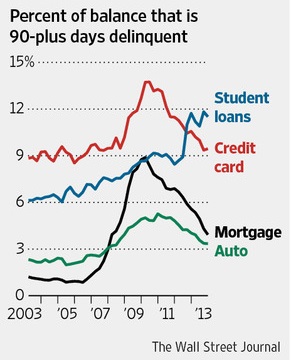
The Wall Street Journal reports on the $1.1 trillion of student loan debt.

Excerpt:

Some Americans caught in the weak job market are lining up for federal student aid, not for education that boosts their employment prospects but for the chance to take out low-cost loans, sometimes with little intention of getting a degree.

[…]A number of factors are behind the growth in student debt. The soft jobs recovery and the emphasis on education have driven people to attain more schooling. But borrowing thousands in low-rate student loans—which cover tuition, textbooks and a vague category known as living expenses, a figure determined by each individual school—also can be easier than getting a bank loan. The government performs no credit checks for most student loans.

College officials and federal watchdogs can’t say exactly how much of the U.S.’s swelling $1.1 trillion in student-loan debt has gone to living expenses. But data and government reports indicate the phenomenon is real. The Education Department’s inspector general warned last month that the rise of online education has led more students to borrow excessively for personal expenses. Its report said that among online programs at eight universities and colleges, non-education expenses such as rent, transportation and “miscellaneous” items made up more than half the costs covered by student aid.

The report also found the schools disbursed an average of $5,285 in loans each to more than 42,000 students who didn’t log any credits at the time. The report pointed to possible factors such as fraud in addition to cases of people enrolling without serious intentions of getting a degree.

Capella Education Co., which runs online schools, examined student costs and debt at institutions— public and private —in Minnesota and concluded that between a quarter and three-quarters of loans taken out by students were for non-education expenses. At one of Capella’s master’s programs, the typical graduate left with about $30,200 in student debt even though tuition, fees and book costs totaled roughly $18,800. Borrowers are prohibited under federal law, except in rare instances, from discharging student debt through bankruptcy.

The share of student borrowers taking out the maximum amount of loans—$12,500 a year for undergraduates—has risen since the recession. In the 2011-12 academic year, federal Education Department data show, 68% of all undergraduate borrowers hit the annual loan ceiling, up from 60% in 2008.

Research suggests a fair chunk of that is going to non-education expenses. In 2011-12, about a quarter of student borrowers took out loans that exceeded their tuition, after grants, by $2,500, according to research by Mark Kantrowitz, a higher-education analyst and publisher of the education site Edvisors.com.

Some students say they intend to get a degree but must borrow as much as possible because they can’t find decent-paying jobs to cover day-to-day expenses.

Here are some examples of how this is working out:

Tommie Matherne, a 32-year-old married father of five in Billings, Mont., has been going to school since 2010, when he realized the $10 an hour he was making as a mall security guard wasn’t covering his family’s expenses. He uses roughly $2,000 in student loans each year to stock his fridge and catch up on bills. His wife is a stay-at-home mother who also gets loans to take online courses.

“We’ve been taking whatever we can for student loans every year, taking whatever we have left over and using it to stock up the freezer just so we have a couple extra months where we don’t have to worry about food,” says Mr. Matherne, who owes $51,600 in federal loans.

Some students end up going deeper into debt. Early last year, when Denna Merritt lost her long-term unemployment benefits, the 49-year-old Indianapolis woman enrolled part-time at the Art Institute of Pittsburgh’s online program, aiming for a degree in graphic design. She took out $15,000 in federal loans, $2,800 of which went to catch up on unpaid bills, including utilities, health-insurance premiums and cable.

Mr. Selent, of Fort Lauderdale, knows he is getting himself deeper in a hole but prefers that to the alternative of making minimum wage. In his 20s, he earned a bachelor’s degree in communications from a local for-profit school but couldn’t find a job in the field after graduating and began falling behind on his student-loan bills. He is now taking courses for a degree in theater so he can become an actor.

Meanwhile, federal loans allow him to cover any needs that arise during the semester. Says Mr. Selent: “It keeps me from falling apart.”

Wow. Communications and Theatre. Do you think a private bank would have given him money to do a degree in theater? I don’t think so. A private banker might give a loan to someone trying to get a STEM degree, like computer science or nursing, but not for theater. So how did the theater major get the loan, then, if no sane private sector banker would give it to him?

This article from the Heritage Foundation think tank explains how he got the money.

Excerpt:

The Obama Administration’s overreach into the student loan industry has been wide-sweeping. In what The Wall Street Journal deemed “that other government takeover,” a provision buried deep in Obamacare effectively nationalized the student loan industry by ending government subsidies to private lenders and putting the federal government in charge of originating and servicing federally backed student loans.

The Obamacare provision came in addition to the Administration’s decision in 2011—made through executive order—to forgive student loan debt after 20 years. And it comes in addition to the Administration’s gainful employment regulations restricting access to student loans for students attending for-profit institutions.

But the current debate’s origins are in separate legislation passed in 2007 whereby the federal government set interest rates on student loans artificially low, cutting the rates in half temporarily for four years. Now that the interest rates are set to increase, President Obama is pressing Congress to keep rates low.

So the Democrats are repeating the mortgage lending recession they caused in 2008 by again transferring risk away from private banks and onto the backs of the taxpayers. Anybody can get a loan for anything, whether it be basket-weaving or women’s studies or… theater.

It’s just more vote-buying from the Democrat party

The government is giving away these loans to students, no questions asked, in order to buy their votes. These are the students who cheered when Obama promised that they could stay on their parents’ insurance plans until they were 26. The Democrats get the moocher vote, and the students get their loans forgiven in 20 years. Everybody wins – except that the next generation of Americans gets stuck with the bill for this vote buying scheme.