Tag Archives: College

Is marriage boring? Why are some women bored by marriage?

In this post, when I refer to women, I am referring to young, unmarried women under the age of 35 who have been influenced by feminism to reject goal-directed marriage.

My pastor gave a sermon recently where he talked about 2 Tim 2:3, and he emphasized that in order to be useful for God, you have to be willing to “flee from youthful lusts”.

2 Tim 2:20-23:

20 Now in a large house there are not only gold and silver vessels, but also vessels of wood and of earthenware, and some to honor and some to dishonor.

21 Therefore, if anyone cleanses himself from these things, he will be a vessel for honor, sanctified, useful to the Master, prepared for every good work.

22 Now flee from youthful lusts and pursue righteousness, faith, love and peace, with those who call on the Lord from a pure heart.

23 But refuse foolish and ignorant speculations, knowing that they produce quarrels.

The pastor asked everyone to consider what they were like when they were young, but not to yell it out for everyone to hear. Then he listed out some of the characteristics of youth. They are impractical. They are thrill-seekers. They are self-centered. They want to pursue selfish pleasures. They want to be the center of attention.

My marriage plan is boring

As I was listening to the sermon, it reminded me of my experiences dealing with Christian women in campus clubs and churches. My approach with Christian women was always to lay out my plans, and then explain what I had already done to prepare for those plans, and then ask them to build skills in a mentoring relationship with me, while deciding whether we were compatible for marriage. It’s understood that I am presenting a complementarian plan here, that I would be the leader of the marriage and family. The customer of the marriage would of course be God, and not my wife or I, nor the children.

Let’s just quickly review what I would tell them and see if it’s boring or not.

So here’s the plan:

  1. Influence the church with apologetics (teach apologetics classes, bring in speakers, organize conferences, etc.)
  2. Influence the university with apologetics (support campus clubs, bring in speakers, organize conferences, open house to students, etc.)
  3. Influence the public square (advocate for pro-family policies, lower taxes, smaller government, religious liberty, peace through strength, etc.)
  4. Raise effective and influential children who are excellent students and who are motivated to enter fields that matter and earn PhDs.

And here are some things I learned over the years from presenting this plan to marriage candidates.

Red flags when choosing a candidate

I really recommend that if you are looking for a wife, you should prefer to interview women who did not have a “wild” period of drinking, hooking up and cohabitation with atheists. Chastity really does matter – even if the woman became unchaste as a non-Christian before returning to Christianity, it will affect her ability to trust you, be vulnerable to you, let you lead her, be content with marriage and family, and in some cases to even remain faithful to you. In my experience the damage done from recreational premarital sex is still detectable after the conversion, and the women involved are unable to articulate why what they did was wrong, and what has been lost. In short, they are not remorseful.

Make sure she has done hard things in her life that have taught her that objective reality trumps her feelings and intuitions. You should prefer a woman with a STEM degree or a trade certification, no student loans, a job related to her degree, savings of her own – and someone who is not still living at home at age 30. If you want to put God first in the marriage, then you want to avoid someone who wants to redirect your time and money to fun and thrill-seeking.

You need to find a woman who is not “bored” by the duties and challenges of being a wife and mother. And you need to make sure to stress her with challenges during the courtship to make sure that she understands that marriage is about serving God, not about serving herself. When a woman has made all of her decisions using her emotions, and has achieved nothing, it does not bode well for her ability to make plans, stick to plans and achieve goals. It also does not help her to respect your plans and achievements. She will look at all your strengths (education, profession, savings, Christian influence) and think it is nothing impressive unless she has experienced sacrifice to achieve goals herself.

The main point is that a woman who has never had to do anything hard and achieve goals over the long-term has NO RESPECT for men who have done these things. Respect is what you need in order to lead. And you need to be in the lead in order for the marriage to work.

You want to avoid a woman who complains that home life is boring, that predictability and routine and safety are boring. You want to avoid a woman who disdains the humdrum of day-to-day earning money in an office building and saving money rather than blowing it on expensive things and one-shot thrills. You want to avoid women who rebels just for the sake of rebelling. You want to avoid women who resent anyone who tells them to be prudent, cautious, modest, etc. You want to avoid women who don’t get along with their fathers, who don’t see the value of benevolent authority. You want to avoid women who don’t have a track record of doing the hard work needed to achieve goals (e.g. – women who avoid STEM degrees). You want to prefer a woman who has the desire for achievement in the service of God more than the desire for pleasure or attention. You want to pick someone with a demonstrated ability to care for and nurture others in a goal-directed way, not someone whose relationships are more about getting her needs met.

The perception of “spiritual maturity”

Many Christian women who have been raised in a Christian home, who have prayed, done Bible studies, read A.W. Tozer, listened to sermons, and gone to AWANA and Sunday school have a very warped view of spiritual maturity. What the Christian home and the church teaches young women is that religion should be about their feelings. Private devotional reading and Bible study are much better (in their eyes) than preparing for public debates or sponsoring public lectures at a university. This is the feminized view of spiritual maturity that you find in the church, and this is how many Christian women judge the spiritual maturity of men.

I recommend that you find a woman who has an outward-focused practical view of Christianity and who respects action and results, not private piety and feelings. A great test for “outward-focusedness” in a woman is whether she has ability in evidential apologetics, especially science and to a lesser degree, history. Apologetics has value in Christianity because it is the thing that makes you resistant to suffering and disappointment with God. And the more evidence-based it is, the better. Reading “Signature in the Cell” is millions of times more effective than anything written by people like C.S. Lewis or G.K. Chesterton.

Is marriage primarily about the woman’s happiness?

Here is my list of courting questions that I use to detect women who will be bored by marriage. If you suspect that a woman is more focused on her own happiness than making the marriage count for God, then you just have to ask her these questions. If she gets angry and refuses to answer or learn how to answer them, then she’s self-centered and wants fun and thrills. Move on to the next one.

Understand that some young, unmarried women today who identify as Christian have these fun-seeking, thrill-seeking skeletons in their closets and that it seriously undermines their ability to perform “boring” marriage and parenting roles. Do not listen to them when they say they want to be married “some day” when all they are doing now is seeking pleasure apart from marriage and family as their fertility clock ticks away. Then they don’t really want it. Women say “some day” because they want to present themselves to others a certain way, but some women say that while really just wanting to indulge their emotions, have a good time, and never sacrifice for the future.

Many Christian women tend to draw their their standards for what will make them happy from the culture and from their peers. Whatever they claim to believe on Sunday, their actions the rest of the time are going to be inline with the culture and their peers. So pay attention to their actions, not their words. The words are designed to paint a picture for others to think well of them, but the actions show what their priorities really are.

Why is it so hard to reason with college-educated millenials about spiritual things?

Why is it hard to reason with students?

The first article today is from lesbian feminist Camille Paglia. She is a university professor, but liberal (in the classical sense) in her outlook.

An hour-long interview is posted at Reason, and there’s a transcript.

Camille says:

reason: Clarify what’s the difference between a legitimate gripe and whining?

Paglia: Well, in my point of view, no college administration should be taking any interest whatever in the social lives of the students. None! If a crime’s committed on campus, it should always be reported to the police. I absolutely do not agree with any committees investigating any charge of sexual assault. Either it’s a real crime, or it’s not a real crime. Get the hell out. So you get this expansion of the campus bureaucracy with this Stalinist oversight. But the students have been raised with helicopter parents. They want it. The students of today—they’re utterly uninformed, not necessarily at my school, the art school, I’m talking about the elite schools.

reason: So it’s those kids over at that other school.

Paglia: It’s the grade grubbers, the bright overachievers. I’m not at that kind of school [here at University of the Arts in Philadelphia] . I’m at a school of arts and communication where people already have a vocational trend. To be admitted here, you have to already have demonstrated a vocational aptitude. I’m talking about the Ivy League. Now, I’ve encountered these graduates of Harvard, Yale, the University of Pennsylvania, and Princeton, I’ve encountered them in the media, and people in their 30s now, some of them, their minds are like Jell-O. They know nothing! They’ve not been trained in history. They have absolutely no structure to their minds. Their emotions are unfixed. The banality of contemporary cultural criticism, of academe, the absolute collapse of any kind of intellectual discourse in the U.S. is the result of these colleges, which should have been the best, have produced the finest minds, instead having retracted into caretaking. The whole thing is about approved social positions in a kind of misty, love of humanity without any direct knowledge of history or economics or anthropology.

reason: Maybe the university is not the place where that sort of stuff is happening anymore. So, for instance, you have think tanks that do a lot of economic or policy work. You have popular historians who are not academic. Fiction and poetry, even as there’s been a rise in for decades now of creative writing programs and what not. Nobody looks to the university to be cutting edge on almost anything really, so maybe it’s just that you picked the wrong hors. Maybe you should have followed the campus radicals’ suggestion and not gone into academia?

Paglia: [As a] writer of cultural criticism, I find that I’m happiest when I’m writing for the British press, and I write quite a bit for The Sunday Times magazine in London. I find that the general sense of cultural awareness means that I can have an authentic discourse about ideas with international journalists from Brazil or Germany or Italy or Norway or Canada even—somewhat, but they have a P.C. problem themselves. I can feel the vacuum and the nothingness of American cultural criticism at the present time. It is impossible—any journalist today, an American journalist, you cannot have any kind of deep discussion of ideas.

The students at the Ivy league universities are so insulated from “vocation” (working for money) and so indoctrinated in political correctness, that they cannot have a civil conversation about ideas. All they can do is state their own views, and if you disagree with them, then they call you names then retreat to “safe spaces”, where all unpleasant communication is blocked . They can’t even explain why they hold their own views except they have been taught to believe that all smart people believe them. They are traumatized by dissent, and they are not able to critically assess arguments and evidence.

Here’s a second article by Eleanor Taylor writing in the ultra-leftist New York Times.

She writes:

KATHERINE BYRON, a senior at Brown University and a member of its Sexual Assault Task Force, considers it her duty to make Brown a safe place for rape victims, free from anything that might prompt memories of trauma.

So when she heard last fall that a student group had organized a debate about campus sexual assault between Jessica Valenti, the founder of feministing.com, and Wendy McElroy, a libertarian, and that Ms. McElroy was likely to criticize the term “rape culture,” Ms. Byron was alarmed. “Bringing in a speaker like that could serve to invalidate people’s experiences,” she told me. It could be “damaging.”

Ms. Byron and some fellow task force members secured a meeting with administrators. Not long after, Brown’s president, Christina H. Paxson, announced that the university would hold a simultaneous, competing talk to provide “research and facts” about “the role of culture in sexual assault.” Meanwhile, student volunteers put up posters advertising that a “safe space” would be available for anyone who found the debate too upsetting.

The safe space, Ms. Byron explained, was intended to give people who might find comments “troubling” or “triggering,” a place to recuperate. The room was equipped with cookies, coloring books, bubbles, Play-Doh, calming music, pillows, blankets and a video of frolicking puppies, as well as students and staff members trained to deal with trauma. Emma Hall, a junior, rape survivor and “sexual assault peer educator” who helped set up the room and worked in it during the debate, estimates that a couple of dozen people used it. At one point she went to the lecture hall — it was packed — but after a while, she had to return to the safe space. “I was feeling bombarded by a lot of viewpoints that really go against my dearly and closely held beliefs,” Ms. Hall said.

Safe spaces are an expression of the conviction, increasingly prevalent among college students, that their schools should keep them from being “bombarded” by discomfiting or distressing viewpoints. Think of the safe space as the live-action version of the better-known trigger warning, a notice put on top of a syllabus or an assigned reading to alert students to the presence of potentially disturbing material.

I have had the opportunity to interact with people who went through the college system in non-STEM programs. The combination of binge-drinking, hooking-up, co-habitating, and indoctrination in secular leftist ideologies like feminism, postmodernism, moral relativism really seems to break down their ability to reason calmly with someone who disagrees with them. They become very brittle and defensive when their indoctrinated views are confronted with critical thinking. I think the indoctrinated views were accepted largely because of emotions, intuitions and peer-pressure, so any kind of questioning using reason, evidence, wisdom and experience are met with this fight-or-flight response. People who are wiser and more experienced aren’t allowed to speak in the “safe space”.

There are two ways I see this playing out. On the one hand, any attempt to lead the thinking of an indoctrinated person is going to be met with insults. For example, trying to teach basic economics is going to be called “manipulation”. Or, trying to tell them to that they have an obligation to behave a certain way towards others is going to be dismissed because others have to take “personal responsibility”. These are just smokescreens that cover the fact that indoctrinated millenials cannot be reasoned with, cannot be led, cannot be told to do the right thing. When challenged, they block all communication and retreat to a “safe space” where their similarly indoctrinated friends are there to reassure them. Unfortunately for them, reality has a way of breaking through the illusions in the long run.

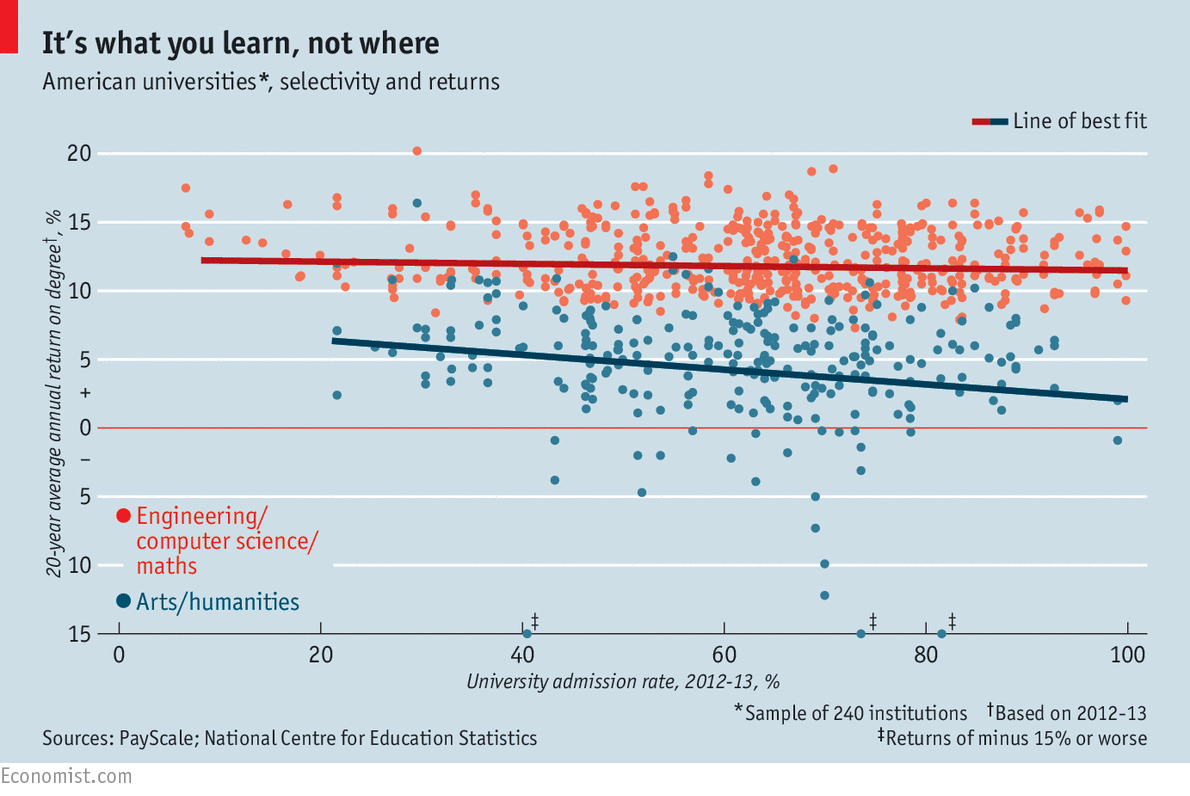
New study: what you study in college matters more than where you go to college

What you study matters more
What you study matters more (click for larger image)

This study was reported by the leftist The Economist.

They write:

A new report from PayScale, a research firm, calculates the returns to a college degree. Its authors compare the career earnings of graduates with the present-day cost of a degree at their alma maters, net of financial aid. College is usually worth it, but not always, it transpires. And what you study matters far more than where you study it.

Engineers and computer scientists do best, earning an impressive 20-year annualised return of 12% on their college fees (the S&P 500 yielded just 7.8%). Engineering graduates from run-of-the-mill colleges do only slightly worse than those from highly selective ones. Business and economics degrees also pay well, delivering a solid 8.7% average return. Courses in the arts or the humanities offer vast spiritual rewards, of course, but less impressive material ones. Some yield negative returns. An arts degree from the Maryland Institute College of Art had a hefty 20-year net negative return of $92,000, for example.

I think if you are looking for a great way to be out of debt before you are 30, it’s a great idea to do your first few years at community college, get rid of all your generic prerequisite courses, then move on to college/university to do your computer science/engineering courses, and then graduate.

Here is the nightmare scenario: you go study a non-stem major at an expensive university, come out with a ton of debt and NO JOB in your field. A much better solution is to go to a less-expensive, less-presitigious school that has a good STEM program in the area you want, and then get in and get out as quickly as possible. Make sure that you either do internships or work in the summer in your field. At this point, you should be willing to pay your employer for letting you work for them, or volunteer – you want to get a company name on your resume, and a name added to your references before you graduate and start looking for a real full-time job. Any pay they give you should be considered a bonus – that’s how important it is to work in your field before graduating. The before-graduation work experience will help you to know what skills are in demand, too – which will improve your course selection. You might even be able to get a mentor from the company you work for to advise you.

The longer you go without working related to your field, the harder it is to be competitive in the job market.  It’s very important to get debt paid off – especially now, because interest rates are going to be rising soon. You definitely want to start investing as soon as possible, so you can use that interest rate in your favor as you head towards retirement. It’s a rocky road ahead with an $18.5 trillion debt, a demographic challenge from the large number of retirees, and the decline of marriage and family. It makes sense to focus on financial issues as early as possible, and have a good plan.