Tag Archives: Church

If you accept Jesus and become a Christian, will God make you happy?

Navy SEAL Matthew "Axe" Axelson
Navy SEAL Matthew “Axe” Axelson

This is a wonderful, wonderful post from Amy Hall, who writes for the Stand to Reason blog.

She writes:

I had a brief interaction with an atheist on Twitter a couple of weeks ago that unexpectedly turned to the issue of suffering when she said:

You clearly never had a time you were hurt. I don’t mean sick. I don’t mean heart broken. I mean literally a near death experience or rape or abusive relationship…. You can keep floating on a [expletive] cloud thinking Jesus will do everything for you but it’s a lie. What makes you so special?

That surprised me at first because it didn’t seem to have anything to do with the tweet she was responding to, and I was confused as to why she would assume I’d never been through anything traumatic. But then in subsequent tweets, when she revealed she had been raped, it became clear that her trauma had played a central role in her becoming an outspoken, obviously angry “antitheist.” She’s a self-described antitheist now because she thinks Christianity teaches Jesus “will do everything for you” to give you a perfect life, and now she knows that’s a lie. The rape proved her understanding of Christianity false.

So it made sense for her to reason that since I believe Christianity is true, I must still be under the delusion that Jesus is making my life special, which means I obviously never encountered any evil or suffering to shake that delusion.

All right, readers. I don’t want any of you to be thinking that if you become a Christian that these things should be expected to happen:

  • you will feel happy all the time
  • you will be able to sense God’s secret plan for your life through your feelings
  • God’s secret plan for your life will automatically work, even though it’s crazy
  • God will give you a perfect spouse and lots of money without you having to do any work
  • you get permission to do things that that make you happy, even if they are expressly forbidden by the Bible
  • you don’t have to do anything that makes you feel bad (e.g. – go to work), because God wants you to be happy

No! Where do people get this idea that if they convert to Christianity, then God will become their cosmic butler?

Amy has the answer: (emphasis mine)

Hear me, everyone: This is a failure of the church.

A friend of mine who was deeply suffering once said to me that many Christians are in for “an epic letdown” when they realize their preconceived notions about what God is expected to do for us are false. Pastors who preach a life-improvement Jesus are leading people down this precarious path to disillusionment.

If suffering disproves your Christianity, you’ve missed Christianity. The Bible is filled with the suffering of those whom God loves. The central event of the Bible is one of suffering. Love involves suffering. “We know love by this, that He laid down His life for us; and we ought to lay down our lives for the brethren.” That means suffering.

It’s the church. It’s all the singing about happy things and having of happy feelings and happy preaching designed to make us feel good. I would say the comforting devotional reading doesn’t help to make us any tougher or more practical, either. People seem to use Bible study and devotion as a way to artificially create good feelings of happiness, peace and comfort, instead of just doing hard things to serve God. I don’t think it’s a “spiritual” Christian thing to read A. W. Tozer, etc. just so that you can feel comforted and spiritual. That stuff just gives you a false sense of safety about your precarious situation. God’s job is not to prevent you from suffering. In fact, even if you make really smart, practical decisions, you can expect to get creamed anyway.

Please take 15 minutes and read the book of 1 Peter in the New Testament.

Here’s a summary from GotQuestions.org:

Purpose of Writing: 1 Peter is a letter from Peter to the believers who had been dispersed throughout the ancient world and were under intense persecution. If anyone understood persecution, it was Peter. He was beaten, threatened, punished and jailed for preaching the Word of God. He knew what it took to endure without bitterness, without losing hope and in great faith living an obedient, victorious life. This knowledge of living hope in Jesus was the message and Christ’s example was the one to follow.

Brief Summary: Though this time of persecution was desperate, Peter reveals that it was actually a time to rejoice. He says to count it a privilege to suffer for the sake of Christ, as their Savior suffered for them. This letter makes reference to Peter’s personal experiences with Jesus and his sermons from the book of Acts. Peter confirms Satan as the great enemy of every Christian but the assurance of Christ’s future return gives the incentive of hope.

Practical Application: The assurance of eternal life is given to all Christians. One way to identify with Christ is to share in His suffering. To us that would be to endure insults and slurs from those who call us “goodie two shoes” or “holier than thou.” This is so minor compared to what Christ suffered for us on the Cross. Stand up for what you know and believe is right and rejoice when the world and Satan aim to hurt you.

Recently, I blogged about how suffering is compatible with an all-powerful God, so you might want to read that too if you missed it.

Why is it so hard for a working man to provide for a family these days?

Welfare spending
Welfare spending

Here’s my argument which answers the question:

  1. Feminism was behind no-fault divorce.
  2. Making it easier to divorce means that more divorces will occur.
  3. Marital instability causes women to vote for bigger government.
  4. Unmarried women vote mostly for Democrats.

*Please note that I am talking about unmarried (never married, divorced) women throughout this post.

Here’s the evidence for each point.

1. Feminism was behind no-fault divorce, according to this feminist, pro-no-fault-divorce writer.

Excerpt:

Households of 2010 don’t look quite like they did in 1969, when no-fault divorce actually was a controversial topic and these counter-arguments held some weight. The working dad/stay-at-home mom model of the middle class has been replaced by two-parent earner households and a growing number of working mom/stay-at-home dad arrangements. In working poor and impoverished families, the one-parent provider model was never the norm. No-fault divorce seemed scary when it had never before existed, but the truth is that its introduction was long overdue. Feminist groups at the time supported no-fault divorce, as it provided women an escape hatch from desperately unhappy marriages in a society where they were already disadvantaged on almost every level, regardless of their marital status. Imagine an abusive marriage in 1968, when the court-savvy abuser could actually force the victim to stay in the relationship forever. Imagine that now, and you know why domestic violence attorneys are in full support of introducing no-fault divorce to New York. And the judges aren’t the only problem.

Note that the author of this piece thinks that it is not women’s fault that they choose men who they then want to divorce. It’s not the woman’s fault that she is unhappy with the man she courted with and then chose and then made vows to – women need a no-fault escape hatch, and children do fine without fathers.

2. Easier divorces means more divorces.

Abstract:

This paper analyzes a panel of 18 European countries spanning from 1950 to 2003 to examine the extent to which the legal reforms leading to “easier divorce” that took place during the second half of the 20th century have contributed to the increase in divorce rates across Europe. We use a quasi-experimental set-up and exploit the different timing of the reforms in divorce laws across countries. We account for unobserved country-specific factors by introducing country fixed effects, and we include country-specific trends to control for timevarying factors at the country level that may be correlated with divorce rates and divorce laws, such as changing social norms or slow moving demographic trends. We find that the different reforms that “made divorce easier” were followed by significant increases in divorce rates. The effect of no-fault legislation was strong and permanent, while unilateral reforms only had a temporary effect on divorce rates. Overall, we estimate that the legal reforms account for about 20 percent of the increase in divorce rates in Europe between 1960 and 2002.

It seems obvious, but more evidence never hurts. About 70% of divorces are initiated by women, either because they chose to marry the wrong man, or because they are unhappy with the right man.

3. Marital instability causes women to vote for bigger government for security.

Excerpt:

Giving women the right to vote significantly changed American politics from the very beginning. Despite claims to the contrary, the gender gap is not something that has arisen since the 1970s. Suffrage coincided with immediate increases in state government expenditures and revenue, and these effects continued growing as more women took advantage of the franchise. Similar changes occurred at the federal level as female suffrage led to more liberal voting records for the state’s U.S. House and Senate delegations. In the Senate, suffrage changed voting behavior by an amount equal to almost 20 percent of the difference between Republican and Democratic senators. Suffrage also coincided with changes in the probability that prohibition would be enacted and changes in divorce laws.

[…]More work remains to be done on why women vote so differently, but our initial work provides scant evidence that it is due to self-interest arising from their employment by government. The only evidence that we found indicated that the gender gap in part arises from women’s fear that they are being left to raise children on their own (Lott and Kenny 1997). If this result is true, the continued breakdown of the family and higher divorce rates imply growing political conflicts between the sexes. 19

Bigger government must be paid for by higher taxes, of course, which makes it harder for one working man’s income to provide for a family. In fact, feminists wanted men to be displaced as sole-providers. They would prefer that women are “equal” to men, and that means making women get out and work like men. Feminists had every reason to want bigger government and higher taxes to make traditional single-earner families unfeasible financially. They did it for equality.

4. Women are in fact observed to vote for bigger government.

Excerpt:

On Tuesday, the nation made history. It made history in electing the first African American president; it made history in building a bigger margin for the first female Speaker of the House; it made history in delivering the biggest Democratic margin since 1964; it made history in sending a record number of people to the polls and the highest percentage turnout since the 1960 election. Analysts will spend the next few months sifting through the data, trying to figure out what happened and why. Historians will likely spend the next several years and decades studying this election, as well. But one thing is immediately clear. Unmarried women played a pivotal role in making this history and in changing this nation. They delivered a stunning 70 to 29 percent margin to Barack Obama and delivered similarly strong margins in races for Congress and the U.S. Senate. Although unmarried women have voted Democratic consistently since marital status has been was tracked, this election represents the highest margin recorded and a 16-point net gain at the Presidential level from 2004.

In fact, there was a recent (2011) study showing that unmarried women do in fact vote for higher taxes and more government as a substitute for a husband’s provider role.

Abstract:

The last three decades have witnessed the rise of a political gender gap in the United States wherein more women than men favor the Democratic party. We trace this development to the decline in marriage, which we posit has made men richer and women poorer. Data for the United States support this argument. First, there is a strong positive correlation between state divorce prevalence and the political gender gap – higher divorce prevalence reduces support for the Democrats among men but not women. Second, longitudinal data show that following marriage (divorce), women are less (more) likely to support the Democratic party.

What follows from voting Democrat?

Since the Democrats took the House and Senate in 2006, and then the Presidency in 2008, the national debt has more than doubled from about 8 trillion to 20 trillion. A lot of that money was spent in welfare for single mothers, which only makes the women and their fatherless children more dependent on government. Children raised in unmarried home are far less likely to marry themselves, and to be independent of government. Which means that they will vote for bigger government when they start to vote, since they can’t make it through life on their own strength.

If more people vote for Democrats then we will get higher taxes to pay for all the government spending. Higher taxes means that a married man can no longer retain enough of his earnings to support a family. And that means his wife has to work, and that means that his children will learn what the government schools decide they should learn – so that all the children will be equal and think the same (pro-government) thoughts. This should not be controversial, because it is what it is. But if we want to talk about the decline of marriage honestly, then we need to be talking to single women about how they choose men, when they have sex with men, and how they vote at election time. You really can’t have it all.

Do atheists have a lower divorce rate than Christians?

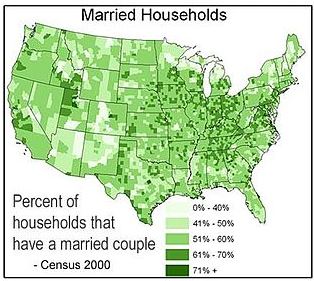
Map of marriage rate by state

Here is an article from USA Today that comments on the notion that atheists have a lower divorce rate than Christians.

Excerpt:

It’s been proclaimed from pulpits and blogs for years — Christians divorce as much as everyone else in America.

But some scholars and family activists are questioning the oft-cited statistics, saying Christians who attend church regularly are more likely to remain wed.

“It’s a useful myth,” said Bradley Wright, a University of Connecticut sociologist who recently wrote “Christians Are Hate-Filled Hypocrites … and Other Lies You’ve Been Told.”

“Because if a pastor wants to preach about how Christians should take their marriages more seriously, he or she can trot out this statistic to get them to listen to him or her.”

The various findings on religion and divorce hinge on what kind of Christians are being discussed.

Wright combed through the General Social Survey, a vast demographic study conducted by the National Opinion Research Center at the University of Chicago, and found that Christians, like adherents of other religions, have a divorce rate of about 42%. The rate among religiously unaffiliated Americans is 50%.

When Wright examined the statistics on evangelicals, he found worship attendance has a big influence on the numbers. Six in 10 evangelicals who never attend had been divorced or separated, compared to just 38% of weekly attendees.

[…]Brad Wilcox, director of the National Marriage Project at the University of Virginia, agrees there’s been some confusion.

“You do hear, both in Christian and non-Christian circles, that Christians are no different from anyone else when it comes to divorce and that is not true if you are focusing on Christians who are regular church attendees,” he said.

Wilcox’s analysis of the National Survey of Families and Households has found that Americans who attend religious services several times a month were about 35% less likely to divorce than those with no religious affiliation.

Nominal conservative Protestants, on the other hand, were 20% more likely to divorce than the religiously unaffiliated.

“There’s something about being a nominal ‘Christian’ that is linked to a lot of negative outcomes when it comes to family life,” Wilcox said.

Here’s a quote from an Oklahoma State University study that confirms the Wright and Wilcox conclusions:

History of Divorce and Religious Involvement

Those who say they are more religious are less likely, not more, to have already experienced divorce. Likewise, those who report more frequent attendance at religious services were significantly less likely to have been divorced. This pattern of findings held using various analytic techniques that test which variables differentiate persons who have been divorced from persons who have not been divorced, while controlling for other variables that might affect the interpretation of the data, such as age, age of first marriage, income, and gender. When both the global rating of religiousness and the item assessing fiequency of attendance at religious services are entered into the same analysis, the attendance item remains significantly associated with divorce history but the global religiousness item does not. This suggests that a key aspect of how religious faith affects marital relationships may be through involvement with a community of faith.

So, please do bookmark this information for the next time you hear an atheist make this argument. Obviously, you can’t expect people who are not serious about their religion to be bound by the moral duties imposed by that religion. People who attend church regularly are probably more serious about their religion, and also probably more informed about what their holy book says. If their holy book is the Bible, then there are few options for divorce.

An article from Focus on the Family by Amy Tracy explains when divorce is allowed according to the Bible.

God is very clear, however, that He hates divorce (Malachi 2:16). He also says, “So they are no longer two, but one. Therefore what God has joined together, let man not separate” (Matthew 19:6). According to the New Testament, there are two justifications for divorce: infidelity (Matthew 5:32) and desertion (1 Corinthians 7:15).

So divorce is not something a Bible believing Christian can do for frivolous reasons, unless he wants to be in rebellion against God.

The future of marriage in the church

In my own case, I learned about chastity and sobriety and courting outside the church, and in my case that means that I am still a virgin, that I don’t drink more than a beer a year, and that when I like a girl, I court her. I do think that people in the church are generally more moral than people outside the church, but that’s more because of convention rather than conviction. I don’t think it’s going to last, in other words. Church is not the place where reasons and evidence are given that help people to resist peer pressure when they enter hostile environments, like the university. And often, parents are too busy working to understand the issues and communicate them to their children.

I’ve never been in a church where they explained the hormones that are released during sex that cause you to bond to the person you’re having sex with. You would have to look in books or listen to lectures in order to understand the problem with having sex with someone you are not committed to – how it causes you to hold back your emotions for fear of a break-up. The church doesn’t have much to say about the social effects of single motherhood by choice or the effects of gay parenting on children. Nor do they have any positive vision to offer men about how they can serve God by marrying carefully.

Christians who participate in a church community will adopt some of these values, especially if they stay clear of popular culture, the university, etc. Especially if they don’t work in a very secular environment, like a high-tech company or in Hollywood. But unless Christian communities get serious about grounding their values in evidence, I wouldn’t expect this situation to go on, and you can already see young people falling away from church in record numbers when they get to university as a result of this refusal to engage. We’re doing well now, but we should move to secure our gains.