Tag Archives: Church

Should Christian men expect a wife / mother candidate to know how to defend the Christian worldview?

C.S. Lewis has some words to live by for you

Over the weekend I debated with Christian feminists about marriage on The Transformed Wife Facebook page. At one point, I asserted that Christian women ought to have some knowledge of how to defend their faith using scientific and historical evidence. Some women asked me: “are you joking?” In this post,  I’ll explain why I’m serious, and then I’ll ask them some questions of my own.

Let’s start with Jesus. Jesus set an example by showing the importance of knowing how to answer questions and challenges from skeptics in the New Testament. His favorite way to answer a challenge was by using evidence to support his truth claims.

So, take this story that’s in Mark 2:1-12, Matthew 9:1-8 and Luke 5:17-26. This story is accepted even by skeptical historians because it’s in three different books, and one of them is early (Mark).

In each version of the story, there are 4 steps:

  1. Jesus forgives the sins of a paralyzed man
  2. The Pharisees say that he doesn’t have authority to forgive sins
  3. Jesus miraculously heals the paralyzed man
  4. Jesus explains the evidence of the healing supports his claim that he has authority to forgive sins

And this is an example that you will find repeated in many places in the life of Jesus. You can see it in the Old Testament as well, where God performs miracles so that people who don’t believe in his existence or respect the Scriptures can still be convinced.

Christian apologetics is the skill of being able to give a defense for the Christian worldview when presented with a challenge from a non-Christian.

So, who has to be ready with a defense?

Look at 1 Peter 3:15-16:

15 But in your hearts revere Christ as Lord. Always be prepared to give an answer to everyone who asks you to give the reason for the hope that you have. But do this with gentleness and respect,

16 keeping a clear conscience, so that those who speak maliciously against your good behavior in Christ may be ashamed of their slander.

This passage applies to every one who claims to be a disciple of Jesus, whether they like to prepare a defense or not. How much work must you put into it? It depends on the sophistication of the challenges you get. In the mountains of Pakistan, you don’t need to know much because there might not be a sophisticated challenge. In an American society filled with college graduates, the challenges are more difficult. So you will need to prepare a lot more, because the challenges will be a lot harder.

Those who take this passage seriously are doing something difficult, and time-consuming, in order to serve Christ. Buying books costs money. Reading books takes time. Debating with non-Christians can make you look bad to others. But the Bible commands us to be ready with answers for the people around us. Sometimes, doing what the Bible says makes us feel bad, or look bad to others. But we have do what the Bible says anyway. Part of being a real Christian is being obedient even if it feels bad or makes you look bad.

William Lane Craig on apologetics and the culture

What’s in an apologetics book?

So, with that said, let’s look at the table of contents of my favorite introduction to Christian apologetics, which is “Is God Just a Human Invention?” written by Sean McDowell and Jonathan Morrow.

In that book, you will find 18 topics.

  1. Is Faith Irrational? (Commentary by: Gregory Koukl)
  2. Are Science and Christianity at Odds? (Commentary by: John Warwick Montgomery)
  3. Are Miracles Possible? (Commentary by: Gary R. Habermas)
  4. Is Darwinian Evolution the Only Game in Town? (Commentary by: William A. Dembski)
  5. How Did the Universe Begin? (Commentary by: R. Douglas Geivett)
  6. How Did Life Begin? (Commentary by: Fazale R. Rana)
  7. Why Is the Universe Just Right for Life? (Commentary by: Jay W. Richards)
  8. Has Science Shown There Is No Soul? (Commentary by: Dale Fincher and Jonalyn Fincher)
  9. Is God Just a Human Invention? (Commentary by: Garry DeWeese)
  10. Is Religion Dangerous? (Commentary by: Douglas Groothuis)
  11. Does God Intend for Us to Keep Slaves? (Commentary by: Paul Copan)
  12. Is Hell a Divine Torture Chamber? (Commentary by: Frank Turek)
  13. Is God a Genocidal Bully? (Commentary by: Clay Jones)
  14. Is Christianity the Cause of Dangerous Sexual Repression? (Commentary by: Kerby Anderson)
  15. Can People Be Good Without God? (Commentary by: Mark D. Linville)
  16. Is Evil Only a Problem for Christians? (Commentary by: Randy Alcorn)
  17. What Good Is Christianity? (Commentary by: Glenn S. Sunshine)
  18. Why Jesus Instead of the Flying Spaghetti Monster? (Commentary by: Darrell L. Bock)

Prominent atheist scholars are quoted in each chapter to introduce the challenges, and then scholarly arguments and evidence are presented to defend the Christian worldview. The language is simple enough, but the material is solid enough to use in a real debate. I would say that introductory books like this one are more than enough to equip you for everyone who will challenge you.

Why are these 18 topics important? Because these are the questions that atheists ask. These are the questions that cause Christians to leave the faith. These are the questions that your children will face in high school and college, which might cause them to leave the faith.

Let’s start with chapter one. One of the most prominent arguments by atheists is that faith is irrational. This chapter allows you to define faith using the Bible’s definition of faith, which relies on logic and evidence.

Atheists also say that Christianity is at war with science. In chapter 2, they discuss the history of science and how Christianity provided the framework that allowed scientific method to take root and flourish.

Atheists like to claim that miracles are impossible. Chapter 3 defends the view that God, if he exists, is capable of interacting with his created world.

Atheists love to put forward Darwinism as means to deny that God is the designer of life. Chapter 4 explains the concept of intelligent design, and why intelligent design is a better explanation for the history of life.

Atheists love to talk about how the universe has always existed, and there’s no need for a Creator. Chapter 5 contains a philosophical argument that is supported by mainstream science to argue that the universe had a beginning, just like the Bible says.

Atheists love to argue that life can emerge from non-life, and the process is simple. Chapter 6 is written by a biochemist, and it takes a look at the real complexity of the simplest living cell.

Atheists like to argue that the universe itself is just an accident, and there is no need for a Designer. Chapter 7 introduces the scientific evidence for fine-tuning and habitability.

Atheists like to say that there is no soul and no afterlife. Chapter 8 gives some arguments for the existence of the soul.

Atheists like to argue that Christians invent God because God makes them feel good. But chapter 9 explains that having an all-powerful God who can hold humans accountable is the last thing any human would want to invent.

Atheists like to talk about how religion, with it’s habit of teaching to believe in things that can’t be tested, causes religious people to do a lot of harm. Chapter 10 takes a look at the real record of Christianity as a force for good in the world.

Atheists like to talk about slavery in the Bible. Chapter 11 talks about what the Bible really says, and provides some rational responses to the accusation.

Atheists like to talk about eternal punishment in Hell isn’t a just punishment for just getting a few questions wrong on a theology exam. Chapter 12 provides an explanation and defense of the concept of Hell.

Atheists love to talk about how God commanded the Israelites to attack their enemies in the Bible. Chapter 13 explains who their enemies really were, and what was really happening in those wars.

Atheists feel that unrestricted sexual activity is very healthy and normal, and that the Biblical prohibitions outside of male-female marriage are repressive and unhealthy.  Chapter 14 explains why God has these rules in place, and supports his rules with evidence.

Atheists love to assert that they don’t need God, because they can behave morally on their own. Chapter 15 explains how to answer this claim by talking about how well atheism grounds objective moral values, objective moral duties, free will and moral accountability: the minimum requirements for objective morality.

Atheists think that the mere existence of natural disasters and human immorality are incompatible with the God of the Bible. Chapter 16 explains why this argument doesn’t work, and why even the concept of evil requires God to exist.

I have an atheist friend in my office who can’t defeat my scientific arguments for the origin of the universe, the fine-tuning and the origin of life. But still, he says to me, even if God exists, why would that matter to my life? Chapter 17 explains what difference Christianity makes in a person’s life.

Atheists think that the life of Jesus has no relevance to their life, and that he has nothing to offer them anyway. Chapter 18 explains the uniqueness of Jesus and explains why his resurrection is relevant to our lives today.

It’s important to understand that this book is not on the level of A. W. Tozer, G.K. Chesterton, Francis Chan, John Piper, etc. Those authors write for a Christian audience and therefore they do not equip you to answer realistic challenges from non-Christians. But the apologetics book we looked at actually equips you to answer challenges from non-Christians using logical arguments and evidence from mainstream history and science. You can use the material in that book in discussions outside the confines of your home and your church.
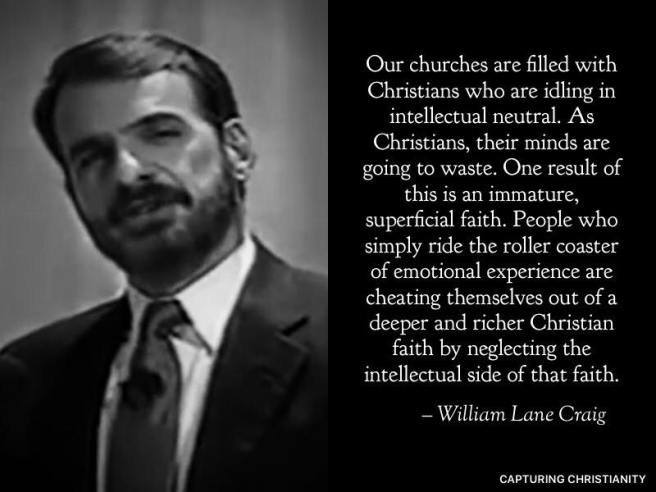
Dr. William Lane Craig says churches aren't preparing Christians to give an answer
Dr. W. L. Craig: churches don’t prepare Christians to answer skeptics

Wife candidates ought to know apologetics

So, back to my original point about how some Christian feminists responded when I said that during courtship, I ask women questions about how much preparation they have done to answer objections from atheists, like the ones answered in this book. Am I joking?

Well, I think the problem is that Christian feminists don’t understand how Christian men view marriage. Christian men are interested in marriage because they think that their marriage will be an enterprise that produces a return for God. They like the idea of having a clean, comfortable home to host debate viewings and discussions over dessert with skeptics. They like the idea of raising children who will be effective and influential. Men don’t see marriage a means of making us feel better, or having fun, or getting our peers to approve of us. We see it as a way to promote Jesus’ agenda in the world. A Christian man loves his wife precisely because she is his partner in serving God.

So, some questions for all the Christian feminists out there. Are you aware of the actual objections that non-Christians have to the Christian worldview? Have you ever put in any effort to prepare to respond to these objections? Have you trained yourself to be calm and persuasive during discussions about Christianity?

Reading devotions or authors like Rachel Hollis, Beth Moore, and Jen Hatmaker won’t teach a Christian woman anything useful about defending the Christian worldview against atheist objections. And those books also won’t teach you how to evaluate a man to see whether he knows how to defend the Christian worldview, either. You have to study apologetics to know how to evaluate how much a candidate for husband and father roles knows about defending his faith. You have to protect yourself from men who lie about being Christians.

Having a rationally-grounded Christian worldview is essential to the roles of wife and mother. A Christian man cannot be confident about the trustworthiness of a Christian woman’s convictions unless she demonstrates her ability to defend those convictions to non-Christians in the ordinary way that she can surely defend other truth claims in areas where she does have the knowledge. If I ask a Christian nurse to defend the claim that germs are real, she will appeal to logic and evidence. I expect her to have put in as much work into defending the claims of Christianity, and to use the same methods: logic and evidence.


How to be an alpha male and signal manliness without being a promiscuous predator

Telling a woman how to make wise decisions protects her

These days, there seems to be a perception that in order to be an alpha male, you have to become a pick-up artist and sleep with a whole bunch of fatherless women, then ghost them (don’t talk to them any more). But as a Christian man, that’s all off-limits to me. Still, my best friend Dina tells me that I am an alpha male, despite being a virgin. How can that be?

In this post, I’m going to lay out three ways for a Christian man to be an alpha male without being a promiscuous predator who preys on vulnerable fatherless girls.

1. Never let a woman override your vision to serve Christ

It can be challenging to project the attitude of aloofness that women associate with strength while still being a good, moral man. One way to do that is to self-sacrificially invest your time, money and effort into some enterprise that benefits Christ. For example, in my case, I’ve invested time in learning apologetics, having a blog as a platform, and giving charity to invest in organizations to do apologetics events. I was pressured from Christian women to “tone it down” for their friends and family. I was also pressured to redirect my attention from apologetics to their need to have a good time (travel, zip-lining, skydiving, surfing were mentioned as good ways to spend my money on them). Alpha males don’t give up their mission in order to get the girl.

It is tempting for a man to let a woman re-focus his time, money and effort on giving her what she wants. If she is his wife, then some of that will be legitimate, just as some government spending is legitimate because it is Constitutional. A man should love his wife, protect her and provide for her. But he should not be distracted for other frivolous priorities that have nothing to do with a Christian marriage plan. Christian women often absorb secular left priorities from the culture, and they expect Christian men to give them what the culture says they ought to want or need, e.g. – putting the kids in daycare and public schools so she can have a career like her non-Christian friends. Alpha males put their own vision above what the secular left culture says they should be doing.

2. Never let a woman disrespect your leadership / mentoring role

It’s important for you to have areas of your life where you actually know what you are talking about, and have demonstrated success at mentoring others. In my case, those areas are education, career and finances. I have invested time in learning what to study. And I achieved a BS and MS in computer science. I have invested time in learning how to interview, what skills to train, and what jobs to take, and how to keep a job. And I achieved a 20-year+ gap-less resume with good companies, using good skills. I have chosen not to borrow money at interest (ever), not to spend money on travel / fun / thrills, and to invest early and often. And I have achieved a six-figure income and will have a 7-figure net worth by my mid-forties. A man needs to have areas like that where he studies and achieves, so that he knows how to advise others, and has a record of successful mentoring.

I sometimes mentor women. Some of them listen to me and some do not. I’ve gotten women to drop their non-STEM majors to study engineering or computer science. I’ve gotten women to stop wasting money on fun and thrills, in order to pay off their debts and start investing and giving to charity. I’ve gotten women to dump hot bad boys who would not commit, and choose commitment-minded men. I’ve gotten women to quit bad jobs in order to take better jobs. In the areas where I have demonstrated competence, I expect women to respect my leadership, even if it makes them feel bad in the short term. Men signal alpha male status when they obtain good results in their mentoring activities.

Also, I’m just going to throw this out there: “spiritual leadership” does not mean telling a woman that God really is speaking to her through her feelings, when she wants to make impulsive, impractical decisions that are likely to result in failure.

3. Never let a woman stop you from expressing your moral convictions

In the 2012 election, most single / unmarried  / divorced women voted pro-abortion and pro-gay-marriage.

Excerpt:

NBC News national exit polling shows that 67 percent of unmarried women said they voted for Obama. That’s in line with the 2008 election, when 70 percent of single women helped usher the president into office. This proves it wasn’t a single-election phenomenon: unmarried women have solidified into a powerful voting force, experts say.

[…]By the way — this isn’t just young women, Maatz pointed out. Many of the single women voters were over 50 — divorced, widowed or never married.

These women voted for a candidate who voted multiple times for infanticide as a state senator in Illinois. Why is this? Well, young unmarried women are more influenced by feelings like compassion. They tend to see themselves as “exempt” from moral standards, because they are constantly told that they are “special”. They tend to see the predictable consequences of poor choices as “unexpected”, causing them to think that people aren’t responsible for their own poor choices. As a result, they tend to be more progressive in their voting, and less Christian in their moral convictions.

A man can signal his alpha male status to women by being bold and persuasive on moral issues (and issues of policy that touch on moral issues). This may not work on all women, but it will work on the ones he should be interested in for wife and mother roles. Men should never just express their feelings about moral issues, or just tell about their experiences. Men ought to go further, and make logical arguments supported by scientific evidence. Instead of sharing “their opinion” (subjective), they ought to press those who disagree to change their minds. It is the studying of arguments and evidence that allows the Christian man to signal alpha male status when these moral issues are debated.

Conclusion

My friend Dina likes to say that the essence of manliness is when a man refuses to let a woman redirect him away from his vision and his moral convictions by using sex, sexual attraction, the promise of sex, or by withholding sex (from her husband). I think men can learn something from her definition. Women are useful as helpers, but we shouldn’t automatically assume that they are wise and virtuous, and give them the authority to rule over us in areas where we ought to lead. Dina also says never to trust women’s words, when deciding whether they will respect your leadership in your vision and moral convictions. Before you marry a woman, you must observe her taking the initiative to perform independent actions that help you with your vision – actions that go against her own feelings and desires. The most important part about being an alpha male is not losing your alpha male status by marrying someone who won’t respect it.

Why don’t men go to church anymore? The decline of male church attendance

Church sucks, that's why men are bored there
Church sucks, that’s why men are bored there

I most recently spent half a year at a PCA church, and then another half a year at a Southern Baptist church. I attended Sunday services as well as Wednesday night Bible study. I am now looking for a new church. For now, I just look around for a sermon I like and listen to that. In this post, I’ll explain why I think men don’t like church.

There are three areas where churches fail to attract men:

    1. Apologetics
    2. Feminism, sex and marriage
    3. Policy and current events

Apologetics

The PCA church discouraged me from becoming a member of the church because they said that conversion to Christianity due to reason and evidence was contrary to their teachings, and a “red flag”. Their words. I didn’t try to fight them on it, because they are Reformed Presbyterian, and this is their actual view. Their approach to apologetics was “pre-suppositional”, which is to say, they try to convince people to become Christians by asking them to assume that the Bible is infallible, without any argumentation or evidence. Naturally, this doesn’t work, so they aren’t trained to answer any serious questions from non-Christians. (1 Pet 3:15-16)

The Reformed Baptist SBC church is led by people like Russell Moore and Al Mohler, who take the “magic words” approach to evangelism. I.e. – they think that people become Christians just by speaking Bible verses out of context to them. So, when the atheist asks “do you have any evidence for God’s existence?” or “do you have any evidence for Jesus’ resurrection?”, their response is to quote Bible verses to the atheist, which have nothing to do with those topics. Christianity has lost so much influence in the culture under their approach, which is not even Biblical. (Mat 12:38–41)

These approaches to evangelism are not used in any other area of human endeavor. No one replies to questions about auto mechanics, or software engineering, or gardening, or cooking, by spouting Bible verses. In literally every other area of human endeavor, the laws of logic and supporting evidence are seen as assets when making claims to know something about the world to someone who disagrees with you.

Feminism, Sex and Marriage

First wave feminism simply asked for women to be given the same liberty and opportunity as men. That was good. But later versions of destroyed all distinctions between men and women. By destroying femininity, feminism directed women away from the traditional life plan of marriage, children and home-making.

Feminism changed how women voted. Today, about 75% of young, unmarried women vote for policies like taxpayer-funded birth control, taxpayer-funded abortion, no-fault divorce, affirmative action for women in schools and in the workplace, taxpayer-funded daycare, public schools, single-mother welfare, social security, etc. These policies and programs raised tax rates, and grew government, making it easier for women to have children without having to choose a marriage-ready man she wasn’t attracted to. Instead, she could choose men she was attracted to, and just use government programs as a substitute provider if it didn’t “work out”. Thanks to feminism, we have a 42% out-of-wedlock birth rate, and it’s rising. Few female college graduates are debt-free. About 5% of women emerge from college as virgins.

Under feminism, the traditional male roles and virtues were deemed “sexist”. Women were shamed for choosing early marriage, large families, and stable men who were good at being husbands and fathers. Instead, women today chose men based on appearance. They spend their 20s and early 30s giving men who will not commit to them premarital sex. The men who are getting sex thrown at them have no interest in Judeo-Christian values, chastity, fidelity, commitment or raising children. Women mistake the men’s willingness to have sex and cohabitate as signs that they are close to marriage. But in fact, chasing the hot bad boys just eats up the chastity, youth and beauty that could have made them interesting to the marriage-minded men they scorned. Later on, they realize that they’ve wasted their 20s on bad boys, but by then they are not attractive for marriage.

What has the response been to feminism from pastors and churches? They accept the anti-male, anti-marriage policies, that came out of feminism. They accept the promiscuity, and the marriage-delaying that came from feminism. Today, pastors just try to bully the men who were passed over to marry the women who had previously rejected them, despite the higher risk of divorce caused by the women’s past behavior.

Policy and current events

Most pastors are anti-intellectual, and they believe that this is a virtue, since they are focused narrowly on what the Bible explicitly says. Because of this, they aren’t able to understand which laws and policies allow Christianity and Christian families to flourish. I agree that what the Bible speaks about is of the highest importance. But we need to understand how to achieve the goals that the Bible states, as well as how to counter the forces that threaten the achievement of those goals.

For example, Christianity thrives when marriage thrives. Christianity is passed on from parents to children. Anything that threatens marriage, or interferes with parental authority, weakens the influence of Christianity. So, policies like higher taxes, no-fault divorce, SOGI laws, all harm the Christian family, while policies like lower taxes, protections for Christian businesses, protection for Christian schools (statements of faith, moral codes), etc. are all good for Christian families. But most pastors never talk about policies or laws, because they don’t think about how to defend the Christian worldview, how to educate Christian children, how to promote marriage, how promote Christian moral values in the public square. Even protecting the right to life of unborn children is ignored.

As the churches lose relevance, it becomes tempting for pastors to accept what the secular left promotes as good and true and beautiful. The big one is pastors pushing for redistribution of wealth by the secular government as a solution to “poverty”, even though the Bible only sanctions voluntary charity. This diminishes the cultural relevance of the church and elevates the secular government. SBC leaders like Russell Moore champion amnesty for refugees and unskilled illegal immigrants, not realizing how it will harm Christian institutions and values down the road to import large numbers of people who will eventually vote for policies like higher taxes, bigger government, etc.