
Tag Archives: Children

Woman raised by two lesbian parents speaks out: I missed my Dad

Heather Barwick
Heather Barwick

This is from The Federalist. Just so you know, the author is a former same-sex marriage advocate.

She writes:

Gay community, I am your daughter. My mom raised me with her same-sex partner back in the ’80s and ’90s. She and my dad were married for a little while. She knew she was gay before they got married, but things were different back then. That’s how I got here. It was complicated as you can imagine. She left him when I was two or three because she wanted a chance to be happy with someone she really loved: a woman.

My dad wasn’t a great guy, and after she left him he didn’t bother coming around anymore.

Do you remember that book, “Heather Has Two Mommies”? That was my life. My mom, her partner, and I lived in a cozy little house in the ‘burbs of a very liberal and open-minded area. Her partner treated me as if I was her own daughter. Along with my mom’s partner, I also inherited her tight-knit community of gay and lesbian friends.

But now she opposes same-sex marriage because it became apparent to her through her own life experience and the experience of having children that children need a mother and father.

She writes:

Growing up, and even into my 20s, I supported and advocated for gay marriage. It’s only with some time and distance from my childhood that I’m able to reflect on my experiences and recognize the long-term consequences that same-sex parenting had on me. And it’s only now, as I watch my children loving and being loved by their father each day, that I can see the beauty and wisdom in traditional marriage and parenting.

Same-sex marriage and parenting withholds either a mother or father from a child while telling him or her that it doesn’t matter. That it’s all the same. But it’s not. A lot of us, a lot of your kids, are hurting. My father’s absence created a huge hole in me, and I ached every day for a dad. I loved my mom’s partner, but another mom could never have replaced the father I lost.

I grew up surrounded by women who said they didn’t need or want a man. Yet, as a little girl, I so desperately wanted a daddy. It is a strange and confusing thing to walk around with this deep-down unquenchable ache for a father, for a man, in a community that says that men are unnecessary. There were times I felt so angry with my dad for not being there for me, and then times I felt angry with myself for even wanting a father to begin with. There are parts of me that still grieve over that loss today.

I’m not saying that you can’t be good parents. You can. I had one of the best. I’m also not saying that being raised by straight parents means everything will turn out okay. We know there are so many different ways that the family unit can break down and cause kids to suffer: divorce, abandonment, infidelity, abuse, death, etc. But by and large, the best and most successful family structure is one in which kids are being raised by both their mother and father.

I recommend reading the whole thing.

Dawn Stefanowicz said similar things about her experience raised by her Dad and his gay partner in this interview posted on MercatorNet. This is mature subject matter.

It says:

MercatorNet: How did you feel about what was going on around you?

Stefanowicz: You become used to it and desensitised. I was told at eight years old not to talk about this but I knew that something was wrong. I was not thinking “this is right or wrong” but I was disturbed by what I was experiencing. I was unhappy, fearful, anxious and confused. I was not allowed to tell my father that his lifestyle upset me. You can be four-years-old and questioning, “Where is Daddy?” You sense women are not valued. You think Daddy doesn’t have time for you or Daddy is too busy to play a game with you. All this is hard because as a child this is the only experience you have.

MercatorNet: How did this affect your relationship with others?

Stefanowicz: I had a hard time concentrating in school on day-to-day subjects and with peers. I felt insecure. I was already stressed out by an early age. I’m now in my 40s. You’re looking at life-long issues. There is a lot of prolonged and unresolved grief in this kind of home environment and with what you witness in the subcultures.

It took me until I was into my 20s and 30s, after making major life choices, to begin to realise how being raised in this environment had affected me. Unfortunately, it was not until my father, his sexual partners and my mother had died, that I was free to speak publicly about my experiences.

And:

MercatorNet: Why do so few children speak out?

Stefanowicz: You’re terrified. Absolutely terrified. Children who open up these family secrets are dependent on parents for everything. You carry the burden that you have to keep secrets. You learn to put on an image publicly of the happy family that is not reality. With same-sex legislation, children are further silenced. They believe there is no safe adult they can go to.

As I’ve written here before there are several completely non-religious reasons to oppose same-sex marriage. But the one that is surely the easiest to understand is that children need a mother and a father, and when they don’t have both they miss having both. In general, children do better with their mom and dad close by as they they are growing up. That’s a very good reason to promote the traditional definition of marriage – one man, one woman, for life. Period. I don’t want to have any part in depriving children of the safety and security of their mothers and fathers. It’s a scary thing to grow up in the world and not have two people who are YOURS. Who are interested in your development, and whose bond to you is irrevocable and undeniable.
Abortion debate: a secular case against legalized abortion

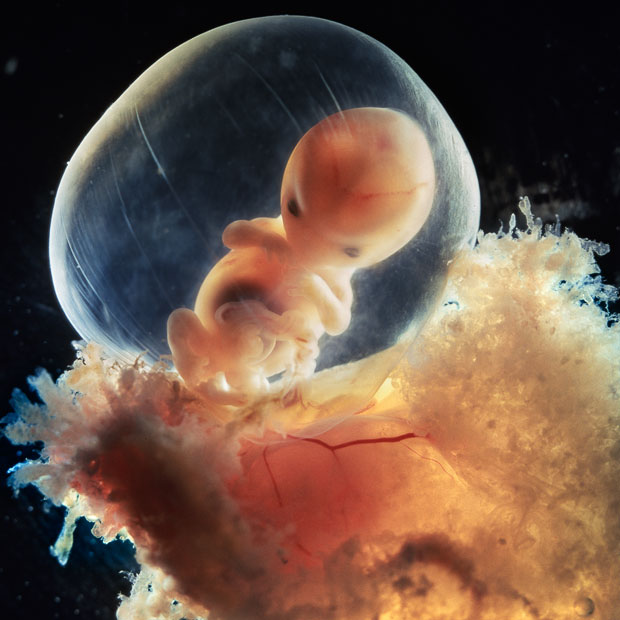
Unborn baby scheming about being only two months old

Note: this post has a twin! Its companion post on a secular case against gay marriage is here.

Now, you may think that the view that the unborn deserve protection during pregnancy is something that you either take on faith or not. But I want to explain how you can make a case for the right to life of the unborn, just by using reason and evidence.

To defend the pro-life position, I think you need to sustain 3 arguments:

  1. The unborn is a living being with human DNA, and is therefore human.
  2. There is no morally-relevant difference between an unborn baby, and one already born.
  3. None of the justifications given for terminating an unborn baby are morally adequate.

Now, the pro-abortion debater may object to point 1, perhaps by claiming that the unborn baby is either not living, or not human, or not distinct from the mother.

Defending point 1: Well, it is pretty obvious that the unborn child is not inanimate matter. It is definitely living and growing through all 9 months of pregnancy. (Click here for a video that shows what a baby looks like through all 9 months of pregnancy). Since it has human DNA, that makes it a human. And its DNA is different from either its mother or father, so it clearly not just a tissue growth of the father or the mother. More on this point at Christian Cadre, here. An unborn child cannot be the woman’s own body, because then the woman would have four arms, four legs, two heads, four eyes and two different DNA signatures. When you have two different human DNA signatures, you have two different humans.

Secondly, the pro-abortion debater may try to identify a characteristic of the unborn that is not yet present or developed while it is still in the womb, and then argue that because the unborn does not have that characteristic, it does not deserve the protection of the law.

Defending point 2: You need to show that the unborn are not different from the already-born in any meaningful way. The main differences between them are: size, level of development, environment and degree of dependence. Once these characteristics are identified, you can explain that none of these differences provide moral justification for terminating a life. For example, babies inside and outside the womb have the same value, because location does not change a human’s intrinsic value.

Additionally, the pro-abortion debater may try to identify a characteristic of the already-born that is not yet present or developed in the unborn, and then argue that because the unborn does not have that characteristic, that it does not deserve protection, (e.g. – sentience). Most of the these objections that you may encounter are refuted in this essay by Francis Beckwith. Usually these objections fall apart because they assume the thing they are trying to prove, namely, that the unborn deserves less protection than the already born.

Finally, the pro-abortion debater may conceded your points 1 and 2, and admit that the unborn is fully human. But they may then try to provide a moral justification for terminating the life of the unborn, regardless.

Defending point 3: I fully grant that it is sometimes justifiable to terminate an innocent human life, if there is a moral justification. Is there such a justification for abortion? One of the best known attempts to justify abortion is Judith Jarvis Thomson’s “violinist” argument. This argument is summarized by Paul Manata, one of the experts over at Triablogue:

Briefly, this argument goes like this: Say a world-famous violinist developed a fatal kidney ailment and the Society of Music Lovers found that only you had the right blood-type to help. So, they therefore have you kidnapped and then attach you to the violinist’s circulatory system so that your kidneys can be used to extract the poison from his. To unplug yourself from the violinist would be to kill him; therefore, pro-lifers would say a person has to stay attached against her will to the violinist for 9 months. Thompson says that it would be morally virtuous to stay plugged-in. But she asks, “Do you have to?” She appeals to our intuitions and answers, “No.”

Manata then goes on to defeat Thomson’s proposal here, with a short, memorable illustration, which I highly recommend that you check out. More info on how to respond to similar arguments is here.

Here is the best book for beginners on the pro-life view.

For those looking for advanced resources, Francis Beckwith, a professor at Baylor University, published the book Defending Life, with Cambridge University Press, 2007.

Large-scale UK study confirms the importance of fathers to children

A family praying and reading the Bible

Dina sent me this article from the UK Daily Mail.

Excerpt:

A father’s love is as important to a child’s emotional development as a mother’s, a large-scale study has confirmed.

Examining the cases of more than 10,000 sons and daughters revealed how a cold or distant father can damage a child’s life, sometimes for decades to come.

The review of 36 studies from around the world concluded that his love is at least as important to youngsters as that of their mothers.

Researcher Professor Ronald Rohner said that fatherly love is key to  development and hopes his findings will motivate more men to become involved in caring for their offspring.

‘In the US, Great Britain and Europe, we have assumed for the past 300 years that all children need for normal healthy development is a loving relationship with their mother,’ he said.

‘And that dads are there as support for the mother and to support the  family financially but are not required for the healthy development of the children.

‘But that belief is fundamentally wrong. We have to start getting away from that idea and realise the dad’s influence is as great, and sometimes greater, than the mother’s.’

His conclusions came after he examined data from studies in which  children and adults were asked how loving their parents were.

Questions included if they were made to feel wanted or needed, if their  parents went out of their way to hurt their feelings and if they felt loved.

Those taking part also answered questions about their personality. These ranged from ‘I think about fighting or being mean’ to ‘I think the world is a good, happy place’.

Tallying the results showed that those rejected in childhood felt more anxious and insecure as well as hostile and aggressive.

Many of the problems carried over into adulthood, reported the study published in the journal Personality and Social Psychology Review.

Crucially, a father’s love was often just as important as a mother’s. In some cases, it was even more so. One reason for this may be that rejection is more painful when it comes from the parent the child regards as more powerful or respected.

You can read more about how fatherlessness damages children here.

I think the first question we should ask the people who want to redefine marriage is this: “which parent to do you think that a child can do without? the mother or the father?”. We must do everything we can as a society to keep both of a child’s natural parents in the home while the child grows up. If we really care about children, then we should prefer to meet their needs, even if the grown-ups have to be a bit more responsible in their decision making. if the conflict is between innocent children and selfish grown-ups, then the children should win.

We need laws and policies that promote traditional marriage, not laws and policies that break it down and destroy it. Repealing no-fault divorce, lowering subsidies for single motherhood, and making shared parenting the default position, would all help solve the problem. Policies like school choice and lower corporate tax rates helps men to be able to perform in their role as provider. We have to be practical and ask: “what makes men capable of marriage and parenting?” If we want strong fathers, then it makes sense to ask how to make fatherhood more reasonable: what do men need in order to do what we want them to do?

Christians should be especially concerned about the presence of fathers, given the evidence I blogged about before showing how the presence of quality fathers is essential for passing Christian beliefs on to children. Churches need to ask themselves tough questions: Are we teaching women how to choose men based on practical concerns and proven abilities in our churches? And are we doing a good job of attracting men to churches by promoting the masculine, practical aspects of Christianity that men like – like science, apologetics debates, economics and foreign policy?