
Tag Archives: Brain

Study: brain of child neglected by mother is smaller and underdeveloped

Dina sent me this article from the UK Daily Mail.

Here is the scan:
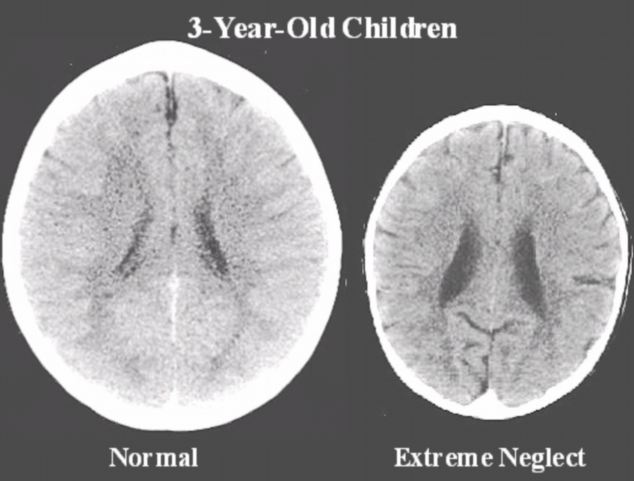
Brain scans of 3-year old children: normal vs neglected

Excerpt:

Both of these images are brain scans of a two three-year-old children, but the brain on the left is considerably larger, has fewer spots and less dark areas, compared to the one on the right.

According to neurologists this sizeable difference has one primary cause – the way each child was treated by their mothers.

The child with the larger and more fully developed brain was looked after by its mother – she was constantly responsive to her baby, reported The Sunday Telegraph.

But the child with the shrunken brain was the victim of severe neglect and abuse.

According to research reported by the newspaper, the brain on the right worryingly lacks some of the most fundamental areas present in the image on the left.

The consequences of these deficits are pronounced – the child on the left with the larger brain will be more intelligent and more likely to develop the social ability to empathise with others.

But in contrast, the child with the shrunken brain will be more likely to become addicted to drugs and involved in violent crimes, much more likely to be unemployed and to be dependent on state benefits.

The child is also more likely to develop mental and other serious health problems.

Professor Allan Schore, of UCLA, told The Sunday Telegraph that if a baby is not treated properly in the first two years of life, it can have a fundamental impact on development.

He pointed out that the genes for several aspects of brain function, including intelligence, cannot function.

[…]The study correlates with research released earlier this year that found that children who are given love and affection from their mothers early in life are smarter with a better ability to learn.

The study by child psychiatrists and neuroscientists at Washington University School of Medicine in St. Louis, found school-aged children whose mothers nurtured them early in life have brains with a larger hippocampus, a key structure important to learning, memory and response to stress.

The research was the first to show that changes in this critical region of children’s brain anatomy are linked to a mother’s nurturing, Neurosciencenews.com reports.

The research is published online in the Proceedings of the National Academy of Sciences Early Edition.

Lead author Joan L. Luby, MD, professor of child psychiatry, said the study reinforces how important nurturing parents are to a child’s development.

I have a very good feminist non-Christian friend who sometimes comments here. I once asked her about marriage and she said that her skills would be wasting on raising children. I explained to her my view that a mother needs to stay at home with the children, and that is more important work. I expect my future wife to read all kinds of books on child care and to give the child attention, nutrition, exercise and play so that the child will grow up to be an effective Christian. Maybe I need to be clear. I am not going to spend hundreds of thousands per child with just any woman. I need a woman who can produce influential and effective Christians who will engage in the public square. And we do not entrust that job to just anyone. Professional women who are willing to be stay-at-home moms in the first five years of each child’s life.

I expect the woman I marry (if I marry) to have a college degree, and preferably a graduate degree, and a couple of years of employment. Then she has to stay home and invest in those children through the first five years at least. After that she can stay home or work as much as she thinks is beneficial to the family goals of impacting the university, the church and the public square – as well as continuing to raise those children. It’s not a waste of her talent to make the next William Lane Craig, the next Marsha Blackburn, the next Doug Axe, or the next Edith Jones. Even if we only aim for those guys and get decent, hard-working Christians who make a difference using apologetics, that would still be something. The main thing is not to be scared to try to achieve something with the family – if you aim at nothing, you always hit it.

UPDATE: I am linking to a relevant post from Lindsay, a Christian mother who has a graduate degree in biology and was teaching biology before leaving her career to care for her children.

New study: patients experience awareness of surroundings after brain ceases to function

Reported in the left-wing UK Independent.

Excerpt:

There is scientific evidence to suggest that life can continue after death, according to the largest ever medical study carried out on the subject.

A team based in the UK has spent the last four years seeking out cardiac arrest patients to analyse their experiences, and found that almost 40 per cent of survivors described having some form of “awareness” at a time when they were declared clinically dead.

Experts currently believe that the brain shuts down within 20 to 30 seconds of the heart stopping beating – and that it is not possible to be aware of anything at all once that has happened.

But scientists in the new study said they heard compelling evidence that patients experienced real events for up to three minutes after this had happened – and could recall them accurately once they had been resuscitated.

Dr Sam Parnia, an assistant professor at the State University of New York and a former research fellow at the University of Southampton who led the research, said that he previously that patients who described near-death experiences were only relating hallucinatory events.

One man, however, gave a “very credible” account of what was going on while doctors and nurses tried to bring him back to life – and says that he felt he was observing his resuscitation from the corner of the room.

Speaking to The Telegraph about the evidence provided by a 57-year-old social worker Southampton, Dr Parnia said: “We know the brain can’t function when the heart has stopped beating.

“But in this case, conscious awareness appears to have continued for up to three minutes.

“The man described everything that had happened in the room, but importantly, he heard two bleeps from a machine that makes a noise at three minute intervals. So we could time how long the experienced lasted for.

“He seemed very credible and everything that he said had happened to him had actually happened.”

Dr Parnia’s study involved 2,060 patients from 15 hospitals in the UK, US and Austria, and has been published in the journal Resuscitation.

Of those who survived, 46 per cent experienced a broad range of mental recollections, nine per cent had experiences compatible with traditional definitions of a near-death experience and two per cent exhibited full awareness with explicit recall of “seeing” and “hearing” events – or out-of-body experiences.

Previously, I blogged about two very reliable examples of near-death experiences, as well as peer-reviewed published work done by UCLA professor Jeffrey Schwartz on “mental effort”. Not to mention philosophical arguments for non-physical minds.

How should we use this evidence? Well, I wouldn’t use it as part of a case for theism, but I think it is useful to show that materialism is clearly false. And that’s before we even get to the cosmological and fine-tuning arguments, which make it even more clear that materialism is false.

William Lane Craig debates Austin Dacey: Does God Exist?

Here is the video and summary of a debate between Christian theist William Lane Craig and Austin Dacey at Purdue University in 2004 about the existence of God.

The debaters:

The video: (2 hours)

The video shows the speakers and powerpoint slides of their arguments. Austin Dacey is one of the top atheist debaters, and I would put him second to Peter Millican alone, with Walter Sinnott-Armstrong in third place. This is the debate to show people who are new to apologetics. The debate with Peter Millican is better for advanced students, and that’s no surprise since he teaches at Oxford University and is familiar with all of Dr. Craig’s work. The Craig-Dacey debate is the one that I give to my co-workers.

By the way, you can get the DVDs and CDs for the first Craig-Dacey debate and the second Craig-Dacey debate and the second Craig-Sinnott-Armstrong debate. The Peter Millican debate is not available on DVD, but the link above (Peter Millican) has the video and my summary.

Dr. Dacey’s 5 arguments below are all good arguments that you find in the academic literature. He is also an effective and engaging speaker, This is a great debate to watch!

SUMMARY of the opening speeches:

Dr. Craig’s opening statement:

Dr. Craig will present six reasons why God exists:

  1. (Contingency argument) God is the best explanation of why something exists rather than nothing
  2. (Cosmological argument)  God’s existence is implied by the origin of the universe
  3. (Fine-tuning argument) The fine-tuning of the universe for intelligent life points to a designer of the cosmos
  4. (Moral argument) God is the best explanation for the existence of objective moral values and objective moral duties
  5. (Miracles argument) The historical facts surrounding the life, death and resurrection of Jesus
  6. (Religious experience) God’s existence is directly knowable even apart from arguments

Dr. Dacey’s opening argument:

There are two ways to disprove God’s existence, by showing that the concept of God is self-contradictory, or by showing that certain facts about ourselves and the world are incompatible with what we would expect to be true if God did exist. Dr. Dacey will focus on the second kind of argument.

  1. The hiddenness of God
  2. The success of science in explaining nature without needing a supernatural agency
  3. The dependence of mind on physical processes in the brain
  4. Naturalistic evolution
  5. The existence of gratuitous / pointless evil and suffering

One final point:

One thing that I have to point out is that Dr. Dacey quotes Brian Greene during the debate to counter Dr. Craig’s cosmological argument. Dr. Craig could not respond because he can’t see the context of the quote. However, Dr. Craig had a rematch with Dr. Dacey where was able to read the context of the quote and defuse Dr. Dacey’s objection. This is what he wrote in his August 2005 newsletter after the re-match:

The following week, I was off an another three-day trip, this time to California State University at Fresno. As part of a week of campus outreach the Veritas Forum scheduled a debate on the existence of God between me and Austin Dacey, whom I had debated last spring at Purdue University. In preparation for the rematch I adopted two strategies: (1) Since Dacey had come to the Purdue debate with prepared speeches, I decided to throw him for a loop by offering a different set of arguments for God, so that his canned objections wouldn’t apply. I chose to focus on the cosmological argument, giving four separate arguments for the beginning of the universe, and on the evidence for Jesus’ resurrection. (2) I reviewed our previous debate carefully, preparing critiques of his five atheistic arguments. In the process I found that he had seriously misunderstood or misrepresented a statement by a scientist on the Big Bang; so I brought along the book itself in case Dacey quoted this source again. I figured he might change his arguments just as I was doing; but I wanted to be ready in case he used his old arguments again.

[…]The auditorium was packed that night for the debate, and I later learned that there were overflow rooms, too. To my surprise Dr. Dacey gave the very same case he had presented at Purdue; so he really got clobbered on those arguments. Because he wasn’t prepared for my new arguments, he didn’t even respond to two of my arguments for the beginning of the universe, though he did a credible job responding to the others. I was pleased when he attacked the Big Bang by quoting the same scientist as before, because I then held up the book, specified the page number, and proceeded to quote the context to show what the scientist really meant.

Dr. Craig is always prepared!