Tag Archives: Blame-Shifting

Frequent denial of sex breaks the marriage covenant as much as adultery

Let’s start this post by quoting a passage from the Bible.

1 Corinthians 7:1-5:

Now concerning the things about which you wrote, it is good for a man not to touch a woman.

But because of immoralities, each man is to have his own wife, and each woman is to have her own husband.

The husband must fulfill his duty to his wife, and likewise also the wife to her husband.

The wife does not have authority over her own body, but the husband does; and likewise also the husband does not have authority over his own body, but the wife does.

Stop depriving one another, except by agreement for a time, so that you may devote yourselves to prayer, and come together again so that Satan will not tempt you because of your lack of self-control.

So with that in mind, I want to turn to a well-known Jewish talk show host named Dennis Prager, who is much loved and listened to by Christians. Dennis Prager features a lot of discussions about male-female relationships on his show, particularly during the male-female hour. In this two part series on male sexuality, he explains why women should not deprive their husbands of sex without a good reason.

Part 1 is here.

Excerpt:

It is an axiom of contemporary marital life that if a wife is not in the mood, she need not have sex with her husband. Here are some arguments why a woman who loves her husband might want to rethink this axiom.

First, women need to recognize how a man understands a wife’s refusal to have sex with him: A husband knows that his wife loves him first and foremost by her willingness to give her body to him. This is rarely the case for women. Few women know their husband loves them because he gives her his body (the idea sounds almost funny). This is, therefore, usually a revelation to a woman. Many women think men’s natures are similar to theirs, and this is so different from a woman’s nature, that few women know this about men unless told about it.

This is a major reason many husbands clam up. A man whose wife frequently denies him sex will first be hurt, then sad, then angry, then quiet. And most men will never tell their wives why they have become quiet and distant. They are afraid to tell their wives. They are often made to feel ashamed of their male sexual nature, and they are humiliated (indeed emasculated) by feeling that they are reduced to having to beg for sex.

When first told this about men, women generally react in one or more of five ways…

He then explains the 5 ways that women respond to this.

Here’s one:

1. You have to be kidding. That certainly isn’t my way of knowing if he loves me. There have to be deeper ways than sex for me to show my husband that I love him.

I think that this is a common mistake that liberal women make because they think that men are just hairy women. But men are not women, we are different and sex means something different to men than it does to women. In the past, most women understood how men are different than women, but younger women have been taught that there are no differences between the sexes. To think any different is “sexism”.

Here’s another from the list:

4. You have it backwards. If he truly loved me, he wouldn’t expect sex when I’m not in the mood.

Again, this is the common mistake that many younger women today make in thinking that love is a one-way street – flowing from men and children to the woman. If men and children DON’T do what the woman wants, or if they make demands on her, then they don’t “love” her and she is justified in ignoring them.

Liberal women have been taught to believe that they are always victims or some group of oppressors, such as men and children or corporations. It makes them rebel against having to do anything for anyone else, because they don’t want to be “oppressed”. That makes them unable to accept that relationships are give-and-take, Once a commitment to love another person permanently has been made, then each person has responsibilities to provide for the needs of the other.

I actually had a conversation with a Christian woman once who said that women should not be obligated to do things that they didn’t feel like doing. I asked her if men were obligated to go to work when they didn’t feel like going. She said yes, and acted as though I were crazy for asking. I just laughed, because she didn’t even see the inconsistency. The truth is that men often don’t feel like working, but they get up and go to work anyway, whether they like it or not (in most cases). Similarly, a women should feel obligated to have sex with her husband, even if she is not in a perfect mood for it (in most cases). Sometimes, a man stays home from work, and it’s OK. And sometimes a woman says no to sex, and it’s OK. But it’s not OK to stop doing it for months and months with no good reason.

Part 2 is here.

Excerpt:

Here are eight reasons for a woman not to allow not being in the mood for sex to determine whether she denies her husband sex.

He then explains the eight reasons.

Here’s one of them:

7. Many contemporary women have an almost exclusively romantic notion of sex: It should always be mutually desired and equally satisfying or one should not engage in it. Therefore, if a couple engages in sexual relations when he wants it and she does not, the act is “dehumanizing” and “mechanical.” Now, ideally, every time a husband and wife have sex, they would equally desire it and equally enjoy it. But, given the different sexual natures of men and women, this cannot always be the case. If it is romance a woman seeks — and she has every reason to seek it — it would help her to realize how much more romantic her husband and her marriage are likely to be if he is not regularly denied sex, even of the non-romantic variety.

Women have to engage their husbands if they expect their husbands to engage in the marriage as a husband and father. Men can’t do their protector, provider and spiritual leader roles forever unless their needs are met at some point. Performance of these male duties is not free. Wives have to love their husbands in the way that men expect to be loved. That’s what they vowed to do in the wedding, isn’t it?

At the end of the article, Prager makes a general point about women that I think needs to be emphasized over and over and over:

That solution is for a wife who loves her husband — if she doesn’t love him, mood is not the problem — to be guided by her mind, not her mood, in deciding whether to deny her husband sex.

This problem of sex-withholding is so widespread, that it really makes me (although I am a virgin) wonder what women think that marriage is about anyway. When a woman vows to love her husband, what do they think that word really means? Why do women think that men marry? What do men want that marriage provides for them? Which of those needs are the women’s responsibility to provide for? I think these are questions that men should ask women. I think women should be prepared to answer them. Men should expect that women be reading books on men and marriage, and that she has relationships with men where she is giving support, respect, affirmation, affection and approval. You can learn a lot about a woman by how she treats her father, for example.

Unfortunately, many men today haven’t thought through what they need from wives in a marriage. They spend their young years chasing women who are fun and sexually permissive. Every husband I asked about what they need has told me that respect, affirmation, affection and regular sex are more important than appearance and fun. Pre-marital sex, having fun, getting drunk, and going out, etc. are not the right foundation for marriage – which requires mutual self-sacrifice in order to work.

Another point: I have a friend who is very concerned that men are breaking sexual rules, but he seems oblivious to 1 Corinthians 7:1-5. I asked him privately what he thought about sex-withholding, and whether this might cause husbands to turn to pornography and even affairs, and I mentioned 1 Corinthians 7:1-5. He said: “no, it’s not something I take much interest in”. I was tempted to ask him if the Bible was something that he does not take much interest in.

I think he misreads 1 Corinthians 7:1-5 so that it could only be used to condemn men. If that were his view, then it actually worries me if well-meaning men are actually undermining marriage, by teaching women that they have no responsibilities to keep the marriage going, and helping them to feel like victims when their marriages fall apart. Sometimes even people who claim to be pro-marriage can undermine marriage practically-speaking, because of their unBiblical belief that women are “naturally good” and should not have any responsibilities in a marriage.

I thought this attitude was so interesting in view of what I read in the Proper Care and Feeding of Husbands. In that book, Dr. Laura urges women to be sensitive to their husbands’ different male natures in order to avoid them looking at pornography and having affairs. Withholding sex from a man is the equivalent of a man withholding conversation to a woman. Sex is how a man feels loved! What’s remarkable is how female callers on her show are shocked that men react badly to being deprived of sex.

I do think that some men will look at porn and cheat regardless of what their wife does sexually, but then it again falls to the woman to choose a man who has demonstrated that he has self-control – i.e., a virgin who has remained chaste with her throughout the courtship and protected her from doing sexual things outside of the covenant context. Chastity is hard, but it is how a man loves his wife self-sacrificially, before he even meets her. It should be a trait much sought after and respected by women. Basically, women need to be led by their minds, not by their feelings, when choosing a husband.

A man has to get up and go to work every day for his family, regardless of whether he feels like it or not. In fact, the many decisions he has made before getting married are also made not because they make him happy, but because he needs to be responsible to his future wife and children. The decision to study science? Loving obligation. The decision to go to grad school in science? Loving obligation. The decision to work in a demanding, risky career? Loving obligation. The decision to save money and eat instant oatmeal for dinner? Loving obligation. Men don’t do these things because we enjoy them. We do it because we love our wives and children self-sacrificially, before we ever even meet them. I think that women need to do the same.
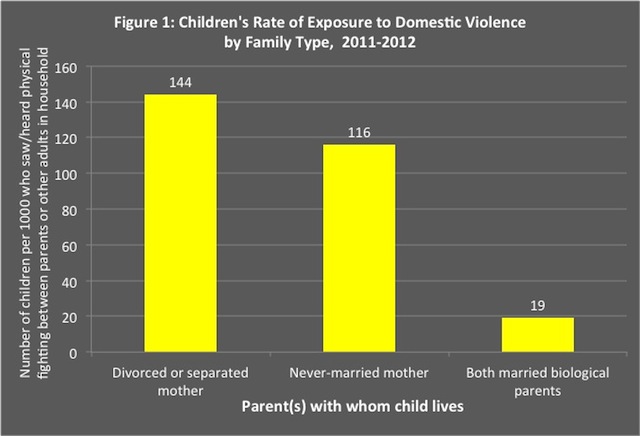
New study: children who grow up with single parents more likely to see domestic violence

Domestic violence least likely in married homes

This is from Family Studies. (H/T Brad Wilcox)

Excerpt:

In the 2011-2012 National Survey of Children’s Health, conducted by the U.S. National Center for Health Statistics, parents of 95,677 children aged 17 and under were asked whether their child had ever seen or heard “any parents, guardians, or any other adults in the home slap, hit, kick, punch, or beat each other up.” Among children living with both married biological parents, the rate of exposure to family violence was relatively low: for every 1,000 children in intact families, 19 had witnessed one or more violent struggles between parents or other household members. By comparison, among children living with a divorced or separated mother, the rate of witnessing domestic violence was seven times higher: 144 children per 1,000 had had one or more such experiences. (See Figure 1.) These comparisons are adjusted for differences across groups in the age, sex, and race/ethnicity of the child, family income and poverty status, and the parent’s education level.

One might suppose that women who had never married would be less likely to get into violent arguments with the fathers of their children than separated or divorced mothers. Yet the rate of witnessing domestic violence among children living with never-married mothers was also elevated. It was 116 per 1,000, six times higher than the rate for children in intact families. (Some of these fights involved subsequent partners or boyfriends of the mother, rather than the father of the child.) Even children living with both biological parents who were cohabiting—rather than married—had more than double the risk of domestic violence exposure as those with married birth parents: 45 out of 1,000 of these children had witnessed family fights that became physical. Note also that a child’s family structure was a better predictor of witnessing family violence than was her parents’ education, family income, poverty status, or race.

Experiencing family violence is stressful for children, undercuts their respect and admiration for parents who engage in abusive behavior, and is associated with increased rates of emotional and behavioral problems at home and in school. For example, among children of never-married mothers who had witnessed family violence, 58 percent had conduct or academic problems at school requiring parental contact. The rate of school behavior problems for those who had not been exposed to family fights was significantly lower, though still fairly high (36 percent). Likewise, among children of divorced or separated mothers, nearly half of those exposed to family violence—48 percent—had had conduct or academic problems at school. Even among the small number of children in intact families who had witnessed family violence, just over half—51 percent—presented problems at school. This was twice the rate of school problems among students from intact families who had not witnessed domestic violence. (See Figure 2.) These figures are also adjusted for differences across groups in age, sex, and race/ethnicity of children, family income and poverty, and parent education levels. Children experiencing domestic violence were also more likely to have repeated a grade in school and to have received psychological counseling for emotional or behavioral problems. This was true in intact as well as disrupted families.

A good book to read on this topic is Theodore Dalrymple’s “Life at the Bottom“, which offered this memorable anecdote about about how and why women choose men who abuse them.

Introduction:

The disastrous pattern of human relationships that exists in the underclass is also becoming common higher up the social scale. With increasing frequency I am consulted by nurses, who for the most part come from and were themselves traditionally members of (at least after Florence Nightingale) the respectable lower middle class, who have illegitimate children by men who first abuse and then abandon them. This abuse and later abandonment is usually all too predictable from the man’s previous history and character; but the nurses who have been treated in this way say they refrained from making a judgment about him because it is wrong to make judgments. But if they do not make a judgment about the man with whom they are going to live and by whom they are going to have a child, about what are they ever going to make a judgment?

“It just didn’t work out,” they say, the “it” in question being the relationship that they conceive of having an existence independent of the two people who form it, and that exerts an influence on their on their lives rather like an astral projection. Life is fate.

Chapter one:

All the more surprising is it to me, therefore, that the nurses perceive things differently. They do not see a man’s violence in his face, his gestures, his deportment, and his bodily adornments, even though they have the same experience of the patients as I. They hear the same stories, they see the same signs, but they do not make the same judgments. What’s more, they seem never to learn; for experience—like chance, in the famous dictum of Louis Pasteur—favors only the mind prepared. And when I guess at a glance that a man is an inveterate wife beater (I use the term “wife” loosely), they are appalled at the harshness of my judgment, even when it proves right once more.

This is not a matter of merely theoretical interest to the nurses, for many of them in their private lives have themselves been the compliant victims of violent men. For example, the lover of one of the senior nurses, an attractive and lively young woman, recently held her at gunpoint and threatened her with death, after having repeatedly blacked her eye during the previous months. I met him once when he came looking for her in the hospital: he was just the kind of ferocious young egotist to whom I would give a wide berth in the broadest daylight.

Why are the nurses so reluctant to come to the most inescapable of conclusions? Their training tells them, quite rightly, that it is their duty to care for everyone without regard for personal merit or deserts; but for them, there is no difference between suspending judgment for certain restricted purposes and making no judgment at all in any circumstances whatsoever. It is as if they were more afraid of passing an adverse verdict on someone than of getting a punch in the face—a likely enough consequence, incidentally, of their failure of discernment. Since it is scarcely possible to recognize a wife beater without inwardly condemning him, it is safer not to recognize him as one in the first place.

This failure of recognition is almost universal among my violently abused women patients, but its function for them is somewhat different from what it is for the nurses. The nurses need to retain a certain positive regard for their patients in order to do their job. But for the abused women, the failure to perceive in advance the violence of their chosen men serves to absolve them of all responsibility for whatever happens thereafter, allowing them to think of themselves as victims alone rather than the victims and accomplices they are. Moreover, it licenses them to obey their impulses and whims, allowing them to suppose that sexual attractiveness is the measure of all things and that prudence in the selection of a male companion is neither possible nor desirable.

Often, their imprudence would be laughable, were it not tragic: many times in my ward I’ve watched liaisons form between an abused female patient and an abusing male patient within half an hour of their striking up an acquaintance. By now, I can often predict the formation of such a liaison—and predict that it will as certainly end in violence as that the sun will rise tomorrow.

At first, of course, my female patients deny that the violence of their men was foreseeable. But when I ask them whether they think I would have recognized it in advance, the great majority—nine out of ten—reply, yes, of course. And when asked how they think I would have done so, they enumerate precisely the factors that would have led me to that conclusion. So their blindness is willful.

The blindness is wilful, because the emotions cannot be corrected by evidence. And everything in the culture affirms women in this craziness, even after they fail over and over again with men – cohabitating with the bad ones for years, and then turning away from the good ones. They freely choose the wrong men, and freely pass by the good ones. And almost no one tells them that it’s entirely their fault. Everyone just tells them “follow your heart”. This emotional craziness causes harm to innocent children, and it needs to stop. We have to stop the man-blaming and hold women accountable for making decisions with their emotions and then expecting craziness to “work out”.

You can read the Dalrymple book online for free in this post.

Frequent denial of sex breaks the marriage covenant as much as adultery

Let’s start this post by quoting a passage from the Bible.

1 Corinthians 7:1-5:

Now concerning the things about which you wrote, it is good for a man not to touch a woman.

But because of immoralities, each man is to have his own wife, and each woman is to have her own husband.

The husband must fulfill his duty to his wife, and likewise also the wife to her husband.

The wife does not have authority over her own body, but the husband does; and likewise also the husband does not have authority over his own body, but the wife does.

Stop depriving one another, except by agreement for a time, so that you may devote yourselves to prayer, and come together again so that Satan will not tempt you because of your lack of self-control.

So with that in mind, I want to turn to a well-known Jewish talk show host named Dennis Prager, who is much loved and listened to by Christians. Dennis Prager features a lot of discussions about male-female relationships on his show, particularly during the male-female hour. In this two part series on male sexuality, he explains why women should not deprive their husbands of sex without a good reason.

Part 1 is here.

Excerpt:

It is an axiom of contemporary marital life that if a wife is not in the mood, she need not have sex with her husband. Here are some arguments why a woman who loves her husband might want to rethink this axiom.

First, women need to recognize how a man understands a wife’s refusal to have sex with him: A husband knows that his wife loves him first and foremost by her willingness to give her body to him. This is rarely the case for women. Few women know their husband loves them because he gives her his body (the idea sounds almost funny). This is, therefore, usually a revelation to a woman. Many women think men’s natures are similar to theirs, and this is so different from a woman’s nature, that few women know this about men unless told about it.

This is a major reason many husbands clam up. A man whose wife frequently denies him sex will first be hurt, then sad, then angry, then quiet. And most men will never tell their wives why they have become quiet and distant. They are afraid to tell their wives. They are often made to feel ashamed of their male sexual nature, and they are humiliated (indeed emasculated) by feeling that they are reduced to having to beg for sex.

When first told this about men, women generally react in one or more of five ways…

He then explains the 5 ways that women respond to this.

Here’s one:

1. You have to be kidding. That certainly isn’t my way of knowing if he loves me. There have to be deeper ways than sex for me to show my husband that I love him.

I think that this is a common mistake that liberal women make because they think that men are just hairy women. But men are not women, we are different and sex means something different to men than it does to women. In the past, most women understood how men are different than women, but younger women have been taught that there are no differences between the sexes. To think any different is “sexism”.

Here’s another from the list:

4. You have it backwards. If he truly loved me, he wouldn’t expect sex when I’m not in the mood.

Again, this is the common mistake that many younger women today make in thinking that love is a one-way street – flowing from men and children to the woman. If men and children DON’T do what the woman wants, or if they make demands on her, then they don’t “love” her and she is justified in ignoring them.

Liberal women have been taught to believe that they are always victims or some group of oppressors, such as men and children or corporations. It makes them rebel against having to do anything for anyone else, because they don’t want to be “oppressed”. That makes them unable to accept that relationships are give-and-take, Once a commitment to love another person permanently has been made, then each person has responsibilities to provide for the needs of the other.

I actually had a conversation with a Christian woman once who said that women should not be obligated to do things that they didn’t feel like doing. I asked her if men were obligated to go to work when they didn’t feel like going. She said yes, and acted as though I were crazy for asking. I just laughed, because she didn’t even see the inconsistency. The truth is that men often don’t feel like working, but they get up and go to work anyway, whether they like it or not (in most cases). Similarly, a women should feel obligated to have sex with her husband, even if she is not in a perfect mood for it (in most cases). Sometimes, a man stays home from work, and it’s OK. And sometimes a woman says no to sex, and it’s OK. But it’s not OK to stop doing it for months and months with no good reason.

Part 2 is here.

Excerpt:

Here are eight reasons for a woman not to allow not being in the mood for sex to determine whether she denies her husband sex.

He then explains the eight reasons.

Here’s one of them:

7. Many contemporary women have an almost exclusively romantic notion of sex: It should always be mutually desired and equally satisfying or one should not engage in it. Therefore, if a couple engages in sexual relations when he wants it and she does not, the act is “dehumanizing” and “mechanical.” Now, ideally, every time a husband and wife have sex, they would equally desire it and equally enjoy it. But, given the different sexual natures of men and women, this cannot always be the case. If it is romance a woman seeks — and she has every reason to seek it — it would help her to realize how much more romantic her husband and her marriage are likely to be if he is not regularly denied sex, even of the non-romantic variety.

Women have to engage their husbands if they expect their husbands to engage in the marriage as a husband and father. Men can’t do their protector, provider and spiritual leader roles forever unless their needs are met at some point. Performance of these male duties is not free. Wives have to love their husbands in the way that men expect to be loved. That’s what they vowed to do in the wedding, isn’t it?

At the end of the article, Prager makes a general point about women that I think needs to be emphasized over and over and over:

That solution is for a wife who loves her husband — if she doesn’t love him, mood is not the problem — to be guided by her mind, not her mood, in deciding whether to deny her husband sex.

This problem of sex-withholding is so widespread, that it really makes me (although I am a virgin) wonder what women think that marriage is about anyway. When a woman vows to love her husband, what do they think that word really means? Why do women think that men marry? What do men want that marriage provides for them? Which of those needs are the women’s responsibility to provide for? I think these are questions that men should ask women. I think women should be prepared to answer them. Men should expect that women be reading books on men and marriage, and that she has relationships with men where she is giving support, respect, affirmation, affection and approval. You can learn a lot about a woman by how she treats her father, for example.

Unfortunately, many men today haven’t thought through what they need from wives in a marriage. They spend their young years chasing women who are fun and sexually permissive. Every husband I asked about what they need has told me that respect, affirmation, affection and regular sex are more important than appearance and fun. Pre-marital sex, having fun, getting drunk, and going out, etc. are not the right foundation for marriage – which requires mutual self-sacrifice in order to work.

Another point: I have a friend who is very concerned that men are breaking sexual rules, but he seems oblivious to 1 Corinthians 7:1-5. I asked him privately what he thought about sex-withholding, and whether this might cause husbands to turn to pornography and even affairs, and I mentioned 1 Corinthians 7:1-5. He said: “no, it’s not something I take much interest in”. I was tempted to ask him if the Bible was something that he does not take much interest in.

I think he misreads 1 Corinthians 7:1-5 so that it could only be used to condemn men. If that were his view, then it actually worries me if well-meaning men are actually undermining marriage, by teaching women that they have no responsibilities to keep the marriage going, and helping them to feel like victims when their marriages fall apart. Sometimes even people who claim to be pro-marriage can undermine marriage practically-speaking, because of their unBiblical belief that women are “naturally good” and should not have any responsibilities in a marriage.

I thought this attitude was so interesting in view of what I read in the Proper Care and Feeding of Husbands. In that book, Dr. Laura urges women to be sensitive to their husbands’ different male natures in order to avoid them looking at pornography and having affairs. Withholding sex from a man is the equivalent of a man withholding conversation to a woman. Sex is how a man feels loved! What’s remarkable is how female callers on her show are shocked that men react badly to being deprived of sex.

I do think that some men will look at porn and cheat regardless of what their wife does sexually, but then it again falls to the woman to choose a man who has demonstrated that he has self-control – i.e., a virgin who has remained chaste with her throughout the courtship and protected her from doing sexual things outside of the covenant context. Chastity is hard, but it is how a man loves his wife self-sacrificially, before he even meets her. It should be a trait much sought after and respected by women. Basically, women need to be led by their minds, not by their feelings, when choosing a husband.

A man has to get up and go to work every day for his family, regardless of whether he feels like it or not. In fact, the many decisions he has made before getting married are also made not because they make him happy, but because he needs to be responsible to his future wife and children. The decision to study science? Loving obligation. The decision to go to grad school in science? Loving obligation. The decision to work in a demanding, risky career? Loving obligation. The decision to save money and eat instant oatmeal for dinner? Loving obligation. Men don’t do these things because we enjoy them. We do it because we love our wives and children self-sacrificially, before we ever even meet them. I think that women need to do the same.