
Tag Archives: Benefits

UK survey: nearly 60% of working moms would cut their work hours if they could afford to

Dina tweeted this UK Daily Mail article that made me think about how women vote.

Excerpt:

More than a third of working mothers would like to give up their jobs completely and stay at home with their children, a major Government survey has found.

It showed that millions of mothers of young children who go out to work do so only because they need to work to pay the bills.

The research for the Department for Education found that, far from being anxious to get out of their homes and into employment, the great majority of mothers are only reluctant workers.

Nearly six out of ten of all working mothers would cut down their hours to spend more time with their families if they could afford to, it said.

The yearning among mothers to leave their jobs and look after their children instead is even more pronounced among the highest achieving women, the  survey indicated.

More than two-thirds of those in senior and middle management roles would spend fewer hours in the office and devote more time to their children if they had enough money, it said.

[…]Yesterday’s survey also undermines the claims that prejudice and discrimination against women in male-dominated companies is the reason why women are heavily outnumbered in the boardroom.

Rather, it suggests that many women who could get to the top in business choose instead to put their children before their careers.

The problem is that when government gives people free stuff, people who work have to work more to pay for it. And the strangest thing is that even though women seem to want to stay home with their kids (which is good), when it comes time to vote, they actually vote NOT to stay home with their kids. How? By growing the size of government, which results in higher taxes. To find out what women really think about staying home with their kids, we can look at how they vote. 
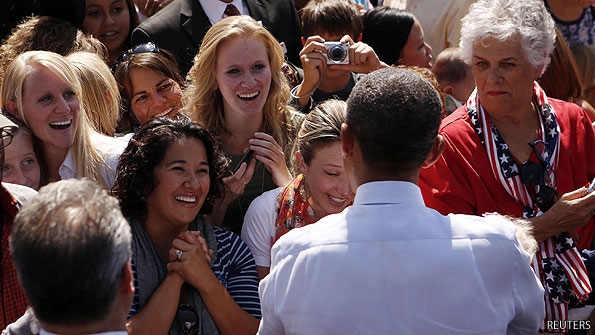
Women voted 55 to 44 for Obama
Women voted 56-44 for more government spending in 2012

CNN reports on how women voted in the 2012 election:

According to CNN’s exit polls, 55% of women and 45% of men voted for Obama and 44% of women and 52% of men voted for Romney. That level of female support for the president made an especially big impact in swing states like Ohio where the gender breakdown mirrored the national figures.

[…]There are some indications that social issues directly impacting women might have helped sway votes in some states.

Tuesday’s early exit polls showed 51% of Missouri voters said they believed abortion should be legal all or most of the time. Of those voters, exit polls showed 76% supported Democratic incumbent Claire McCaskill, who won Tuesday night, while 19% voted for Akin.

Forty-seven percent of Missouri’s voters said abortion should be illegal. Exit polls showed Akin netted 67% of this group’s votes while 27% of people who think abortion should be illegal supported McCaskill.

But much more than social issues, pocketbook economic issues most concerned women voters, exit polling showed.

“Women like all voters felt the economics were most important,” Swers said. “Women tend to be more supportive of government spending… than men are … so they were less responsive to Romney in that way and more responsive to Obama’s message on empathy and helping the middle class.”

Gallup reported that the gender gap in the 2012 election was actually 20 points. That was the largest ever measured in a Presidential election. The actual vote for Obama among women, according to Gallup, was 56-44.

More government means higher taxes
Women are also more pro-abortion more than men

Here is a peer-reviewed research paper that shows the problem that we need to warn women about, so that they vote smarter.

The abstract reads:

This paper examines the growth of government during this century as a result of giving women the right to vote. Using cross‐sectional time‐series data for 1870–1940, we examine state government expenditures and revenue as well as voting by U.S. House and Senate state delegations and the passage of a wide range of different state laws. Suffrage coincided with immediate increases in state government expenditures and revenue and more liberal voting patterns for federal representatives, and these effects continued growing over time as more women took advantage of the franchise. Contrary to many recent suggestions, the gender gap is not something that has arisen since the 1970s, and it helps explain why American government started growing when it did.

When people vote for government to do more for everyone else, then men who work have to pay more in taxes.
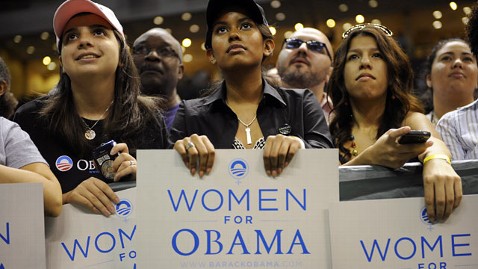
Women for bigger government, higher taxes
Women vote for higher taxes, so they have to work more

If women want to stay home with their children more, then they need to vote for their husbands (present or future) to pay less in taxes when they work. That means voting for smaller government, more liberty and more personal responsibility. Until women get to the point of connecting their future plans (marriage and parenting) for their lives with their current voting, this situation is not going to change. Marriages run on money. It’s no good to urge men to “man-up” and then take away their ability to provide by taxing more of their earnings to pay for Sandra Fluke’s birth control pills and abortions. Keep the money in the family, and then you can stay home with the kids more.

Liberal feminist Hanna Rosin debunks the 77 percent pay for women myth

In the far-left Slate, of all places.

Excerpt:

The official Bureau of Labor Department statistics show that the median earnings of full-time female workers is 77 percent of the median earnings of full-time male workers. But that is very different than “77 cents on the dollar for doing the same work as men.” The latter gives the impression that a man and a woman standing next to each other doing the same job for the same number of hours get paid different salaries. That’s not at all the case. “Full time” officially means 35 hours, but men work more hours than women. That’s the first problem: We could be comparing men working 40 hours to women working 35.

How to get a more accurate measure? First, instead of comparing annual wages, start by comparing average weekly wages. This is considered a slightly more accurate measure because it eliminates variables like time off during the year or annual bonuses (and yes, men get higher bonuses, but let’s shelve that for a moment in our quest for a pure wage gap number). By this measure, women earn 81 percent of what men earn, although it varies widely by race. African-American women, for example, earn 94 percent of what African-American men earn in a typical week. Then, when you restrict the comparison to men and women working 40 hours a week, the gap narrows to 87 percent.

But we’re still not close to measuring women “doing the same work as men.” For that, we’d have to adjust for many other factors that go into determining salary. Economists Francine Blau and Lawrence Kahn did that in a recent paper, “The Gender Pay Gap.”.”They first accounted for education and experience. That didn’t shift the gap very much, because women generally have at least as much and usually more education than men, and since the 1980s they have been gaining the experience. The fact that men are more likely to be in unions and have their salaries protected accounts for about 4 percent of the gap. The big differences are in occupation and industry. Women congregate in different professions than men do, and the largely male professions tend to be higher-paying. If you account for those differences, and then compare a woman and a man doing the same job, the pay gap narrows to 91 percent. So, you could accurately say in that Obama ad that, “women get paid 91 cents on the dollar for doing the same work as men.”

I believe that the remainder of the gap can be accounted for by looking at other voluntary factors that differentiate men and women.

The Heritage Foundation says that a recent study puts the number at 95 cents per dollar.

Excerpt:

Women are more likely than men to work in industries with more flexible schedules. Women are also more likely to spend time outside the labor force to care for children. These choices have benefits, but they also reduce pay—for both men and women. When economists control for such factors, they find the gender gap largely disappears.

A 2009 study commissioned by the Department of Labor found that after controlling for occupation, experience, and other choices, women earn 95 percent as much as men do. In 2005, June O’Neil, the former director of the Congressional Budget Office, found that “There is no gender gap in wages among men and women with similar family roles.” Different choices—not discrimination—account for different employment and wage outcomes.

A popular article by Carrie Lukas in the Wall Street Journal agrees.

Excerpt:

The Department of Labor’s Time Use survey shows that full-time working women spend an average of 8.01 hours per day on the job, compared to 8.75 hours for full-time working men. One would expect that someone who works 9% more would also earn more. This one fact alone accounts for more than a third of the wage gap.

[…]Recent studies have shown that the wage gap shrinks—or even reverses—when relevant factors are taken into account and comparisons are made between men and women in similar circumstances. In a 2010 study of single, childless urban workers between the ages of 22 and 30, the research firm Reach Advisors found that women earned an average of 8% more than their male counterparts. Given that women are outpacing men in educational attainment, and that our economy is increasingly geared toward knowledge-based jobs, it makes sense that women’s earnings are going up compared to men’s.

When women make different choices about education and labor that are more like what men choose, they earn just as much or more than men. What does it mean that people on the left keep pushing pseudo-science on us to try to punish men and reward women? Why are men so awful that they need to be denigrated like this? And how will men respond to social expectations when they have to face being told that they are “bad”? It seems to me that putting men down is going to lower their level of engagement.

New CBO study: top 40% of earners paid 106.2% of net income taxes collected

CNS News reports on a new study by the Congressional Budget Office (CBO).

Excerpt:

The top 40 percent of households by before-tax income actually paid 106.2 percent of the nation’s net income taxes in 2010, according to a new study by the Congressional Budget Office.

At the same time, households in the bottom 40 percent took in an average of $18,950 in what the CBO called “government transfers” in 2010.

Taxpayers in the top 40 percent of households were able to pay more than 100 percent of net federal income taxes in 2010 because Americans in the bottom 40 percent actually paid negative income taxes, according to the CBO study entitled, “The Distribution of Household Income and Federal Taxes, 2010.

[…]When the the negative 9.1 percent in federal income taxes paid by those in the bottom 40 percent is subtracted from the 109.1 percent paid by those in the top 60 percent, federal tax revenues net out to an even 100 percent.

[…]The households in the bottom 40 percent of income—which on average paid negative federal income taxes—were on average receiving many thousands of dollars in what the report calls “government transfers.” These transfers included, among other things, benefits from unemployment insurance, Medicare and Social Security, as well as from means-tested programs such as the Supplemental Nutrition Assistance Program (food stamps), and Medicaid.

“Government transfers increase income in all groups, but those increases, both in dollars and as a percentage of market income, are larger for groups with lower market income,” says the report.

According to the CBO, households in the bottom quintile received an average of $22,700 in government transfers in 2010 (including $14,300 in payments from Medicare and Social Security and $8,500 in payments from other government programs); and households in the second quintile received an average of $15,200 in government transfers (including $10,300 in payments from Medicare and Social Security and $4,900 from other government programs).

Now I have been reading articles like this one in National Review by James Pethokoukis, which talk about Obama’s rhetoric about “income inequality”. And I think that when the President goes on a rant about how much he wants to fix “income inequality”, you have to keep in mind what he is actually fixing. He thinks the people who earn the most need to be taxed more and he thinks that the people who earn the least need to be given more benefits. That’s what he is trying to fix.