

Tag Archives: Baby

Brian Auten interviews pro-life debater Scott Klusendorf

Unborn baby scheming about pro-life apologetics

Scott Klusendorf is the director of the excellent Life Training Institute, and he’s been interviewed by Brian Auten on Apologetics 315.

Details of the interview:

Today’s interview is with Scott Klusendorf, president of Life Training Institute. LTI is the first place to look for excellent resources to get better equipped to defend the pro-life position. Scott talks about defining abortion and its terms, the issue of the debate, the legal history of abortion, defending the pro-life view using science and philosophy, the four pillars of the pro-life argument, answering a litany of objections to the pro-life position, the right and wrong use of emotional appeals, taking on the right tone in the debate, how to get better equipped, and more.

Grab the MP3 file here at Apologetics 315.

The article Scott mentions “How to Defend Your Pro-Life Views in 5 Minutes or Less” is worth the read, and it’s a good summary of some of the points he makes in the lecture.

If you like this interview, please be sure and buy the best basic book on pro-life apologetics – Scott Klusendorf’s “The Case for Life“.

And there is actually a full transcript, and here’s an excerpt:

BA: Great stuff. Now I want you to go into these pillars if you will of defending the pro-life position with science and philosophy, and in your web site prolifetraining.com one of the things that you provide is sort of a four point acronym, some would say sled S-L-E-D. Can you lay out what those main pillars are and their relevance to the issue?

SK: Well as I mentioned a moment ago, pro-life advocates argue that elective abortion unjustly takes the life of a developing human being, and we defend that claim using science and philosophy. We use science to determine what kind of thing the unborn is, and we use philosophy to show that there’s no relevant deference between the embryos we once were and the adults we are today that would justify killing us at that earlier stage of development. Scientifically, as I mentioned just moments ago embryology text books worldwide indicate that from the very beginning you and I were distinct living whole human beings. You can’t see that I’m doing this right now, Brian, but at the moment I’m picking cells off the back of my hand. These cells, which we call somatic cells, contain my entire DNA and coding. But you don’t thing I just committed mass murder by sending a couple hundred of those puppies hurling to their deaths on the floor in front of me. And the reason is, you know that these cells though they contain my DNA and coding are merely part of a larger human being, me. They are not distinct whole living organisms the way that you were when you were an embryo. The way I was when I was an embryo. In other words, there is a difference in kind between each of our bodily cells and the embryonic human beings we once were. That’s what science teaches us; that’s what the science of embryology lays down for us.Philosophically, we argue using that SLED acronym that you mentioned a moment ago that there’s no difference between that embryo we once were and the adult we are today. The adults we are today that justify killing us at that earlier stage of development and as Steven Schwarz points out, the differences between that embryo and the adult that you are today are one of size, level of development, environment and degree of dependency. Think of the acronym SLED and you will remember those four differences. Size, yeah you were smaller as an embryo, but since when does body size determine the rights that you have. Shaquille O’Neal, the seven foot two basketball star with the Boston Celtics, is a foot taller than I am, but he doesn’t have a greater right to life simply because he’s bigger.

Level development? Sure, we were less developed as embryos but since when is a matter of principal does that mean we can kill you? Two-year-old girls are less developed than twenty-year-old young women. We don’t think though the two year old girl has less to a right to life simply because she can’t function at the level that the twenty year old can. Level of size, I should say level of development. What about environment; where you are located there is the letter “E” in that SLED acronym. You were once in the womb now you’re out but sense when does were you are determine what you are? When you walk from your living room into the studio to do this interview. You changed location but you didn’t stop being you. When I jump on an airplane and fly from Atlanta to London’s Heathrow airport. I get off the plane I’m in a new location, but I’m the same being as I was when I left Atlanta. If that’s true how does a journey of eight inches down the birth canal suddenly change me from non-human, non-valuable thing that we can kill? To a valuable human being that we can’t kill. And the answer is, if I wasn’t already human and valuable I’m not going to get there by changing my address. And then finally, degree of dependency—yes we depended on our mother for survival but sense when does dependency on another human being mean we can kill you? Conjoined twins depend on each other for survival and unless one of the twins is killing its partner we don’t go ahead and slit the throat of both twins simply because they can’t live independent of each other. Size, level of development, environment, degree of dependency, think “SLED” those are the only four differences between that embryo you once were and the adult you are today. And the pro-lifer would argue that not one of those four differences justifies killing you at that earlier stage.

You can see Scott in a debate about abortion right here.

And if you like that interview, I have some more things for you to read from Dr. Francis Beckwith.

Learn more by reading

Frank Beckwith is the author of “Defending Life: A Moral and Legal Case Against Abortion Choice“. He wrote that book for Cambridge University Press, a top academic press. But before Cambridge University Press, Beckwith wrote easy-to-understand essays for the Christian Research Journal.

Here are four essays that answer common arguments in favor of legalized abortion.

I have a copy of Dr. Beckwith’s previous book “Politically Correct Death”, which I read bit-by-bit on my lunch hours 10 years ago. Excellent stuff.
Pregnant South African women binge drinking in order to get more welfare

A horrible article from the UK Daily Mail.

Excerpt:

Pregnant South African women are deliberately drinking large quantities of alcohol to harm their unborn babies in a bid to earn more welfare money, it has been claimed.

Expectant mothers living in the Eastern Cape, one of the poorest areas in South Africa, are bingeing on a ‘moonshine’ type drink which contains battery acid – with some drinking up to five and six bottles a day.

It has been reported they do it to claim a disability benefit from the government – using their disabled children as a source of income.

Video taken by Sky News shows a mother drinking a homemade brew called ‘kah-kah’ while heavily pregnant.

[…]The addictive milky brown brew is made from yeast, water and battery acid.

[…]The World Health Organisation said there has been an increase in the number of babies born with Foetal Alcohol Spectrum Disorder (FASD) in the area  since 2002.

The syndrome is also the most common birth defect in South Africa.

The irreversible symptoms mean children suffer from speech problems, physical deformities, learning difficulties and behavioural issues.

Families receive 250 South African rand ($29 US) per child, per month but a disabled child brings in around 1200 rand a month ($138 US).

It’s very important for Christians to understand that policies that sound compassionate can actually provide incentives to people to do more bad things in order to get more money from the government. A good rule of thumb is this: whatever you tax, you get less of. And whatever you subsidize, you get more of. We shouldn’t be paying people to do evil things. We should be encouraging people who do good things instead. It’s important that we not just feel good, but that we do good.

New study: fewer than one in ten women staying home with children

Dina sent me this article from the UK Daily Mail.

Excerpt:

Fewer than one in ten women stay at home to look after their children

  • Latest census figures show 300,000 fewer staying home than thought
  • Concerns for well-being of mothers and impact on toddlers in day care
  • Stay-at-home figures dropped from 17 per cent of women 20 years ago

The stay-at-home mother is fast becoming consigned to history, according to the latest census figures.

Returns showed there are 300,000 fewer than officials  had previously estimated, with those who devote their lives to bringing up families now reduced to a tiny minority.

Fewer than one in ten women of working age are stay-at-home mothers.

The collapse follows a decade in which governments urged mothers to take jobs on the grounds that working is the route to fulfilment for women and that families with two incomes are much less likely to fall into poverty.

Critics, however, are concerned for the well-being of mothers who might prefer to be with their families, and the impact on increasing numbers of toddlers who spend long hours in day care.

The 2011 census results found there are 1,598,000 women who do not work because they are looking after their home and family – 298,000 fewer than estimates from the Office for National Statistics.

Note that this is applauded by feminist groups, like the UK Labour Party:

The decline in numbers of stay-at-home mothers will be welcomed by ministers as the Labour drive to push mothers into work has continued under the Coalition.

Childcare minister Elizabeth Truss has made a priority of providing cheaper day care to help mothers into jobs.

In an article earlier this year  she said it was ‘vital’ for mothers to work, adding: ‘To power ahead Britain needs to look at best practice from overseas to discover how to increase women’s participation, especially for those who are parents.’

But critics say the sky-high level of house prices and the lack of help for two-parent families in the tax and benefit systems means most mothers have to work, whether they like it or not.

Earlier this week I blogged studies that showed the importance of fathers to children. But it’s important to remember that mothers are also important to children, especially in the first few years of the child’s life. And we have studies to back that up as well.

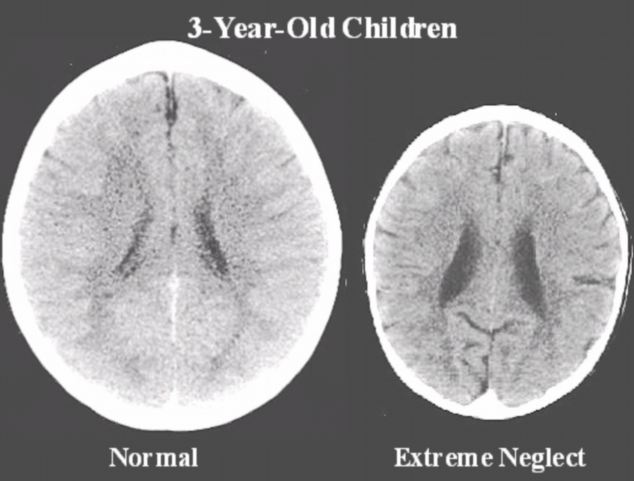
Brain scans of 3-year old children: normal vs neglected

This was discussed before in another article from the UK Daily Mail. (H/T Dina)

Excerpt:

Both of these images are brain scans of a two three-year-old children, but the brain on the left is considerably larger, has fewer spots and less dark areas, compared to the one on the right.

According to neurologists this sizeable difference has one primary cause – the way each child was treated by their mothers.

The child with the larger and more fully developed brain was looked after by its mother – she was constantly responsive to her baby, reported The Sunday Telegraph.

But the child with the shrunken brain was the victim of severe neglect and abuse.

According to research reported by the newspaper, the brain on the right worryingly lacks some of the most fundamental areas present in the image on the left.

The consequences of these deficits are pronounced – the child on the left with the larger brain will be more intelligent and more likely to develop the social ability to empathise with others.

But in contrast, the child with the shrunken brain will be more likely to become addicted to drugs and involved in violent crimes, much more likely to be unemployed and to be dependent on state benefits.

The child is also more likely to develop mental and other serious health problems.

Professor Allan Schore, of UCLA, told The Sunday Telegraph that if a baby is not treated properly in the first two years of life, it can have a fundamental impact on development.

He pointed out that the genes for several aspects of brain function, including intelligence, cannot function.

[…]The study correlates with research released earlier this year that found that children who are given love and affection from their mothers early in life are smarter with a better ability to learn.

The study by child psychiatrists and neuroscientists at Washington University School of Medicine in St. Louis, found school-aged children whose mothers nurtured them early in life have brains with a larger hippocampus, a key structure important to learning, memory and response to stress.

The research was the first to show that changes in this critical region of children’s brain anatomy are linked to a mother’s nurturing, Neurosciencenews.com reports.

The research is published online in the Proceedings of the National Academy of Sciences Early Edition.

Lead author Joan L. Luby, MD, professor of child psychiatry, said the study reinforces how important nurturing parents are to a child’s development.

If we are really interested in providing for the needs of young children, then we have to voluntarily limit the freedom of adults. Traditional marriage is the way that societies have provided for the needs of young children. Marriage puts boundaries on sexual activity (premarital chastity, post-marital fidelity) that are beneficial to children. Children need to have access to their parents over the course of their development.

We should be promoting behaviors and policies that strengthen marriage, like chastity and low tax rates. We should be opposing behaviors and policies that weaken marriages, like hooking-up and no-fault divorce. That’s what we would do if we really had the best interests of children at heart instead of the best interests of adults.