Tag Archives: Activist

Everything you need to know about the SCOTUS pick

If you haven’t already bookmarked Verum Serum, now is the time to do it.

Verum Serum’s May 3rd post discussed Obama’s SCOTUS pick, Sonia Sotomayor.

The post features this video of the nominee from a Duke University panel in 2005.

Quote from the video: (H/T Heritage Foundation via Commenter ECM)

“All of the legal defense funds out there, they’re looking for people with Court of Appeals experience. Because it is — Court of Appeals is where policy is made. And I know, and I know, that this is on tape, and I should never say that. Because we don’t ‘make law,’ I know. [Laughter from audience] Okay, I know. I know. I’m not promoting it, and I’m not advocating it. I’m, you know. [More laughter] Having said that, the Court of Appeals is where, before the Supreme Court makes the final decision, the law is percolating. Its interpretation, its application.

Verum Serum’s May 5th post has some quotes from a speech she gave at UC Berkeley, at a conference sponsored by the Berkeley La Raza Law Journal.

Here’s one of the quotes from Verum Serum:

Whether born from experience or inherent physiological or cultural differences, a possibility I abhor less or discount less than my colleague Judge Cedarbaum, our gender and national origins may and will make a difference in our judging. Justice O’Connor has often been cited as saying that a wise old man and wise old woman will reach the same conclusion in deciding cases…I am also not so sure that I agree with the statement. First, as Professor [Martha] Minnow has noted, there can never be a universal definition of wise. Second, I would hope that a wise Latina woman with the richness of her experience would more often than not reach a better conclusion than a white male who hasn’t lived that life. (emphasis added)

Nice Deb comments: “Imagine the hue and cry if a white male had said that about a Hispanic female.”

And one more from Verum Serum:

I willingly accept that we who judge must not deny the differences resulting from experience and heritage but attempt, as the Supreme Court suggests, continuously to judge when those opinions, sympathies, and prejudices are appropriate.

There is always a danger embedded in relative morality, but since judging is a series of choices that we must make, that I am forced to make, I hope I can make them by informing myself on the questions I must not avoid asking and continuously pondering. We…must continue individually and in voices united in organizations that have supported this conference, to think about these questions and to figure out how we go about creating the opportunity for there to be more women and people of color on the bench so we can finally have statistically significant numbers to measure the differences we will and are making.

You need to click through and read the rest of the quotes. Heritage Foundation has more quotes from the same speech, and some other quotes from her published papers.

Here’s one of the additional quotes from her published work:

The constant development of unprecedented problems requires a legal system capable of fluidity and pliancy. Our society would be strait-jacketed were not the courts, with the able assistance of the lawyers, constantly overhauling the law and adapting it to the realities of ever-changing social, industrial and political conditions; although changes cannot be made lightly, yet law must be more or less impermanent, experimental and therefore not nicely calculable. Much of the uncertainty of law is not an unfortunate accident: it is of immense social value.

The Heritage Foundation has more here, on their rapid response page.

And what about her judicial temperament, which is of critical importance?

John Lott has this quote on his blog from the Almanac of the Federal Judiciary:

Sotomayor can be tough on lawyers, according to those interviewed. “She is a terror on the bench.” “She is very outspoken.” “She can be difficult.” “She is temperamental and excitable. She seems angry.” “She is overly aggressive–not very judicial. She does not have a very good temperament.” “She abuses lawyers.” “She really lacks judicial temperament. She behaves in an out of control manner. She makes inappropriate outbursts.” “She is nasty to lawyers. She doesn’t understand their role in the system–as adversaries who have to argue one side or the other. She will attack lawyers for making an argument she does not like.”

And how smart is she?

Here’s Eric Posner writing on the Volokh Conspiracy blog:

The most complete effort so far to evaluate federal appellate judges is this paper by Stephen Choi and Mitu Gulati. Choi and Gulati use data from Lexis to measure three aspects of the judge’s performance—productivity, opinion quality, and independence.

…To determine how Sotomayor would do in the ranking, I had some research assistants collect her data for the years 1999-2001. To address the “freshman effect” (the possibility that her statistics are worse for her earliest years because of inexperience), we also looked at her data from 2006.

Productivity. Judges write opinions, which provide guidance to lawyers and the public. All else equal, a judge who writes more opinions is more productive, and provides a greater social benefit. Over the three year period from 1998 to 2000, the most productive judge published 269 opinions, the least productive judge published 38 opinions, and the mean was 98.1. For the comparable period from 1999-2001, Judge Sotomayor published 73 opinions. She would have ranked 68th out of 98.

Quality (1). Choi and Gulati measure quality by counting citations to a judge’s top twenty opinions… The range is 96 to 734, with a mean of 277.9. Judge Sotomayor’s statistic is 231, which would place her 59th.

Quality (2). Judge Sotomayor’s opinions from 1999-2001 were cited 289 times in law reviews and other legal periodicals through May 31, 2004… Sotomayor would have ranked 65th.

Quality (3). Choi and Gulati also check what they call “invocations”—the frequency with which opinions written by other judges refer to the judge in question by name… Invocations range from 0 to 175 (excluding two outliers, the highest is 23), with a mean of 32. Judge Sotomayor was invoked 0 times (tied for last).

Independence. Judges should decide cases in a non-partisan way… A score of 0 means that a judge is just as likely to disagree as agree with a co-partisan (or opposite-partisan). Negative scores mean that a judge is more likely to agree with co-partisans. Judge Sotomayor’s score is -0.153 …which would have placed her 55th.

And how liberal is she?

Wendy Long at Bench Memos has that angle covered.

Judge Sotomayor is a liberal judicial activist of the first order who thinks her own personal political agenda is more important that the law as written. She thinks that judges should dictate policy, and that one’s sex, race, and ethnicity ought to affect the decisions one renders from the bench.

She reads racial preferences and quotas into the Constitution, even to the point of dishonoring those who preserve our public safety. On September 11, America saw firsthand the vital role of America’s firefighters in protecting our citizens. They put their lives on the line for her and the other citizens of New York and the nation. But Judge Sotomayor would sacrifice their claims to fair treatment in employment promotions to racial preferences and quotas. The Supreme Court is now reviewing that decision.

She has an extremely high rate of her decisions being reversed, indicating that she is far more of a liberal activist than even the current liberal activist Supreme Court.

Isn’t there are word to describe a person that discriminates against people based on their race?

Verum Serum has a video of the White House and left-wing media responses to these shocking challenges to the pick. Charles Shumer warns the GOP not to oppose her in this video at Hot Air. Michelle Malkin and Gateway Pundit go over her liberal credentials in detail.
Should Obama pick judges who favor Democrat special interest groups?

Yes, I know he calls it “empathy”. And by empathy he means twisting the law to benefit the people who voted for him. What you don’t believe me? Well, check out the evidence here about who Obama’s bailouts really benefit. Nice Deb even links to a story that questions whether the recent Chrysler dealership closures were made because the owners donated to Republican candidates.

Now, what kind of judges does someone like Obama need to install in order to back his authoritarian regime? Well, it has to be someone who will help him to punish the people who disagree with him. Someone who believes that there are good Americans (Democrats) and bad Americans (Republicans), and that the laws should apply differently to those different groups.

Let’s take a look at what my favorite two economists, Thomas Sowell and Walter Williams have to say about this.

Thomas Sowell

Thomas Sowell has a four-part series on Obama’s judicial philosophy.

In part one, Sowell asks what it means that Obama will pick judges who come from certain groups, and who believe in twisting the law to favor those groups.

That President Obama has made “empathy” with certain groups one of his criteria for choosing a Supreme Court nominee is a dangerous sign of how much further the Supreme Court may be pushed away from the rule of law and toward even more arbitrary judicial edicts to advance the agenda of the left and set it in legal concrete, immune from the democratic process.

Would you want to go into court to appear before a judge with “empathy” for groups A, B and C, if you were a member of groups X, Y or Z? Nothing could be further from the rule of law. That would be bad news, even in a traffic court, much less in a court that has the last word on your rights under the Constitution of the United States.

Appoint enough Supreme Court justices with “empathy” for particular groups and you would have, for all practical purposes, repealed the 14th Amendment, which guarantees “equal protection of the laws” for all Americans.

In part two, Sowell talks about Olive Wendell Holmes’ strict constructionist jurisprudence, which allowed citizens to undertake economic enterprises because they could predict how the law would be enforced.

Justice Holmes saw his job to be “to see that the game is played according to the rules whether I like them or not.”

That was because the law existed for the citizens, not for lawyers or judges, and the citizen had to know what the rules were, in order to obey them.

He said: “Men should know the rules by which the game is played. Doubt as to the value of some of those rules is no sufficient reason why they should not be followed by the courts.”

Legislators existed to change the law.

In part three, Sowell talks about why the judiciary must remain impartial as a check on the power of the legislative and executive branches.

Barack Obama’s vision of America is one in which a President of the United States can fire the head of General Motors, tell banks how to bank, control the medical system and take charge of all sorts of other activities for which neither he nor other politicians have any expertise or experience.The Constitution of the United States gives no president, nor the entire federal government, the authority to do such things. But spending trillions of dollars to bail out all sorts of companies buys the power to tell them how to operate.

Appointing judges to the federal courts– including the Supreme Court– who believe in expanding the powers of the federal government to make arbitrary decisions, choosing who will be winners and losers in the economy and in the society, is perfectly consistent with a vision of the world where self-confident and self-righteous elites rule according to their own notions, instead of merely governing under the restraints of the Constitution.

In part four, Sowell explains how big government socialists like Obama view the Constitution as an obstacle to be overcome.

Judicial expansion of federal power is not really new, even if the audacity with which that goal is being pursued may be unique. For more than a century, believers in bigger government have also been believers in having judges “interpret” the restraints of the Constitution out of existence.

They called this “a living Constitution.” But it has in fact been a dying Constitution, as its restraining provisions have been interpreted to mean less and less, so that the federal government can do more and more.

For example, the Constitution allows private property to be taken for “public use”– perhaps building a reservoir or a highway — if “just compensation” was paid. But that power was expanded by the Supreme Court in 2005 when it “interpreted” this to mean that private property could be taken for a “public purpose,” which could include almost anything for which politicians could come up with the right rhetoric.

Walter Williams

And Walter Williams writes about the dangers of empathy using last year’s Super Bowl as an example.

The Pittsburgh Steelers have won six Super Bowl titles, seven AFC championships and hosted 10 conference games. No other AFC or NFC team can match this record. By contrast, the Arizona Cardinals’ last championship victory was in 1947 when they were based in Chicago. In anyone’s book, this is a gross disparity. Should the referees have the empathy to understand what it’s like to be a perennial loser and what would you think of a referee whose decisions were guided by his empathy? Suppose a referee, in the name of compensatory justice, stringently applied pass interference or roughing the passer violations against the Steelers and less stringently against the Cardinals. Or, would you support a referee who refused to make offensive pass interference calls because he thought it was a silly rule? You’d probably remind him that the league makes the rules, not referees.

I’m betting that most people would agree that football justice requires that referees apply the rules blindly and independent of the records or any other characteristic of the two teams. Moreover, I believe that most people would agree that referees should evenly apply the rules of the games even if they personally disagreed with some of the rules.

But what if the Steelers had lost due to referee partiality? Well, presumably they would stop playing the game. And when enough small businesses get tired of being sued by special interest group plaintiffs, we will all be working for the government and that will be the end of our liberty.

Further study

Probably one of the greatest books ever written is Thomas Sowell’s “A Conflict of Visions”. Go out right now and buy it if you don’t have it, but be warned, it was a tough read for a software engineer like me, and my Dad also found it difficult when I gave it to him.

Why do people oppose same-sex marriage?

UPDATE: The research paper seems to have expired from the FRC web site, but you can see the whole thing here.

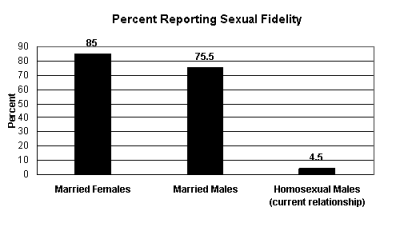
I found this research paper at the Family Research Council web site. The paper compares same-sex couples and heterosexual married couples, in the following ways:

  • relationship duration
  • monogamy vs. promiscuity
  • relationship commitment
  • number of children being raised
  • health risks
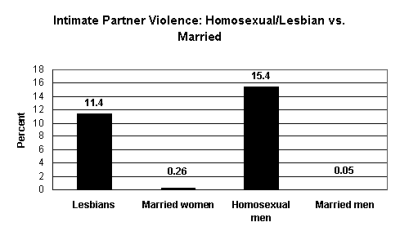
  • rates of intimate partner violence

Are there really significant differences between the two arrangements? Let’s take a look at the some of the data.

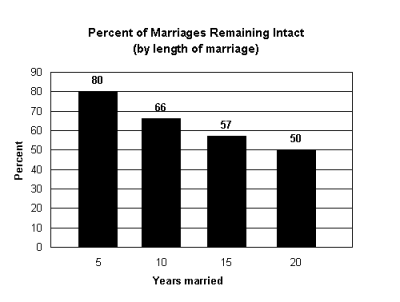
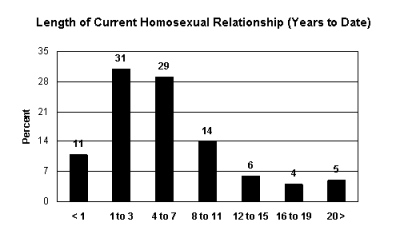
Relationship duration

% of Marriages Remaining Intact

Source: National Center for Health Statistics, Centers for Disease Control and Prevention (2001)

Length of Current Homosexual Relationship

Source: 2003-2004 Gay/Lesbian Consumer Online Census

Monogamy vs Promiscuity

% Reporting Sexual Fidelity

Sources:Laumann, The Social Organization of Sexuality, 216; McWhirter and Mattison, The Male Couple: How Relationships Develop (1984): 252-253; Wiederman, “Extramarital Sex,” 170.

Rates of intimate partner violence

Intimate Partner Violence

Sources: “Extent, Nature, and Consequences of Intimate Partner Violence,” U.S. Department of Justice: Office of Justice Programs: 30; “Intimate Partner Violence,” Bureau of Justice Statistics Special Report:11.

Conclusion

Marriage is a relationship that has a specific purpose. That purpose is to bind together two opposite natures and to produce children that are biologically linked to the parents. The children gain the benefits of being parented by the two different natures, so they get two perspectives. The fact that the children are genetically linked to two parents helps to ensure the stability of the commitment, as we see in the animal kingdom where animals protect their young.

The goal of marriage is not to increase the happiness of the adults, or to “recognize” the love of adults. The goal of marriage is have two people enter into a relationship where they understand that it is not about adults being fulfilled. Marriage is about people having a goal of raising children, which are tremendously stressful to raise. Marriage requires self-denial and sacrifice in order to raise those children – that is the main point of it. It also requires fidelity and chastity, so that the environment is kept stable for the children over a long period of time.

Children benefit from the stability that is more common in traditional marriages than it is in other arrangements, including heterosexual co-habitation which is similarly unstable (50% greater chance of divorce, more domestic violence, etc.). Therefore, it is important to keep the concept of marriage separate from other kinds of relationships so that the focus on commitment for the sake of the children is clear to those who contemplate marriage. Society needs to give special recognition to married couples, in view of their child-focused commitment.

I apologize in advance if this post causes anyone any harm or distress, I am just trying to explain why people have that opinion. They could be wrong, but that is the case they make. Obviously, married couples fall short of the goal, but that is their goal.

Further study

Two much bigger challenges to marriage are big-government socialism and especially no-fault divorce. I also wrote about same-sex marriage and co-habitation before, in the context of European states like Sweden and Norway.

You may also be interested in a recent post about whether homosexuality is caused by a “gay gene”.