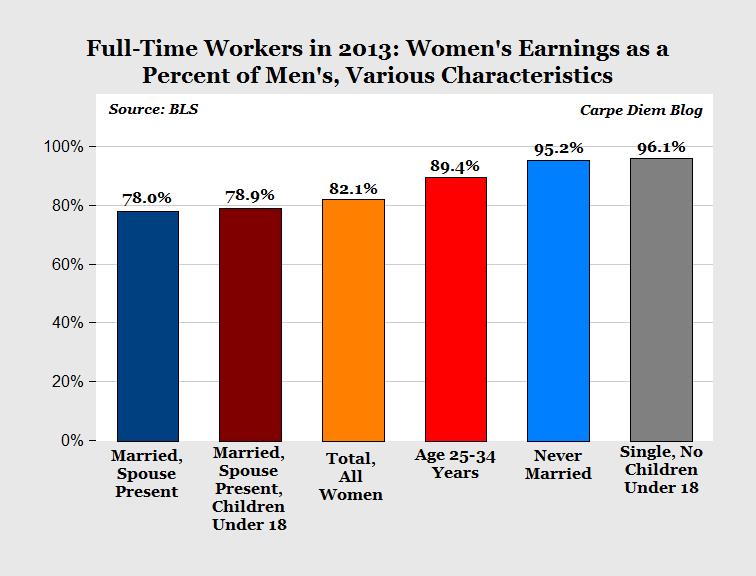
The pay gap is caused by women’s preference for having children
Liberal feminist Hanna Rosin takes a look at this question in the far-left Slate, of all places.
Excerpt:
The official Bureau of Labor Department statistics show that the median earnings of full-time female workers is 77 percent of the median earnings of full-time male workers. But that is very different than “77 cents on the dollar for doing the same work as men.” The latter gives the impression that a man and a woman standing next to each other doing the same job for the same number of hours get paid different salaries. That’s not at all the case. “Full time” officially means 35 hours, but men work more hours than women. That’s the first problem: We could be comparing men working 40 hours to women working 35.
How to get a more accurate measure? First, instead of comparing annual wages, start by comparing average weekly wages. This is considered a slightly more accurate measure because it eliminates variables like time off during the year or annual bonuses (and yes, men get higher bonuses, but let’s shelve that for a moment in our quest for a pure wage gap number). By this measure, women earn 81 percent of what men earn, although it varies widely by race. African-American women, for example, earn 94 percent of what African-American men earn in a typical week. Then, when you restrict the comparison to men and women working 40 hours a week, the gap narrows to 87 percent.
But we’re still not close to measuring women “doing the same work as men.” For that, we’d have to adjust for many other factors that go into determining salary. Economists Francine Blau and Lawrence Kahn did that in a recent paper, “The Gender Pay Gap.”.”They first accounted for education and experience. That didn’t shift the gap very much, because women generally have at least as much and usually more education than men, and since the 1980s they have been gaining the experience. The fact that men are more likely to be in unions and have their salaries protected accounts for about 4 percent of the gap. The big differences are in occupation and industry. Women congregate in different professions than men do, and the largely male professions tend to be higher-paying. If you account for those differences, and then compare a woman and a man doing the same job, the pay gap narrows to 91 percent. So, you could accurately say in that Obama ad that, “women get paid 91 cents on the dollar for doing the same work as men.”
I believe that the remainder of the gap can be accounted for by looking at other voluntary factors that differentiate men and women.
The Heritage Foundation says that a recent study puts the number at 95 cents per dollar.
Excerpt:
Women are more likely than men to work in industries with more flexible schedules. Women are also more likely to spend time outside the labor force to care for children. These choices have benefits, but they also reduce pay—for both men and women. When economists control for such factors, they find the gender gap largely disappears.
A 2009 study commissioned by the Department of Labor found that after controlling for occupation, experience, and other choices, women earn 95 percent as much as men do. In 2005, June O’Neil, the former director of the Congressional Budget Office, found that “There is no gender gap in wages among men and women with similar family roles.” Different choices—not discrimination—account for different employment and wage outcomes.
A popular article by Carrie Lukas in the Wall Street Journal agrees.
Excerpt:
The Department of Labor’s Time Use survey shows that full-time working women spend an average of 8.01 hours per day on the job, compared to 8.75 hours for full-time working men. One would expect that someone who works 9% more would also earn more. This one fact alone accounts for more than a third of the wage gap.
[…]Recent studies have shown that the wage gap shrinks—or even reverses—when relevant factors are taken into account and comparisons are made between men and women in similar circumstances. In a 2010 study of single, childless urban workers between the ages of 22 and 30, the research firm Reach Advisors found that women earned an average of 8% more than their male counterparts. Given that women are outpacing men in educational attainment, and that our economy is increasingly geared toward knowledge-based jobs, it makes sense that women’s earnings are going up compared to men’s.
When women make different choices about education and labor that are more like what men choose, they earn just as much or more than men.
How far did Obama go to give Iran nuclear weapons?
Everywhere I turn in the mainstream media, I’m told how the Obama administration was the most scandal-free administration in history. There wasn’t even a hint of corruption, according to the mainstream media. I’m beginning to think that it’s a good test of intelligence to ask a person how many Obama scandals they can name. In this post, I want to look at an Obama scandal that the media ignored.
4. The DOJ seized Associated Press phone records as well as phone and email records from Fox News reporter James Rosen.
5. The NSA conducted mass surveillance against American citizens without a warrant.
6. The Obama administration paid ransom to Iran for hostages, and lied to the American people about it.
7. Hillary’s email scandal.
8. The Environmental Protection Agency poisoned a Colorado river.
9. The EPA also broke federal law in promoting a regulation.
10. The GSA scandal.
11. The Secret Service scandal.
This list doesn’t even include many of the foreign policy scandals of the administration, like leaking classified information, trading a deserter for 5 senior Taliban commanders, releasing the traitor Bradley/Chelsea Manning early, etc. I mean, the list could be twice that length. But you would never know about any of these if you relied on the mainstream media, or their “fact checkers”, because they are Democrats and they lie to cover up for their party.
Former Defense Secretary Jim Mattis says he predicted years ago that Iran would escalate its provocations against the United States — and he partly blames the Obama administration’s anemic reaction to an Iranian plot to bomb a restaurant in Washington, D.C.
[…]Mattis says Washington didn’t even inform him when Iran committed an “act of war” on American soil.
[…]As Mattis writes, “Attorney General Eric Holder said the bombing plot was ‘directed and approved by elements of the Iranian government and, specifically, senior members of the Qods Force.’ The Qods were the Special Operations Force of the Revolutionary Guards, reporting to the top of the Iranian government.”
[…]“In my view, we had to hold Iran to account and strike back when attacked. But there was a reason for the administration’s restraint. The administration was secretly negotiating with Iran, although I was not privy to the details at the time.”
Those negotiations would lead to the Iran nuclear deal, signed in 2015. Mattis is critical of the agreement, which President Trump withdrew from last year. “In my military judgment, America had undertaken a poorly calculated, long-shot gamble. At the same time, the administration was lecturing our Arab friends that they had to accommodate Iran as if it were a moderate neighbor in the region and not an enemy committed to their destruction,” Mattis writes. “As long as its leaders consider Iran less a nation-state than a revolutionary cause, Iran will remain a terrorist threat potentially more dangerous than Al Qaeda or ISIS.”
So, Obama covered for a terrorist attack attempted by Iran against a U.S. ally on U.S. soil.But that’s not the only time that Obama covered for Iran in order to save his Iran deal.
Here is another one, reported by the far-left New York Post:
The Obama administration stymied a sprawling investigation into the terror group Hezbollah — and its highly lucrative drug- trafficking networks — to protect the Iran nuclear deal, according to a bombshell report.
A team at the Drug Enforcement Administration had been working for almost a decade to bring down the Iran-backed militant organization’s sophisticated $1 billion-a-year drug ring, which laundered money and smuggled cocaine into the United States, Politico reported.
But the departments of Justice and Treasury repeatedly undermined agents’ efforts to arrest and prosecute key members of the criminal network — because the Obama White House feared upsetting Tehran ahead of the nuclear agreement, according to Politico.
Former Treasury official Katherine Bauer even admitted in little-noticed testimony to the House Committee on Foreign Affairs last February that “under the Obama administration . . . these [Hezbollah-related] investigations were tamped down for fear of rocking the boat with Iran and jeopardizing the nuclear deal.”
In my opinion, Obama made the Iran deal happen because he wanted to send $1.7 billion in cash to Iran to help them to develop nuclear weapons that they could then use against their enemy Israel. And that’s the foreign policy that every single Democrat voter voted for when they voted for him in 2008 and again in 2012. They believed in destroying Israel and they paid a terrorist-sponsoring, drug-smuggling nation to do their dirty work for them. Hitler would have been proud.
Two tough rams butt heads, and may the best ram win!
Looks like Justin Brierley on the Unbelievable radio show found a pastor with a Ph.D in philosophy, and he can really whip some ass. And that’s a good thing, because he is taking on one of the two leading proponents of religious pluralism, in my opinion, (the other being Paul Knitter).
The players:
John Hick is a noted philosopher and theologian who is a proponent of a pluralist view of religion – that there is one light (God) but many lampshades (religious expressions).
Chris Sinkinson is a pastor and Bible tutor who has critiqued Hick’s work. He says that pluralism empties Christianity of any content and in its own way disrespects other religions more than his own exclusivist stance.
Justin does a great job as moderator of this debate. He said what I was thinking of saying a number of times during the debate.
Anyway, here is my snarky summary. I creatively paraphrase some of the things that Hick says to make it more clear. And funny.
—-
Hick:
– had an experience looking at the buildings of other religions
– other religions have buildings, so all religions are equal
– I spent some time in the East, and met nice Eastern people
– since Eastern people are nice that means all religions are equal
Justin:
– isn’t Jesus’ claim to be the exclusive path to salvation offensive?
Sinkinson:
– all religions that are exclusive and have to deal with religious pluralism
– even John Hick writes polemically in favor of his own view
– even John Hick thinks that religions that are exclusive are false
Justin:
– what about the blind man and the elephant?
– the story seems to say that other people have a partial grasp?
– but the story-teller himself has the privileged view
– so isn’t the religious pluralist just as arrogant as exclusivists?
Hick:
– well, it’s not arrogant to claim to have the right answer
– Jesus never made the claim to be God incarnate
– Jesus never made the claim to be the exclusive path to God
– historians don’t think that John’s gospel is reliable because it is late
– the proclamation of exclusivity was added by evangelists much later
Sinkinson:
– the historians who doubt the high Christology are radical skeptics
– the mainstream of historical scholarship accepts a high Christology
– the EARLIEST history about Jesus has the highest Christology
Hick:
– the moderate scholars do think Jesus was divine but that he didn’t think he was divine
– the phrase “Son of God” was used to describe any remarkable person
– only later did the early church turn the generic term into “God the Son”
Sinkinson:
– there is reflection on Jesus’ identity and developments, but not invention
– Jesus and his followers were in trouble precisely for linking him to deity
– why else would Jesus get into trouble and get crucified?
Hick:
– the Romans crucified him because people were saying he was the Messiah
– but the Messiah was not identified as being divine, but political
– and that’s why the Romans crucified him
Justin:
– do you (Sinkinson) think that people in other religions can be saved?
Sinkinson:
– the traditional view is exclusivism
– the other world religions are logically contradictory with Christianity
– you have to respect their differences – they are not the same as Christianity
– exclusivists allow that people can be saved by responding to natural theology
– and there are also other cases where non-Christians are saved, like old testament saints and babies who die in infancy
Hick:
– but people’s religions are based on where they are born
– so it’s not fair for God to expect people to be saved in one religion only
Sinkinson:
– the plurality of religions grouped by location doesn’t make christianity false
– that would be the genetic fallacy – rejecting an idea because of its origin
– the real question to consider is whether it is true
– and even the objection assumes that God is a God of love, who should be fair
– but how do you know that God is loving? that is an exclusive view
– how can the “blob” ultimate of religious pluralism be “loving” and “fair”
Hick:
– the ultimate reality is loving or not loving depending on each person’s religion
Sinkinson:
– but some religions and theistic and some are atheistic
– how can those God exist and not exist?
Hick:
– God is beyond everyone’s understanding, except mine
– God is beyond all definitions, except mine
– God is beyond all human understanding, except mine
– i’m not contradicting myself, it’s a mystery! a mystery!
– as long as you don’t look to closely, they’re all the same!
– allow me to tell you about God, which no one can do but me
Justin:
– doesn’t your religious pluralism mean that Christianity is false?
Hick:
– well, Christianity can’t be true, because it disagrees with other religions
– Christianity can’t falsify other religions, that would be mean to them
– other religions are just as “profound” as Christianity – and that’s what matters – not whether a religion makes true claims
– some religions are older than Christianity, that means they can’t be disagreed with
– we can’t let Christianity be true, because then some people will feel bad
– if people feel bad, then they don’t like me and then I feel bad
– if there’s one thing I know about the unknowable ultimate reality, it’s that it wants me to be liked by lots of people
Sinkinson:
– your view seems to be agnosticism – that nothing can be known about the “ultimate real”
– if we can’t express in words what God is like, then why are you saying what God is like?
Hick:
– the indescribable ultimate is described (falsely, but interestingly) by various tradition
Sinkinson:
– does the “ultimate real” exist?
Hick:
– no
Justin:
– are all the exclusive religions wrong, and only you are right?
Hick:
– all propositions about God in all the religions are false
– the experience of being deluded and having feelings about your delusions is “valid” in all religions
– all religions are equally good ways to believe false things and to have feelings about your false beliefs
– only my propositions about God are true
– everyone who disagrees with me is wrong
Sinkinson:
– so all the propositions of all the religions are wrong
– but all the experiences and feelings are “right”
Hick:
– yes
– all propositions about God are humanly constructed, and so false
– except mine – mine are true!
Sinkinson:
– so everything distinctive about Christianity are literally false?
Hick:
– yes, Christian doctrines are all false
– because if they were true, other religions would be false, and they would feel bad
– and we can’t have that, because everyone has to like me
– only things that don’t offend people in other religions can be true
Sinkinson:
– so do we have to then treat all religions as non-propositional?
Hick:
– well just don’t ask people about the content of their beliefs
– just treat their religion as non-cognitive rituals, feelings and experiences
– don’t inquire too deeply into it, because all religions are all nonsense
– i’m very respectful and tolerant of different religions!
Sinkinson:
– but Muslims, for example, think their religion is making truth claims
Hick:
– but there can be tolerance as long as you treat religions as non-propositional nonsense
Sinkinson:
– um, I have a higher respect for religions than you do
– I actually consider that the claims of other religions could be true
– I think that other religions make truth claims and not nonsense claims
Hick:
– well they are all useful because they are all false
– I don’t emphasize beliefs, I emphasize living, experiences and feelings
– as long as everyone accepts my view and rejects their religion, we’ll all be tolerant
Justin:
– erm, isn’t that an exclusive claim?
– you’re trying to say that your view of what religion is is right, and everyone else is wrong
Hick:
– I’m not arrogant, I just think that all the religions of the worlds are false
– only my statements about religion are true – everyone else is wrong
– I’m tolerant, and Christians are arrogant
Justin:
– but you think Sinkinson’s view is wrong
– why should we accept your view and deny his view?
Hick:
– His view of salvation is false, and mine is true
Sinkinson:
– you use words with set meanings, but you mean completely different things
– when I say salvation, I mean deliverance from sins through Jesus
Hick:
– I get to decide what salvation means for everyone, you intolerant bigot
Sinkinson:
– but that word has a specific meaning that has held true in all of Christian history
– but what you mean by salvation is people having subjective delusions that are not true
Hick:
– I don’t like using the word salvation
Sinkinson:
– but you just used it!
– and you think that it is present in different world religions, but it isn’t
Hick:
– God is unknowable and indescribable
– God isn’t a wrathful God though
– and the Christian description of God is false
– Evangelical Christians are mean
– I had experiences with people of other faiths
– and these experiences taught me that religions that think that the universe is eternal are true
– as long as you reduce religion to behaviors and not truth, then religions are all good at producing behaviors
– if you just treat all religions as clothing fashion and food customs, they are all valid
– the main point of religion is for people to agree on cultural conventions and stick to them
– never mind the propositional statements of religions… who cares about truth? not me!
– but Christianity is definitely false
Sinkinson:
– the Judeo-Christian God is different – he reveals himself to humans
– he is distinct from the other religions
– he is personal, and is loving but also angry at sin
Hick:
– But God isn’t a person, and he isn’t a non-person
– I can’t say what he is – I’ll offend someone if I say anything at all!
– except Christians – I can offend them because they are arrogant bigots
– I’m also very spiritual – I meditate on my breathing
Sinkinson:
– you can’t assess a religion by the experiences that people have
– people who have weird experiences do all kinds of evil things
– so the real question has to be about truth – is the New Testament reliable?, etc.