
We need to teach women to not make false accusations of rape

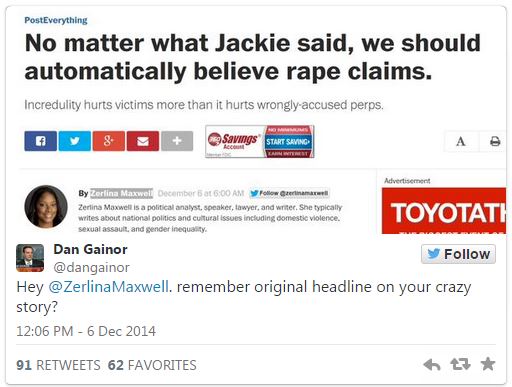
Zerlina Maxwell writes in the Washington Post: “we should automatically believe rape claims”

Here’s the news story that is prompting this post, from the Washington Free Beacon.

Excerpt:

Rolling Stone settled the defamation lawsuit filed by a University of Virginia fraternity over a false story about a rape on campus, agreeing to pay $1.65 million on Tuesday.

The lawsuit stemmed from the 2014 story “A Rape on Campus,” published in Rolling Stone by Sabrina Rubin Erdely. The story detailed the sexual assault of a woman identified only as “Jackie” at the Virginia Alpha Chapter of the Phi Kappa Psi fraternity.

The story was officially retracted in 2015 after a police investigation did not find any evidence to back up the story. News outlets also began to question Jackie’s story, and once again did not find any evidence to confirm her account.

The fraternity sought $25 million and settled for $1.65 million. Phi Kappa Psi plans to donate a “significant portion” to groups that provide sexual assault awareness education, prevention training, and victim counseling services, according to the Associated Press.

“Rolling Stone and Erdely had an agenda, and they were recklessly oblivious to the harm they would cause innocent victims in their ruthless pursuit of that agenda,” the fraternity’s lawsuit said.

Rolling Stone settled another defamation lawsuit against university administrator Nicole Eramo for $3 million.

Naturally, the liberal mainstream media – which anxiously reported on the hoax – is not nearly as interested in reporting on the correction. Because they have their agenda of blaming men for the free choices that women make. But it’s not just liberal mainstream media that pushes the rape culture myth. At the time this Rolling Stone story came out, I remember that traditional pro-marriage advocates like Brad Wilcox gleefully tweeted the false rape accusation story, and then had to take it back later. So this was by no means seen through at the beginning, except by men’s rights activists who were familiar with the nature of false rape hoax stories. “Pro-marriage” people are anxious to prove that they can fit in with liberals, and if they have to denigrate men to do it, they will.

So why do some women lie about rape? Let’s look at a study.

Studies show about 40% of rape accusations are false

False accusations of rape or sexual assault are commonly used by women to get attention and sympathy, or to get an alibi when they’ve done something wrong, or to get revenge on someone who has rejected them.

Here’s a Fox News article from a prominent equity feminist, Wendy McElroy.

Excerpt:

“Forty-one percent of all reports are false.”

This claim comes from a study conducted by Eugene J. Kanin of Purdue University. Kanin examined 109 rape complaints registered in a Midwestern city from 1978 to 1987.

Of these, 45 were ultimately classified by the police as “false.” Also based on police records, Kanin determined that 50 percent of the rapes reported at two major universities were “false.”

Although Kanin offers solid research, I would need to see more studies with different populations before accepting the figure of 50 percent as prevalent; to me, the figure seems high.

But even a skeptic like me must credit a DNA exclusion rate of 20 percent that remained constant over several years when conducted by FBI labs. This is especially true when 20 percent more were found to be questionable.

False accusations are not rare. They are common.

If you would like to get an idea of how false rape accusations are handled by the police, here is an example. Usually no charges are filed against the women, or if charges are filed, then they get off without jail time. Meanwhile, men falsely accused of rape spend years in jail, until the women finally admits she made the whole thing up. The presumption is that women always tell the truth, and that evidence isn’t needed to prove her charges.

False accusations in divorce trials

False accusations of domestic violence and sexual abuse are also commonly made during divorce settlements in order to get custody of the children, and the attendant benefits.

Consider this article from Touchstone magazine, by Stephen Baskerville.

Excerpt:

Today it is not clear that we have learned anything from these miscarriages of justice. If anything, the hysteria has been institutionalized in the divorce courts, where false allegations have become routine.

What is ironic about these witch-hunts is the fact that it is easily demonstrable that the child abuse epidemic—which is very real—is almost entirely the creation of feminism and the welfare bureaucracies themselves. It is well established by scholars that an intact family is the safest place for women and children and that very little abuse takes place in married families. Child abuse overwhelmingly occurs in single-parent homes, homes from which the father has been removed. Domestic violence, too, is far more likely during or after the breakup of a marriage than among married couples.

Yet patently false accusations of both child abuse and domestic violence are rampant in divorce courts, almost always for purposes of breaking up families, securing child custody, and eliminating fathers. “With child abuse and spouse abuse you don’t have to prove anything,” the leader of a legal seminar tells divorcing mothers, according to the Chicago Tribune. “You just have to accuse.”

Among scholars and legal practitioners it is common knowledge that patently trumped-up accusations are routinely used, and virtually never punished, in divorce and custody proceedings. Elaine Epstein, president of the Massachusetts Women’s Bar Association, writes that “allegations of abuse are now used for tactical advantage” in custody cases. The Illinois Bar Journal describes how abuse accusations readily “become part of the gamesmanship of divorce.” The UMKC Law Reviewreports on a survey of judges and attorneys revealing that disregard for due process and allegations of domestic violence are used as a “litigation strategy.” In the Yale Law Review, Jeannie Suk calls domestic violence accusations a system of “state-imposed de facto divorce” and documents how courts use unsupported accusations to justify evicting Americans from their homes and children.

I often hear men, especially men in the church, complaining that young men won’t get married because they are too busy watching porn and playing video games. But maybe the real reason is that they don’t want to be exposed to domestic violence laws and divorced courts that are waiting to separate them from their earnings.

If the church isn’t speaking out against premarital sex (to women) and against no-fault divorce (to women) and against biased domestic violence laws (to women), then they have no one to blame for the so-called “marriage strike” but themselves. Unfortunately, it seems that no one who advocates for marriage has the courage to attack the root cause of the marriage decline: women’s own irresponsible choices. When women choose immoral men and then choose to have sex with them before marriage, they have no one to blame but themselves for the damage that results.

Domestic violence rates

Here’s a recent article in the radically leftist UK Guardian that summarizes the evidence that women commit domestic violence at the same rates as men.

Excerpt:

Domestic violence has traditionally been understood as a crime perpetrated by domineering men against defenceless women. Research spanning over 40 years has, however, consistently found that men and women self-report perpetrating domestic violence at similar rates. Professor John Archer from the University of Central Lancashire has conducted a number of meta-analytic reviews of these studies and found that women are as likely to use domestic violence as men, but women are twice as likely as men to be injured or killed during a domestic assault. Men still represent a substantial proportion of people who are assaulted, injured or killed by an intimate partner (50%, 30% and 25% respectively).

If the empirical research is correct in suggesting that between a quarter and half of all domestic violence victims are men, a question follows: why has women’s domestic violence towards men been unreported for so long, and what has changed in the last five years to make it more visible?

One reason may be the feminist movement. Feminism took up the cause of domestic abuse of women in the 1970s, with the world’s first women’s refuge being opened by Erin Pizzey in 1971. Feminism understood domestic violence as the natural extension of men’s patriarchal attitudes towards women, leading men to feel they had the right to control their partners, using violence if necessary. Feminists campaigned successfully to bring the issue into the public arena, thereby securing resources to establish services to help victims. This activism and advocacy led to governmental and public acceptance that “domestic violence” was synonymous with violence against women.

[…]The dual stereotypes of the violent man and passive woman have undoubtedly obscured the existence of male victims of domestic violence in the past. Men were also unlikely to view their own victimisation as either domestic violence or a criminal assault, and so were unlikely to seek help.

More domestic violence studies from multiple countries are discussed here. They confirm the study discussed above – the rates are similar for men and women. But all the taxing and spending is for women, not men. It’s a huge difference in how women and men are treated, just like there is a difference in concern and spending with breast cancer vs prostate cancer.

I’ve only met one unmarried woman in my entire life who was aware of all of these injustices against men. And yet so many women want to get married, and think they are qualified for marriage. What kind of friend could a woman be to a man, when she only knows about the trendy problems that concern leftists (global warming, rape culture, transgenders in bathrooms, etc.) but nothing about the problems that face unmarried men – especially if they take on the challenges of marriage and fatherhood? The typical young, unmarried woman today (Christian and non-Christian) is pro-abortion, pro-no-fault-divorce, pro-big-government,  a radical feminist and anti-male. Why do they think that marriage is something they deserve? What exactly is it that they offer a man?
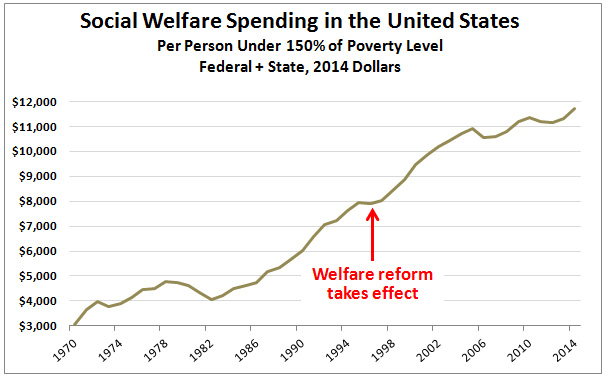

Why is it so hard for a working man to provide for a family these days?

Welfare spending
Welfare spending

Here’s my argument which answers the question:

  1. Feminism was behind no-fault divorce.
  2. Making it easier to divorce means that more divorces will occur.
  3. Marital instability causes women to vote for bigger government.
  4. Unmarried women vote mostly for Democrats.

When government spending increases for social programs and welfare, then taxes must be raised to pay for it. When taxes rise, men keep too little of their salaries to hold onto the provider role.

*Please note that I am talking about unmarried (never married, divorced) women throughout this post.

Here’s the evidence for each point.

1. Feminism was behind no-fault divorce, according to this feminist, pro-no-fault-divorce writer.

Excerpt:

Households of 2010 don’t look quite like they did in 1969, when no-fault divorce actually was a controversial topic and these counter-arguments held some weight. The working dad/stay-at-home mom model of the middle class has been replaced by two-parent earner households and a growing number of working mom/stay-at-home dad arrangements. In working poor and impoverished families, the one-parent provider model was never the norm. No-fault divorce seemed scary when it had never before existed, but the truth is that its introduction was long overdue. Feminist groups at the time supported no-fault divorce, as it provided women an escape hatch from desperately unhappy marriages in a society where they were already disadvantaged on almost every level, regardless of their marital status. Imagine an abusive marriage in 1968, when the court-savvy abuser could actually force the victim to stay in the relationship forever. Imagine that now, and you know why domestic violence attorneys are in full support of introducing no-fault divorce to New York. And the judges aren’t the only problem.

Note that the author of this piece thinks that it is not women’s fault that they choose men who they then want to divorce. It’s not the woman’s fault that she is unhappy with the man she courted with and then chose and then made vows to – women need a no-fault escape hatch, and children do fine without fathers.

2. Easier divorces means more divorces.

Abstract:

This paper analyzes a panel of 18 European countries spanning from 1950 to 2003 to examine the extent to which the legal reforms leading to “easier divorce” that took place during the second half of the 20th century have contributed to the increase in divorce rates across Europe. We use a quasi-experimental set-up and exploit the different timing of the reforms in divorce laws across countries. We account for unobserved country-specific factors by introducing country fixed effects, and we include country-specific trends to control for timevarying factors at the country level that may be correlated with divorce rates and divorce laws, such as changing social norms or slow moving demographic trends. We find that the different reforms that “made divorce easier” were followed by significant increases in divorce rates. The effect of no-fault legislation was strong and permanent, while unilateral reforms only had a temporary effect on divorce rates. Overall, we estimate that the legal reforms account for about 20 percent of the increase in divorce rates in Europe between 1960 and 2002.

It seems obvious, but more evidence never hurts. About 70% of divorces are initiated by women, either because they chose to marry the wrong man, or because they are unhappy with the right man.

3. Marital instability causes women to vote for bigger government for security.

Excerpt:

Giving women the right to vote significantly changed American politics from the very beginning. Despite claims to the contrary, the gender gap is not something that has arisen since the 1970s. Suffrage coincided with immediate increases in state government expenditures and revenue, and these effects continued growing as more women took advantage of the franchise. Similar changes occurred at the federal level as female suffrage led to more liberal voting records for the state’s U.S. House and Senate delegations. In the Senate, suffrage changed voting behavior by an amount equal to almost 20 percent of the difference between Republican and Democratic senators. Suffrage also coincided with changes in the probability that prohibition would be enacted and changes in divorce laws.

[…]More work remains to be done on why women vote so differently, but our initial work provides scant evidence that it is due to self-interest arising from their employment by government. The only evidence that we found indicated that the gender gap in part arises from women’s fear that they are being left to raise children on their own (Lott and Kenny 1997). If this result is true, the continued breakdown of the family and higher divorce rates imply growing political conflicts between the sexes. 19

Bigger government must be paid for by higher taxes, of course, which makes it harder for one working man’s income to provide for a family. In fact, feminists wanted men to be displaced as sole-providers. They would prefer that women are “equal” to men, and that means making women get out and work like men. Feminists had every reason to want bigger government and higher taxes to make traditional single-earner families unfeasible financially. They did it for equality.

4. Women are in fact observed to vote for bigger government.

Excerpt:

On Tuesday, the nation made history. It made history in electing the first African American president; it made history in building a bigger margin for the first female Speaker of the House; it made history in delivering the biggest Democratic margin since 1964; it made history in sending a record number of people to the polls and the highest percentage turnout since the 1960 election. Analysts will spend the next few months sifting through the data, trying to figure out what happened and why. Historians will likely spend the next several years and decades studying this election, as well. But one thing is immediately clear. Unmarried women played a pivotal role in making this history and in changing this nation. They delivered a stunning 70 to 29 percent margin to Barack Obama and delivered similarly strong margins in races for Congress and the U.S. Senate. Although unmarried women have voted Democratic consistently since marital status has been was tracked, this election represents the highest margin recorded and a 16-point net gain at the Presidential level from 2004.

In fact, there was a recent (2011) study showing that unmarried women do in fact vote for higher taxes and more government as a substitute for a husband’s provider role.

Abstract:

The last three decades have witnessed the rise of a political gender gap in the United States wherein more women than men favor the Democratic party. We trace this development to the decline in marriage, which we posit has made men richer and women poorer. Data for the United States support this argument. First, there is a strong positive correlation between state divorce prevalence and the political gender gap – higher divorce prevalence reduces support for the Democrats among men but not women. Second, longitudinal data show that following marriage (divorce), women are less (more) likely to support the Democratic party.

What follows from voting Democrat?

Since the Democrats took the House and Senate in 2006, and then the Presidency in 2008, the national debt has more than doubled from about 8 trillion to 20 trillion. A lot of that money was spent in welfare for single mothers, which only makes the women and their fatherless children more dependent on government. Children raised in unmarried home are far less likely to marry themselves, and to be independent of government. Which means that they will vote for bigger government when they start to vote, since they can’t make it through life on their own strength.

If more people vote for Democrats then we will get higher taxes to pay for all the government spending. Higher taxes means that a married man can no longer retain enough of his earnings to support a family. And that means his wife has to work, and that means that his children will learn what the government schools decide they should learn – so that all the children will be equal and think the same (pro-government) thoughts. This should not be controversial, because it is what it is. But if we want to talk about the decline of marriage honestly, then we need to be talking to single women about how they choose men, when they have sex with men, and how they vote at election time. You really can’t have it all.

Can relationships succeed independently of the efforts of the people involved?

Man helping a woman with proper handgun marksmanship

A few years ago, I blogged about the soul mate / fairy tale view of marriage, which I think is the dominant view of marriage among young people today – even among Christians. This view of marriage basically says that there is a person in the world out there who will match up so perfectly with each one of us that we will have to expend no effort and perform no actions and take responsibility for nothing in order for the relationship to work. it will just work on its own!

I’ve decided to link to this recent article by Matt Walsh which is on that same topic.

He writes:

The disease is the fanciful, unrealistic, fictionalized perceptions that both males and females harbor about marriage.

For example, think of the glamorization of the “mysterious” and “damaged” guy from the “wrong side of the tracks.” Hollywood makes him seem alluring and sexy, but forgets to mention that most of the time, in the real world, that dude probably has herpes, a coke habit, and a criminal record.

Still, that bit of propaganda is nothing compared to the underlying misconception that so many of us carry around consciously or subconsciously, because we’ve seen it on TV and in the movies, and read it in books a million times since childhood: namely, that there is just one person out there for us. Our soul mate. Our Mr. or Mrs. Right. The person we are “meant to be with.”

Matt thinks this view of relationships is not realistic:

I didn’t marry my wife because she’s The One, she’s The One because I married her. Until we were married, she was one, I was one, and we were both one of many. I didn’t marry The One, I married this one, and the two of us became one. I didn’t marry her because I was “meant to be with her,” I married her because that was my choice, and it was her choice, and the Sacrament of marriage is that choice. I married her because I love her — I chose to love her — and I chose to live the rest of my life in service to her. We were not following a script, we chose to write our own, and it’s a story that contains more love and happiness than any romantic fable ever conjured up by Hollywood.

Indeed, marriage is a decision, not the inevitable result of unseen forces outside of our control. When we got married, the pastor asked us if we had “come here freely.” If I had said, “well, not really, you see destiny drew us together,” that would have brought the evening to an abrupt and unpleasant end. Marriage has to be a free choice or it is not a marriage. That’s a beautiful thing, really.

God gave us Free Will. It is His greatest gift to us because without it, nothing is possible. Love is not possible without Will. If we cannot choose to love, then we cannot love. God did not program us like robots to be compatible with only one other machine. He created us as individuals, endowed with the incredible, unprecedented power to choose. And with that choice, we are to go out and find a partner, and make that partner our soul mate.

That’s what we do. We make our spouses into our soul mates by marrying them. We don’t simply recognize that they are soul mates and then just sort of symbolically consecrate that recognition through what would then be an effectively meaningless marriage sacrament. Instead, we find another unique, dynamic, wholly individualized human being, and we make the monumental, supernatural decision to bind ourselves to them for eternity.

It’s a bold and risky move, no matter how you look at it. It’s important to recognize this, not so that you can run away like a petrified little puppy and never tie the knot with anyone, but so that you can go into marriage knowing, at least to some extent, what you’re really doing. This person wasn’t made for you. It wasn’t “designed” to be. There will be some parts of your relationship that are incongruous and conflicting. It won’t all click together like a set of Legos, as you might expect if you think this coupling was fated in the stars.

It’s funny that people get divorced and often cite “irreconcilable differences.” Well what did they think was going to happen? Did they think every difference would be reconcilable? Did they think every bit of contention between them could be perfectly and permanently solved?

Finally, regarding his own marriage:

There were literally millions of things that either of us could have done. An innumerable multitude of possible outcomes, but this was our outcome because we chose it. Not because we were destined or predetermined, not because it was “meant to happen,” but because we chose it. That, to me, is much more romantic than getting pulled along by fate until the two of us inevitably collide and all that was written in our horoscopes passively comes to unavoidable fruition.

We are the protagonists of our love story, not the spectators.

I see this problem everywhere, even with Christian women who have been raised as Disney princesses. I was just told by one last week that she will marry when she meets “the right man” – the man who will require her to do nothing. This magical relationship will require no communication, no working through disagreements, no problem solving, no compromise, no effort, no self-sacrifice of any kind. it will just “work”, without any growing up by anyone. Two unemployed people with degrees in English can have a fine marriage, I suppose, traveling the world and skydiving every Tuesday.

I think that when problems arise between two people who are largely compatible, the right thing to do is to engage and solve the problems. Yes, work isn’t required in pop culture notions of romance, but those things don’t reflect the real world anyway. In the real world, actions to solve a problem count for more than words that avoid the problem. Engineering principles and self-sacrificial attitude are infinitely more useful in a relationship than all the pop culture descriptions of ideal men and ideal women and ideal relationships combined.

By the way, the best book on this problem is Dr. Laura’s “The Proper Care and Feeding of Husbands”, which clearly sets out how a woman’s choices influence her husband’s ability to perform well. The myth of the mind-reading “right man” is also debunked.